

Listings are marketing. The photos are shot at the best angle in the best light, the description highlights the good and omits the rest, and the price is set to get you through the door. The viewing is your one chance to find out what the listing left out, and most people waste it by just walking around and nodding.
A good viewing is active, not passive. You test things, you look in the places a photo never shows, and you ask the questions that reveal how the place, and the landlord, actually behave. This checklist walks you room by room through what to check, what to test on the spot, and the red flags that should make you pause, so the problems surface now, while you can still walk away, rather than after you have signed.
Test it, do not just look at it
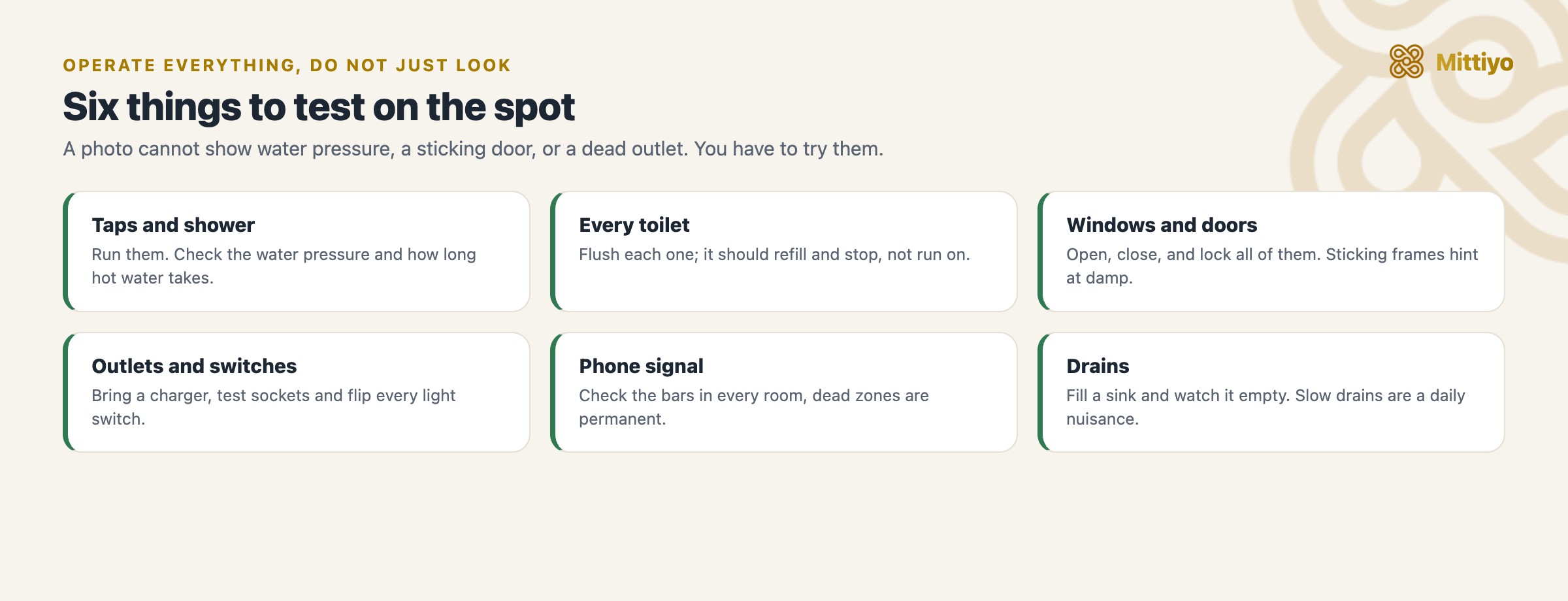 Photos cannot show you water pressure, a sticking door, or a dead outlet. Test them yourself.
The single biggest upgrade to any viewing is to operate everything, not just observe it:
- Water. Run every tap and the shower. Check the pressure, and time how long hot water takes to arrive. Weak flow or a long wait signals plumbing or heating problems.
- Toilets. Flush each one. Watch that it refills and stops, rather than running continuously.
- Windows and doors. Open and close every one. Do they stick, seal, and lock? Sticking frames can mean damp or a settling building.
- Electrics and lighting. Bring a phone charger and test outlets in every room. Switch on every light and flip every switch, one that does nothing, flickers, or buzzes points to wiring you do not want to inherit. Glance at the fuse box or MCB panel for scorch marks or loose, unlabelled wiring, and note how few or many sockets sit where you will actually need them.
- Appliances and climate. Turn on anything that is staying: the water heater or geyser (does it actually get hot, and how fast?), the air-conditioning or heating, ceiling and exhaust fans, and the fridge, oven, hob, or washing machine if included. Ring the doorbell and test the intercom or video door phone. A fixture that is present but broken is a repair you will be chasing for months.
- Phone signal. Check the bars in every room, especially the bedroom and any interior room. Dead zones are common and permanent.
- Drains. Fill a sink briefly and watch it empty. Slow drains are a nuisance you will live with daily.
- Use your nose. Damp and mould smell musty; drains and sewage smell sour; a whiff of gas near the hob needs flagging at once. A strong air freshener or fresh paint in just one spot is often covering a problem, not solving it.
Look where the photos never do
The listing shows you the good corners. Your job is to check the ones it skips:
- Damp and mould. Look at ceiling corners, around windows, behind furniture, under sinks, and inside cupboards. A musty smell, blistered paint, or fresh paint in one specific patch often hides a stain or leak.
- Storage. Open the cupboards and wardrobes. Listings rarely show real storage, and a place with none becomes cramped fast.
- Natural light. Note which way the windows face and how much light actually reaches the rooms. A “bright” flat can be dark by mid-afternoon.
- Noise. Stand still and listen. Traffic, a main road, a lift shaft, a bar downstairs, or thin walls will define your daily life.
- Pests. Look for droppings, traps, or gaps around pipes and skirting.
- The floor and walls. Check for cracks, uneven floors, and patched-over damage.
A newly painted, freshly done-up flat feels like a plus, and often it is. But a hasty cosmetic job is also the easiest way to bury a problem that resurfaces a few months after you move in, long after the deposit is paid. Look past the finish:
- Paint in one patch only. A single freshly painted wall or ceiling corner, while the rest is older, often sits over a damp patch or water stain that will bleed back through.
- Blistering, bubbling, or a chalky, flaking surface means moisture is still behind the paint.
- Run your hand over the wall. Cold or slightly damp patches, or a musty smell up close, point to damp the paint is masking.
- Check the same wall from the other side, the next room, the bathroom behind it, or the outside wall, for stains or seepage.
- New sealant or filler around windows, showers, and skirting can be covering cracks or a recurring leak. Ask what was repaired, and why.
- Fresh paint plus a strong air freshener in one area deserves extra suspicion.
A renovated flat is not a bad sign. A too-perfect patch in an otherwise older flat is a question to put to the landlord directly, what was done here, and what caused it?
Room by room
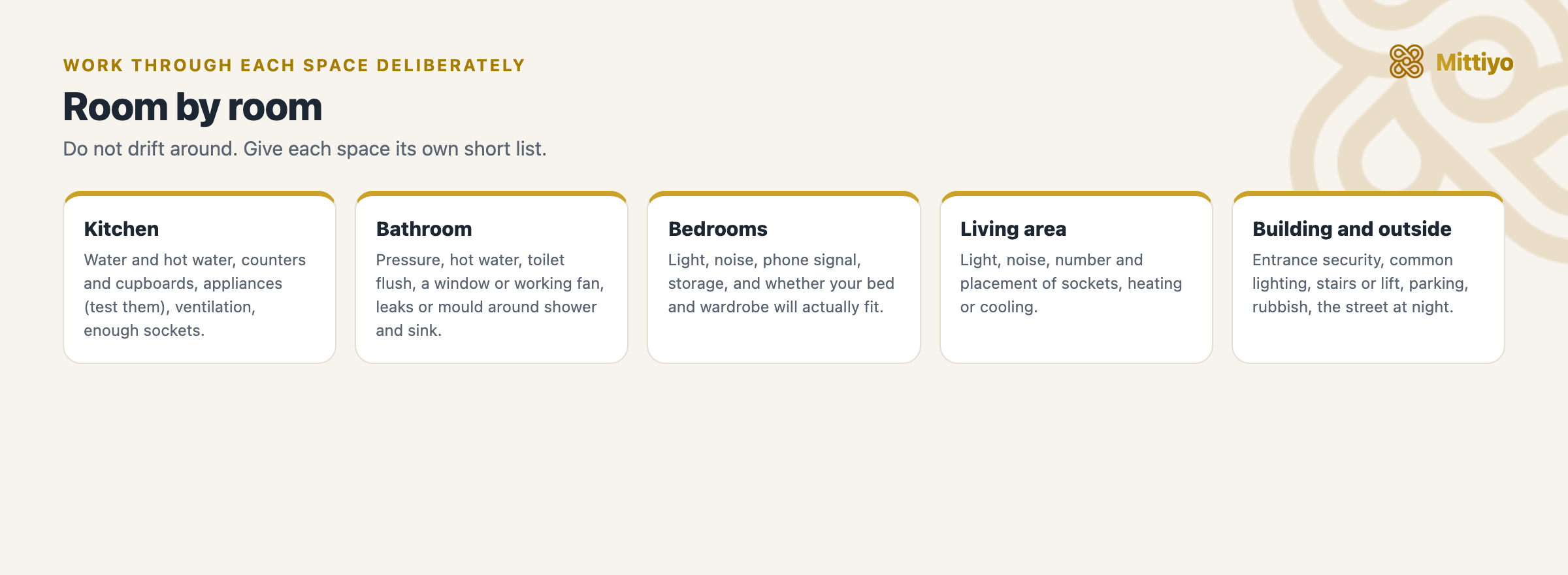 Work through each space deliberately, rather than drifting around.
Kitchen. Water pressure and hot water, the state of the counters and cupboards, any included appliances (test them), extraction/ventilation, and enough sockets for how you cook.
Bathroom. Water pressure, hot water, the toilet flush, ventilation (a window or a working fan, or damp is inevitable), and any signs of leaks or mould around the shower and sink.
Bedrooms. Natural light, noise, phone signal, storage, and whether your furniture will actually fit (a bed and a wardrobe need real wall space).
Living area. Light, noise, the number and placement of sockets, and heating or cooling.
The building and outside. Security at the entrance, working common-area lighting, the state of the stairs or lift, parking, rubbish and recycling, and how the street feels. If you can, come back at night to check safety and noise.
Does daily life actually reach the address?
A flat can be perfect and still be a daily struggle if the services you rely on do not properly cover the address. This is intensely local, what is seamless in one neighbourhood or country can be patchy two streets away, so check it for the specific building, not the city in general. Stand at the door and actually test these on your phone:
- Ride-hailing and taxis. Open your usual cab or ride-hailing app at the address and see whether cars are genuinely available and how long the wait is, ideally at the times you will travel. Some pockets have almost no supply, or drivers who routinely cancel.
- Quick-commerce and grocery delivery. Check whether instant-grocery and grocery-delivery apps deliver to the pincode or postcode, and how fast. A short delivery radius can quietly rule an address out.
- Food delivery. See how many restaurants actually deliver to the address, and until how late at night.
- Internet and broadband. Ask which providers serve the building, not just the area, and at what speeds. Fibre on the main road does not mean fibre in the flat. Ask a current tenant or the society which connections people really use and whether they hold up.
- Mobile network. Your own SIM may have great city coverage and dead spots in this exact building. Test it room by room, and ask others in the block about their networks.
- Water and power reliability. In many places supply is not constant. Ask about the water source and timing (municipal hours, tank, borewell), and whether there is power backup for cuts.
- The real commute. Walk or map the actual route to the nearest metro, bus, or train at rush hour, not the straight-line distance. Add a pharmacy, a clinic, a grocer, and an ATM within easy reach.
Where you can, ask a current resident: they know which apps work, which providers are reliable, and which services quietly do not bother with the building.
The questions that reveal the landlord
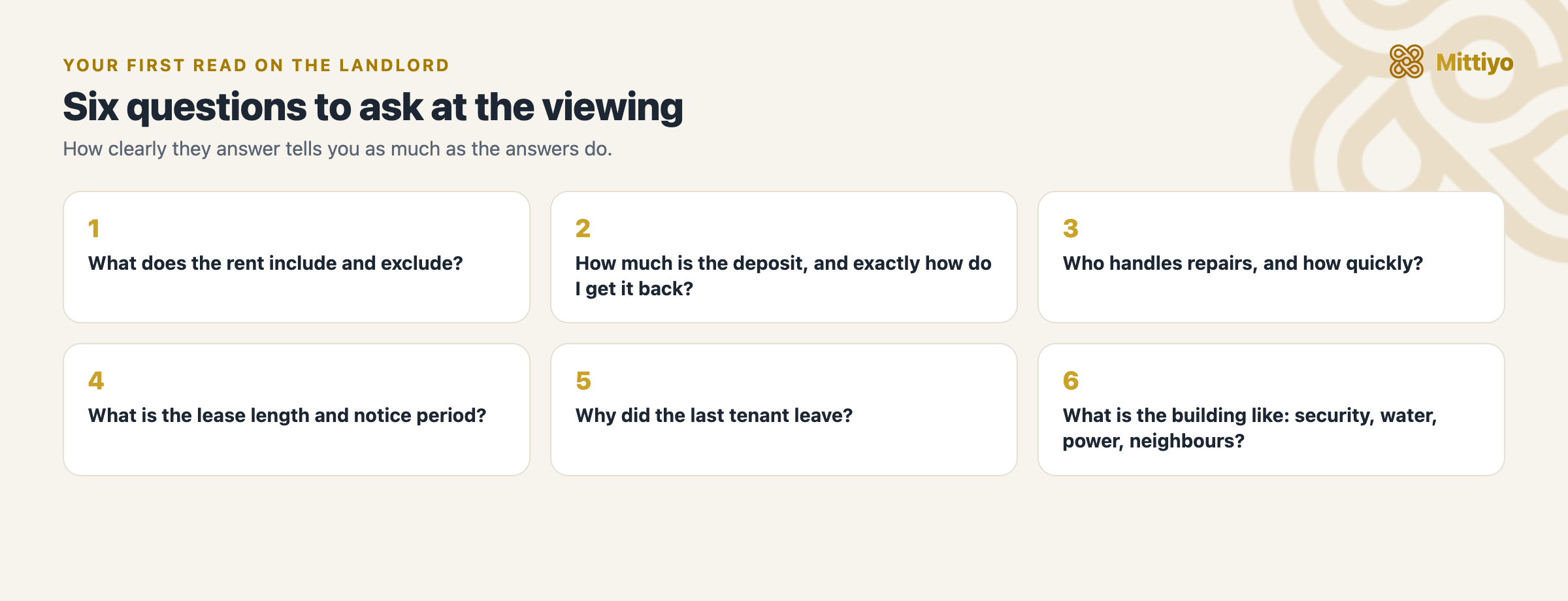 How clearly they answer tells you as much as the answers themselves.
A viewing is also your first read on the person you will be dealing with for a year. Ask:
- What does the rent include and exclude? Utilities, maintenance, internet, parking.
- How much is the deposit, and exactly how do I get it back? Vague answers here are a warning.
- Who handles repairs, and how quickly? The landlord directly, or an agent or manager?
- What is the lease length and notice period?
- Why did the last tenant leave?
- What is the building like? Security, water, power, neighbours.
Confident, specific answers are reassuring. Evasion, rushing, or “do not worry about that” is a reason to slow down.
Visit twice if you can
One daytime viewing hides a lot. A quiet street at noon can be loud at 10 pm; a bright room in the morning can be gloomy by evening; parking and traffic swing through the day. A second visit at the time you will most often be home catches what a single viewing cannot. If a second visit is not possible, talk to the current tenants or the neighbours, they will tell you things no listing will.
Furnished, semi-furnished, or bare: know what you are getting
The same rent can mean very different things depending on what stays in the flat, and the label is not standardised. Ask the landlord to spell out, in writing, exactly what is included, then check each item works during the viewing.
Unfurnished usually means bare walls: no furniture, sometimes not even light fittings or a wardrobe. You bring everything.
Semi-furnished is the fuzziest label and varies wildly. It often means the fixed things stay, wardrobes, kitchen cabinets, fans, lights, sometimes a fridge or geyser, but not beds, sofas, or a dining table. Two “semi-furnished” flats can differ by tens of thousands in what you must buy.
Furnished should mean move-in ready: beds, seating, a dining set, white goods, and often curtains. In practice, always get the exact list.
Because the words mean whatever the landlord wants them to, the only protection is a written, itemised list of what is included, attached to the agreement.
If you decide to take it: photograph everything first
The viewing does not end when you say yes. Before you move a single box in, and ideally before you hand over the deposit, record the exact condition of the flat. This is the single best thing you can do to protect your deposit, in any country.
- Photograph and video every room, including existing scratches, stains, cracks, chipped tiles, and any appliance that is already worn or not working. Get the date on the file.
- Test the included appliances again and note anything faulty in writing, so a pre-existing fault is not billed to you on the way out.
- Make an itemised inventory of what the landlord provides, and have both sides sign it.
Bring this with you
A quick, portable version to run through on the spot:
- Ran taps and shower, checked pressure and hot water
- Flushed every toilet
- Opened, closed, and locked all windows and doors
- Tested outlets (with a charger), every light, and every switch
- Ran the geyser, AC or heating, fans, and any included appliances
- Rang the doorbell and tested the intercom
- Used my nose for damp, drains, and gas
- Checked phone signal in each room
- Looked for damp, mould, and one-patch fresh-paint cover-ups
- Checked storage, natural light, and noise
- Inspected the building entrance, lighting, and security
- Tested cab, quick-commerce, food-delivery, and internet coverage at the address
- Asked what rent includes, the deposit terms, and repair process
- Asked why the last tenant left
- Got the exact list of what is furnished, in writing
- Planned a second visit, or spoke to current tenants or neighbours
- If taking it: photographed and videoed every room, and signed a move-in inventory
Key takeaways
- A viewing is active: test the water, every light and appliance, the windows, and the doors instead of just looking.
- Check the places photos never show, damp, storage, light, noise, and smells, and treat a one-patch fresh-paint job as a question, not a reassurance.
- Test that daily-life services reach the exact address: cabs, quick-commerce, food delivery, internet, and mobile signal vary street by street.
- Ask about the deposit, repairs, lease, and why the last tenant left; how they answer matters.
- Visit twice if you can, or talk to the current tenants and neighbours.
- The problems you catch at the viewing are the ones you will not be arguing about after you move in.
A viewing shows you one hour. Residents live there every day.
Wherever you rent, know.place is building a map of honest, building-level rental experiences from the people who actually live there. Read what residents say about a building before you even book a viewing, or add the first experience for yours so the next person walks in with their eyes open.
Explore know.placeRelated guides: Questions to ask a landlord before you rent · How to spot a rental scam · How much rent can you afford?