Ask three tenants how they got their electricity connected and you will hear three answers: the landlord handled it, the meter was already in the previous tenant’s name, or the utility wanted a landlord NOC and the landlord went quiet. All three are common, and none of them is what the law actually requires. A tenant is entitled to apply for a connection in their own right. What varies is how much paperwork your state’s utility asks for, and how much of it depends on the landlord.
The short answer: the Electricity Act, 2003 gives the right to apply to the “owner or occupier” of a premises, and the central consumer rules define an occupier to include a tenant. For connections up to 10 kW the central rules list just two mandatory documents, an identity proof and proof of ownership or occupancy. In practice, utilities differ: Karnataka’s BESCOM says the owner’s consent is not necessary for a domestic connection if the owner does not live there, while the published checklists of Maharashtra’s MSEDCL and Delhi’s BSES ask for the owner’s NOC in the tenant route.
This guide covers the three routes open to a tenant, what the law says, what three large utilities actually ask for, how to escalate when you are stuck, and what to do at move-out. It is pan-India; for the Bengaluru-specific BESCOM walkthrough, see our utility transfer guide for Bengaluru.
The Three Routes for a Tenant
When you move into a rented home with a working meter, you can do one of three things.
Route 1: Stay on the landlord’s connection. Nothing changes on the utility’s records. You pay the bill, usually by reimbursing the landlord or paying directly. This is the quickest, and the weakest position. Every record, every dispute and every refund sits in someone else’s name, and the bill is of no use to you as address proof.
Route 2: Change the name on the existing connection. The utility updates the consumer’s name from the owner or previous tenant to yours. This is called a change of name or mutation. The central rules treat it as an application the owner or occupier can file, and they require every utility to publish its procedure for it. Expect an identity proof, proof of your occupancy, and often an owner’s NOC.
Route 3: A new connection or separate meter in your name. This applies when the premises has no meter, when you need a separate meter from the owner’s, or when the old connection was surrendered. It follows the new-connection procedure, with the timelines described below.
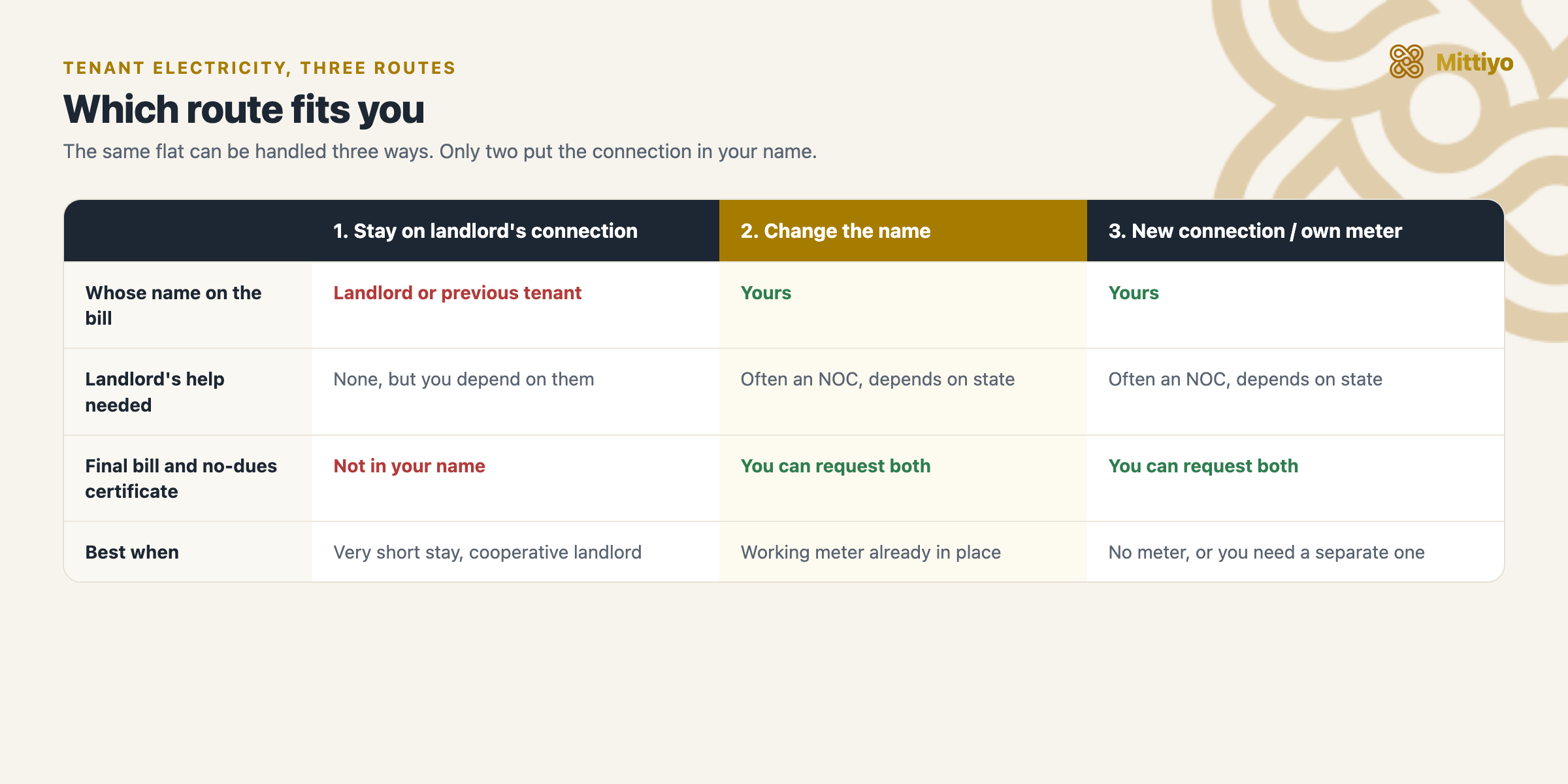 The three routes. Route 1 is fast but leaves you with no record; Routes 2 and 3 put the connection in your name.
What the Law Says
Three layers matter: the Act, the central consumer rules, and your state’s own supply code.
The Electricity Act, 2003
Section 43 is titled “Duty to supply on request”. It requires a distribution licensee to give supply to a premises on the application of the owner or occupier, within one month of a complete application, and it provides a penalty of up to Rs 1,000 for each day of default. The word “occupier” is the hook for tenants: you apply in your own right, not through the owner.
The Electricity (Rights of Consumers) Rules, 2020
The Ministry of Power notified these rules on 31 December 2020, and they set a national floor for what a utility must do. The parts a tenant needs, taken from the gazette text:
- Who is an occupier. The rules define “occupier” as “the owner, tenant or person in occupation of the premises where electricity is used or proposed to be used” (Rule 2).
- Name changes are covered. An “applicant” is an owner or occupier who applies for supply, a change in title or mutation of name, a shift of connection and similar services (Rule 2).
- Procedures must be public. Every distribution company must display on its website and in its offices the detailed procedure for new connections, change of name, transfer of ownership and more, the address for submission, and the complete list of documents to attach (Rule 4(1)).
- Two documents up to 10 kW. For new connections up to 10 kW, or a higher load the state commission specifies, the application needs only two mandatory documents: an identity proof such as a passport or Aadhaar, and proof of your ownership or occupancy of the premises, or, if you have no such proof, any other address proof that you have not already used as identity proof (Rule 4(9)).
- Time limits. The state commission must fix a maximum time, not more than seven days in metro cities, fifteen days in other municipal areas and thirty days in rural areas, from a complete application (Rule 4(11)).
- Move-out paperwork. On vacating, the utility must read the meter on your written request, issue a final bill with all arrears, and issue a No-Dues Certificate within seven days of receiving final payment (Rule 6(12)).
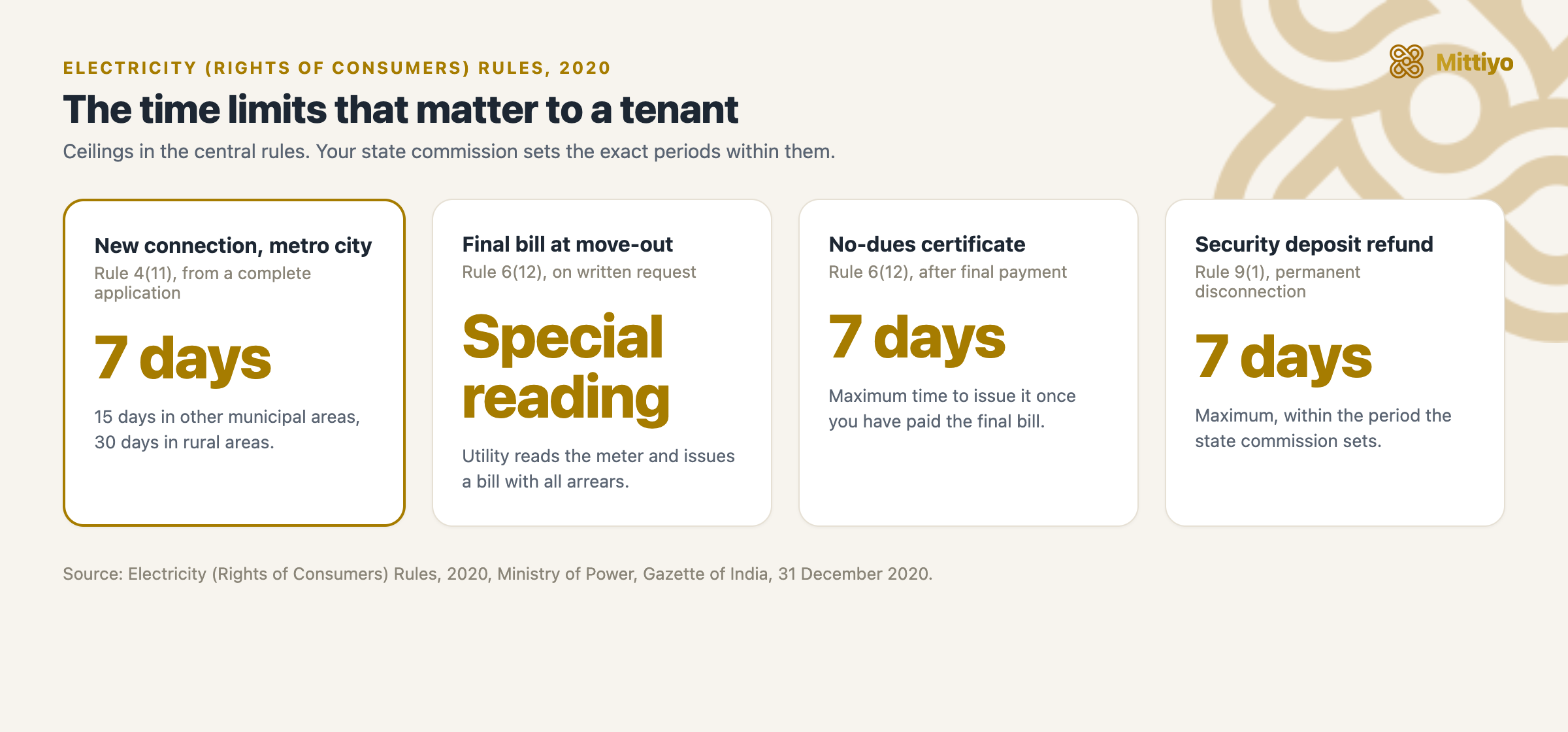 The time limits that matter to a tenant, from the central rules. State commissions set the exact periods within these ceilings.
Your state’s supply code
The state electricity regulatory commission frames the supply code and conditions of supply that decide the details: which forms, what deposit, and whether an owner’s NOC is needed. This is where states diverge, and it is the reason a checklist that works in Bengaluru may not work in Mumbai or Delhi.
What Three Utilities Actually Ask For
We read each utility’s own published document rather than third-party summaries. All three below are domestic (low-tension residential) connections.
| Utility | What it says for a tenant | Owner’s NOC? | Source |
|---|---|---|---|
| BESCOM (Karnataka) | For domestic installations, the owner’s consent is not necessary where the owner is not the occupant. Proof of occupancy such as a valid power of attorney, latest rent paid receipt or valid lease deed. An indemnity bond is required if the applicant is not the owner. Unauthorised occupants are not given connections. | Not needed | Conditions of Supply, clause 4.09 |
| MSEDCL (Maharashtra) | Name-change checklist, category “premises is let out to the applicant”, residential: a legal document supporting the letting, and the owner’s NOC. | Required | Documents required for name change |
| BSES (Delhi) | Tenant route falls under “title through NOC by owner(s)”: ownership proof of the address, a registered rent agreement, and an NOC from the landlord or owner. | Required | Quick check on documents required |
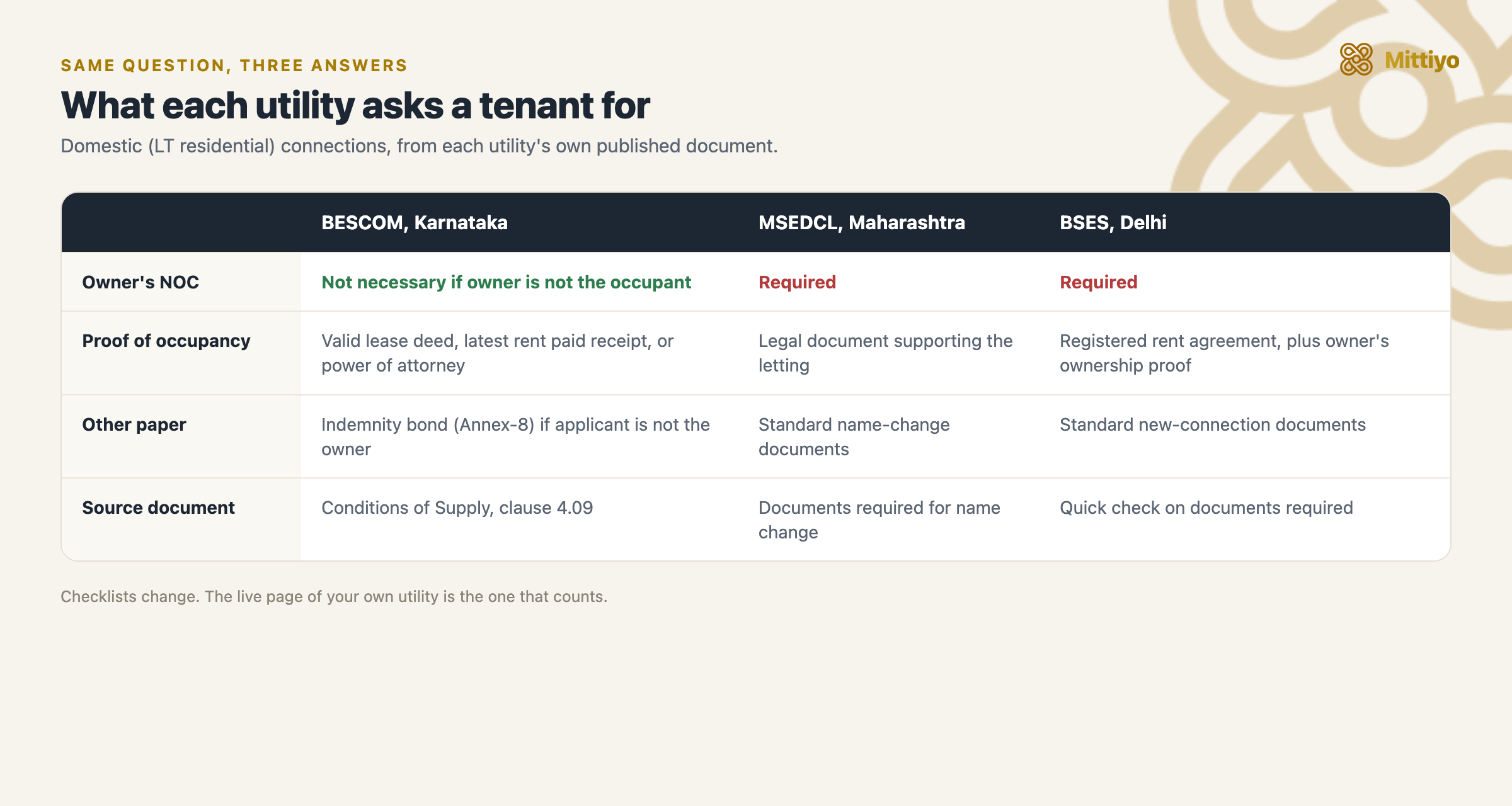 Three utilities, three different answers to the same question. Check the checklist of your own utility.
Three cautions on reading that table:
- These are checklists, and checklists change. The BESCOM document is the published Conditions of Supply; the MSEDCL and BSES documents are the current downloadable checklists. The central rules require each utility to keep its list public, so the live page on the utility’s site is the one that counts.
- There is tension with the central floor. The 2020 rules say the application needs only two mandatory documents for loads up to 10 kW. A tenant with an identity proof and a rent agreement or rent receipt as occupancy proof arguably meets that, while a utility checklist that adds a mandatory owner’s NOC goes further. We are not offering a legal conclusion on how that conflict resolves in each state. What it gives you is a reasoned point to raise in writing if you are stuck, described below.
- Other states. We have not verified the checklists for every state utility, so we have not guessed at them. Rule 4(1) means yours must publish one. Look for it under the name-change or new-connection section of its website.
Step by Step: Getting the Connection in Your Name
The steps are the same everywhere; only the documents differ.
- Find your utility’s published checklist for “new connection” or “change of name” for a residential consumer. This is the document the central rules require it to publish.
- Gather the two core documents: an identity proof (Aadhaar, passport, voter ID, driving licence) and proof of occupancy. A registered or notarised rent agreement is the strongest. In Karnataka a latest rent receipt also qualifies, and our rent receipt generator produces one in the usual format.
- Add what your state asks for on top. That may be an owner’s NOC, an indemnity bond (BESCOM’s clause 4.09 requires one when the applicant is not the owner), or a signed undertaking.
- Apply online where possible. The rules say licensees must offer online submission and a tracking mechanism for the application.
- Photograph the meter at move-in. Take the meter number and the reading on the day you take possession. It protects you against the previous consumer’s usage and anything that follows.
- Pay the deposit and fees the state commission has set, and keep the receipts. The deposit is refundable on closure, within the period the rules cap at seven days after a permanent disconnection.
- Track the time limit. Note the date of your complete application. If the utility exceeds the commission’s period, you have a documented complaint.
For the identity and address documents themselves, see our guide to tenant police verification, since the same ID bundle is usually reused.
If the Landlord Will Not Cooperate
This is the situation behind most searches on this topic: the utility asks for an NOC, and the landlord ignores you or refuses.
First, check whether your state needs one at all. In Karnataka the published conditions say it does not for a domestic tenant. If you are in a state whose checklist asks for the NOC, ask the utility whether an alternative occupancy proof is accepted.
Second, put it in writing. Write to the utility’s office or portal asking for (a) its published checklist for your category, and (b) the reason, in writing, for rejecting or holding your application. The central rules require a complete document list to be public, so an unexplained demand for an extra paper is a fair thing to question.
Third, make the argument once, politely. Your written request can note that the central consumer rules define a tenant as an occupier, and that for loads up to 10 kW they list identity proof and proof of occupancy as the mandatory documents. Attach your rent agreement or rent receipt. This does not guarantee a result, and the utility’s state-level rules may differ, but it puts your position on record before you escalate.
Fourth, use the grievance system. Each distribution company must have a Consumer Grievance Redressal Forum under Section 42(5) of the Act, and an aggrieved consumer can go on to the Electricity Ombudsman under Section 42(6). Each sets its own filing format, which your utility and state commission publish, so check how to file in your state.
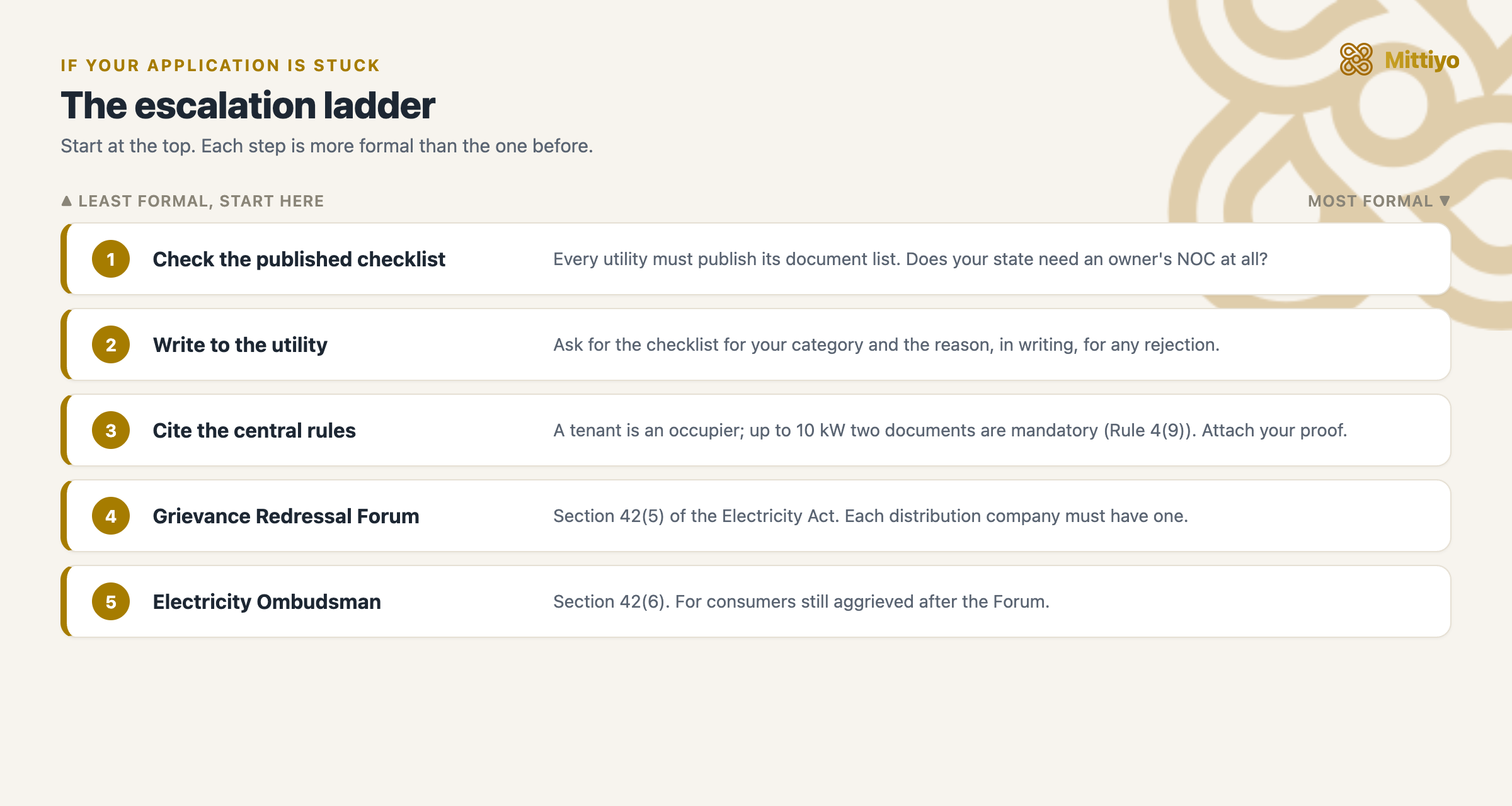 Start at the top. Each step is more formal than the one before.
What not to do. Do not run a line from a neighbour’s meter or tamper with the existing one. Tapping a utility’s line or tampering with a meter can amount to theft of electricity under Section 135 of the Act, which carries criminal penalties, and it leaves you with no consumer record and no recourse if something goes wrong.
If the landlord is the one cutting the supply. Switching off the power to force a tenant out is a separate problem. Some states are now writing a specific ban into their rent laws: Gujarat’s Rent Bill, passed in September 2026 and not yet in force, bars landlords from cutting electricity, water and gas. Our Gujarat Rent Bill guide explains what it says and why a passed Bill is not yet an enforceable law.
Dues, Deposits and the Previous Tenant
The fear behind many name-change delays is inherited debt: what if the last occupant left unpaid bills?
The Supreme Court addressed a close version of this in K.C. Ninan v. Kerala State Electricity Board, decided on 19 May 2023 by a three-judge bench. As reported in this SCC Online summary, the Court held that the duty to supply under Section 43 is not absolute and is subject to the charges and compliances the utility stipulates, that premises cannot be held to be defaulters and no dues can be attached to the premises as such, but that a utility may recover a previous owner’s arrears from a subsequent purchaser if the state’s statutory conditions of supply provide for it.
Read that narrowly: it was an auction-purchaser case, not a tenancy case, and it turns on each state’s supply code. What it supports is a practical approach:
- Ask for the last bill and last paid receipt before you take the premises.
- Record the opening reading with a dated photograph.
- If a utility demands the previous consumer’s arrears as a condition, ask for the specific clause of its conditions of supply that allows it, in writing.
Your own deposit. A new consumer pays a security deposit set by the state commission. On permanent disconnection, the final bill is settled and the balance of the deposit has to be refunded within the period the commission specifies, which the central rules cap at seven days.
Moving Out: The Electricity Checklist
If the connection is in your name, the move-out steps matter as much as the move-in ones.
- Apply in writing for a special meter reading on the date you hand over the keys.
- Photograph the meter at that moment.
- Settle the final bill. The utility must include all arrears to the billing date.
- Collect the No-Dues Certificate. The rules require it within seven days of the final payment.
- Decide the connection’s future. Either arrange a name change to the landlord or the next tenant, or apply for permanent disconnection and the deposit refund.
- Keep the paperwork with your rental documents. It is useful evidence when the landlord settles your deposit; see our guide on getting your security deposit back in India.
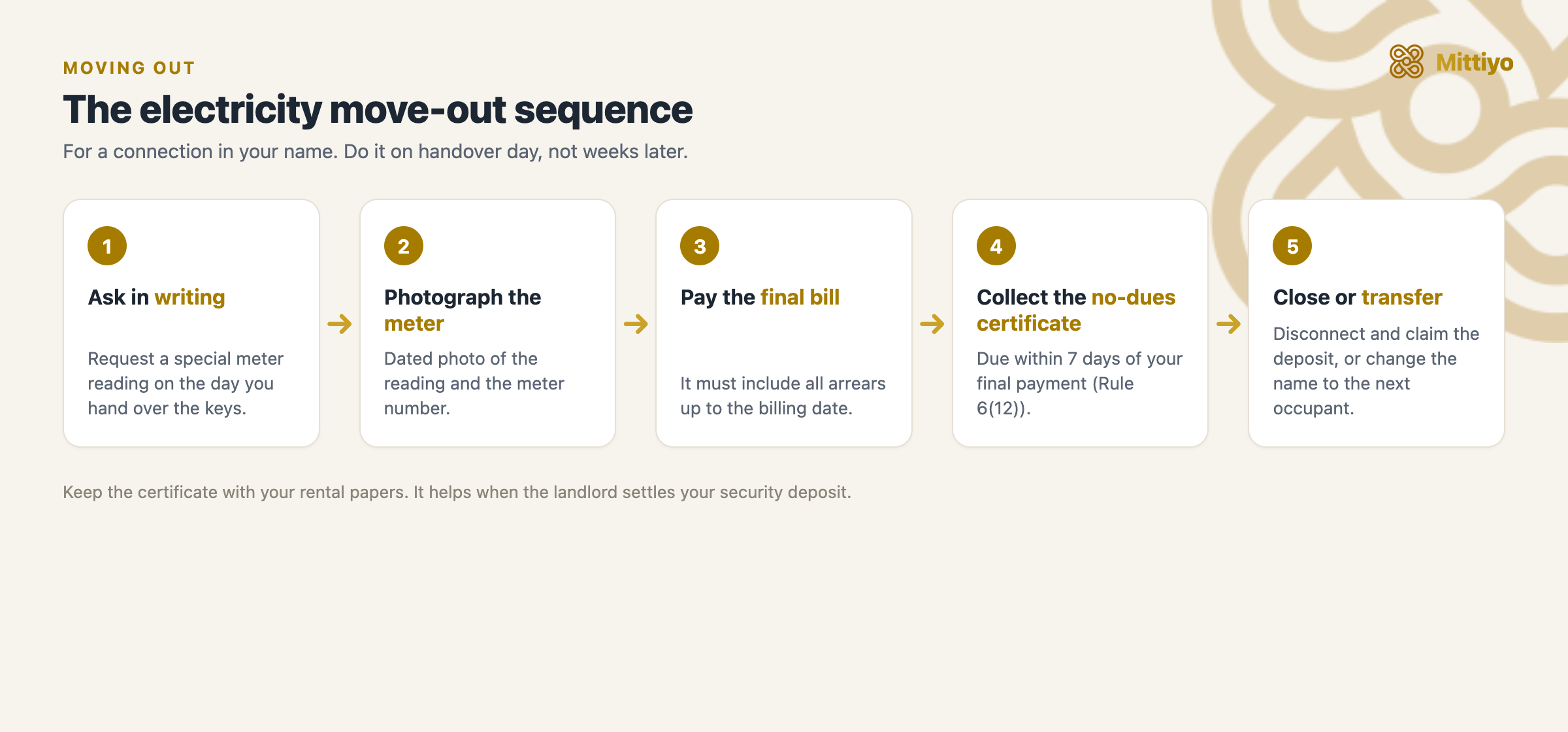 The move-out sequence from the 2020 rules. Do it on handover day, not weeks later.
Common Mistakes
Assuming the connection name is who owns the problem. If the bill is in the landlord’s name and you stop paying, the landlord’s account is what falls behind, and the dispute is theirs to resolve with the utility, not yours.
Paying the landlord in cash without a receipt. If you reimburse the landlord for the bill, keep dated evidence of every payment. It is your proof of occupancy and of what you paid.
Using a utility bill in the landlord’s name as your own address proof. It does not prove you live there. Your rent agreement or a bill in your own name does.
Skipping the opening reading. Without it you have no answer to a dispute about what the meter showed when you arrived.
Waiting until move-out to ask for a no-dues certificate. Ask in writing on handover day, so the seven-day clock starts when you pay.
Treating a state’s checklist as universal. A friend’s experience in another city tells you about that utility, not yours.
Key Takeaways
- A tenant can apply for an electricity connection in their own right. The Act speaks of the “owner or occupier”, and the 2020 consumer rules define an occupier to include a tenant.
- For loads up to 10 kW the central rules list two mandatory documents: identity proof and proof of ownership or occupancy, or other address proof if you have none.
- Utilities differ on the landlord’s NOC. BESCOM’s conditions say it is not necessary for a domestic tenant; the published MSEDCL and BSES Delhi checklists ask for it.
- Utilities must publish their procedures and document lists, and the rules set outer time limits of 7, 15 and 30 days for new connections.
- If you are stuck, ask in writing for the checklist and the reason, then use the Consumer Grievance Redressal Forum and the Electricity Ombudsman.
- At move-out, request a special reading and final bill in writing; the no-dues certificate and any deposit refund each have a seven-day limit in the central rules.
- Rules vary by state and change. Confirm the current checklist with your own utility before you act.
Renting somewhere new and want to vet the building first?
Electricity paperwork is one part of settling in. know.place maps honest, structured experiences of specific buildings, the rent, deposit, water and power, from people who have lived there.
Explore know.placeThis is general information, not legal advice. Utility procedures, forms and state rules change, and your own situation may differ. Confirm the current requirements with your electricity distribution company, or consult a local advocate for a dispute.
References
- Electricity Act, 2003, Section 43: Duty to supply on request (IndiaKanoon): the duty to supply on application by the owner or occupier, and the daily penalty for default.
- Electricity Act, 2003, Section 42: Duties of distribution licensee (IndiaKanoon): sub-sections (5) and (6) on the Consumer Grievance Redressal Forum and the Electricity Ombudsman. Also Section 135: theft of electricity, including tapping lines and tampering with meters.
- Electricity (Rights of Consumers) Rules, 2020 (Gazette of India, Extraordinary, Ministry of Power, hosted by PIB): Rules 2 (definitions of “occupier” and “applicant”), 4(1), 4(9), 4(11), 6(12) and 9(1).
- Press release on the Electricity (Rights of Consumers) Rules, 2020 (Press Information Bureau, Government of India).
- BESCOM Conditions of Supply of Electricity (BESCOM): clause 4.09 on owner’s consent, proof of occupancy and the indemnity bond.
- Documents required for name change (MSEDCL): the LT residential category for premises let out to the applicant.
- List of requisite documents for new connection (BSES Delhi): the tenant route under title through NOC by owner(s).
- K.C. Ninan v. Kerala State Electricity Board, 2023 LiveLaw (SC) 453 (Supreme Court of India, 19 May 2023), read with this SCC Online explainer.
State checklists are the utilities’ current published documents at the time of writing. Check the live page of your own utility before applying.