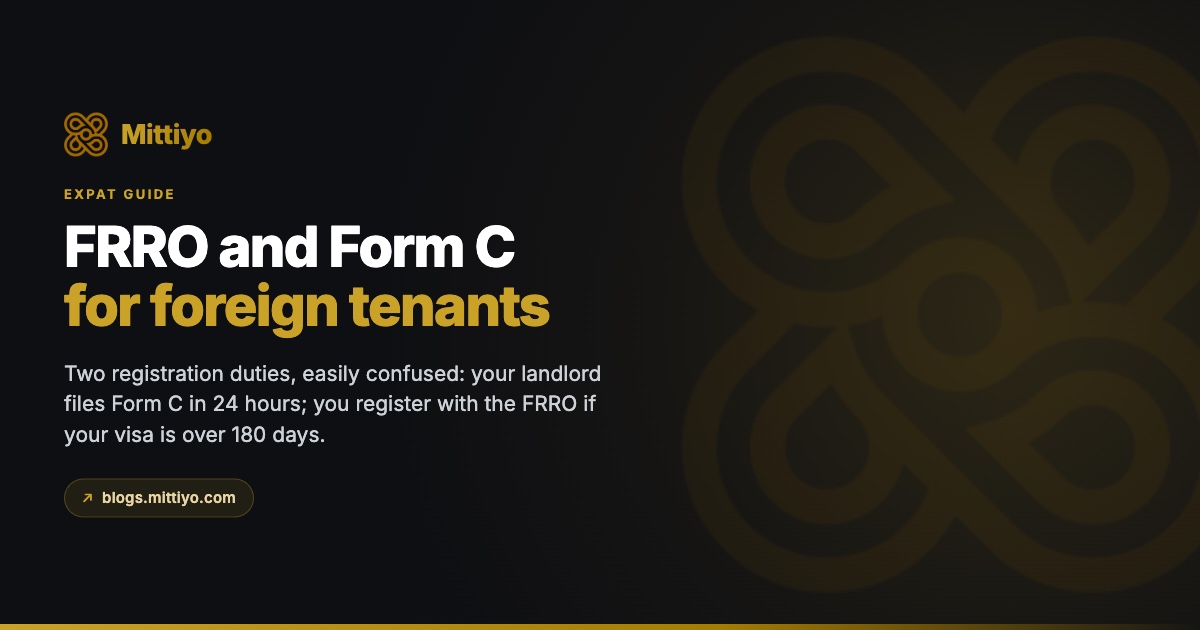
If you are a foreigner renting in India, there are two pieces of registration you need to get right, and they are easy to confuse. One is your landlord’s job; the other is yours. Getting them mixed up, or skipping them, can mean fines for your host and trouble for your visa. The rules were recently overhauled, too: the old Foreigners Act, 1946 and the Registration of Foreigners Act, 1939 were replaced by the Immigration and Foreigners Act, 2025, in force from 1 September 2025, and “Form C” is now formally Form III (most people still call it Form C).
This guide separates the two duties clearly, who files what, by when, and what happens if it is missed, so you and your landlord both stay on the right side of the rules.
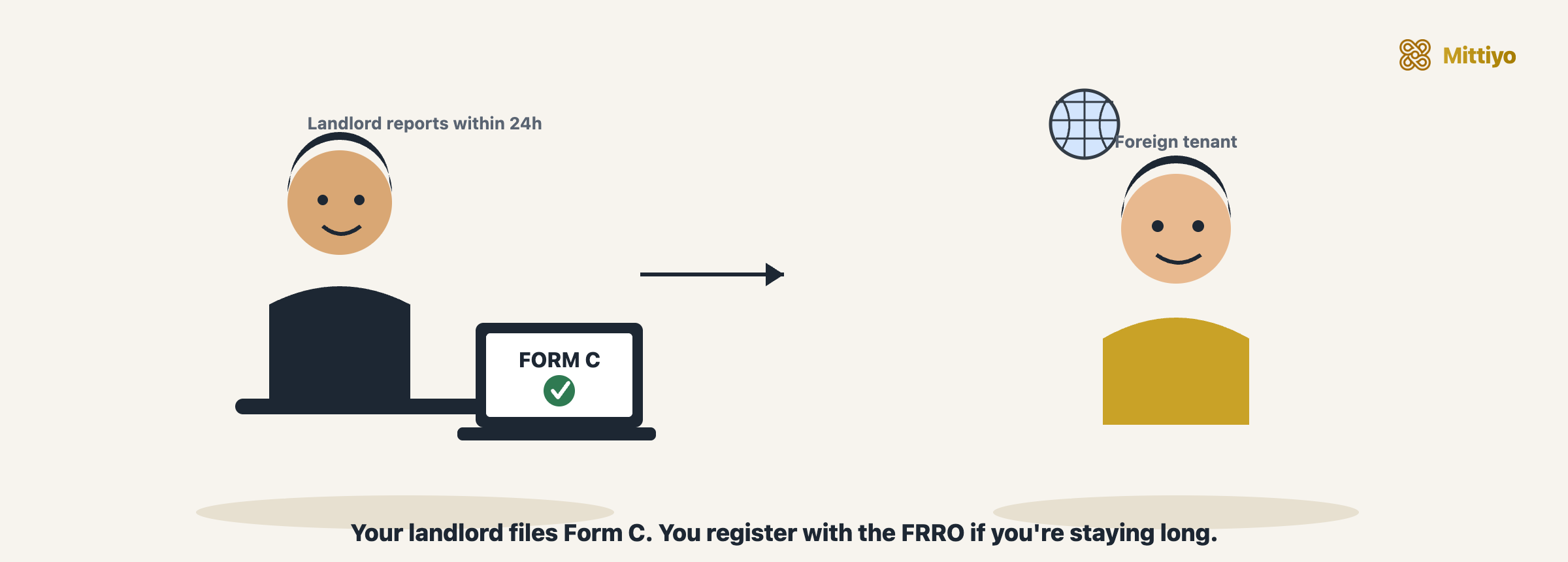
Two duties, not one
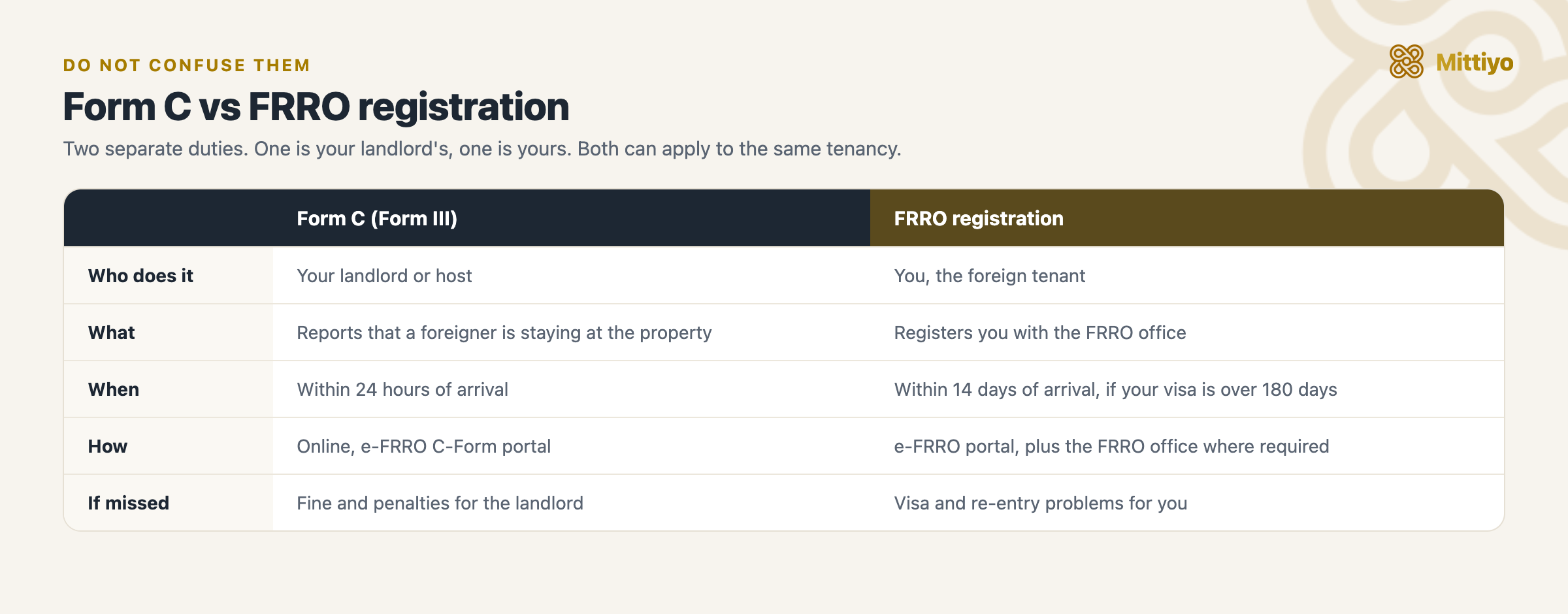 The single most important thing: these are separate. One is your landlord’s; one is yours.
- Form C (the landlord’s duty). The person providing your accommodation must report your stay to the authorities.
- FRRO registration (your duty). If your visa is for more than 180 days, you must register yourself with the FRRO.
They are independent. Your landlord filing Form C does not discharge your own FRRO registration, and your registering does not remove your landlord’s Form C duty.
Form C: your landlord reports your stay
Under the Immigration and Foreigners Act, 2025, any keeper of accommodation, a hotel, guest house, hostel, or a private landlord or host, who accommodates a foreign national must report their stay to the FRRO or Bureau of Immigration using Form C (Form III), generally within 24 hours of arrival (and again on departure).
Key points foreigners get wrong:
- It is the host’s duty, not yours. You do not file Form C. But you should confirm your landlord will, and give them your passport and visa details.
- It applies to private landlords, not just hotels, and whether or not rent is paid, even hosting a foreign friend for free counts.
- It is filed online through the Bureau of Immigration C-Form portal.
Because many individual landlords have never heard of Form C, raise it before you sign, and be ready to walk your host through the online filing.
The filing is your host’s job, but they can only do it with your details. Hand these over on move-in day so there is no excuse for a late filing:
- Your full name as printed in your passport
- Passport number, nationality, date and place of issue and expiry
- Visa type, number, and validity
- Your date and place of arrival in India
- Intended duration of stay and purpose
- A scan of your passport photo page and visa
A cooperative landlord files within minutes once they have this. If a landlord refuses to file Form C at all, treat it as a warning sign about how they will handle the rest of the tenancy.
FRRO registration: you register yourself
If your visa or intended stay is for more than 180 days, you must register in person with the FRRO or FRO, generally within 14 days of first arriving in India.
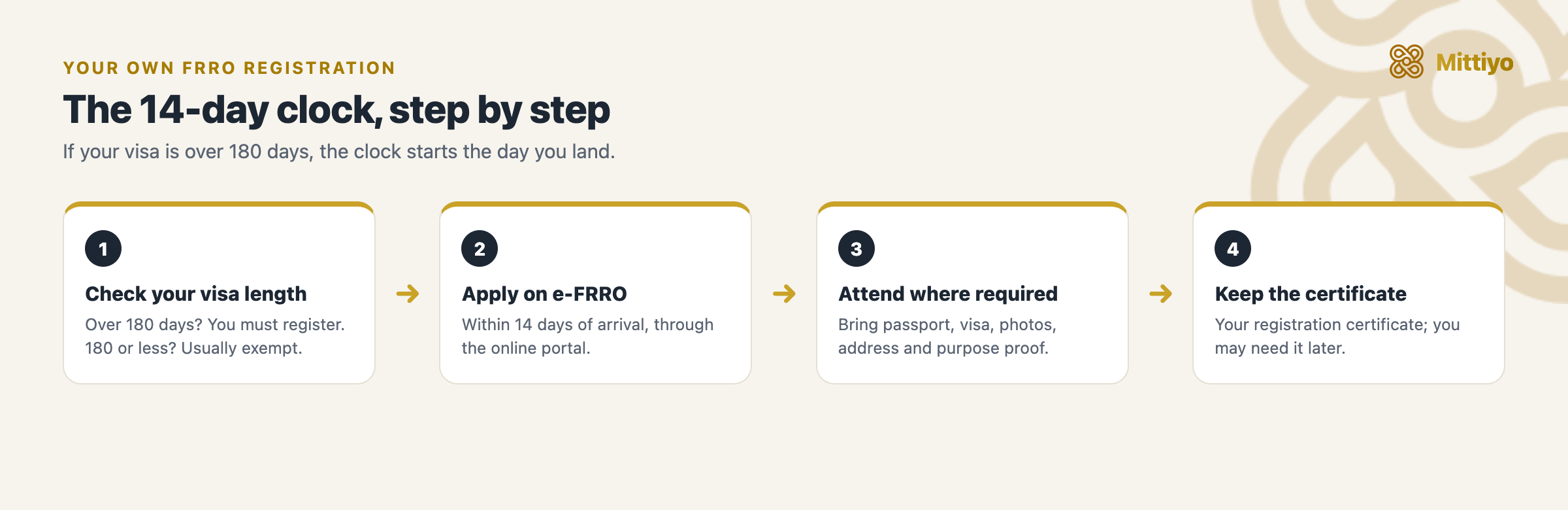 If your visa is over 180 days, the 14-day clock starts when you land.
- Who registers: foreigners on long-stay visas (employment, student, research, medical, and others over 180 days).
- Who is usually exempt: anyone whose continuous stay is 180 days or less (most tourists), and children under 16. Many multiple-entry holders register only once on the first visit.
- The rules vary by visa type and nationality, and enforcement now expects long-stay foreigners to complete registration before the 180-day point rather than relying on any grace period. Always check your specific visa endorsement and the e-FRRO portal.
You will typically need your passport, visa, photographs, proof of address, and proof of purpose (employment or study).
Where to do it: the e-FRRO portal
Both Form C and FRRO registration run through the e-FRRO portal, operated by the Bureau of Immigration under the Ministry of Home Affairs. A landlord registers once as a user, then files the C-Form for each guest. You apply for your own registration through the same portal and attend the FRRO office where required. Start the process early and keep every acknowledgement.
Penalties: why this matters
Neither duty is optional. Failing to report a foreign guest is an offence for the accommodation provider, and under the rules made under the 2025 Act, a fine is reported for not filing Form C in time, with more serious or repeated non-compliance attracting the Act’s heavier penalties (imprisonment and larger fines) and possible blacklisting of the host or property. For a foreigner, failing to register with the FRRO when required can create problems with your visa, extensions, and future entry. The safe course is simple: confirm your landlord will file Form C, and complete your own FRRO registration on time.
Key takeaways
- There are two separate duties: your landlord’s Form C (report your stay within 24 hours) and your own FRRO registration if your visa is over 180 days.
- Form C is the host’s job, applies to private landlords, and covers paid and unpaid stays. Confirm your landlord will file it.
- You register with the FRRO yourself within 14 days of arrival if your visa exceeds 180 days, rules vary by visa and nationality, so check.
- Both are done online at the e-FRRO portal; keep the acknowledgements.
- The law changed in 2025 (the Immigration and Foreigners Act, 2025), but the core duties are the same, with stiffer penalties.
Renting in a new Indian city as a foreigner?
Paperwork aside, you still need to know which buildings and landlords are trustworthy, which is hard as a newcomer. know.place is a map of honest, building-level rental experiences across India, so you can choose a home, and a landlord, that residents actually vouch for.
Explore know.placeThis guide is general information, not legal or immigration advice. FRRO rules have many exemptions and vary by visa type and nationality, and the 2025 Act’s rules are still settling; verify your exact requirements on the e-FRRO portal or with a qualified adviser.
Related guides: Renting in India as a foreigner · International students renting in India · How to get your security deposit back
References
- Foreigners registration (FRRO), the 180-day rule and exemptions, Ministry of External Affairs
- The Immigration and Foreigners Act, 2025 (the current law, replacing the Foreigners Act, 1946 and the Registration of Foreigners Act, 1939)
- e-FRRO portal and Form C filing, Bureau of Immigration
- Bureau of Immigration, Ministry of Home Affairs