
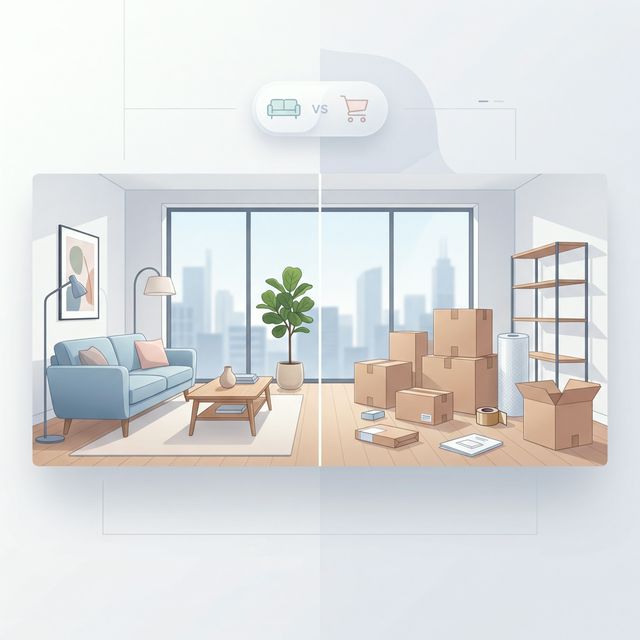
The idea of “ownership” is shifting. For the millions of young professionals moving to tech hubs like Bengaluru, Hyderabad, or Pune, buying a full bedroom set or a designer sofa no longer makes obvious sense when furniture subscriptions exist.
But is renting furniture just a “convenience tax,” or is it a savvy financial move for the modern renter? This guide breaks down the math, the stress-factors, and the long-term implications of the “Rent vs. Buy” dilemma.
Part 1: Persona Analysis - Which are You?
Before looking at the numbers, you must identify your “relocation profile.” Your decision should align with your career trajectory and residential stability.
The “Mobile Professional”
- Stay duration: 11-18 months.
- Priority: Speed, zero-upfront capital, and zero-effort moving.
- Verdict: Rent. The cost of buying, transporting, and eventually selling furniture at a 60-70% loss (common for second-hand particle-board furniture) makes renting the clear winner.
The “Stability Seeker”
- Stay duration: 3+ years.
- Priority: Personalized aesthetics, asset ownership, and long-term cost efficiency.
- Verdict: Buy. For a three-year period, the cumulative rental cost can easily reach 120-150% of the furniture’s original value.
Part 2: The Deep Math (12 vs. 36 Months)
Let’s look at a standard “2BHK Essential Package” (Sofa, Dining Table, Bed, Wardrobe, Fridge, Washing Machine).
| Factor | Renting (Monthly Rs 4,500) | Buying (EMI/Cash Rs 1,40,000) |
|---|---|---|
| Upfront Cost | Rs 9,000 (Refundable Deposit) | Rs 1,40,000 (Full Capital) |
| Total Cost (12 Months) | Rs 54,000 | Rs 1,40,000 |
| Total Cost (36 Months) | Rs 1,62,000 | Rs 1,40,000 |
| Resale Value (36 Months) | Rs 0 | Rs 40,000 - 55,000 |
| Net Cost (36 Months) | Rs 1,62,000 | Rs 85,000 - 1,00,000 |
The “Crossover Point”: In most Indian markets, the crossover point - where buying becomes cheaper than renting - occurs between 22 and 26 months. If you plan to stay in one city for less than two years, renting is mathematically superior.
Part 3: Pros and Cons Matrix
| Feature | Renting Furniture | Buying Furniture |
|---|---|---|
| Upfront Capital | Very Low (1-2 months security) | Very High (Full price or 20% EMI down-payment) |
| Quality | Consistent (Mid-tier/Commercial grade) | Variable (Whatever you can afford) |
| Maintenance | Included (Free brand-led repairs) | Self-managed (Finding local carpenters) |
| Moving Stress | Zero (Provider handles swap/relocation) | Very High (Packers and Movers costs + damage risk) |
| Credit Impact | Minimal/None | High (EMI affects loan eligibility) |
| Lifestyle Flex | High (Swap styles every 12 months) | Low (Committed to the piece for years) |
Part 4: The Hidden Factors
1. The “Resale Trap”
The second-hand furniture market in India remains highly fragmented. Selling a used sofa or bed on online marketplaces often involves:
- Low-ball offers from unverified buyers.
- Safety and security risks of strangers visiting your home.
- The logistical cost of moving the item to the buyer’s house. Buying only makes sense if you are willing to keep the furniture for its entire lifecycle.
2. Credit and Debt (RBI Context)
Buying furniture on “No-Cost EMIs” is technically a consumer durable loan. According to RBI (Reserve Bank of India) credit guidelines, high utilization of consumer loans can marginally impact your debt-to-income ratio, which banks look at during home loan or car loan applications. Renting avoids this debt-profile entirely.
3. Circular Economy & Sustainability
Renting promotes a “circular economy” model where furniture is refurbished and reused across multiple users, reducing the carbon footprint of fresh manufacturing and the waste generated from discarded low-quality furniture.
Part 5: The Mittiyo Recommendation
At Mittiyo, we believe in Hybrid Living. You don’t have to choose one exclusively.
- Rent the Tech and Utility: Appliances (Fridge, Washing Machine) and high-wear items (Dining sets, secondary beds) are great for renting as they require frequent maintenance.
- Buy the Comfort: Invest in a high-quality mattress and a primary “ergonomic” work chair. These are personal health investments that have the highest ROI on your well-being.
At 10% annual escalation, a tenant starting at Rs 25,000 would pay nearly Rs 65,000 after 10 years - a 2.6x increase. At 5%, the same tenant would pay Rs 40,722 - a 1.6x increase. The cumulative difference over 10 years exceeds Rs 10 lakh.
Part 6: Deep Value Analysis - ROI and Opportunity Cost
When deciding between renting and buying, look beyond the monthly outflow. Consider the Opportunity Cost of Capital.
- Buying Context: If you spend Rs 1,40,000 upfront on furniture, that capital is “locked.” If invested in a diversified mutual fund or a high-yield savings instrument at a conservative 8-10% return, that capital could grow to Rs 1,75,000 in 3 years.
- Renting Context: By renting at Rs 4,500/month, you keep the Rs 1,40,000 liquid. The “cost” of renting is partially offset by the “earnings” on your saved capital.
Asset Depreciation 101: Most furniture (especially MDF/Particle board) depreciates at 20-30% annually in the secondary market. By the time you move after 3 years, your Rs 1.4 Lakh investment might only be worth Rs 50,000. Renting effectively transfers this depreciation risk to the provider.
Part 7: Reputable Furniture Rental Platforms in India
While Mittiyo is platform-neutral, the following providers are the established market leaders with transparent pricing and official service-level agreements (SLAs). We recommend visiting their official portals to compare inventory and monthly subscription rates.
| Provider | Core Strength | Official Website |
|---|---|---|
| Rentomojo | Balanced inventory, strong presence in 8+ cities, flexible tenures. | rentomojo.com |
| Furlenco | Design-forward furniture, “unlimited” swap features, premium aesthetics. | furlenco.com |
| Cityfurnish | Solid wood options, simple UI, competitive long-term plans. | cityfurnish.com |
| Fabrento | Good mix of traditional and modern furniture, extensive appliance range. | fabrento.com |
Note: Avoid clicking on “sponsored” links or third-party aggregators that may charge hidden commissions. Always use the official domains listed above.
Part 8: The “Relocation Factor” - Inter-City Logistics
One of the most valuable (and under-discussed) perks of modern furniture rentals is Inter-city Relocation Support.
If you are moving from Bengaluru to Mumbai:
- Owned Furniture: You must hire an inter-city packer and mover (cost: Rs 25,000 - 45,000), buy transit insurance, and risk damage during the 1,000km transit.
- Rented Furniture: Major platforms (like Rentomojo and Furlenco) handle the entire swap. They take back your items in the old city and provide identical or upgraded stock in the new city - often for a nominal service fee or even for free if your subscription is above a certain tenure. This “logistical insurance” alone can save you a month’s salary in moving costs.
Setting up a new rental?
Before you furnish it, make sure the home is right. See what residents say a building actually rents for, the deposit, the society, the water and power reality, on know.place, a map of honest, building-level rental experiences across India.
Explore know.placeReferences and Official Sources
- Reserve Bank of India (RBI) - Report on Trend and Progress of Banking in India (covers NBFC lending, consumer credit growth, personal loans): RBI Annual Publications
- Consumer Protection (E-Commerce) Rules, 2020 - Rules governing digital subscriptions and consumer rights in the rental economy: Consumer Protection Act, 2019 on India Code
- CIBIL (TransUnion) - How personal loans and EMIs affect your credit score: CIBIL - Personal Loans and Credit Score
- Bureau of Indian Standards (BIS) - IS 12674: Methods of Test for Strength and Stability of Settees and Benches (CED 35 - Furniture committee): BIS Standard Details
- Income Tax Rules - Depreciation Rates (Appendix I): Understanding asset value loss over time for furniture and appliances: Depreciation Rates Chart
- Ellen MacArthur Foundation - Circular Economy in India: Rethinking Growth for Long-Term Prosperity: Report Page