

Bengaluru renters face a fundamental decision early in their housing search: the structured, amenity-rich environment of a gated community, or the independence and space of a standalone house. This choice shapes not just monthly expenses but daily routines, social interactions, privacy levels, and even legal obligations. Unlike many online comparisons that treat this as a simple cost question, the reality involves trade-offs across at least a dozen dimensions - from water supply reliability to the legal implications of apartment association bylaws.
This guide examines both options across cost, amenities, legal frameworks, maintenance, lifestyle factors, and neighborhood dynamics. It draws on the legal provisions of the Transfer of Property Act, 1882, the Karnataka Apartment Ownership Act, 1972, the Karnataka Rent Act, 1999 (as amended in 2025), and the Karnataka Stamp Act, 1957 to help you evaluate your options with clarity.
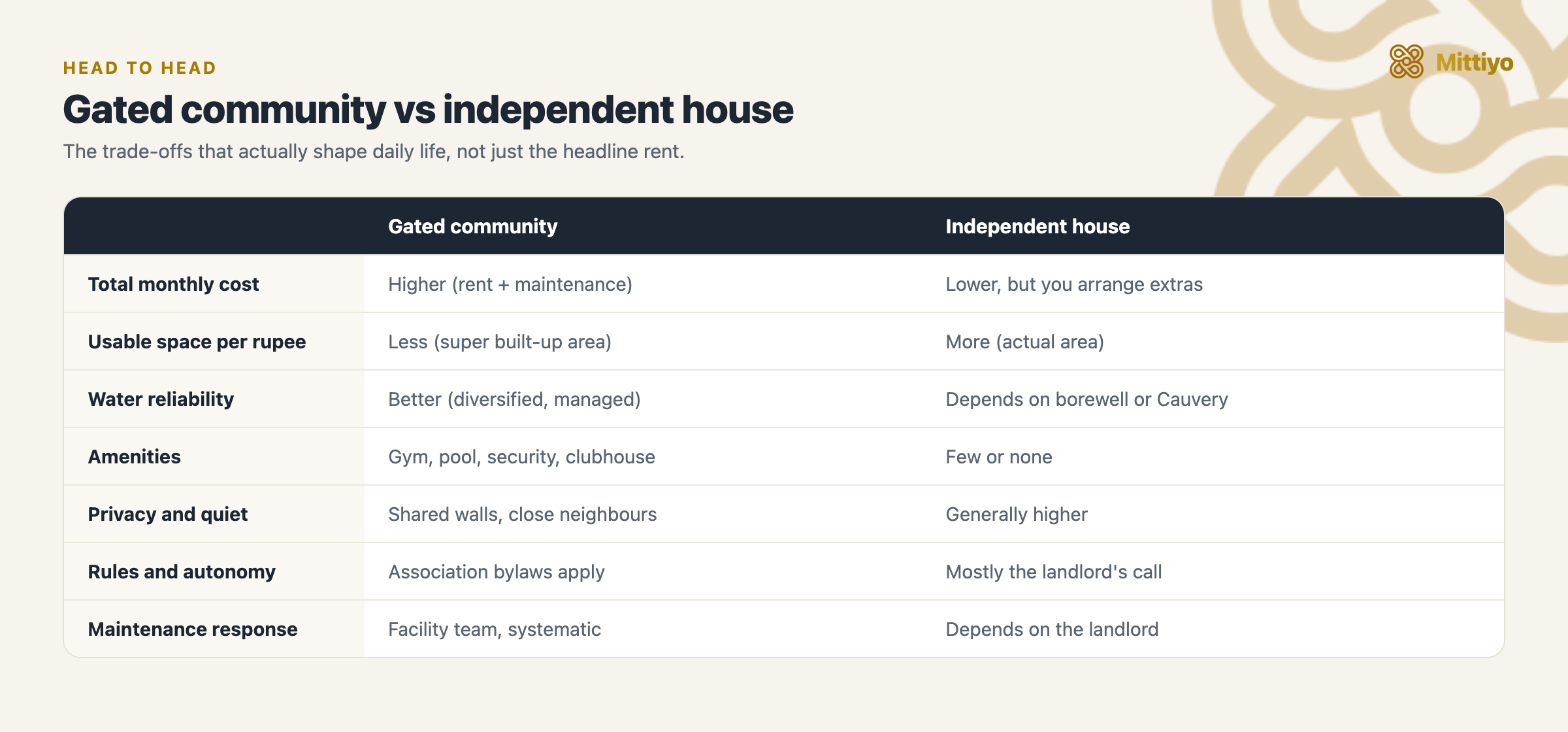 Gated community versus independent house, at a glance.
What Exactly Are These Two Options?
Before diving into comparisons, it helps to define what each category means in the Bengaluru rental market.
Gated communities refer to multi-unit residential complexes - typically apartment buildings or villa clusters - enclosed within a boundary wall with controlled access. These are managed by an apartment owners’ association (formed under the Karnataka Apartment Ownership Act, 1972) or a Residents’ Welfare Association (RWA). The association collects maintenance charges, manages common facilities, enforces bylaws, and handles security. Examples range from large township-style developments with hundreds of units to smaller complexes with 20-50 apartments.
Independent houses refer to standalone residential buildings or portions of such buildings rented out by individual owners. These include independent floors in multi-story owner-built houses (the most common format in older Bengaluru neighborhoods), standalone bungalows, and row houses not governed by a formal association. The landlord directly manages the property without an intermediary management body.
The distinction matters legally. In a gated community, the tenant’s daily life is shaped by three layers of authority: the landlord (apartment owner), the apartment association, and the facility management company. In an independent house, there is typically only one layer: the landlord.
Cost Comparison: Beyond Base Rent
The most common mistake renters make is comparing base rent figures without accounting for the full cost of living in each option. Here is a detailed breakdown for a 2BHK equivalent in a mid-range Bengaluru locality (areas like Whitefield, Sarjapur Road, Electronic City, Hennur, Thanisandra).
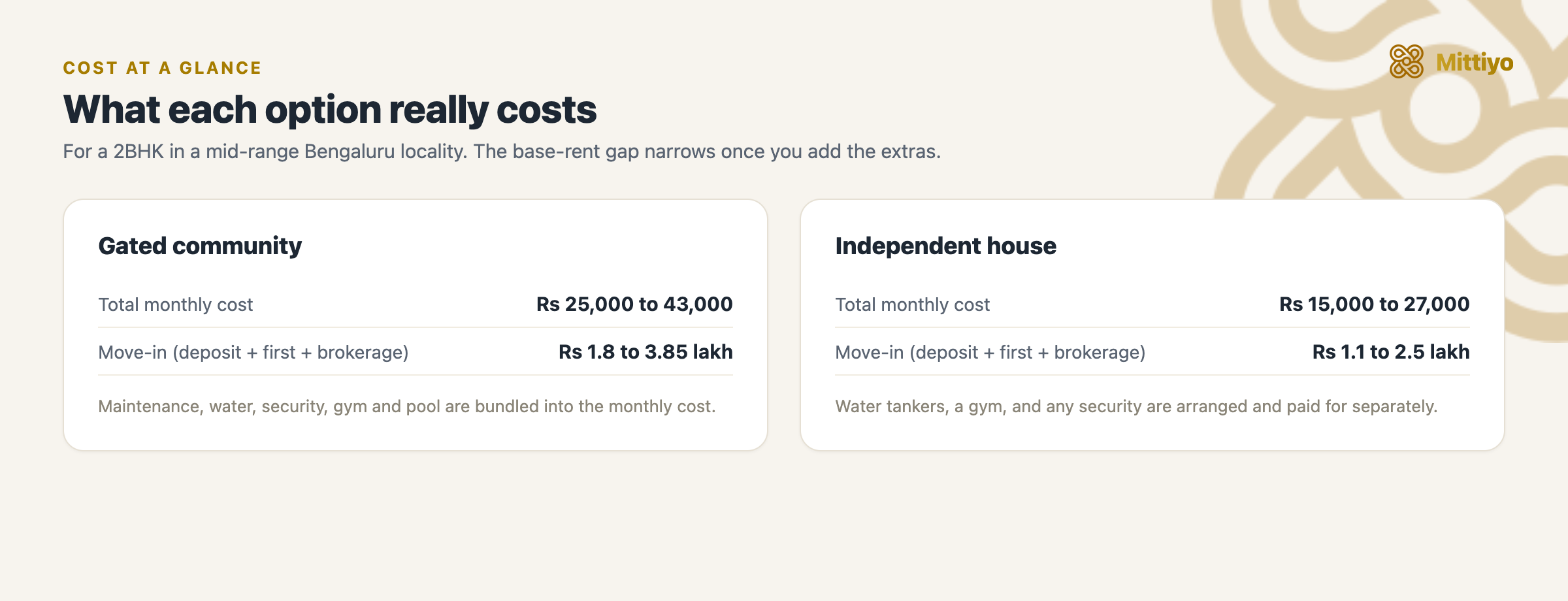 Monthly and move-in costs compared, with what each bundles in.
| Factor | Gated Community | Independent House |
|---|---|---|
| Base rent (2BHK) | Rs 22,000-35,000 | Rs 14,000-22,000 |
| Maintenance charges | Rs 3,000-8,000/month | Minimal or none |
| Water cost | Included in maintenance | Rs 500-2,000 (tanker may be extra) |
| Security | Included | Rs 0-1,500 (if hired separately) |
| Gym/pool | Included | Rs 1,500-3,000 (external gym) |
| Parking | Usually included (1 car) | Usually included |
| Internet | Self-arranged | Self-arranged |
| Power backup | Included (DG for common areas) | Rs 0-500 (inverter maintenance) |
| Total monthly cost | Rs 25,000-43,000 | Rs 15,000-27,000 |
| Security deposit | 6-10 months’ rent | 6-10 months’ rent |
| Move-in cost (deposit + first month + brokerage) | Rs 1,80,000-3,85,000 | Rs 1,10,000-2,50,000 |
Understanding maintenance charges: In gated communities, maintenance is not optional. Under Section 11 of the Karnataka Apartment Ownership Act, 1972, each apartment owner must contribute to the common expenses in proportion to their undivided interest in the common areas. This obligation is passed to tenants through the rental agreement in most cases. The maintenance charge covers a bundle of services that independent house tenants must arrange and pay for separately - or go without.
The hidden cost equalizer: When you add up the cost of a gym membership, private security (even a shared watchman arrangement with neighbors), water tanker deliveries during Bengaluru’s dry months (March-May), and the time cost of personally managing maintenance tasks, the effective cost gap narrows to Rs 5,000-10,000 per month rather than the Rs 8,000-13,000 suggested by base rent alone.
Security deposit considerations: Both options in Bengaluru have typically required 6-10 months’ rent as security deposit, though the Karnataka Rent (Amendment) Act, 2025 (in force January 2026) moves to cap residential deposits at two months; how firmly this binds the standard 11-month leave-and-license agreement is still being worked out, so confirm the current position before you pay. The deposit is refundable when you vacate, subject to deductions for damage beyond normal wear and tear, with the amount and the deduction terms set by the agreement, so get them in writing. Stamp duty on rental agreements is levied under the Karnataka Stamp Act, 1957 (with the central Indian Stamp Act, 1899 as the underlying framework). A standard 11-month leave and license agreement attracts only nominal stamp duty, whether the property is in a gated community or an independent house.
Amenities: What You Actually Get
| Amenity | Gated Community | Independent House |
|---|---|---|
| Swimming pool | Common in mid-to-premium segments | None |
| Gym/fitness center | Common | None |
| Children’s play area | Dedicated, maintained, secure | Garden (if available), unstructured |
| Clubhouse / community hall | Common | None |
| 24/7 security with CCTV | Standard | Varies - usually absent |
| Power backup (DG set) | For common areas; some provide full backup | Inverter (self-arranged, self-maintained) |
| Lift/elevator | Standard in buildings above 3 floors | Rare |
| Intercom system | Standard | None |
| CCTV coverage | Common areas covered | Self-arranged |
| Landscaped gardens | Professionally maintained | Owner-maintained (if any) |
| Sewage Treatment Plant (STP) | Required for large complexes under KSPCB norms | Septic tank or municipal connection |
| Rainwater harvesting | Mandatory for buildings above 2,400 sq ft plot (BBMP bylaws) | Required but compliance varies |
| Indoor games (TT, badminton) | Common in larger complexes | None |
The amenity utilization question: One important consideration that often goes unexamined is whether tenants actually use the amenities they are paying for. Industry surveys suggest that in most apartment complexes, swimming pool utilization is below 30% of residents, and gym utilization is even lower. If you are someone who does not swim, exercise at home, or has no children to use the play areas, you are effectively subsidizing facilities for other residents through your maintenance charges. This is not necessarily a reason to avoid gated communities - the security, common area maintenance, and water management alone justify a substantial portion of the maintenance charge - but it is worth honest self-assessment.
Space, Light, and Privacy
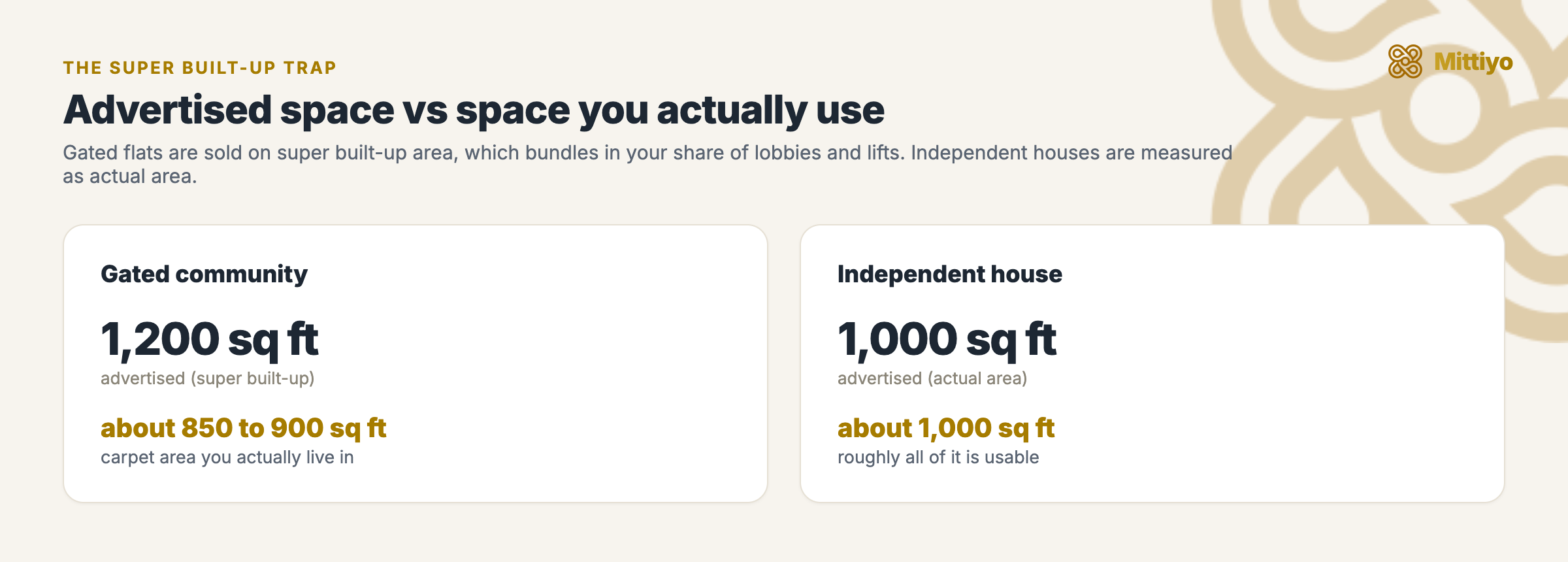 Super built-up area versus the carpet area you actually use.
| Factor | Gated Community | Independent House |
|---|---|---|
| Floor area | 800-1,400 sq ft for 2BHK (carpet area often 70-75% of super built-up area) | 1,000-1,600+ sq ft for similar rent (no loading factor) |
| Ceiling height | Standard 9-10 ft | 10-12 ft in older constructions |
| Balcony/terrace | Small balcony (utility balcony common) | Larger verandah or dedicated terrace access |
| Natural light and ventilation | Depends on floor, orientation, and adjacent buildings | Generally better (fewer adjacent high-rises) |
| Cross-ventilation | Limited in many modern designs | Common in older constructions |
| Noise levels | Neighbors above, below, and adjacent; lift noise; common area noise | Quieter (fewer shared walls in standalone houses) |
| Privacy | CCTV in common areas, visible entry/exit logs, close-quarter neighbors | Higher privacy, fewer observers |
| Outdoor space | Shared - no exclusive outdoor area | Private garden, yard, or terrace (if available) |
The super built-up area trap: One of the most significant practical differences is how space is measured. Gated community apartments are marketed using super built-up area, which includes the tenant’s proportionate share of common areas (lobbies, staircases, lift shafts). A “1,200 sq ft” apartment may have only 850-900 sq ft of actual carpet area. Independent houses are typically measured by the actual usable area. This means that a “1,000 sq ft” independent house portion may actually offer more living space than a “1,200 sq ft” gated community apartment.
Noise as a lifestyle factor: Noise transmission in apartment buildings is a widely underestimated issue. Sound travels through shared walls, floors, and ceilings. A neighbor’s washing machine, a child running on the floor above, or a late-night gathering in an adjacent unit can affect sleep and work-from-home productivity. Independent houses, especially standalone structures, offer significantly better acoustic isolation. For professionals working from home - an increasingly common arrangement - this difference can affect daily productivity and mental wellbeing.
Rules, Restrictions, and Autonomy
Gated communities come with association bylaws that regulate daily life. These bylaws are adopted under the authority of the Karnataka Apartment Ownership Act, 1972 (Section 10) and are binding on all occupants, including tenants. Understanding these restrictions before signing a rental agreement is essential.
| Factor | Gated Community | Independent House |
|---|---|---|
| Pet ownership | Association bylaws may restrict breeds, sizes, or prohibit pets entirely | Landlord’s discretion - typically more flexible |
| Guest stays | Registration required; some associations limit duration | No formal restrictions |
| Parties and gatherings | Noise rules, clubhouse booking required for events | Greater flexibility (neighbor consideration still applies) |
| Cooking restrictions | Some associations restrict non-vegetarian cooking | Rare |
| Home modifications | Strict approvals required; external changes prohibited | Easier with landlord’s permission |
| Moving in/out | Scheduled hours, lift booking, security clearance | Anytime |
| Drying clothes | Balcony only, with aesthetic restrictions in many complexes | More options |
| Working from home (commercial use) | Some associations restrict commercial activity | Generally more flexible |
| Vehicle restrictions | Allocated parking only; visitor parking limited | Usually more parking flexibility |
The pet ownership issue: Pet ownership is one of the most contentious areas in gated community living. While no Indian statute prohibits pet ownership in apartments - and the Animal Welfare Board of India has issued circulars stating that housing societies cannot impose blanket pet bans - many apartment associations continue to enforce restrictive pet policies. The legal position, as clarified in multiple High Court judgments, is that associations can regulate pets (leash rules, common area restrictions) but cannot impose outright bans. However, enforcing your rights against an association resolution can be stressful and time-consuming. If you have or plan to have pets, an independent house is generally the lower-friction option.
Association governance and tenant voice: Under the Karnataka Apartment Ownership Act, 1972, the apartment association consists of apartment owners - not tenants. This means tenants have no direct voting rights in association meetings, cannot stand for office (President, Secretary, Treasurer), and cannot directly challenge association decisions. Your interests in a gated community are represented by your landlord, who may or may not prioritize tenant concerns. In an independent house, you negotiate directly with the landlord without an intermediary governance layer.
Maintenance and Repairs
The maintenance experience differs fundamentally between the two options - not just in who pays, but in response times, accountability, and the tenant’s recourse when things go wrong.
| Aspect | Gated Community | Independent House |
|---|---|---|
| Common area repairs | Facility management team; funded by maintenance charges | Landlord directly - response depends on individual |
| Internal repairs (tenant’s unit) | Tenant arranges (or requests landlord); facility team may assist for a fee | Tenant arranges or requests landlord |
| Emergency response | Dedicated maintenance team, usually available 24/7 | You call the plumber/electrician yourself |
| Quality consistency | Professional but sometimes bureaucratic | Personal attention, but quality varies |
| Escalation path | Tenant → Landlord → Association → Facility Management | Tenant → Landlord |
| Cost of repairs (common areas) | Covered by maintenance charges | Landlord bears cost (Section 108(c), TPA) |
The Section 108(c) obligation: Under Section 108(c) of the Transfer of Property Act, 1882, the landlord is bound to keep the property in a reasonable state of repair throughout the tenancy. This obligation applies equally in both gated communities and independent houses. However, the practical experience differs. In a gated community, common area maintenance is handled by the association and is generally consistent. In an independent house, the quality and speed of repairs depends entirely on the individual landlord’s responsiveness. A responsive, invested landlord can provide a superior maintenance experience; an absentee or uncooperative landlord can make life difficult.
The escalation problem: In a gated community, a repair issue that affects common areas (water supply from the main tank, lift malfunction, common area electrical failure) goes through a defined process: report to facility management, escalation to the association committee, resolution through maintenance funds. The advantage is systematization. The disadvantage is that the tenant has no direct standing to approach the association - the landlord must do so. In an independent house, the tenant communicates directly with the landlord, which is faster when the landlord is cooperative but lacks any fallback when the landlord is unresponsive.
Water Supply: A Critical Factor in Bengaluru
Water availability deserves special attention because Bengaluru’s water situation creates genuinely different experiences in gated communities versus independent houses.
| Factor | Gated Community | Independent House |
|---|---|---|
| Primary source | Multiple borewells + tanker contracts + Cauvery (where available) | Single borewell or Cauvery connection |
| Backup arrangements | Professional management with standing tanker contracts | Depends on landlord; ad hoc tanker orders |
| Reliability | Generally good - diversified supply | Depends entirely on locality and individual setup |
| Summer shortage risk | Lower (multiple sources, professional management) | Higher (single-source dependency) |
| Cost | Included in maintenance | May be separate; tanker costs can spike in summer |
| Quality management | Some complexes have water treatment plants | Depends on source; no treatment in most cases |
Seasonal water stress: During Bengaluru’s dry season (March-May), water tanker prices can increase substantially, and availability becomes unpredictable. Gated communities, by virtue of having standing contracts with tanker operators and diversified water sources, handle these shortages more reliably. Independent house tenants in water-stressed localities (parts of Whitefield, outer Sarjapur Road, Yelahanka) may face genuine hardship during peak summer. If you are considering an independent house, ask about the water source, its reliability during summer months, and the landlord’s arrangements for backup supply before signing the rental agreement.
BWSSB Cauvery water: Areas with Bangalore Water Supply and Sewerage Board (BWSSB) Cauvery water connections have a more reliable supply regardless of housing type. However, BWSSB coverage remains incomplete in Bengaluru’s rapidly expanding periphery, where both gated communities and independent houses rely heavily on borewells and tankers.
Legal Considerations for Tenants
The legal framework affecting tenants varies between gated communities and independent houses in several important ways.
Rental agreement structure: The rental agreement itself is substantially similar in both cases - a leave and license agreement or lease deed governed by the Transfer of Property Act, 1882 and the Karnataka Rent Act, 1999. However, gated community rental agreements typically include additional clauses: obligation to pay maintenance charges, obligation to follow association bylaws, restrictions on alterations, and parking allocation. Review these clauses carefully - they create enforceable obligations beyond the standard landlord-tenant terms.
Stamp duty and registration: Rental agreements in Karnataka attract stamp duty under the Karnataka Stamp Act, 1957 (with the central Indian Stamp Act, 1899 as the underlying framework), calculated on the total consideration (rent plus deposit). Agreements for 11 months or less, the standard Bengaluru practice, attract lower stamp duty and have not required compulsory registration under the Registration Act, 1908. Note, however, that the Karnataka Rent (Amendment) Act, 2025 pushes tenancy agreements toward digital registration on the Kaveri 2.0 portal; how this applies to 11-month leave-and-license agreements is still settling. These points apply equally to both housing types.
TDS on rent: Under Section 194-IB of the Income Tax Act, 1961, if monthly rent exceeds Rs 50,000, the tenant must deduct TDS at 2% before paying rent. This applies regardless of whether the property is in a gated community or an independent house. The tenant must deposit this TDS using Form 26QC within 30 days of the end of the month.
Police verification: The Karnataka Police Act requires landlords to report tenant details to the local police station. In gated communities, this process is typically handled through the association or facility management. In independent houses, the landlord must do this directly. Failure to register tenants can result in penalties for the landlord.
Lifestyle and Social Considerations
Beyond legal and financial factors, the two options create fundamentally different social environments.
Community building: Gated communities provide built-in social infrastructure - festival celebrations, weekend sports, children’s activities, WhatsApp groups, and regular interaction in common areas. For people new to Bengaluru, this can significantly ease the transition. Independent houses, by contrast, offer limited organic social interaction with neighbors. Building a social network requires more deliberate effort through workplaces, interest groups, or other channels.
Work-from-home suitability: The post-2020 shift to remote and hybrid work has made home environment quality a professional consideration. Independent houses generally offer better work-from-home conditions: quieter environments, more space for a dedicated office, fewer restrictions on internet installation (some gated communities mandate specific providers), and no shared-wall noise transmission. Gated communities counter with co-working spaces (in newer complexes), reliable power backup, and high-speed internet infrastructure - but the noise factor remains a common complaint.
Proximity to essential services: Gated communities, especially large township-style developments, are often located on city peripheries where land was available for development. This can mean longer commutes and fewer walkable amenities (local markets, street food, neighborhood stores). Independent houses in established neighborhoods (Jayanagar, Basavanagudi, Malleshwaram, Rajajinagar, Indiranagar) offer walkable access to markets, restaurants, temples, and public transport - a significant quality-of-life advantage that rarely features in standard rental comparisons.
Who Should Choose What?
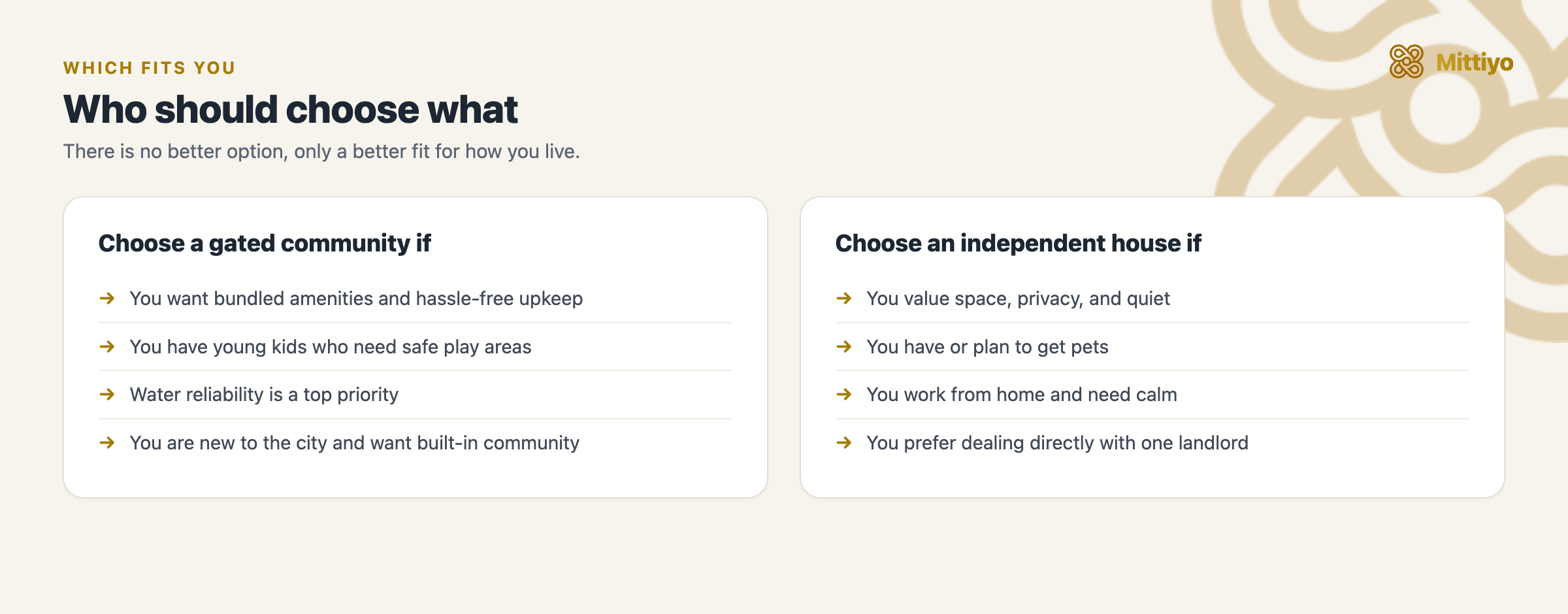 A quick way to tell which suits you.
Choose a gated community if:
- You value bundled amenities and are willing to pay maintenance charges for them
- You have young children who benefit from secure play areas and a peer group
- You want hassle-free maintenance with a dedicated facility management team
- You are new to Bengaluru and want built-in community and social infrastructure
- You work long hours and value convenience over space
- Water supply reliability is a high priority
- You prefer a structured, predictable living environment
Choose an independent house if:
- You value privacy, space, and independence above amenities
- You want more usable living space for the same or lower rent
- You have pets or plan to get pets
- You dislike society rules, association politics, and lifestyle restrictions
- You enjoy gardening, outdoor space, or terrace access
- You work from home and need a quiet environment
- You prefer established neighborhoods with walkable access to local markets and services
- You want to save on total monthly costs and do not need gym, pool, or clubhouse access
- You prefer dealing directly with a landlord rather than navigating association bureaucracy
Practical Checklist Before Signing
Regardless of which option you choose, verify these before committing:
For gated communities:
- Request a copy of the association bylaws and read them before signing
- Ask about the maintenance charge breakdown and any planned increases
- Check the water source and summer supply history
- Verify the power backup arrangement (common areas only, or full backup?)
- Confirm parking allocation (covered/uncovered, specific spot or first-come)
- Ask about pet policies if relevant
- Visit the property at different times of day to assess noise levels
- Confirm whether the maintenance charge is the owner’s or tenant’s responsibility in the agreement
For independent houses:
- Verify the water source (Cauvery, borewell, both) and ask about summer reliability
- Check the electrical wiring age and condition (older houses may have outdated wiring)
- Confirm the landlord’s typical response time for repairs
- Verify property tax payment status (the landlord’s obligation, but non-payment can create complications)
- Check for structural issues: wall cracks, ceiling dampness, terrace waterproofing condition
- Assess natural light and ventilation - visit during the day
- Check the neighborhood: noise levels, safety, proximity to essentials
- Clarify responsibility for water tanker costs if the borewell runs dry
Gated or independent, vet the building first
Water reliability, noise, society rules, and the real monthly cost vary unit to unit, not just by type. See what residents actually say about a specific building on know.place before you sign: the rent, the deposit, the water and power reality.
Explore know.placeKey Takeaways
- Gated communities cost more in absolute terms, but the total cost gap narrows to Rs 5,000-10,000 per month when you account for amenities that independent house tenants must arrange separately
- Independent houses offer more usable space per rupee because they are measured in actual area rather than super built-up area
- Water supply reliability is a genuine differentiator - gated communities with diversified sources handle Bengaluru’s dry season significantly better
- Association bylaws in gated communities create binding obligations on tenants for pets, guests, modifications, and common area use - read them before signing
- Independent houses offer greater privacy, quiet, and autonomy, making them better for work-from-home professionals and pet owners
- Tenants in gated communities have no direct voting rights in association governance (Karnataka Apartment Ownership Act, 1972) - your interests depend on your landlord’s engagement
- Both options carry the same tenancy protections under the Transfer of Property Act, 1882 and the Karnataka Rent Act, 1999
- The right choice depends on individual priorities: there is no objectively superior option, only better fits for specific circumstances
This guide is part of the Bengaluru Renter’s Handbook, our complete set of guides for moving in and settling down. For the water question specifically, see our Bengaluru water supply guide.
References
- Transfer of Property Act, 1882 - Sections 105-117 (leases), particularly Section 108 (rights and liabilities of lessor and lessee)
- Karnataka Apartment Ownership Act, 1972 - definitions, common areas, association governance, maintenance charges
- Karnataka Rent Act, 1999 (Karnataka Act 34 of 2001), as amended by the Karnataka Rent (Amendment) Act, 2025 (deposit cap, digital registration) - rent fixation, essential services
- Indian Stamp Act, 1899 - the central framework for stamp duty on instruments
- Karnataka Stamp Act, 1957, as updated by the Karnataka Stamp (Amendment) Act, 2025 (digital e-stamping) - stamp duty on lease and licence agreements
- Income Tax Act, 1961, Section 194-IB - TDS on rent exceeding Rs 50,000 per month
- Registration Act, 1908 - Section 17 (compulsory registration of leases exceeding 12 months)
- Karnataka Police Act, and police orders under Section 144 of the CrPC (now Section 163 of the BNSS, 2023), enforced via Section 188 of the IPC (now Section 223 of the BNS, 2023) - tenant verification obligations
- BBMP Building Bye-Laws (as amended) - rainwater-harvesting requirements for buildings
- Karnataka State Pollution Control Board - sewage-treatment-plant norms for apartment complexes