
The Gujarat Legislative Assembly unanimously passed the Gujarat Rent Bill, 2026 on 11 September 2026, on the final day of the Assembly’s three-day Monsoon session, alongside several other Bills including a land-fragmentation reform. It replaces the Gujarat Rents, Hotel and Lodging House Rates Control Act, 1947, a law that predates Gujarat’s own existence as a separate state, carved out of the old Bombay State in 1960. The Bill was introduced by Urban Development Minister Kanubhai Desai.
One caveat that matters more than any single provision below: a Bill passed by the Assembly is not yet a law in force. It still needs the Governor’s assent, a gazette notification, and a commencement date before its clauses become legally binding, and none of those three have been made public as of this writing. Everything in this guide describes what the Bill says as passed, which is the direction the law is heading, not necessarily what is enforceable on the date you are reading this. Check the Gujarat government gazette before treating any of it as currently binding on an existing tenancy.
What Changed, in Brief
The 1947 Act it replaces has no cap on security deposits, no fixed deadline for returning one, and dates from a rent-control era built for a very different housing market, when Ahmedabad and Surat were a fraction of their current size and rental housing worked very differently. The 2026 Bill rebuilds the framework around three things: a capped, time-bound deposit system, a written-agreement requirement backed by digital registration, and a dedicated three-tier dispute system instead of routing rent disputes through ordinary civil courts, where a straightforward eviction or deposit dispute can otherwise take years.
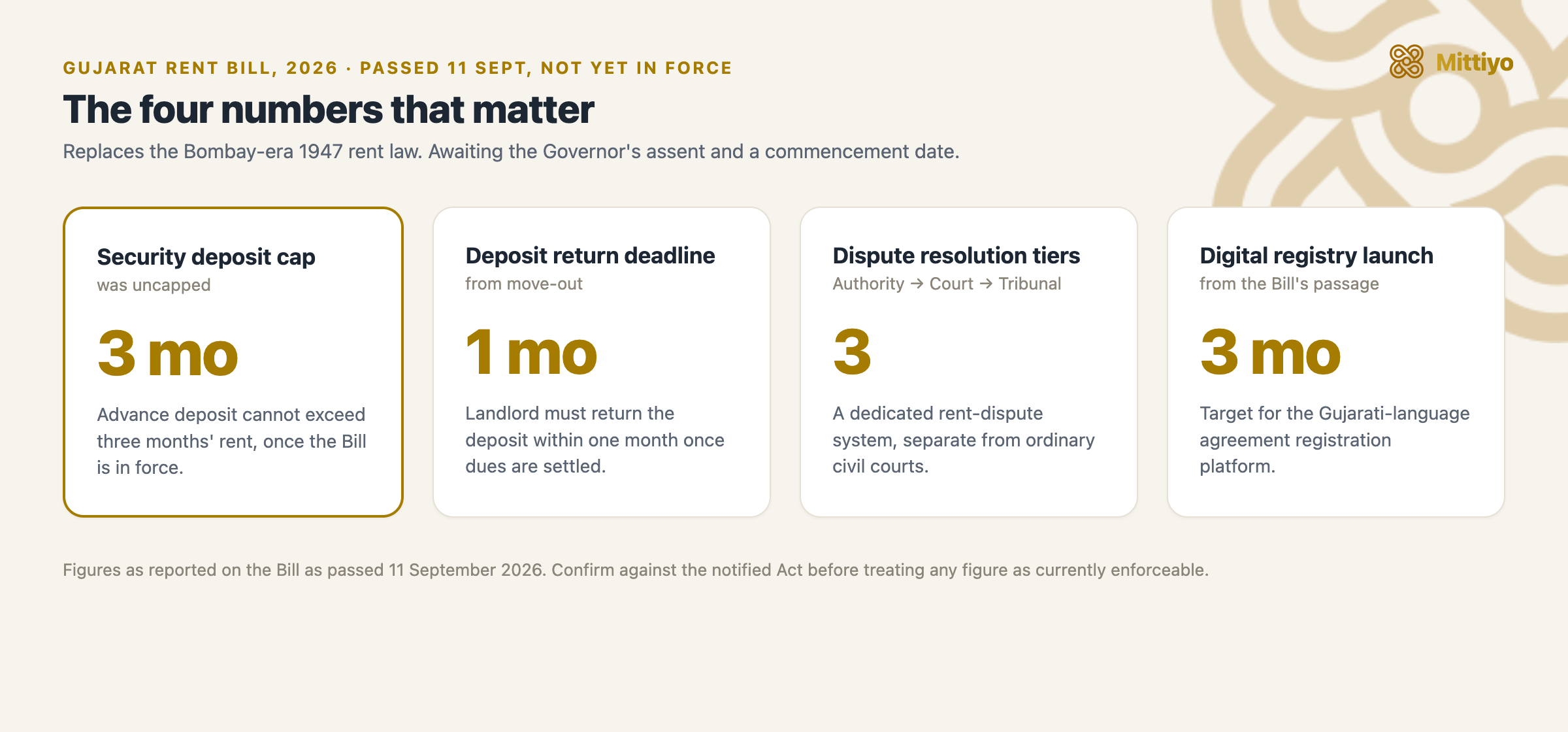 The Bill’s headline numbers, as passed on 11 September 2026. None of them are yet enforceable pending assent and a commencement date.
The table below lays out the change row by row, since “replaces the 1947 Act” undersells how little the old law actually specifies.
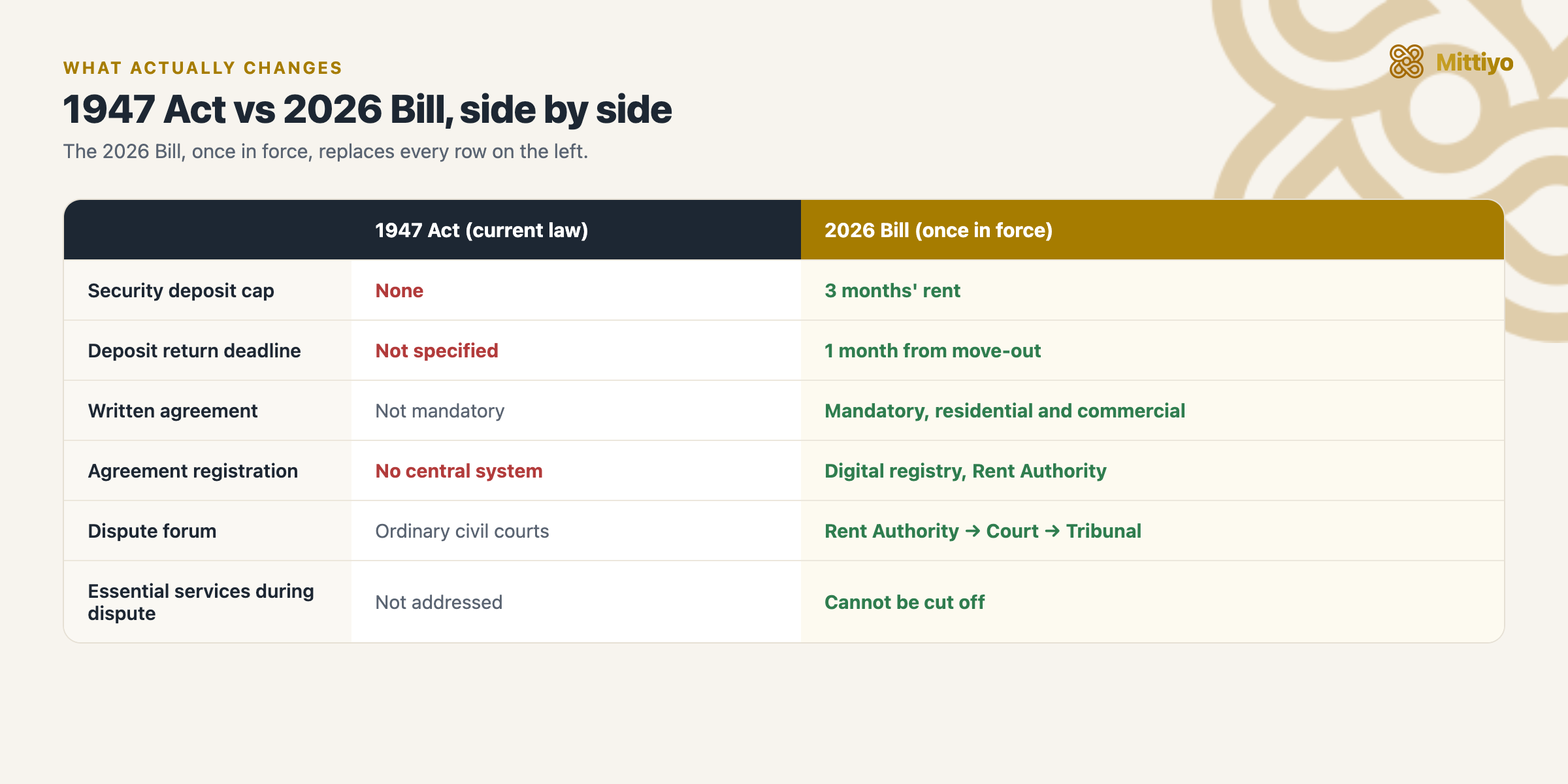 Every row on the left is what currently governs a Gujarat tenancy. Every row on the right is what the Bill proposes, once it clears assent and commencement.
What It Means for Tenants
Security deposit is capped at three months’ rent. Landlords who currently ask for six months, ten months, or a full year’s rent as deposit, a common practice in parts of Gujarat, will not be able to once the law is in force. Nothing in the 1947 Act it replaces caps deposits at all, so this is a genuine change, not a formality.
The deposit has to come back within one month. Once you vacate and settle any outstanding dues, the landlord has a statutory one-month window to return the deposit. Today that timeline is whatever your rental agreement says, if it says anything.
Essential services cannot be used as leverage. The Bill bars landlords from cutting off electricity, water, or gas to a tenant, including as a pressure tactic during a dispute. The Rent Authority can order services restored if a landlord does this, which addresses a specific, well-documented tactic in informal tenancies where cutting utilities is how a landlord forces a tenant out without going through any formal eviction process at all.
You get relief if the property becomes uninhabitable. Reporting on the Bill describes protection for tenants when a rented property is damaged by events like floods, earthquakes, or cyclones, potentially including rent relief or the ability to end the tenancy early. Gujarat’s coastal and seismic exposure, the state sits in a high-risk earthquake zone and its coastline is cyclone-prone, makes this more than a boilerplate clause. The exact conditions will depend on the rules once notified.
A written agreement becomes your right, not just the landlord’s preference. Verbal tenancies, common for short-term and informal arrangements, will not be legally valid once the Bill is in force. Both parties have to put the terms in writing, and those terms then get filed with the new Rent Authority.
What It Means for Landlords
Faster, dedicated dispute resolution. Instead of an ordinary civil suit, the Bill sets up a three-tier structure: a Rent Authority for registration and first-level administration, a Rent Court for adjudicating disputes, and a Rent Tribunal for appeals. The stated intent is resolving rent disputes faster than the general court system.
Specific, named grounds for eviction. Under the Bill’s Section 21 as reported, a landlord can approach the Rent Court for eviction on grounds including persistent non-payment of rent, damage to the property, and unauthorized subletting. Having named grounds, rather than relying on general civil procedure, is meant to make a legitimate eviction case move faster, and it also gives a tenant a clearer sense of what does and does not put a tenancy at risk.
A real deterrent for tenants who overstay. Reporting on the Bill describes a provision under which a tenant who remains in the property after the tenancy period ends, without renewing the agreement, can become liable for double the normal rent during the overstay period. Treat the exact formula and conditions as the reported direction until the Act’s rules are notified, since the news coverage available does not spell out every mechanical detail.
The registration obligation applies to you too. Written agreements are a joint filing requirement. The Rent Authority is building a digital platform, in Gujarati, targeted for launch within three months of the Bill’s passage, and each registered agreement gets a unique ID number. A centrally registered, written agreement also makes rental income harder to under-report, since a paper trail now exists where an informal, verbal tenancy left none; see Mittiyo’s rental income tax guide for landlords for what that income actually owes once it is on the record.
Not every property is covered. Reporting on the Bill notes exemptions for government-owned premises, employment-linked staff or service quarters, and properties owned by religious, charitable, or Waqf trusts, unless the parties involved agree otherwise. If you manage one of these categories, confirm which rules actually apply once the Act and its rules are notified.
The Registration Requirement: What You Actually Have to Do
This is the part that turns a legal headline into a practical task, and it is also the part most explainer coverage skips. Based on the Bill as reported:
- Put the tenancy in writing. Residential and commercial tenancies both need a written agreement once the law is in force; a verbal arrangement will not hold up.
- Both parties jointly submit the agreement to the Rent Authority. This is described as a joint filing, not something either side can do alone, so plan for both landlord and tenant to be involved in the paperwork.
- The agreement gets logged on a new digital platform. The Rent Authority is building this in Gujarati, with a target of launching within three months of the Bill’s passage, and each registered agreement receives a unique identification number.
- Watch for the Act’s actual commencement date. None of the above is enforceable until the Bill receives the Governor’s assent and a commencement notification. Existing tenancies should not assume the new rules already apply.
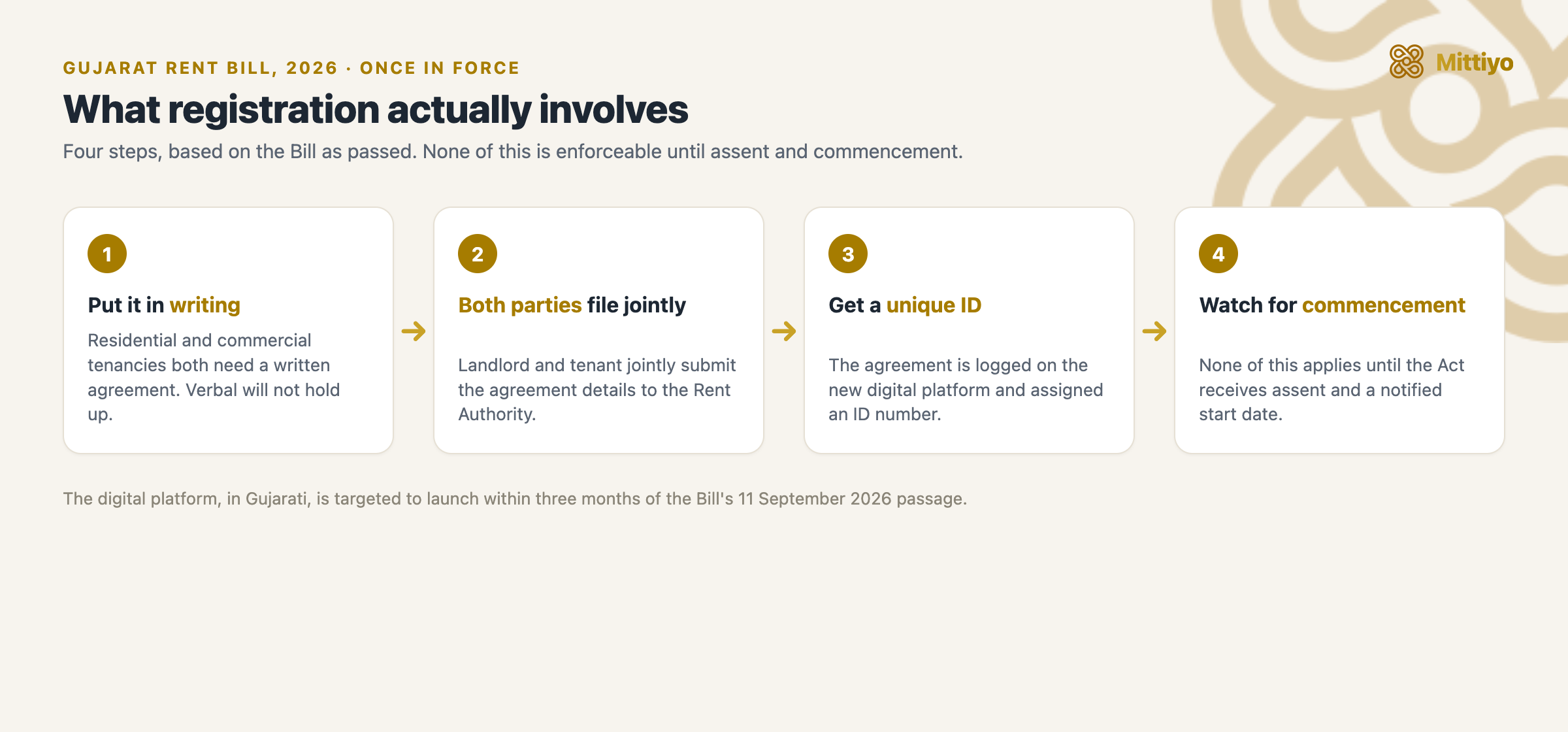 What the registration process looks like once the Bill is actually in force, based on the text as passed.
If your monthly rent is high enough to trigger TDS on rent under Section 194-IB, a written, registered figure removes any ambiguity about what that rent actually is, which matters for both sides once the tenancy is on official record.
If you are entering a new Gujarat tenancy now, before the Act is formally in force, the safest move is the same one that will be required once it is: a clear written agreement covering the deposit amount, the return timeline, and the tenancy period, with both sides keeping a signed copy, well before a digital registry gives you no choice in the matter.
A Worked Example: What the Deposit Cap Means in Real Numbers
Headlines about a “three-month cap” are easy to skim past without registering what that actually changes. Take a fairly ordinary 2BHK in Ahmedabad renting for Rs 22,000 a month, in the middle of the range reported for areas like Shela and South Bopal:
| Today, under the 1947 Act | Once the 2026 Bill is in force | |
|---|---|---|
| Monthly rent | Rs 22,000 | Rs 22,000 |
| Deposit a landlord could ask for | However much they want; 6 to 12 months is common | Capped at 3 months |
| Maximum deposit in rupees | Rs 1,32,000 to Rs 2,64,000 (6 to 12 months) | Rs 66,000 |
| Deposit return deadline | Whatever the agreement says, if anything | 1 month from move-out |
That is a difference of roughly Rs 66,000 to nearly Rs 2 lakh in cash a tenant does not have to hand over upfront, on a fairly typical mid-range Ahmedabad flat. In Surat, where median 2BHK rents run closer to Rs 15,000 a month, the same math caps a deposit at Rs 45,000 instead of the Rs 90,000 to Rs 1,80,000 a landlord charging six to twelve months could currently ask for. The cap does not set what rent a landlord can charge, only what they can hold as a refundable deposit against it.
How a Bill Actually Becomes Enforceable Law
This step gets skipped in most coverage, and it is the single most important thing to understand if you are trying to decide whether any of the above applies to you right now. Under Article 200 of the Constitution of India, a Bill passed by a state legislature is presented to the Governor, who can assent to it, withhold assent, or reserve it for the President’s consideration. Only after assent does the government issue a gazette notification declaring the Bill an Act, and even then, the Act’s actual provisions typically do not take effect until a further commencement notification, often issued alongside the implementing rules.
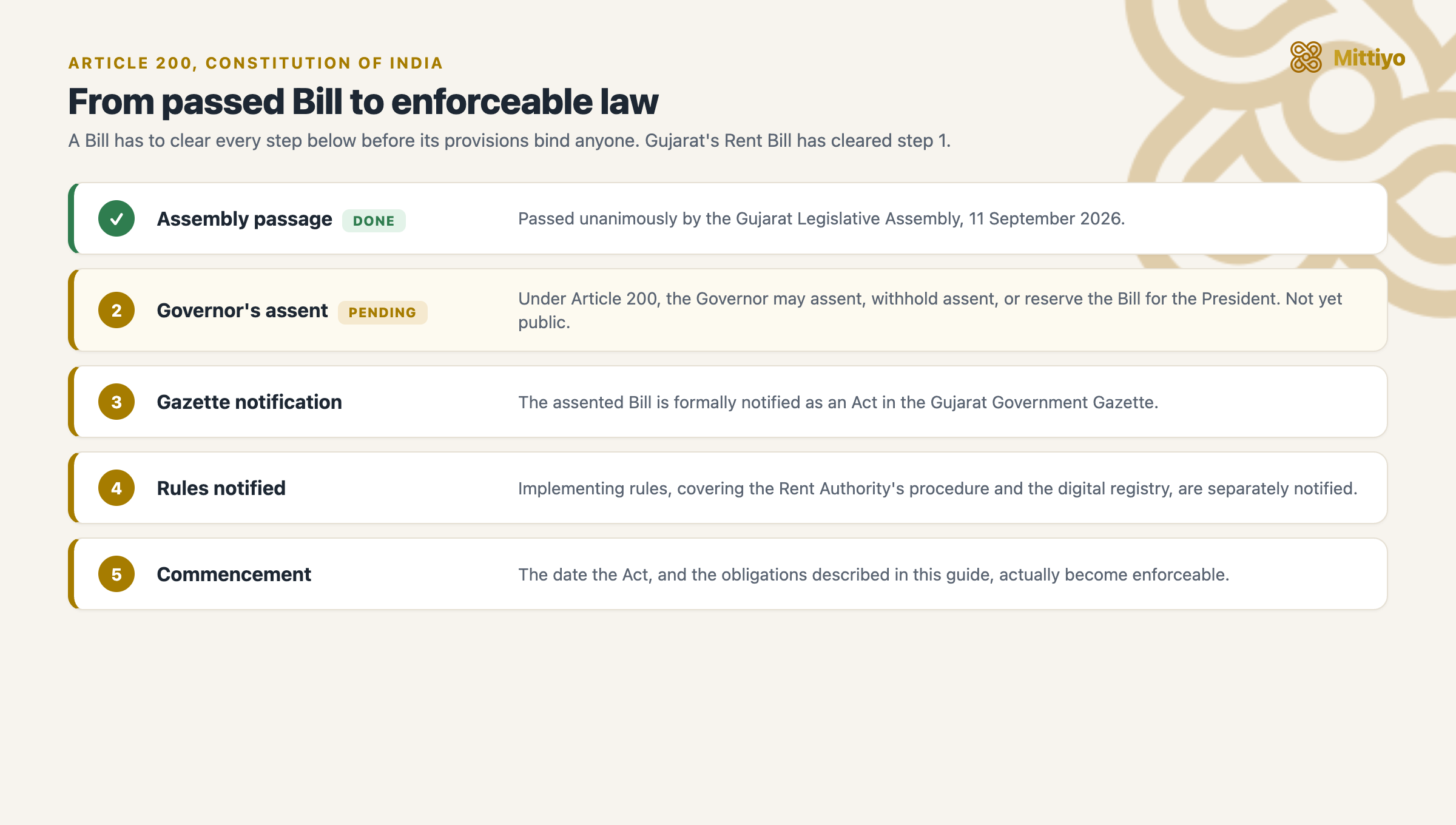 The Gujarat Rent Bill has cleared exactly one of these five steps. The other four have no public timeline as of this writing.
Practically, this means the gap between “the Assembly passed it” and “you have to comply with it” can run from a few weeks to many months, and there is no guaranteed timeline. Some states notify commencement quickly after assent; others let an assented Act sit un-notified for a long stretch while rules are drafted. There is no substitute for checking the Gujarat government gazette directly before treating any provision in this guide as currently binding.
Common Misconceptions About the Bill
“The three-month cap is already in effect.” It is not, for the reasons above. A landlord can still lawfully ask for whatever deposit the market bears until the Act commences.
“This applies everywhere in India now.” No. This is Gujarat state legislation. It has no effect on tenancies in Karnataka, Maharashtra, Delhi, or anywhere outside Gujarat.
“Written agreements were never required before, so nothing changes there.” Written agreements were not legally mandatory under the 1947 Act, but they were already standard, sensible practice, and most formal tenancies in Gujarat already use one. What is new is the registration requirement and the fact that a verbal agreement will stop being legally valid at all.
“The digital registry is live now.” It is not. The Rent Authority is targeting a launch within three months of the Bill’s passage, and that platform is a separate thing from the Bill itself becoming law.
How Gujarat Compares to the Rest of India
Most Indian states have no statutory cap on residential security deposits at all, which is why local custom does most of the work, and that custom varies enormously by city.
| Location | Typical deposit norm | Statutory cap |
|---|---|---|
| Gujarat, once the 2026 Bill is in force | 3 months’ rent | Yes, by law |
| Bengaluru, Karnataka | Commonly 10 months’ rent | No statutory cap; market custom only |
| Delhi-NCR | Often 2 to 3 months’ rent | No statutory cap in most cases |
| Mumbai, Maharashtra | Varies widely, sometimes 6 months or more | No general cap under the older Maharashtra Rent Control framework |
| Andhra Pradesh, Tamil Nadu, Uttar Pradesh, Assam | Varies | Adopted the central Model Tenancy Act, 2021, in some form |
| Most other states | No consistent norm | No statutory cap |
The Model Tenancy Act, 2021 is worth naming here, since it is the obvious point of comparison. The Union Cabinet approved it in June 2021 as a template for states to voluntarily adopt, covering broadly similar ground: capped deposits, written agreements, and a dedicated rent authority. Adoption has been slow; as of the most recent tally only four states, Andhra Pradesh, Tamil Nadu, Uttar Pradesh, and Assam, had ratified it, more than two years after the Cabinet approved the template. Gujarat has written its own Bill rather than adopting the central one, but the shared direction, away from open-ended deposits and informal tenancies, is the same.
Gujarat, once its Bill is actually in force, would join a short list of Indian states with a hard legal ceiling on deposits rather than a market norm a landlord can set however they like. Karnataka has discussed similar caps in draft rent-reform proposals, but nothing equivalent has been enacted there yet, so Bengaluru’s roughly ten-month norm remains a matter of local custom, not law. Mittiyo’s state-by-state security deposit guide covers this comparison for US states in more depth; Gujarat’s cap gives India its own version of the same question, and it is likely to come up again as other states weigh whether to follow.
What To Do Right Now, Before the Act Commences
There is a real gap between “the Bill was passed” and “the Bill is enforceable,” and that gap is exactly when a lot of Gujarat tenancies get signed. Here is what actually makes sense to do in that window, for each side.
If you are a tenant signing a new lease now:
- Negotiate the deposit as if the cap already applied. It costs nothing to ask, and a landlord who has read the news is more likely to agree to three to four months than one who has not.
- Get everything in writing regardless of whether the Bill has commenced. A verbal agreement is a weak position under the old law and will not be a legal option under the new one, so there is no version of the future where it helps you.
- Keep dated proof of the deposit amount, the rent, and the condition of the property at move-in, since none of the Bill’s protections matter if you cannot show what was actually agreed.
If you are a landlord entering a new tenancy now:
- Consider pricing the deposit closer to the coming cap voluntarily. A tenancy signed today at ten months’ deposit is a tenancy you may be asked to renegotiate, or that becomes a dispute, once the Act commences and a tenant realizes the old terms would not be legal under it.
- Document the property’s condition at move-in with photos and a written inventory. The Bill’s uninhabitability protections and its eviction grounds both turn on being able to show what the property was like when the tenancy started.
- Watch the Gujarat government gazette directly rather than relying on news summaries for the commencement date and the final rules, since the rules will fill in exactly the details, the overstay penalty’s mechanics, the exemptions’ precise scope, that current reporting only describes in outline.
The Bottom Line
The direction of the Gujarat Rent Bill, 2026 is clear: cap deposits, force agreements into writing, register them centrally, and route disputes through a dedicated system instead of the general courts. Whether any of that is actually enforceable on the date you are reading this depends entirely on the Governor’s assent, a gazette notification, and a commencement date, none of which had been made public as of publication. Track the Gujarat government’s official gazette for that step before treating any provision above as currently binding, and revisit this guide once the Act, and its implementing rules, are formally notified.
Vetting a building before you sign in Gujarat, or anywhere else?
A capped deposit only helps if you also know what you are actually moving into. know.place maps honest, structured experiences of specific buildings, the rent, deposit, water, and power, from people who have actually lived there.
Explore know.placeThis is general information about a recently passed Bill, not legal advice. Rent-related disputes and the precise application of any provision depend on the final enacted text, the rules made under it, and the facts of your own tenancy. Consult a Gujarat-licensed advocate for anything specific to your situation.
References
Because the Gujarat Rent Bill, 2026 is not yet an enacted, gazetted law, there is no official Act text to cite section by section the way an existing statute allows. The provisions above are drawn from the following, cross-checked against each other where more than one was available:
- Gujarat Rents, Hotel and Lodging House Rates Control Act, 1947 (IndiaKanoon, Act 57 of 1947): the law the 2026 Bill replaces, and the baseline for the comparison table above.
- Article 200, Constitution of India: governs the Governor’s assent, withholding, or reservation of a state Bill, the step that decides whether the Gujarat Rent Bill becomes law.
- The Model Tenancy Act, 2021 (PRS Legislative Research): the central template referenced in the national-comparison section, including its state-adoption status.
- Examining the Model Tenancy Act, 2021 and regulation of rental property in India (PRS Legislative Research): background on why rent-control reform has moved slowly across Indian states.
- Contemporaneous news reporting on the Bill’s passage and provisions, cross-checked across multiple outlets for the deposit cap, return deadline, registration requirement, and dispute-resolution structure, including coverage from Gujarat Samachar and The Hans India (both reporting the same 11 September 2026 Assembly session).
Figures and provisions above reflect the Bill as passed and as reported on 11 September 2026. This guide will be updated once the Act and its rules are formally notified.