

Life changes: a job moves, a relationship ends, a home stops being safe. But a lease is a contract, and leaving early can be expensive. The good news is that the bill is rarely the whole remaining term, and in some situations you can leave with no penalty at all. Here is how breaking a lease actually works, what it costs, and how to owe as little as possible.
TL;DR: Some situations let you leave penalty-free, notably qualifying military orders under the SCRA, domestic violence in most states, and a genuinely uninhabitable home. Otherwise you either pay the lease’s early-termination fee or stay liable for rent until the unit is re-rented. Crucially, in most states the landlord must actively try to re-rent, which caps what you actually owe.
First, read these three things in your lease
Before anything else, find these clauses. They decide most of what follows.
- Early termination clause. Many leases let you leave for a set fee, commonly one to two months’ rent, plus notice. If it exists, this is often your cheapest, cleanest exit.
- Notice period. Usually 30 or 60 days, in writing. Missing it costs you regardless of the reason.
- Sublet or assignment clause. If you can hand the unit to an approved replacement tenant, that often ends your liability sooner than paying a fee.
If your lease has none of these, you fall back on your state’s default rules, which is where the duty to mitigate below becomes important.
When you can leave penalty-free
These are the situations where the law, not your landlord, decides.
- Qualifying military orders (federal, all states). Under the Servicemembers Civil Relief Act (SCRA), an active-duty servicemember who receives qualifying deployment or permanent-change-of-station orders can terminate a residential lease. You give written notice plus a copy of the orders, and the tenancy generally ends 30 days after the next rent due date. A landlord may not charge an early-termination penalty for an SCRA termination.
- Domestic violence, and often stalking or sexual assault. Most states let a victim terminate early without penalty, typically on written notice plus documentation such as a protective order or police report. The exact notice and proof requirements vary by state.
- An uninhabitable home. If the landlord fails to keep the place safe and livable and will not fix it after proper notice, many states let you treat the lease as effectively ended. This runs through the implied warranty of habitability, and the procedure matters, so see our guide to repairs and habitability before relying on it.
- Other state-specific grounds, which can include the landlord’s serious breach, foreclosure on the property, or the unit being destroyed.
What is generally not protected: a new job, buying a house, a breakup, or simply disliking the place. Those are ordinary early terminations.
The rule that limits your bill: duty to mitigate
This is the single most important thing to understand, and most renters do not know it.
In the majority of US states, a landlord has a duty to mitigate damages. They cannot leave your old unit sitting empty for the rest of your term and send you the bill. They must make reasonable efforts to re-rent it, and any rent collected from a new tenant is credited against what you owe. Once a new tenant moves in, your rent obligation generally stops, no matter how many months were left. In many states, a lease clause that tries to waive this duty is unenforceable.
Two honest limits: the landlord must take reasonable steps, not extraordinary ones. They do not have to prioritise your unit over their other vacancies, and they do not have to cut the rent to fill it faster. They may also be able to charge you reasonable costs of advertising and showing the unit.
In practice this is why walking away from eight remaining months often turns into owing six weeks of rent plus advertising, not eight months.
What it actually costs
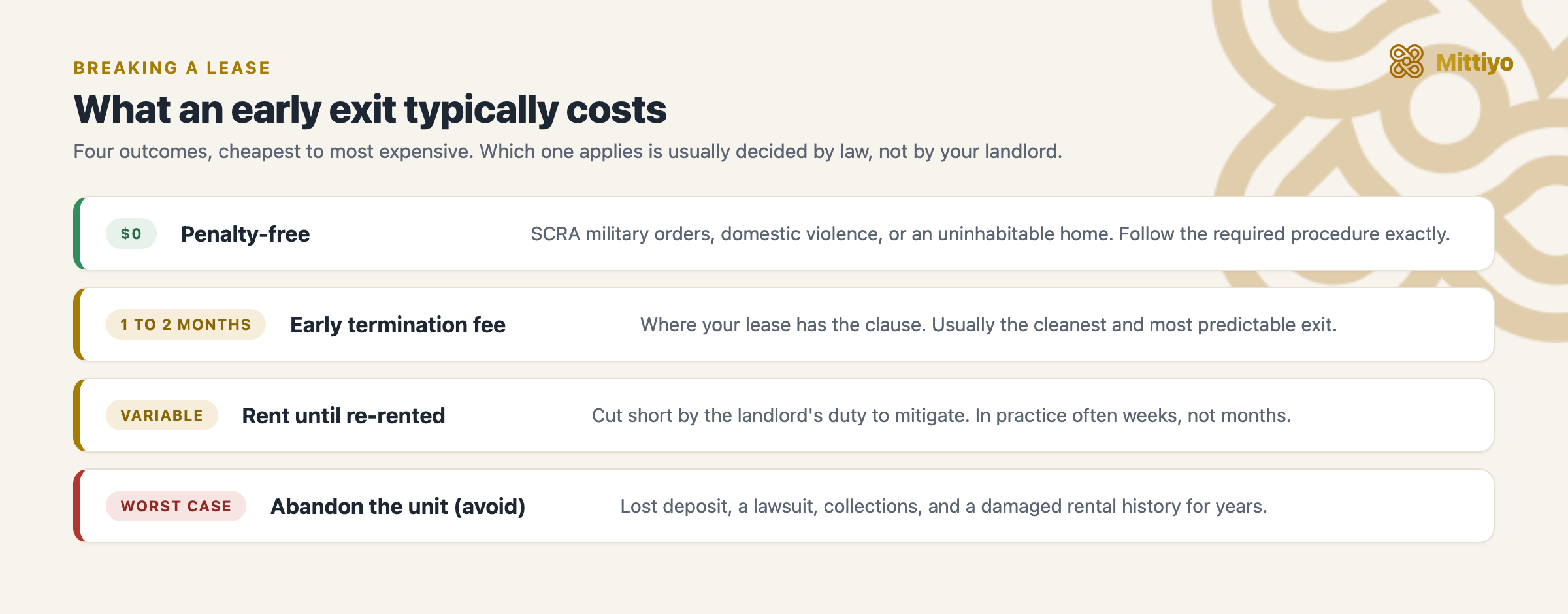
Putting the pieces together, an early exit usually lands in one of these buckets:
- Penalty-free, if SCRA, domestic violence, or uninhabitability applies and you follow the procedure.
- The early termination fee, commonly one to two months’ rent, where your lease has that clause.
- Rent until re-rented, reduced by the landlord’s mitigation, plus possibly reasonable re-letting costs.
- Forfeited deposit and a lawsuit, if you simply abandon the unit. This is the worst outcome and the one to avoid.
Your security deposit is a separate question: it is not an early-exit fee, and it still has to be returned or itemised under your state’s rules. If yours is withheld, see what to do when a landlord will not return your deposit.
A worked example: leaving eight months early
Say your rent is 1,800 dollars and you need to leave with eight months left. Your lease has no early-termination clause, so you fall back on state default rules.
- The scary number is eight months of rent: 14,400 dollars. That is what many renters assume they owe, and what some landlords will initially claim.
- What actually happens in a duty-to-mitigate state: you give 30 days’ written notice and offer to let the landlord show the unit while you are still living there. They list it, and it re-rents six weeks after you leave.
- What you owe: roughly six weeks of rent (about 2,500 dollars), possibly plus reasonable advertising costs. Once the new tenant’s rent starts, your obligation ends. Your deposit is a separate matter and still has to be returned or itemised.
The 14,400 became about 2,500 for two reasons: the landlord had a legal duty to re-rent, and you gave enough notice and cooperation for them to do it quickly. Both halves matter, which is why silence and a midnight move-out are the expensive options.
Negotiating with your landlord
Most early exits are settled, not litigated. A few things genuinely help:
- Go first, and go early. A landlord told two months ahead has time to re-rent with no gap; one told on the last day has a guaranteed vacancy and a reason to be difficult.
- Bring a solution, not just a problem. A qualified replacement tenant, or an offer to keep paying until re-rented, is far more persuasive than an apology.
- Offer a specific number. “I can pay one month’s rent to end this cleanly on the 30th” gives them something concrete to accept. Many will, because a fast, certain resolution beats an uncertain one.
- Ask for a written release. Whatever you agree, get a signed document saying the tenancy ends on a date and no further amounts are owed.
- Stay factual. Your position is that they have a duty to mitigate and you are making it easy for them; you do not need to argue about fairness.
If you are protected (SCRA, domestic violence, uninhabitability), you are not really negotiating: you are giving notice under a statute. Say so plainly, in writing, and attach the documentation the law requires.
How to break a lease and owe less
- Re-read the lease for the early-termination, notice, and sublet clauses.
- Check whether a protected reason applies (military orders, domestic violence, uninhabitability), because that changes everything.
- Tell the landlord in writing, early. More notice gives them more time to re-rent, which directly reduces your bill. Keep a dated copy.
- Offer to help re-rent. Bringing an approved replacement tenant, or letting them show the unit while you are still there, shortens the vacancy.
- Get the exit in writing. A signed termination or release stating you owe nothing further is what protects you later. A verbal “don’t worry about it” does not.
- Document the condition with dated photos at move-out, so the deposit is a separate, clean conversation.
- Keep records of every payment, notice, and reply until the deposit is returned and the account is settled.
If it goes wrong
If the landlord bills you for the entire remaining term with no attempt to re-rent, that is exactly what the duty to mitigate exists to prevent, and it is worth pushing back in writing and citing your state’s rule. If they keep your deposit on top, the deposit rules give you a separate remedy. Local legal aid and your state attorney general can tell you what your state actually requires, usually for free.
This is general information, not legal advice; lease terms and state rules vary widely and change over time, so confirm the current position where you live before acting. Last reviewed July 2026.
Related: Repairs and habitability · Landlord will not return your deposit · Security deposit laws by state · Renters insurance explained
Free tools: Notice to vacate generator · Prorated rent calculator · All free renter tools
Renting somewhere new?
know.place maps honest, structured experiences of specific buildings, the rent, deposit, water, and power, from people who have actually lived there, so you can vet a place before you sign.
References
- Military OneSource, terminating a lease under the SCRA: https://www.militaryonesource.mil/deployment/pre-deployment/military-clause-terminate-your-lease-due-to-deployment-or-pcs/
- Legal Information Institute (Cornell Law), Servicemembers Civil Relief Act, 50 U.S.C. 3955 (termination of leases): https://www.law.cornell.edu/uscode/text/50/3955
- Legal Information Institute (Cornell Law), duty to mitigate: https://www.law.cornell.edu/wex/mitigation_of_damages
- Consumer Financial Protection Bureau, help for renters: https://www.consumerfinance.gov/housing/housing-insecurity/help-for-renters/
- USA.gov, tenant rights and responsibilities: https://www.usa.gov/tenant-rights