

The security deposit is usually the largest single sum a tenant hands over, and getting it back can be the most stressful part of moving out. The good news is that the law is firmly on the side of a tenant who paid a genuine deposit and left the property in reasonable condition. A deposit is refundable, in full, minus only legitimate and documented deductions. It is not a fee, and it is not the landlord’s to keep.
What decides whether you get it back smoothly is rarely the law in the abstract; it is evidence and process. This playbook covers what a landlord can and cannot deduct, what the Model Tenancy Act changed, and exactly how to escalate, step by step, if your deposit is withheld, so you approach the right forum with the right paperwork.
What the law says about deposits
There is no single nationwide deposit cap, because rental law in India is a state subject. The central government’s Model Tenancy Act, 2021 recommends capping the security deposit at two months’ rent for residential premises and six months’ for non-residential premises, and it sets up a dedicated dispute system (a Rent Authority, Rent Court, and Rent Tribunal).
But the Model Tenancy Act is exactly that, a model. It only takes effect in a state once that state enacts or notifies it. Only a handful of states and union territories have done so; most large states still run older Rent Control Acts (see the table below). Where the Act does not apply, the deposit depends on the local Rent Act or market practice, which in some cities has historically run much higher. So the practical position is:
- If your state follows the Model Tenancy Act: the two-month cap and the Rent Authority or Rent Court apply.
- If it does not: your local Rent Act and your rental agreement govern, and the deposit amount is whatever was agreed, though it is still refundable minus lawful deductions.
Either way, the core principle is the same everywhere: the deposit is your money, held in trust, and returnable except for genuine dues.
Which states have actually adopted it
Because tenancy is a state subject, the Model Tenancy Act binds only where a state enacts or notifies it, and adoption so far is patchy.
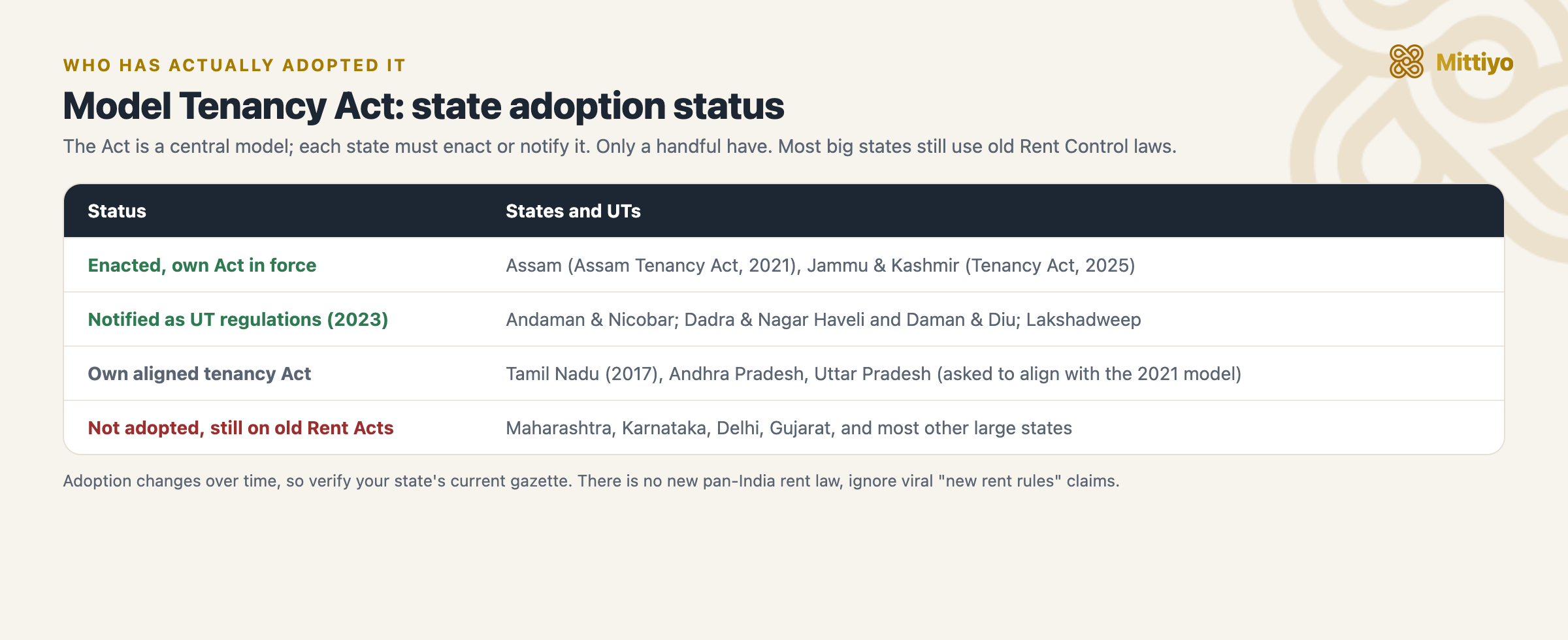 Only a handful of states and UTs have enacted or notified it; most big states still use old Rent Control laws.
Assam and Jammu & Kashmir have enacted their own Acts on the model; Andaman & Nicobar, Dadra & Nagar Haveli and Daman & Diu, and Lakshadweep notified tenancy regulations in 2023; and Tamil Nadu, Andhra Pradesh, and Uttar Pradesh have their own aligned tenancy laws. Large states such as Maharashtra, Karnataka, and Delhi have not adopted it. Be wary of viral “new pan-India rent law” posts: there is no new central rent law, and adoption changes over time, so check your own state’s current position.
What a landlord can, and cannot, deduct
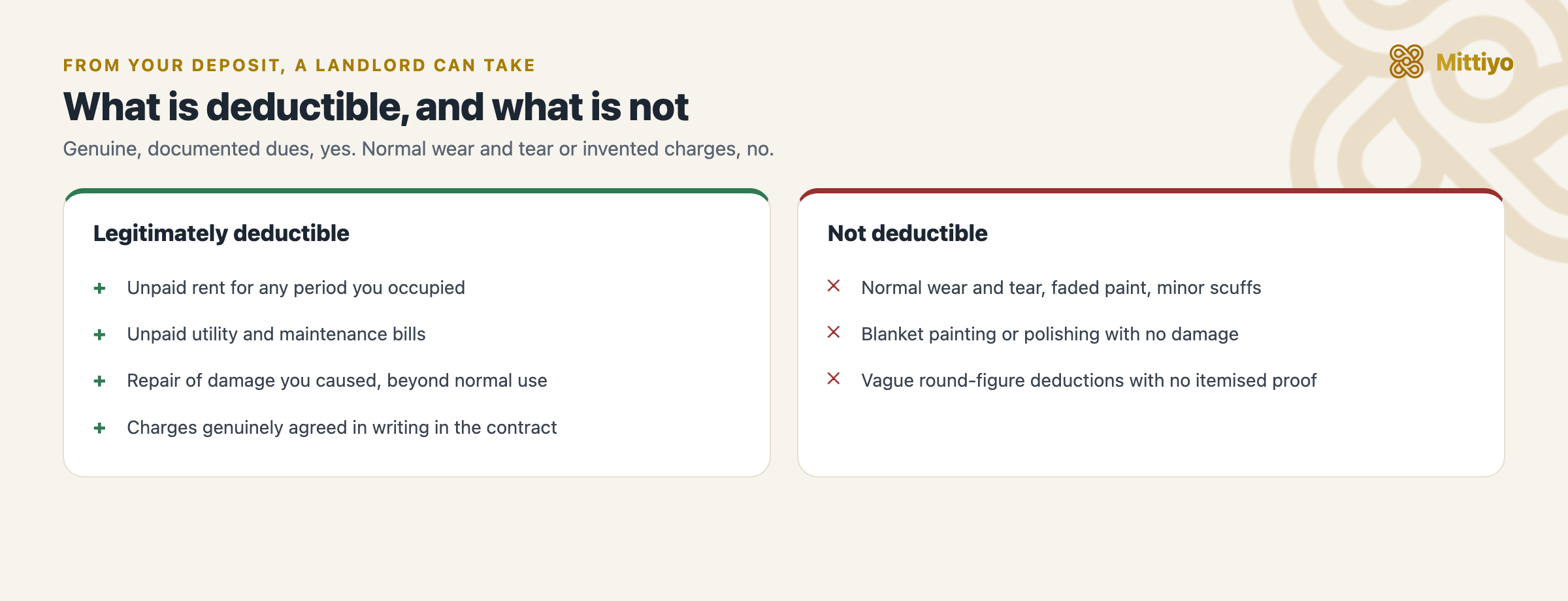 Genuine, documented dues can be deducted. Normal wear and tear and invented charges cannot.
Legitimately deductible:
- Unpaid rent for any period you occupied the property.
- Unpaid utility bills (electricity, water, gas, maintenance) up to your move-out.
- The cost of repairing damage you caused beyond normal wear and tear, a broken fixture, a stained or burnt surface, a damaged appliance.
- Charges agreed in writing in the rental agreement (for example, an agreed end-of-tenancy painting charge), if they are genuinely part of the contract.
Not legitimately deductible:
- Normal wear and tear, faded paint, minor scuff marks, gentle aging of fittings from ordinary use.
- Blanket painting or polishing charges with no agreement and no actual damage.
- Vague, round-figure deductions with no itemised proof.
If a landlord proposes a deduction, ask for it in writing and itemised. A landlord who cannot produce a breakdown is usually on weak ground.
This distinction settles most deposit fights, so it is worth being concrete. Normal wear and tear is the gradual, expected deterioration from simply living somewhere, and it is the landlord’s cost, not yours:
- faded or lightly marked paint, small nail holes from hanging pictures
- worn or slightly discoloured flooring, loosened fittings from ordinary use
- minor scuffs on walls and doors
Damage is loss beyond ordinary use, caused by you, your guests, or neglect, and it can be deducted:
- a cracked window, a burnt or deeply stained countertop, a hole in a door
- a broken appliance or sanitary fitting, tiles cracked by impact
- stains or damage from a pet, where pets were not permitted
The test is roughly: would this have happened anyway from normal living over the tenancy, or did something specific cause it? A full move-in and move-out photo record is what proves which side of the line a mark falls on.
How to get your deposit back, step by step
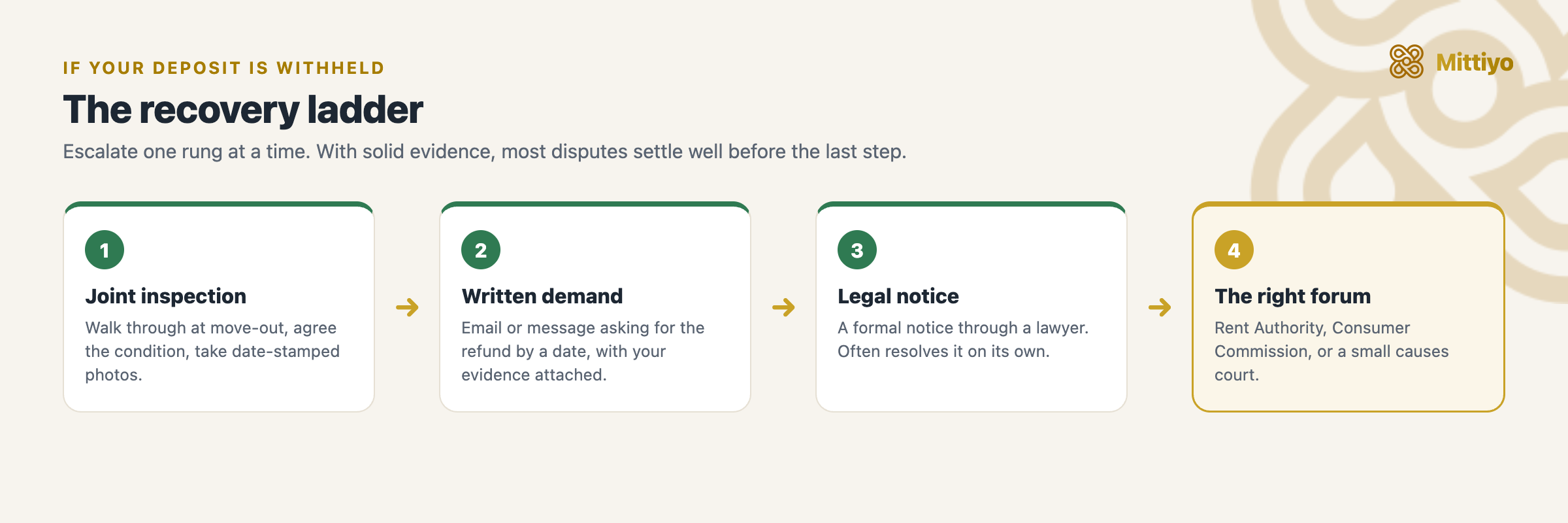 Escalate one rung at a time. Most disputes settle long before the last step, if your evidence is solid.
- Do a joint move-out inspection. Walk through the property with the landlord, agree on its condition, and take date-stamped photos or a video of every room and fixture. This single step prevents most disputes.
- Send a written demand. After vacating, send a clear message or email asking for the refund by a specific date, attaching your inspection evidence and the deposit receipt. Keep it polite and factual.
- Send a formal legal notice. If the written demand is ignored, have a lawyer send a formal legal notice. This often resolves matters on its own, because it signals you are serious and creates a record.
- Approach the right forum. If the landlord still refuses, file in the appropriate forum (see below). Withholding a deposit without a valid, itemised reason is a recoverable claim.
Where to take a dispute
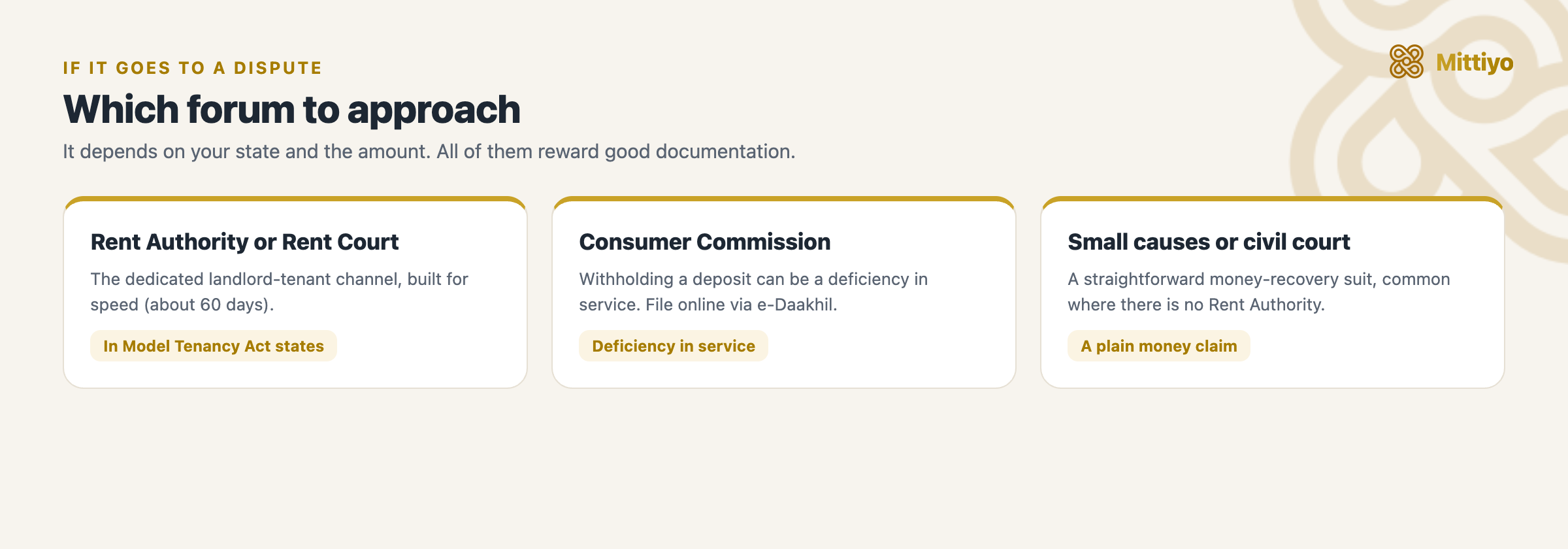 The right forum depends on your state and the amount. All of them reward good documentation.
- Rent Authority or Rent Court. In states that follow the Model Tenancy Act, this is the dedicated, faster channel for landlord-tenant disputes, designed to resolve most matters within about sixty days.
- Consumer Commission. Withholding a deposit without a valid reason can be treated as a deficiency in service. Tenants have recovered deposits, sometimes with compensation, through the Consumer Commission, and you can file online via the e-Daakhil portal.
- Small causes or civil court. For a straightforward money claim, a civil suit (often in the small causes court) is a standard route, especially in states without a Rent Authority.
Which to choose depends on your state and the sum involved. In all of them, the tenant who arrives with a signed agreement, a deposit receipt, bank proof, and move-out photos is in a strong position.
The Consumer Commission (formally the Consumer Disputes Redressal Commission, and often still called “consumer court”) is the forum set up under the Consumer Protection Act to resolve complaints about a bad or deficient service, and a landlord wrongly sitting on your deposit can count as exactly that. It is deliberately tenant-friendly: for claims up to Rs 5,00,000 the filing fee is nil, and you can argue your own case without a lawyer.
e-Daakhil is the government’s online portal for filing those complaints, so you do not have to visit the commission in person to lodge one. You register, file the complaint with your documents (agreement, deposit receipt, payment proof, move-out photos), pay any fee online, and track it. The trade-off is time: a complaint can realistically take 1.5 to 2 years, which is why a firm legal notice first is usually worth trying.
What legal recourse costs
Escalation is only worth it if the cost and time make sense against the deposit at stake. Here is the realistic picture.
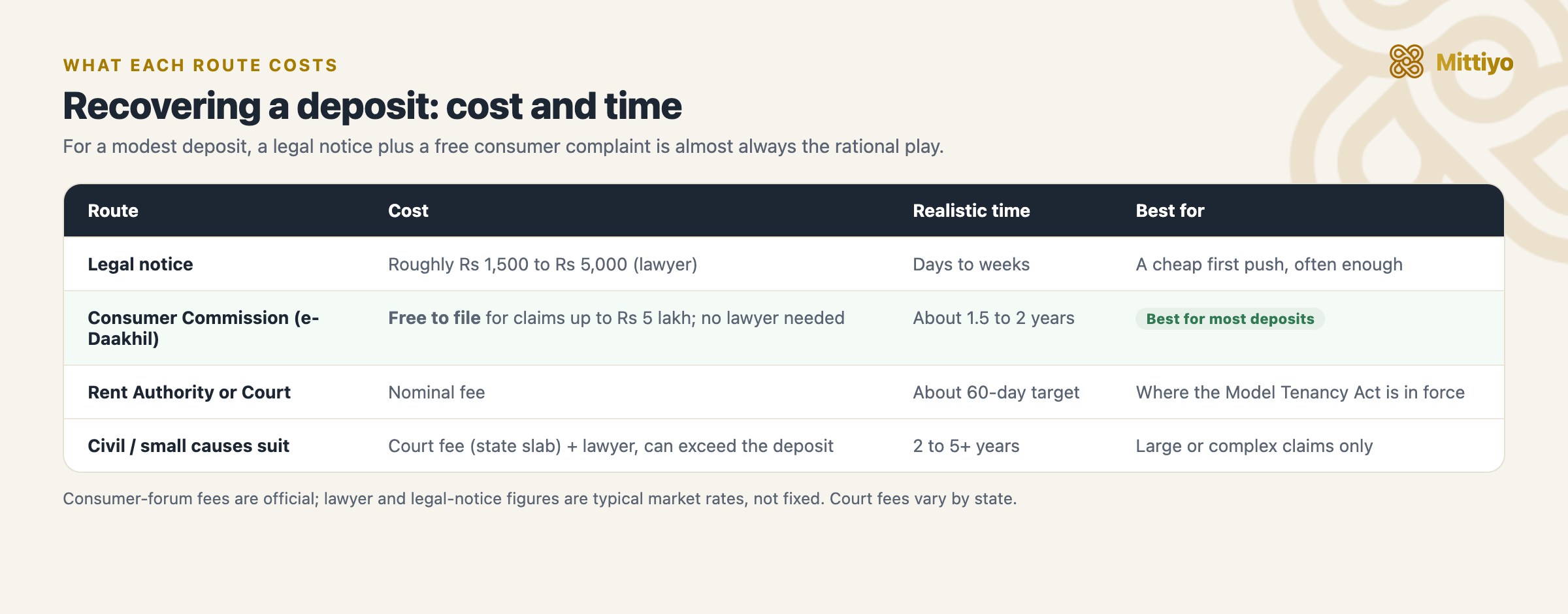 For a modest deposit, a legal notice plus a free consumer complaint is almost always the rational play.
- A lawyer’s legal notice typically costs around Rs 1,500 to Rs 5,000 and is often enough on its own; many deposits are refunded the moment a formal notice arrives.
- The Consumer Commission is the workhorse route. Withholding a deposit is a deficiency in service, and for claims up to Rs 5,00,000, filing is free, with no lawyer required; you can file online through e-Daakhil. The catch is time: the statutory target is a few months, but in practice a complaint can take around 1.5 to 2 years.
- The Rent Authority or Rent Court (in Model Tenancy Act states) charges only a nominal fee and aims to dispose of matters in about 60 days, but it exists only where the Act is in force.
- A civil or small causes suit carries an ad valorem court fee (which varies by state) plus lawyer fees that can exceed the deposit itself, and can run two to five years or more. It rarely makes economic sense for a routine deposit.
The takeaway: for most deposits, a firm legal notice followed by a free e-Daakhil complaint is the sensible path. Reserve a full civil suit for large or genuinely complex claims.
The evidence that wins
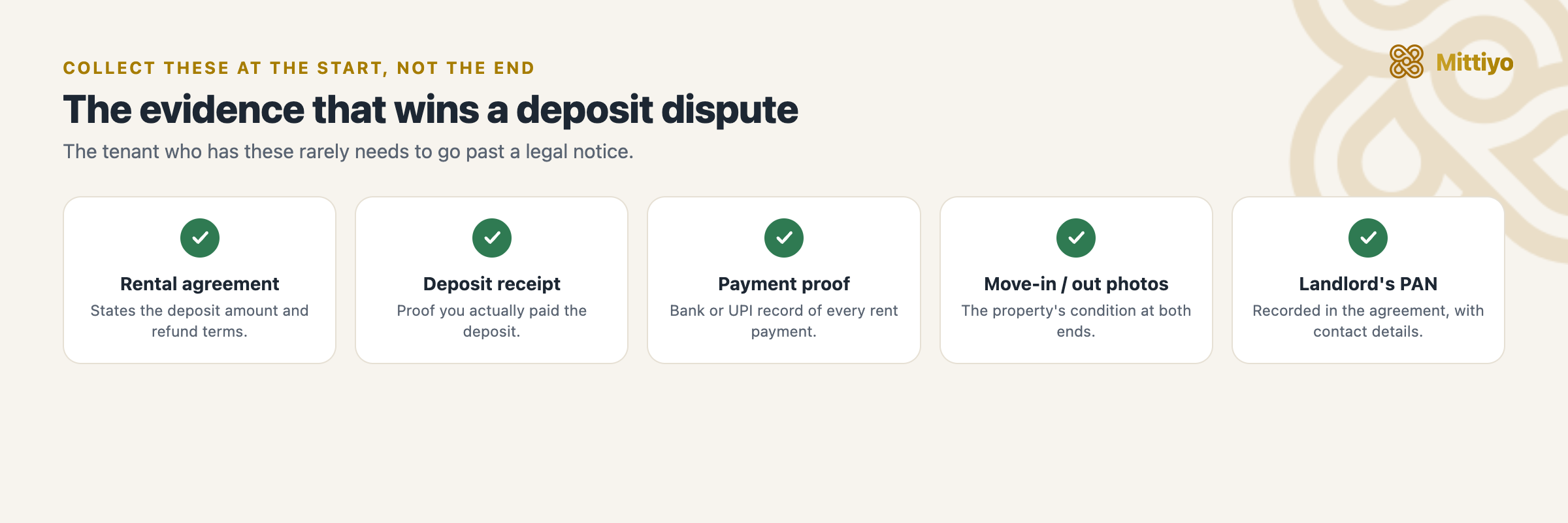 Collect these at the start of the tenancy, not the end. They are what turn a dispute your way.
Gather and keep:
- The rental agreement, stating the deposit amount and refund terms.
- The deposit receipt or bank record showing you paid it.
- Bank or UPI proof of every rent payment, so there is no dispute over dues.
- Move-in and move-out photos or video, ideally a joint inspection both times, so the property’s condition is documented at both ends.
- The landlord’s PAN and contact details, recorded in the agreement.
The tenant who has these rarely needs to go past a legal notice. The tenant who has none is at the landlord’s word.
Common mistakes to avoid
- Paying the deposit in cash with no receipt, leaving no proof you paid it.
- Skipping the move-out inspection, so the landlord can later claim damage you did not cause.
- Accepting vague deductions without asking for an itemised, written breakdown.
- Letting it slide. A deposit wrongly withheld is a recoverable claim; silence only helps the landlord.
- Not keeping rent-payment proof, which lets a landlord allege unpaid dues.
Key takeaways
- A security deposit is refundable in full, minus only genuine, documented deductions. It is not a fee.
- The Model Tenancy Act caps residential deposits at two months’ rent, but it applies only in states that have adopted it; elsewhere your agreement and local Rent Act govern.
- A landlord can deduct unpaid dues and real damage, not normal wear and tear or invented charges. Demand an itemised breakdown.
- Escalate in steps: joint inspection, written demand, legal notice, then the right forum (Rent Authority or Rent Court, the Consumer Commission via e-Daakhil, or a civil or small causes court).
- Evidence wins. Collect the agreement, deposit receipt, payment proof, and inspection photos at the start, not the end.
Choosing where to put down a deposit?
A clean deposit refund starts with a fair landlord and a well-run building. Before you sign, see what residents say about a building, its deposit terms, and how disputes actually go, on know.place, a map of honest, building-level rental experiences across India. Rented somewhere before? Add your own experience and help the next tenant.
Explore know.placeThis guide is general information, not legal advice. Tenancy law varies by state and your remedy depends on your facts; for a specific dispute, consult a qualified lawyer.
Related guides: Security deposit rules in Karnataka · What is a leave and license agreement · Moving to a new city: a relocation checklist
References
- The Model Tenancy Act, 2021, Ministry of Housing and Urban Affairs (deposit cap, Rent Authority, Rent Court, Rent Tribunal)
- The Model Tenancy Act, 2021, overview, PRS Legislative Research
- Consumer Protection Act, 2019 (deficiency in service), the e-Daakhil consumer-complaint portal, and the National Consumer Disputes Redressal Commission (filing is free for claims up to Rs 5,00,000 under the Consumer Disputes Redressal Commissions Rules, 2020)