

Bengaluru’s rental market is competitive, but it is not a take-it-or-leave-it market. Most landlords expect some degree of negotiation, and tenants who approach the conversation with preparation and data consistently secure better terms - not only on monthly rent but on deposits, escalation clauses, maintenance obligations, and exit conditions. This guide provides a structured, evidence-based approach to negotiating rent in Bengaluru.
Understanding the Bengaluru Rental Market
Before diving into tactics, it helps to understand the structural characteristics that make Bengaluru’s rental market distinct from other Indian cities.
Bengaluru is primarily a tenant-driven city. The IT and startup ecosystem generates a large floating population - professionals who relocate for employment and stay for two to five years on average. This creates high tenant turnover, which in turn has led to market practices that are unusual by Indian standards: 10-month security deposits (the highest among metros), relatively standardized 11-month Leave and License agreements, and a broker ecosystem that operates largely on a one-month-commission model.
However, these market norms are exactly that - norms, not legal mandates. Every one of these terms is negotiable, and understanding the legal baseline gives you leverage.
Under the Indian Contract Act, 1872, a rental agreement is a contract between two consenting parties. Section 10 requires free consent, lawful consideration, and competent parties, but imposes no mandatory terms on deposit amounts, escalation percentages, or lock-in periods. The Transfer of Property Act, 1882 governs leases and provides default rules (such as Section 106 on notice periods and Section 108 on rights and liabilities), but these defaults can be contractually modified by agreement between the parties.
This means that every term in a rental agreement - rent amount, deposit, escalation, maintenance, painting, lock-in - is a product of negotiation, not statute.
1. Research Before You Negotiate
The single most powerful tool in rental negotiation is comparable data. A negotiation grounded in market evidence is fundamentally different from one that is simply a request for a discount.
Gathering Comparable Data
Before you make an offer or respond to a quoted rent, invest time in systematic research:
Check 5-8 similar listings in the same locality and building tier. Note the asking rents for the same configuration (1BHK, 2BHK, etc.) with similar amenities (semi-furnished vs. unfurnished, Cauvery water vs. borewell, covered parking vs. open). Check the major rental listing portals - different platforms often carry different listings for the same area, giving you a broader sample. And because asking rents and what tenants actually pay often differ, see building-level experiences on know.place to anchor your offer to what residents really pay.
Ask current tenants in the building or complex what they pay. There is often a 10-20% variance between what a landlord quotes to a new prospect and what existing tenants actually pay. This is particularly true in large apartment complexes where units on lower floors or north-facing units command lower rents. Residents’ WhatsApp groups, if you can get added, are a goldmine of pricing information.
Track days-on-market for the specific property you are interested in. If a listing has been active for more than two weeks, the landlord is likely overpricing relative to the market. Every day of vacancy costs the landlord one day’s worth of rent that is permanently lost - unlike a slightly lower monthly rent, which is recoverable over time.
Understand the building’s vacancy rate. If multiple units in the same building are listed simultaneously, the landlord (or the building’s association, in the case of investor-heavy buildings) is under pressure to fill them. In newly constructed apartment complexes, this can be a significant source of leverage - developers and investors who have purchased multiple units may accept below-market rents to avoid carrying costs on vacant apartments.
Using Data in the Conversation
When you have specific data points, your negotiation has a factual foundation. Consider the difference between these two approaches:
- Weak: “Can you reduce the rent a little?”
- Strong: “I have seen three comparable 2BHKs in this locality listed between Rs 25,000 and Rs 28,000 - one in this same building, posted two weeks ago, at Rs 26,000. Given this, I would like to offer Rs 26,000 per month.”
The second approach is not adversarial; it is informational. It signals that you have done your homework and that your offer is grounded in reality.
2. Timing Matters Significantly
Bengaluru’s rental market has distinct seasonal patterns driven by the city’s employment cycles. Understanding these patterns lets you time your house-hunting for maximum leverage.
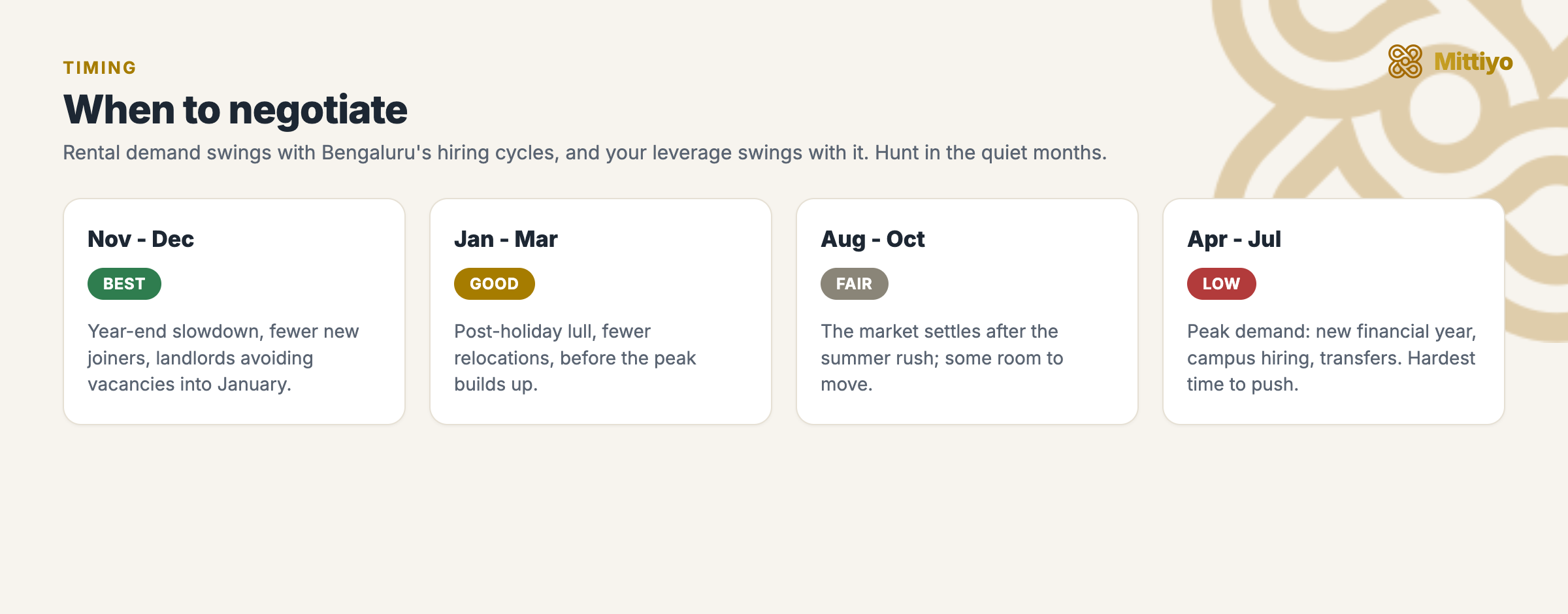 Negotiation leverage across Bengaluru’s rental year.
| Period | Market Condition | Negotiation Leverage | Why |
|---|---|---|---|
| January - March | Moderate demand | Good | Post-holiday lull; fewer relocations |
| April - July | Peak demand | Low | New financial year, campus hiring joins, transfer season |
| August - October | Moderate to high | Fair | Market stabilizes after peak |
| November - December | Lower demand | Best | Year-end slowdown, fewer new joiners |
The April-July window is the hardest time to negotiate. Fresh graduates joining IT companies, inter-city transfers driven by the new financial year, and returning NRIs all create a demand surge. Landlords in IT corridor areas (Whitefield, Sarjapur Road, Electronic City, Marathahalli, Bellandur) often receive multiple inquiries within days of listing.
The November-January window is the most tenant-friendly. Fewer people relocate during this period, holiday travel means some tenants give up their apartments, and landlords who need to re-let properties before the year-end want to avoid carrying vacancies into the new calendar year.
Beyond seasonal timing, pay attention to micro-timing within the month. Properties that become available mid-month (the 10th-20th) are often harder to fill because most tenants time their moves to coincide with month-end or month-start. A landlord whose property has been vacant since the 15th faces the prospect of losing nearly a full month’s rent, making them more amenable to negotiation around the 25th-30th.
3. Negotiate Beyond the Monthly Rent
Rent is only one component of your total housing cost. Sophisticated negotiation addresses all cost components, not just the headline number. In many cases, negotiating on non-rent items can save you more money than a monthly rent reduction.
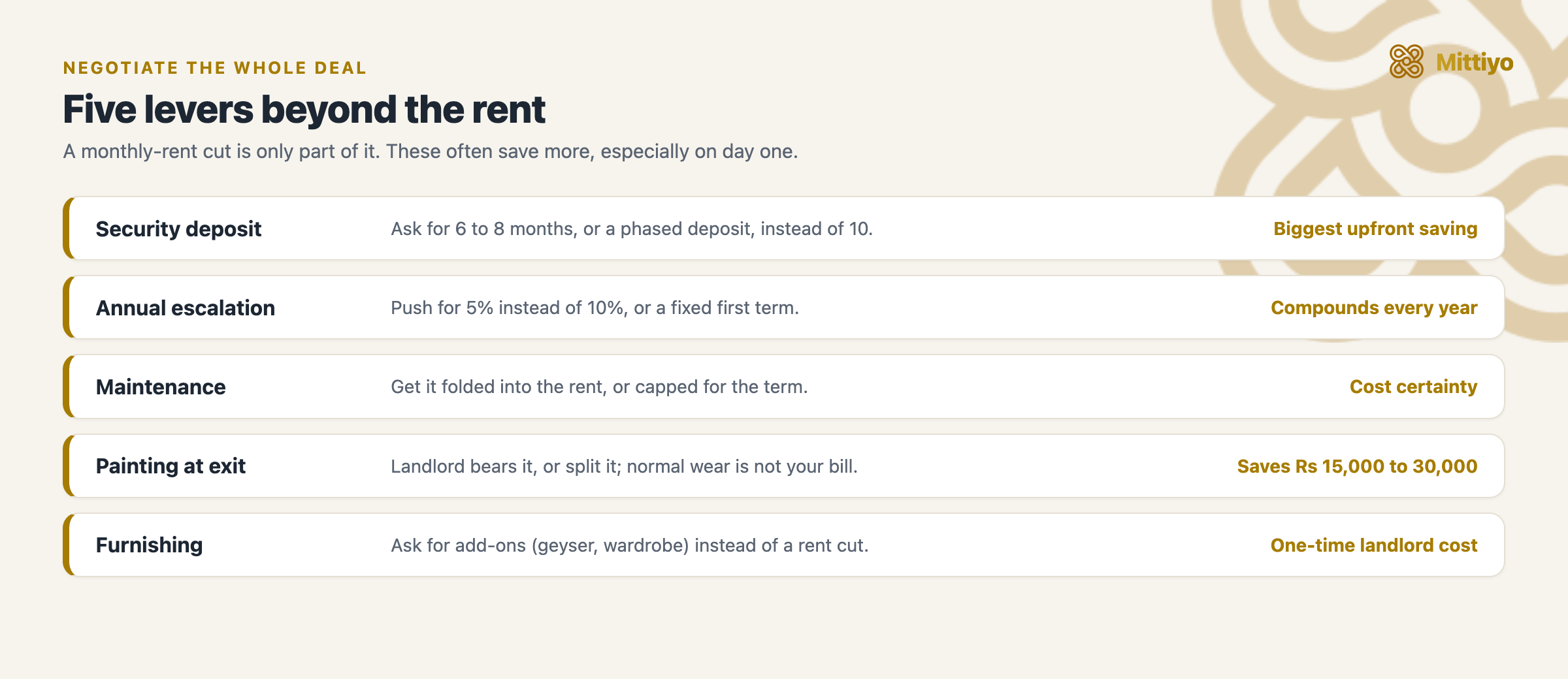 The levers that often save more than the rent itself.
Security Deposit
Bengaluru’s 10-month deposit norm has long been among the highest in India, and it is now being challenged by law. The Karnataka Rent (Amendment) Act, 2025, in force since January 2026, moves to cap residential security deposits (reported at two months’ rent) and to require agreements to be registered digitally on the Kaveri 2.0 portal. What is genuinely unsettled is how this applies to the standard 11-month leave-and-license agreement that most of Bengaluru uses: whether the two-month cap binds it, and whether such agreements must now be registered, are open questions in practice. Until that is clear, treat the 10-month norm as on its way out rather than a fixed rule, confirm the current position before you sign, and negotiate hard. (For what a landlord can actually deduct and how to get the deposit back, see our Karnataka security deposit guide.)
The financial impact of deposit negotiation is substantial. Consider: reducing a deposit from 10 months to 7 months on a Rs 30,000 apartment saves you Rs 90,000 in upfront cash. This is equivalent to a Rs 8,182 monthly rent reduction over an 11-month agreement - a figure far larger than most tenants achieve through rent negotiation alone.
Effective deposit negotiation strategies:
- Propose a middle ground: Offer 6-8 months instead of 10, with a clear rationale (employer backing, willingness to sign for a longer term)
- Phased deposit: Pay 6 months upfront and the balance in 2-3 monthly installments. This reduces the landlord’s perceived risk while easing your cash flow
- Link to lock-in period: Offer a longer lock-in (6 months instead of the typical 2-3) in exchange for a reduced deposit. The landlord trades a lower deposit for assured occupancy
- Cite the direction of the law: Point to the Karnataka Rent (Amendment) Act, 2025 and its move to cap residential deposits at two months. Even while its application to 11-month agreements is being worked out, the policy direction strengthens your case for a lower deposit
Rent Escalation Clause
The standard annual escalation clause in Bengaluru is 5-10%. Over a multi-year tenancy, this compounds significantly. A Rs 25,000 rent with 10% annual escalation becomes Rs 27,500 at first renewal and Rs 30,250 at the second - a 21% increase over three years.
Negotiate for:
- 5% annual escalation instead of 10% - this is widely accepted and saves you Rs 2,500-5,000 per month by the third year on a Rs 25,000 base rent
- Fixed rent for the first agreement term with escalation applying only at renewal
- Cap on escalation: Include a clause that escalation applies only if mutual agreement exists, or cap it at a specific percentage. Under Section 23 of the Indian Contract Act, 1872, a clause imposing an unconscionably high escalation rate (such as 20-30% per annum) could be challenged as having an unlawful object
Maintenance Charges
Clarify whether maintenance is included in the rent or billed separately. In large apartment complexes, maintenance charges can range from Rs 2,000 to Rs 8,000 per month depending on amenities (swimming pool, gym, clubhouse, 24/7 security). If maintenance is separate, ask about the exact monthly amount and whether it is subject to increase during your tenancy. Some landlords agree to absorb maintenance charges into the rent, giving you cost certainty.
Painting and Repairs at Exit
Many landlords include a clause requiring the tenant to repaint the apartment at exit. The cost of repainting a 2BHK in Bengaluru ranges from Rs 15,000 to Rs 30,000 depending on the apartment size and paint quality.
The legal position is nuanced. Section 108(m) of the Transfer of Property Act, 1882 requires the lessee to maintain the property in the condition received, accounting for changes caused by “reasonable wear and tear.” Normal fading or yellowing of paint over an 11-month period is unambiguously wear and tear, not damage. If the walls are not stained, holed, or damaged beyond normal use, the tenant has no legal obligation to repaint - regardless of what the agreement says.
Negotiate for one of these positions:
- The landlord bears repainting costs entirely
- Costs are split 50/50 between landlord and tenant
- The tenant pays for repainting only if the tenancy exceeds a specified duration (e.g., 2 years)
- No repainting required if walls are in the same condition as received, adjusted for normal wear
Furnishing and Fixtures
If the apartment is semi-furnished, the landlord may be willing to add specific items - a water purifier, curtain rods, a wardrobe, a washing machine stand - rather than reducing the rent. This costs the landlord a one-time amount (often Rs 5,000-15,000 for basic items) while saving you upfront setup costs. From the landlord’s perspective, these additions also make the property more attractive for future tenants.
4. Build Your Credibility as a Tenant
Landlords do not just evaluate your willingness to pay - they evaluate your risk as a tenant. Anything that reduces perceived risk strengthens your negotiating position.
Employment stability: Share your employer name and tenure. Tenants from established companies (large IT firms, MNCs, government organizations) or in stable roles represent lower risk. If you have been with the same employer for 2+ years, mention it. Some landlords will accept a lower deposit from tenants with verified employment at reputed firms.
Longer commitment: Offering to sign for 11 months with a documented intent to renew for 2-3 years gives the landlord confidence in consistent rental income. This is particularly effective because tenant turnover is costly for landlords - they face vacancy periods, broker commissions for re-letting, and the hassle of executing new agreements.
Clean track record: If you have a reference from a previous landlord in Bengaluru, volunteer it. It signals that you maintain properties well, pay rent on time, and do not cause disputes at exit. In a market where landlords routinely lose one to two months’ rent to vacancies between tenants, a reliable, long-term tenant is genuinely valuable.
Upfront payment readiness: Signaling that you can execute the agreement and pay the deposit immediately (or within a few days) is a meaningful negotiation lever. Landlords often have multiple prospects at different stages of commitment. A tenant who can close quickly - with a demand draft or NEFT ready - has an advantage over one who needs two more weeks to arrange funds.
5. Common Mistakes to Avoid
Starting too low. An unreasonably low opening offer can offend a landlord and end the conversation before it begins. An opening position that is 10-15% below the asking price is reasonable in most Bengaluru localities. Going below that without strong justification (comparable data showing the listing is overpriced, long vacancy period, property condition issues) appears unserious and may lead the landlord to refuse further engagement.
Negotiating after committing. Some tenants agree to a rent verbally, then try to renegotiate after the agreement draft is prepared. This damages trust and rarely works. Worse, it can lead the landlord to impose stricter terms (higher deposit, shorter notice period) to compensate for perceived unreliability. Make your negotiation before any verbal commitment.
Ignoring the broker’s role. If a broker is involved, understand that the broker is incentivized to close the deal quickly at the highest possible rent - the broker’s commission is typically one month’s rent, so a higher rent means higher commission. Consider engaging directly with the landlord for substantive negotiation on deposit and escalation terms, while keeping the broker informed. Under the Real Estate (Regulation and Development) Act, 2016 (RERA) and the Karnataka Real Estate (Regulation and Development) Rules, 2017, brokers must be registered, though enforcement in the rental segment remains inconsistent.
Focusing only on rent. A Rs 1,000 per month reduction saves Rs 11,000 over the agreement period. Reducing the security deposit by 2 months (on a Rs 25,000 rent) saves Rs 50,000 in upfront cash outlay. Negotiating escalation from 10% to 5% saves Rs 15,000+ per year from the second year onward. Deposit and escalation negotiation often have higher financial impact than rent negotiation alone.
Neglecting to document agreed terms. Verbal understandings reached during negotiation must be reflected in the written agreement. If the landlord agrees to bear painting costs, include it as a clause. If you agreed on a 5% escalation, ensure the agreement does not contain 10%. Section 92 of the Indian Evidence Act, 1872 (the parol evidence rule) generally prevents parties from introducing oral evidence to contradict a written contract. Once you sign the agreement, its terms - not your verbal discussions - govern the tenancy.
Not reading the agreement before signing. This sounds obvious but is remarkably common. Review every clause, not just rent and deposit. Look for penalty clauses, forfeiture provisions, unilateral termination rights, and blanket liability clauses that may disadvantage you.
6. Structuring Your Offer
Structure your proposal clearly and professionally:
- Acknowledge the property’s value: Start by noting what you like about the apartment. This is not flattery - it signals genuine interest and reduces the landlord’s concern that you are merely testing the market
- Present your comparable data: “Similar apartments in this area are available at Rs X. I have checked five listings in this micro-market.”
- State your offer: “I would like to offer Rs Y per month with a Z-month deposit, and a 5% annual escalation”
- Provide your rationale: Employment stability, willingness to commit long-term, readiness to move in quickly, references from previous landlord
- Identify your trade-offs: “I am flexible on the lock-in period - I can commit to 6 months if that helps with the deposit discussion”
- Be prepared to compromise: Negotiation is a two-way process. Identify your non-negotiables (maximum deposit you can pay, maximum rent you can afford) and your areas of flexibility (lock-in period, move-in date, minor furnishing requests) before the conversation
7. Legal Protections During Negotiation
While negotiation is primarily a commercial exercise, there are legal guardrails worth knowing:
Section 16 of the Indian Contract Act, 1872 defines “undue influence” - if a party in a dominant position uses that position to obtain an unconscionable advantage, the contract may be voidable. While this is rarely invoked in rental negotiations, it underscores the principle that grossly one-sided terms can be challenged.
Section 23 of the Indian Contract Act renders agreements with unlawful object or consideration void. A clause that imposes a penalty disproportionate to the actual loss (e.g., forfeiture of the entire 10-month deposit for breaking the lock-in by one day) may be struck down as unconscionable.
Section 74 of the Indian Contract Act limits damages for breach of contract. Even if a penalty clause specifies a fixed amount, the court will assess whether the amount is “reasonable compensation” for the breach. The Supreme Court in Fateh Chand v. Balkishan Das (AIR 1963 SC 1405) held that Section 74 applies to all stipulations by way of penalty and that the court must determine reasonable compensation regardless of the contractual amount specified.
Section 108 of the Transfer of Property Act, 1882 provides default rights and obligations for both parties. These apply unless the agreement explicitly modifies them. Knowing these defaults gives you a fallback position in negotiation - if the landlord pushes for terms that are worse than the statutory default, you can point to the Act.
Negotiate with the real numbers
The strongest negotiation is backed by data. know.place shows what residents of a specific building actually pay and live with, the rent, the deposit, the water and power reality, so you walk in with the real number, not just the asking price.
Explore know.placeFinal Note
Rental negotiation in Bengaluru works best when both parties feel they have reached a fair arrangement. The goal is not to extract the maximum possible concession but to establish terms that make the tenancy sustainable and dispute-free for both you and the landlord over the entire agreement period. A landlord who feels fairly treated is more likely to maintain the property, respond to repair requests promptly, and return your deposit without dispute at exit.
This guide is part of the Bengaluru Renter’s Handbook, our complete set of guides for moving in and settling down, from choosing a locality to the paperwork and utilities.
References
- Indian Contract Act, 1872 - Sections 10 (competent parties), 16 (undue influence), 23 (unlawful agreements), 73 (compensation for breach), 74 (penalty as the upper limit of compensation)
- Transfer of Property Act, 1882 - Sections 106 (notice-period defaults), 108 (rights and liabilities of lessor and lessee), 109 (rights of lessee on transfer of lessor’s interest)
- Bharatiya Sakshya Adhiniyam, 2023 (which replaced the Indian Evidence Act, 1872) - the parol-evidence rule (earlier Section 92 of the 1872 Act)
- Karnataka Rent Act, 1999, as amended by the Karnataka Rent (Amendment) Act, 2025 - fair rent, eviction, security deposit, and registration
- Model Tenancy Act, 2021 - security-deposit cap recommendation of 2 months
- Registration Act, 1908 - Section 17 (compulsory registration for leases exceeding 11 months)
- Real Estate (Regulation and Development) Act, 2016 and the Karnataka RERA Rules, 2017 - real-estate agent registration
- Fateh Chand v. Balkishan Das, AIR 1963 SC 1405 - Supreme Court ruling on Section 74 and reasonable compensation for breach of contract