
Rental scams work because renting puts you in a hurry. A good place at a good price feels like it will be gone tomorrow, and that urgency is exactly what a scammer sells. The US Federal Trade Commission reported that from 2020 to mid-2025, people lost around $65 million to rental scams, with a median loss of $1,000 per victim, and that people aged 18 to 29 were about three times more likely than older adults to be caught. About half of those scams started with a fake ad on a social-media marketplace.
The reassuring part: almost every rental scam depends on one thing, getting you to pay before you can verify anything. Learn the patterns and the payment red flags, and you can spot them in seconds. This guide walks through how the scams work, the checks that defeat them, and where to report one if you have been hit.
How rental scams work
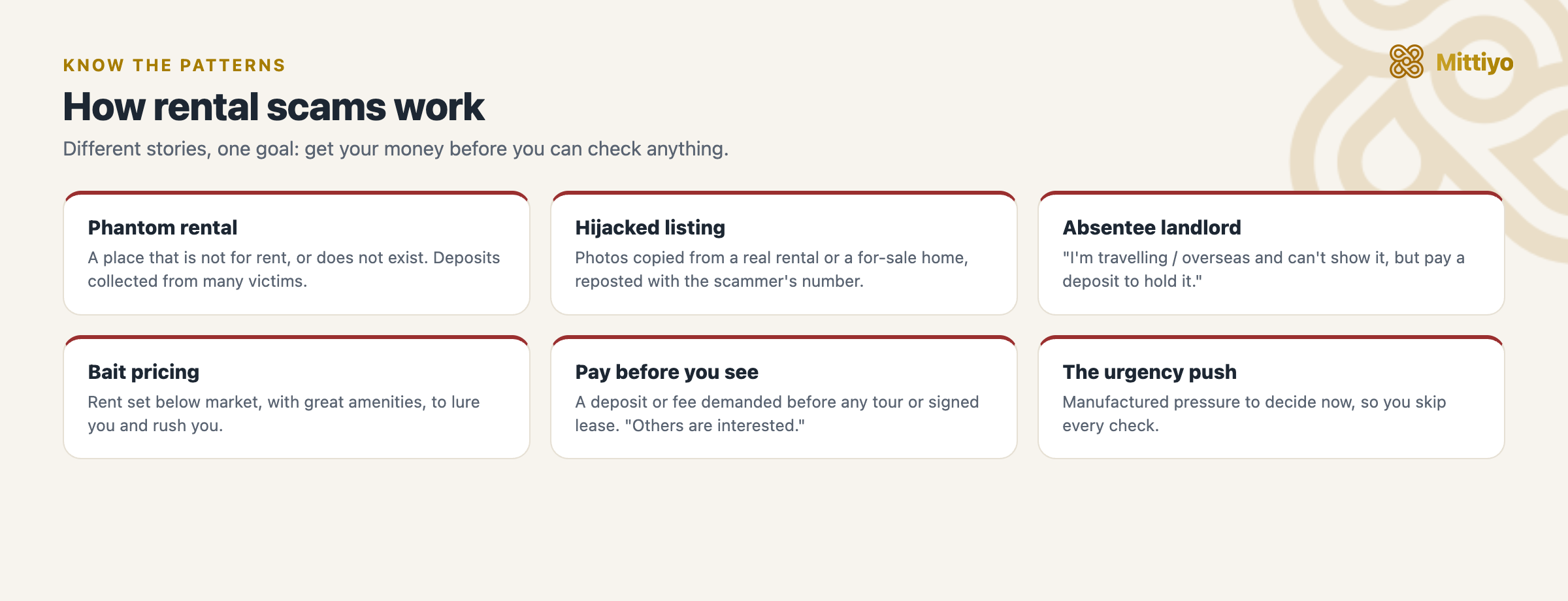 Different stories, one goal: get your money before you can check anything.
A handful of patterns cover most rental fraud:
- The phantom rental. A listing for a place that is not actually for rent, or does not exist at all. The scammer collects deposits from several victims for a property they have no connection to.
- The hijacked listing. Photos and details copied from a real rental, or from a home that is actually for sale, reposted with the scammer’s contact info. It looks real because it is real, just stolen.
- The absentee landlord. When you ask to see the place, the “owner” says they are travelling, overseas, or deployed, and so cannot show it, but they want a deposit to “hold” it.
- Bait pricing. Rent set conspicuously below the market, with great amenities, to lure you in and create urgency.
- Pay before you see or sign. Pressure to send a deposit or fee before touring the unit or signing a lease, wrapped in “others are interested, act now.”
Scam scripts are remarkably consistent. A typical one reads like this:
“Thanks for your interest. I have relocated abroad for work and took the keys with me, so I cannot show the flat in person. The apartment is in great condition and I want a responsible tenant. If you are serious, send the first month plus deposit to reserve it and I will courier the keys and the signed agreement. I have several other applicants, so please confirm today.”
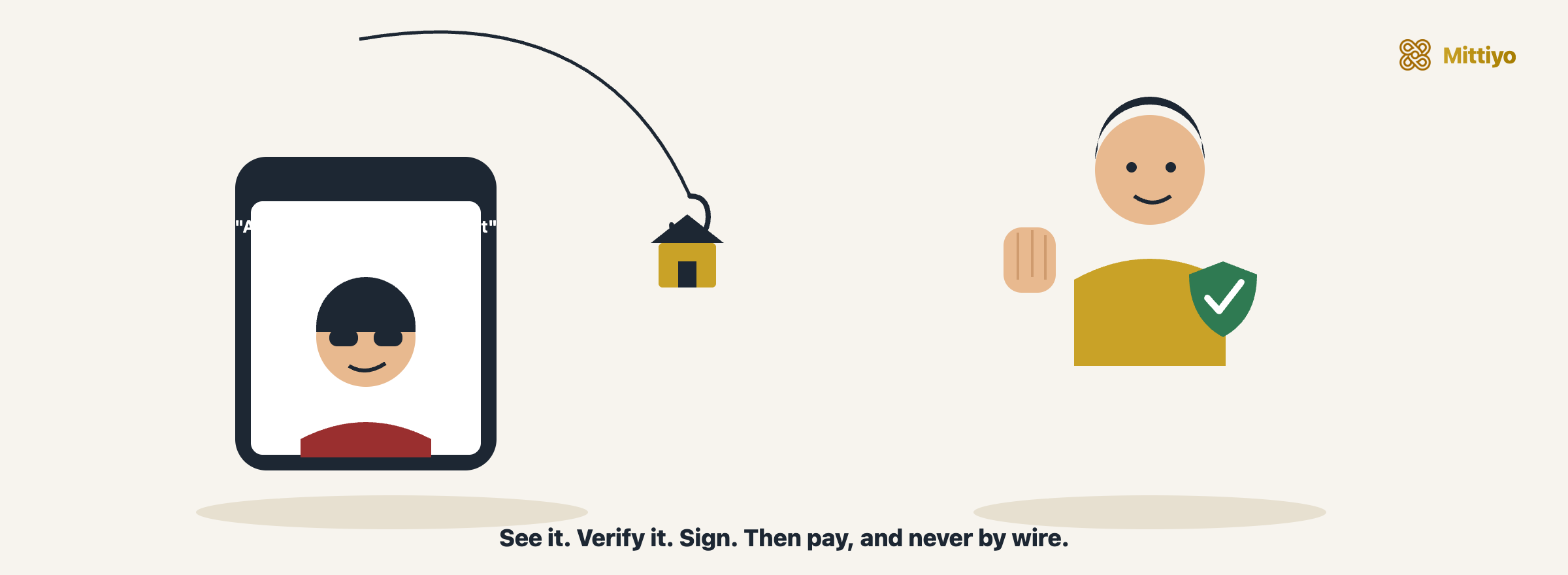
Every lever is here: an absentee owner who cannot show the place, a request to pay before you see it, urgency (“several other applicants”), and a promise to send keys and paperwork after you pay. A real landlord shows the property first and takes payment last. Reverse it, and it is a scam.
The payment red flags that define a scam
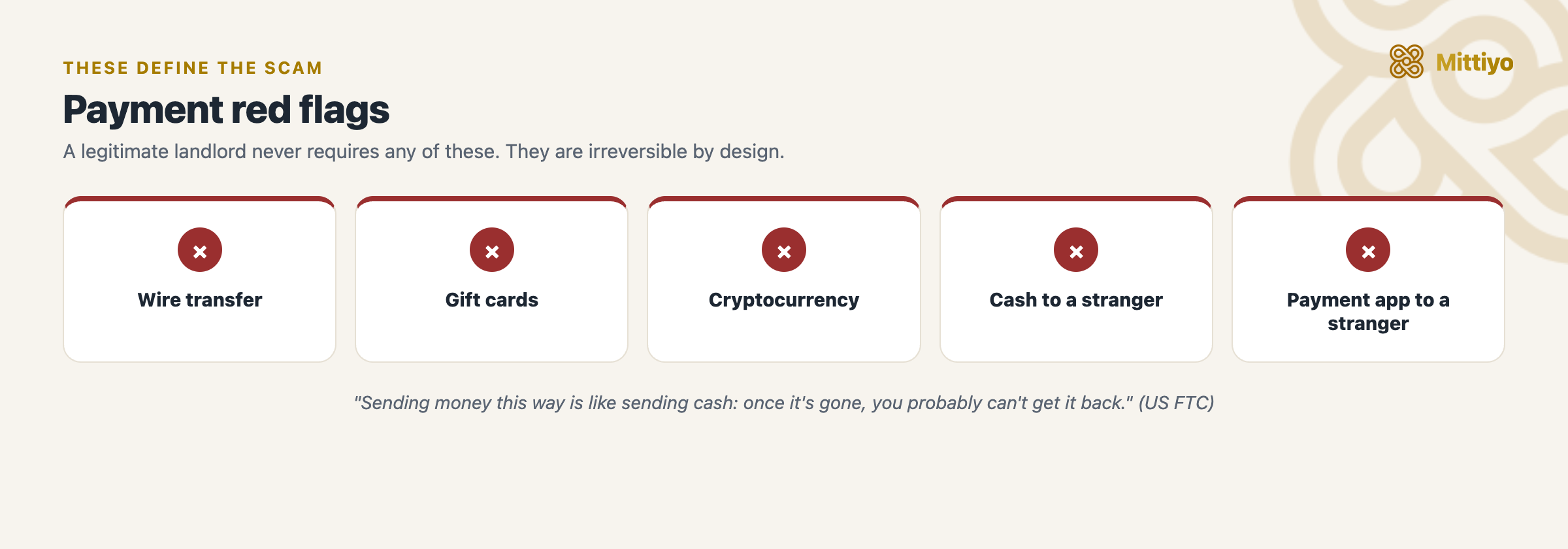 Legitimate landlords never require these. They are irreversible by design, which is why scammers ask for them.
Treat any of these payment requests as a stop sign:
- Wire transfer (bank wire, or services like Western Union or MoneyGram)
- Gift cards
- Cryptocurrency
- Cash
- Peer-to-peer payment apps sent to a stranger
In the FTC’s words, sending money this way is like sending cash: once it is gone, you probably cannot get it back. That irreversibility is the whole point. A real landlord or agent has no need for it. Where you can, pay by a method with fraud protection such as a credit card, and never pay anything before you have toured the unit and signed a lease.
The checks that defeat every version
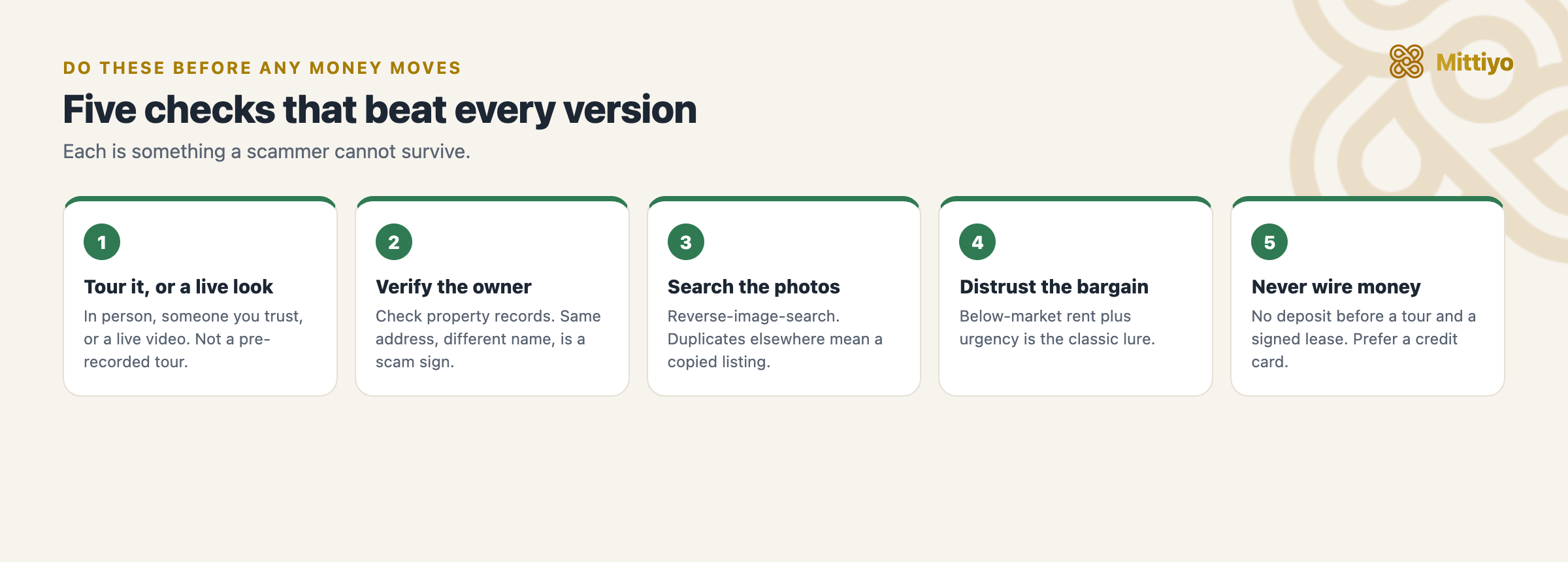 Do these before any money moves. Each one is something a scammer cannot survive.
- Tour it, or get a live look. See the property yourself, send someone you trust, or insist on a live video walkthrough. A pre-recorded tour can be stolen.
- Verify the owner independently. Check who actually owns the unit through public property records. If the same address appears in other ads under a different name or company, that is a scam sign.
- Reverse-image-search the photos. Duplicate photos under different owners, addresses, or prices mean the listing is copied or hijacked.
- Be skeptical of below-market rent and urgency. Too-good pricing plus “decide now” is the core lure.
- Never wire money, or send gift cards, crypto, or cash to someone you have not verified.
This one check unmasks most hijacked listings, and anyone can do it:
- Save the listing photos to your phone or computer (long-press or right-click, save image).
- Open a reverse-image-search tool in your browser, most major search engines have one built in, look for the small camera icon in the search bar.
- Upload each photo and look at where else it appears.
- Read the results. If the same interior shows up on other rental ads at different prices, on a property-for-sale page, or on a listing in a different city, the photos are stolen. Walk away.
Do the same with the “landlord’s” phone number and email, paste them into a search engine. Numbers and addresses tied to known scams often surface instantly.
The one rule
If you take away a single thing: never send money for a rental, no deposit, application fee, or first month’s rent, until you (or someone you trust) have seen the actual place in person or by live video and signed a lease. If you cannot tour it and you are being rushed to wire money, it is a scam.
If you have already paid
Move fast, and in this order:
- Contact your bank or card issuer immediately to try to stop or reverse the payment. Card and bank transfers may be recoverable; wire, gift-card, and crypto payments usually are not, so the same-day call matters.
- Report it to the right authority for where you are (see the table below).
- Keep all evidence, the listing, every message, and your payment records. Screenshots, not just links, because scam listings vanish fast.
Where to report a rental scam, by country
The scams look the same everywhere, but who you report them to differs. If your country is not listed, search for your national consumer-protection or cybercrime reporting body, most have an online form.
| Country | Where to report | Channel |
|---|---|---|
| United States | Federal Trade Commission; FBI Internet Crime Complaint Center | reportfraud.ftc.gov · ic3.gov |
| India | National Cyber Crime Reporting Portal (Ministry of Home Affairs); helpline 1930 | cybercrime.gov.in |
| United Kingdom | Action Fraud (police national reporting); phone 0300 123 2040 | actionfraud.police.uk |
| Canada | Canadian Anti-Fraud Centre | antifraudcentre-centreantifraude.ca |
| Australia | Scamwatch, National Anti-Scam Centre | scamwatch.gov.au/report-a-scam |
If you were scammed while looking for a place in India, our India-specific field guide walks through the local versions of these scams and how to check ownership here: how to spot rental scams and fake listings in India.
Key takeaways
- Rental scams run on paying before you can verify. Refuse that, and most of them collapse.
- Wire transfer, gift cards, crypto, and cash are the defining red flags. A real landlord never needs them.
- Tour the place, verify the owner in property records, and reverse-image-search the photos before paying.
- Below-market rent plus urgency is the classic lure, treat it as a reason to slow down.
- If you are hit, contact your bank and report to reportfraud.ftc.gov and ic3.gov right away.
The best scam check is talking to someone who already lives there.
Wherever you rent, know.place is building a map of honest, building-level rental experiences from real residents. Sanity-check a building and the people behind a listing before you send a single payment, or add an experience of your own building to warn the next tenant.
Explore know.placeRelated guides: Apartment viewing checklist · Questions to ask a landlord before you rent · Renting in India as a foreigner
References and reporting
- Rental listing scams and rental and housing scams, US Federal Trade Commission consumer advice
- Rental scams data spotlight (about $65 million in reported losses), Federal Trade Commission, December 2025
- Report fraud to the FTC and the FBI Internet Crime Complaint Center (IC3)
- National Cyber Crime Reporting Portal and helpline 1930, Ministry of Home Affairs, Government of India
- Action Fraud, UK national fraud and cybercrime reporting centre
- Canadian Anti-Fraud Centre, Government of Canada
- Scamwatch, National Anti-Scam Centre, Australian Competition and Consumer Commission