If you are a salaried tenant, two pieces of paper changed names on 1 April 2026. The form you give your employer to claim house rent allowance is no longer Form 12BB, it is Form 124. And if you pay rent above Rs 50,000 a month and deduct TDS on it, the challan-cum-statement is no longer Form 26QC, it is Form 141. Both come from the Income-tax Act, 2025, which the Income Tax Department says came into force on 1 April 2026.
The short answer: the substance of most tenant rules looks familiar, with the same Rs 1,00,000 landlord-PAN threshold and the same 2% rent TDS above Rs 50,000 a month, but the forms, rule numbers and section numbers are new, and one extra detail has appeared: Rule 205 asks you to state your relationship with the landlord, if any. This guide covers what we verified against the Department’s own pages and, just as important, what we could not confirm yet.
What Changed, and When
The Income Tax Department’s announcement states that the Income-tax Act, 2025 came into force on 1 April 2026, and the Income-tax Rules, 2026 were notified in March 2026 to put it into operation. Under it, the Department’s guidance treats tax year 2026-27, the year beginning on 1 April 2026, as the first year, and it uses “tax year” where the older law spoke of the previous year and financial year.
The Department’s pages on the 1961 Act, which it labels as the 1961 Act as amended by the Finance Act, 2026, continue to describe the rules for earlier years. So our earlier guides, which explain section 194-IB, Form 26QC and the 1961 section numbers, are accurate for FY 2025-26 and before. This guide is about the year you are in now.
| What | Under the 1961 Act (FY 2025-26 and earlier) | Under the 2025 Act (tax year 2026-27 on) |
|---|---|---|
| Employee’s claims statement to the employer | Form 12BB, under Rule 26C | Form 124, under section 392(5)(b) and Rule 205 |
| Rent TDS by an individual or HUF | Section 194-IB | Section 393(1), Table serial number 2(i) |
| Challan-cum-statement for rent TDS | Form 26QC | Form 141, Schedule A |
| Other PAN-based TDS statements | Forms 26QB, 26QD, 26QE | Also folded into Form 141, as other schedules |
| Landlord PAN threshold for HRA | Rent above Rs 1,00,000 in the year | Rent above Rs 1,00,000 in the tax year (Rule 205) |
| Relationship with landlord | Not listed in the Department’s summary of Rule 26C | “Relationship with the landlord, if any” (Rule 205) |
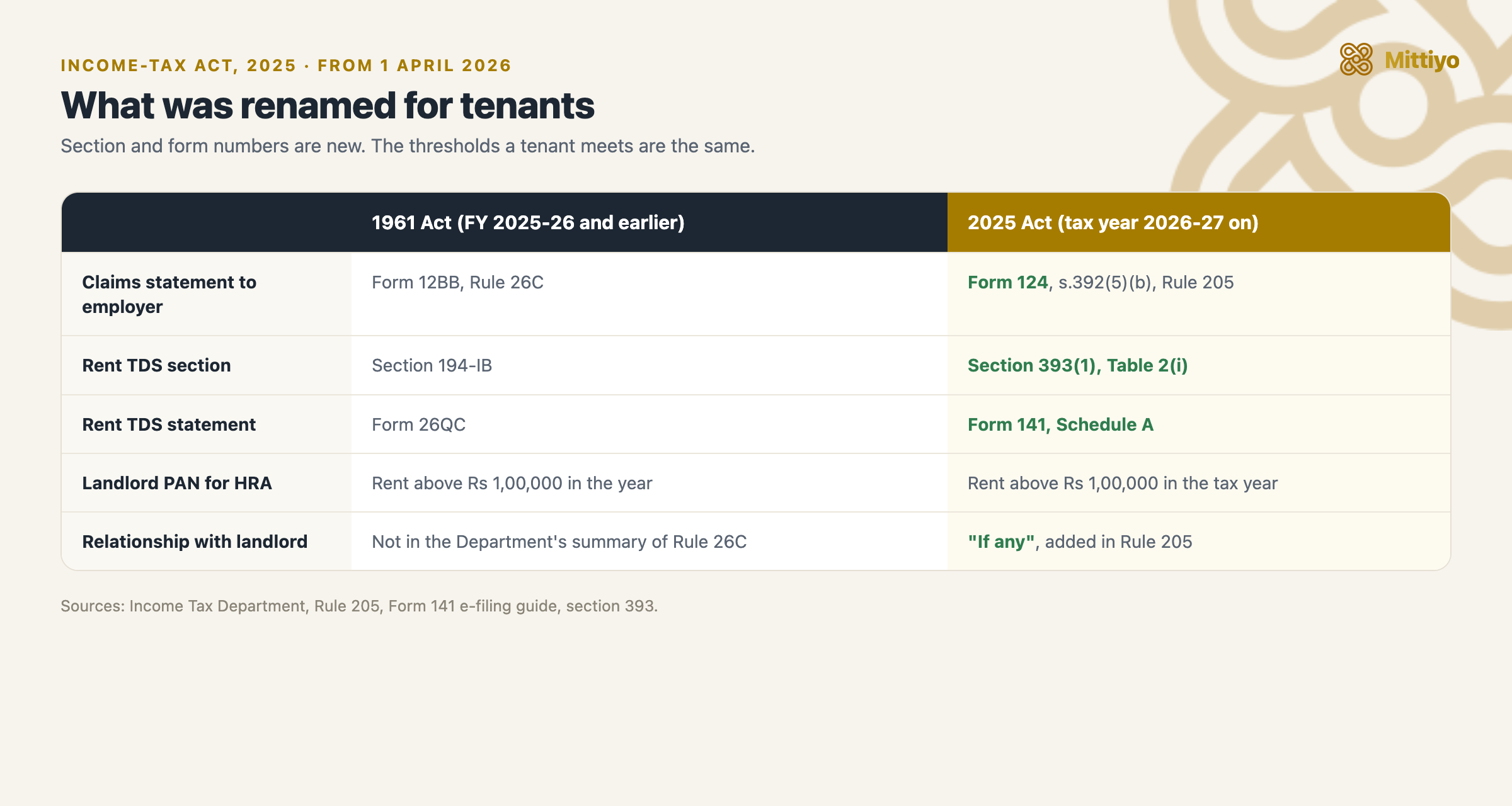 The renamed pieces. Section numbers and form numbers are new; the thresholds a tenant meets are the same.
If You Are a Salaried Tenant: Form 124
Form 124 is what you give your employer so that tax is deducted from your salary after taking your claims into account. The Department’s own description is that it is the statement showing particulars of claims by an employee for deduction of tax under section 392(5)(b) of the Income-tax Act, 2025. Rule 205 of the Income-tax Rules, 2026 says you furnish the evidence or particulars, in Form 124, to the person responsible for paying your salary.
For house rent allowance, Rule 205 lists:
- the name, address and PAN of the landlord or landlords, where the aggregate rent paid during the tax year exceeds Rs 1,00,000, and
- the relationship with the landlord, if any.
The same rule lists the other claims you might make on the form: leave travel concession (evidence of expenditure), deduction of interest under the head income from house property (name, address and PAN of the lender), and deductions under Chapter VIII (evidence of investment or expenditure).
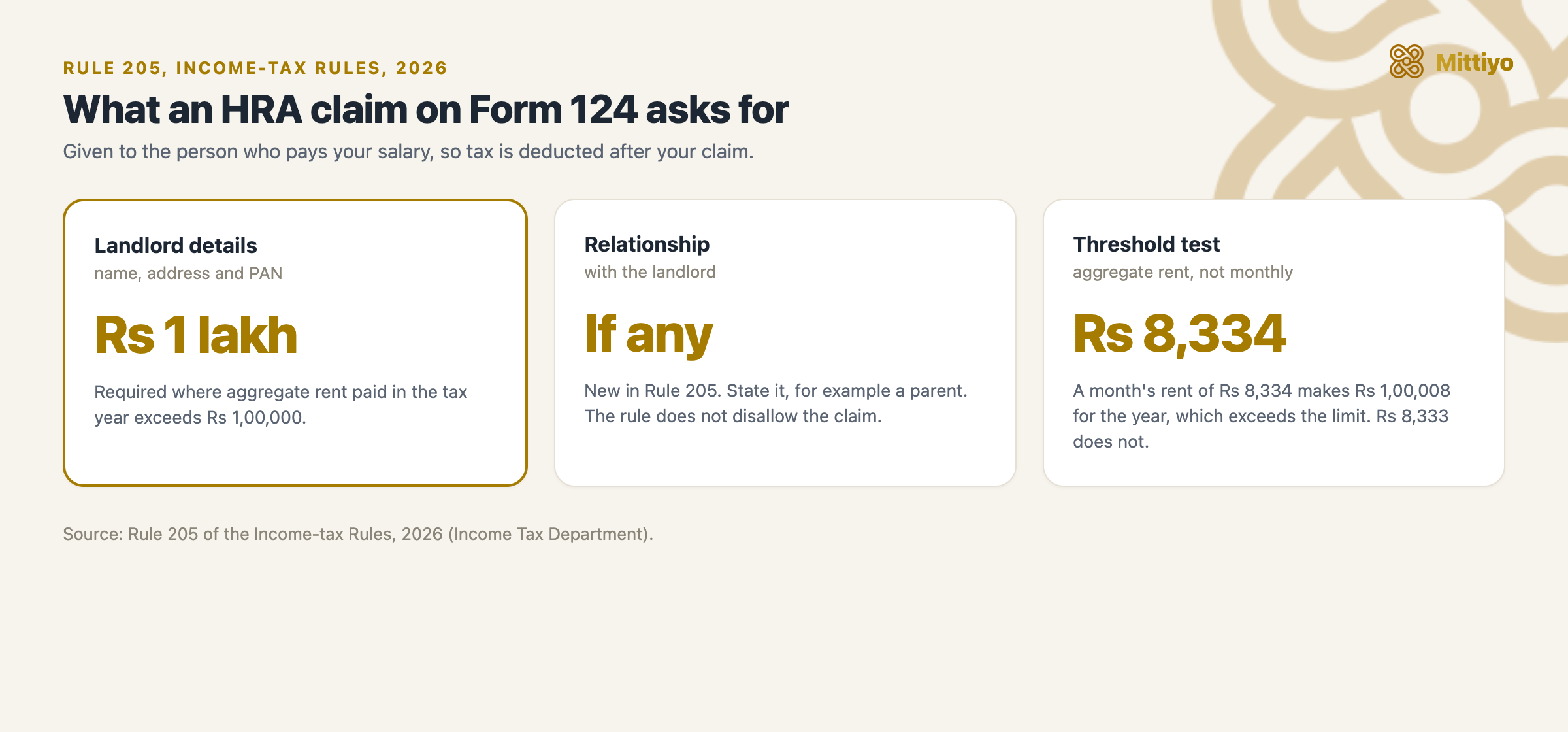 What Rule 205 asks for an HRA claim, in the Rules’ own terms.
How the Rs 1,00,000 line works
The threshold is the aggregate rent paid during the tax year, not the monthly rent. A few examples:
| Monthly rent | Rent for the tax year | Landlord PAN under Rule 205? |
|---|---|---|
| Rs 8,000 | Rs 96,000 | Not required by the rule |
| Rs 8,333 | Rs 99,996 | Not required by the rule |
| Rs 8,334 | Rs 1,00,008 | Required |
| Rs 20,000 | Rs 2,40,000 | Required |
If your rent changes mid-year, add up what you actually pay across the tax year. If you change flats, the aggregate is what you paid in total, and the rule refers to the landlord or landlords, so list each one.
Paying rent to a parent
The new relationship line means the relationship has to be stated. For many people this is simply “father” or “mother”. Nothing in Rule 205 says that a relative landlord disqualifies the claim. What happens in practice is governed by the facts and the paperwork, a real rent agreement, rent actually paid through traceable channels and the landlord declaring the income. Our HRA exemption guide covers that in detail.
If the landlord will not give a PAN
Rule 205 as written lists the PAN and no alternative. We have not found an official statement of what an employer should accept in its place under the new Rules, and we are not going to guess. The practical steps are to ask your payroll team in writing what it accepts, give them the landlord’s refusal in writing if there is one, and never invent or borrow a PAN: a wrong PAN on an employer filing creates a bigger problem than the one it solves.
What to gather before your employer asks
Employers set their own cut-off dates for these claims, and many collect them towards the end of the financial year, so check your payroll calendar rather than a general date. A sensible file contains:
- the landlord’s full name, address and PAN,
- a note of how you are related, if you are,
- the total rent you expect to pay in the tax year,
- your rent receipts, which you can generate with our rent receipt generator, and
- your rent agreement.
The last two are what employers commonly ask for in addition to what Rule 205 lists. See our guide to rent receipts for tax for the stamp and format rules.
If You Deduct TDS on Rent: Form 141
If you are an individual or HUF paying rent above Rs 50,000 a month, you were used to deducting 2% TDS and filing Form 26QC. Section 393(1), Table serial number 2(i), which the Form 141 guide ties to rent paid by an individual or HUF, sets a rate of 2% with a threshold of Rs 50,000 for a month or part of a month. It is worded as applying to a person other than a “specified person”; a separate entry, 2(ii), covers a specified person with different rates, and we have not covered that category here. For a tenant, the rate and threshold match what you were used to. What changes is the form.
The Department’s e-filing guide states that Form 141 consolidates the PAN-based TDS statements and replaces Forms 26QB, 26QC, 26QD and 26QE. It has four schedules, and Schedule A is TDS on rent paid by an individual or HUF, under section 393(1), Table serial number 2(i). Some practical points from that guide:
- Each Form 141 reports one type of transaction. You file a separate form for each category.
- Filed after login. You use your PAN login on the e-Filing portal, with an active PAN (the guide recommends that an individual’s PAN be linked to Aadhaar), and the payment is made through the e-Pay Tax route.
- Resident deductees only. Form 141 applies to payments to resident landlords. A non-resident landlord is a different case; see our NRI landlord guide.
- You choose why you are deducting. Schedule A asks whether the tax is being deducted because of the end of the tax year or the end of the tenancy.
- Co-tenants enter only their own share. If several tenants share the rent, you enter your proportion, and the landlords’ shares must total 100%.
Schedule A asks for the property type and address, the details of all tenants and all landlords, the period of tenancy in months, the total rent paid or credited in the tax year and the rent for the last month, and then, for each landlord, the PAN, the amount on which tax is deducted, the rate and the date of deduction.
A worked example: how the form splits shared rent
Shared flats are where the form is most different to fill in, so here is the Department’s own formula applied to numbers. In its guide, the amount on which tax is to be deducted for each landlord is the total rent, multiplied by your share as a tenant, multiplied by that landlord’s share of the rent.
Say you and a flatmate split the rent equally, and the flat has two co-owners who receive 60% and 40% of the rent. The total rent for the year is Rs 9,60,000. You are filing, so you enter only your own share:
| Landlord | Their share | Amount on which tax is deducted (you) | Tax at 2% |
|---|---|---|---|
| Landlord C | 60% | Rs 9,60,000 x 50% x 60% = Rs 2,88,000 | Rs 5,760 |
| Landlord D | 40% | Rs 9,60,000 x 50% x 40% = Rs 1,92,000 | Rs 3,840 |
| Total for you | 100% | Rs 4,80,000 | Rs 9,600 |
Your flatmate files their own Form 141 for their half. The landlords’ shares must total 100%, and each landlord’s PAN is entered row by row. This shows how the form computes the amounts, not whether tax is due in your case: whether your arrangement crosses the Rs 50,000 a month threshold, and who must deduct, are the questions our TDS on rent guide works through.
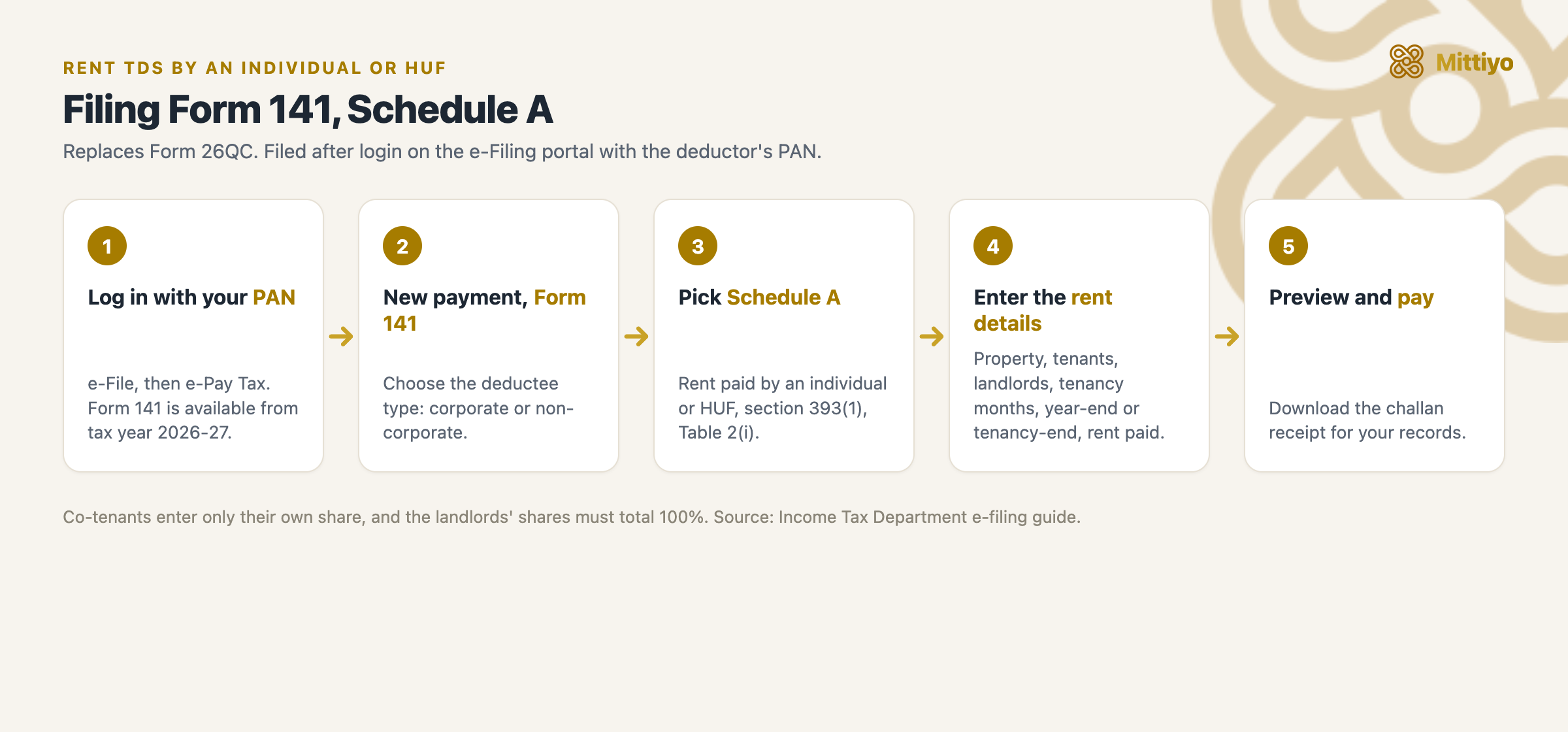 The Form 141 route for rent TDS, from the Department’s e-filing guide.
For the mechanics of working out the amount, who must deduct and what happens if you do not, see our TDS on rent guide. It is written for the 1961 Act and Form 26QC, so read it for the calculation and use the Form 141 route above for filing in the current year.
What We Could Not Confirm
A guide on a recent change is only as good as its sources, so here is where ours stop. We could not find, in the Department’s published material that we were able to read:
- The section number of the HRA exemption in the 2025 Act. The Department pages we found that mention the exemption cite section 10(13A), the 1961 Act’s numbering.
- An official statement on whether HRA remains limited to the old regime for tax year 2026-27. The regime guidance we read covers the 1961 Act.
- The due date for depositing the Form 141 tax and the form of TDS certificate under the new Act. The Form 141 guide we read does not state them.
- Who counts as a “specified person” under section 393. Table serial number 2(i) applies to a person other than one, and the Form 141 guide places individual and HUF rent there; we did not read the definition.
- What an employer should accept where a landlord has no PAN.
We will update this guide when we can confirm them. Until then, treat anything you read about them elsewhere, including in comparison tables from third-party sites, as unconfirmed, and check your employer’s payroll team and the Department’s pages for the current position.
Key Takeaways
- The Income-tax Act, 2025 came into force on 1 April 2026; tax year 2026-27 is the first year under it.
- Form 124 replaces Form 12BB for claims to your employer, under section 392(5)(b) and Rule 205 of the Income-tax Rules, 2026.
- For HRA, Rule 205 asks for the landlord’s name, address and PAN where aggregate rent in the tax year exceeds Rs 1,00,000, and your relationship with the landlord, if any.
- Form 141 replaces Form 26QC (and 26QB, 26QD, 26QE) for rent TDS. Rent paid by an individual or HUF is Schedule A, under section 393(1), Table serial number 2(i).
- Section 393(1), Table serial number 2(i), sets rent TDS at 2% above Rs 50,000 for a month or part of a month, the same figures as before for a tenant.
- Our earlier tax guides describe the 1961 Act and apply to FY 2025-26 and before; use this guide for the forms in the current year.
- Several details are not yet confirmed from official text. Check with payroll before relying on them.
Sorting your rent paperwork for the year?
Receipts, agreements and TDS are one side of renting. know.place maps honest, structured experiences of specific buildings, the rent, deposit, water and power, from people who have lived there.
Explore know.placeThis is general information, not tax advice. Rules, forms and due dates change, and your own situation may differ. Confirm the current position with your employer’s payroll team, the Income Tax Department’s pages, or a chartered accountant.
References
- Rule 205, Income-tax Rules, 2026: furnishing of evidence of claims by employee under section 392(5)(b) (Income Tax Department): the HRA row of the table, the Rs 1,00,000 aggregate-rent threshold and the relationship with the landlord.
- Form No. 124 (earlier Form No. 12BB) and its frequently asked questions (Income Tax Department): the form’s purpose and its legal basis in section 392(5)(b) of the Income-tax Act, 2025.
- Form 141 [Challan-cum-statement of TDS on transfer of property, VDA, rent payments, payments to contractors and professionals under section 393(1)] (e-Filing portal help): the replacement of Forms 26QB, 26QC, 26QD and 26QE, Schedule A for rent, and the fields it asks for. See also the Form 141 form and instructions.
- Income-tax Act, 2025 comes into force from 1st April, 2026 (Income Tax Department).
- Section 393, Income-tax Act, 2025 (Income Tax Department): Table serial number 2, rent, with the 2% rate and the Rs 50,000 a month threshold.
- TDS on Rent by Certain Individual or HUF (Income Tax Department): the Department’s description of rent TDS, which it labels as the 1961 Act as amended by the Finance Act, 2026. Used for the old-law column and the 2% and Rs 50,000 figures.
Official pages on incometaxindia.gov.in and incometax.gov.in sometimes block automated link checks. They are the Department’s canonical sources, and we read each of them directly in a browser.