Arriving in a new country for university is exciting and disorienting in equal measure, and finding somewhere to live is usually the first real test. As an international student in India, you have good options, but the process, the deposits, and the paperwork are different from what you are used to, and a few of the pitfalls, from very high deposits to scams that target students booking from abroad, are worth knowing before you land.
This guide covers the practical choices: where to live, the student-visa registration you must complete, the documents and money you will need, and how to stay safe while you settle in.
Where to live: hostel, PG, or flat
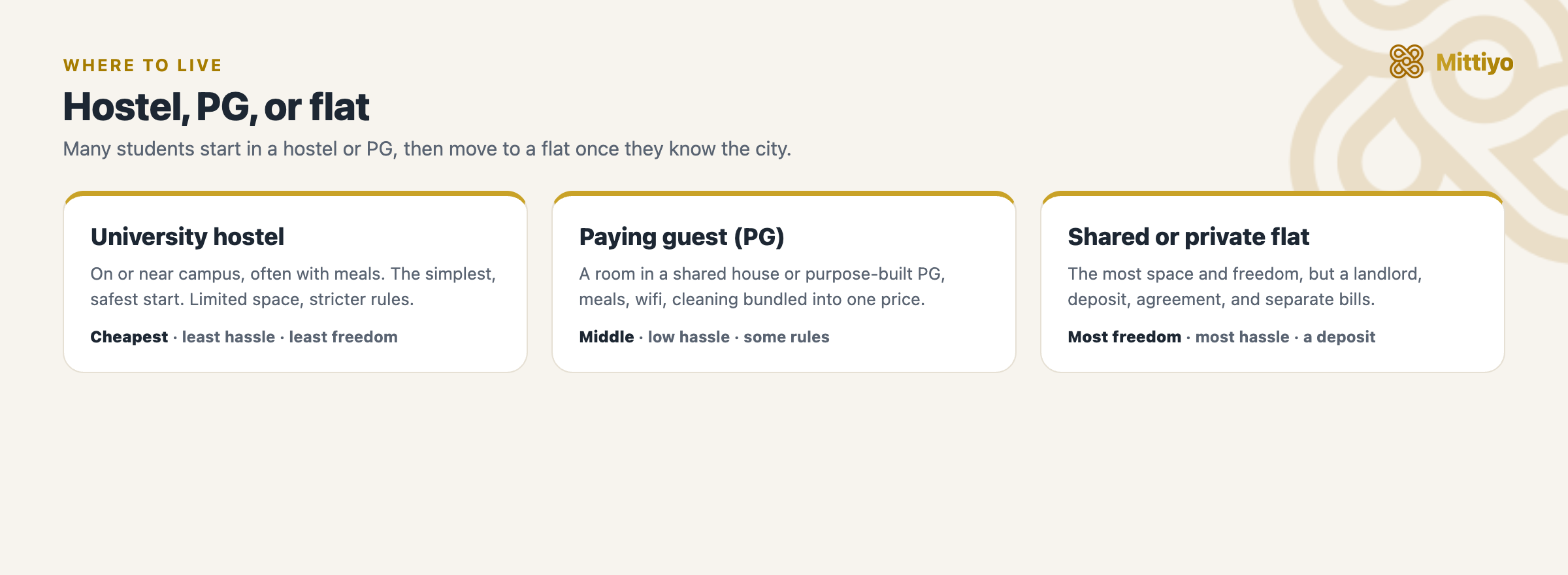 Many students start in a hostel or PG, then move to a flat once they know the city.
- University or college hostel. The simplest and safest place to start: on or near campus, often with meals, and few surprises. Space is limited and rules can be strict, but it removes deposits, agreements, and bills while you find your feet.
- Paying-guest (PG) accommodation. A room in a shared house or a purpose-built PG, usually with meals, wifi, and cleaning bundled into one monthly price. A popular middle path, less independence than a flat, far less hassle.
- A shared or private flat. The most space and freedom, but you deal with a landlord, a deposit, an agreement, and separate utility bills. Best once you know the city and have people to share with.
A common approach: book a hostel or PG for the first term (ideally something you can arrange safely from abroad), then move to a flat once you are on the ground and can view places in person.
“PG” is short for paying guest, and it is one of the most common ways young people rent in Indian cities, so you will hear the term constantly. In practice it is a room (private or shared) in a house or a purpose-built PG property, where you pay a single monthly amount that usually bundles the room, meals, wifi, cleaning, and sometimes laundry. That all-in simplicity is the appeal: no separate deposit-heavy lease, no utility bills to set up, no furniture to buy.
The trade-offs are less independence and more rules, many PGs have gender segregation, meal timings, guest restrictions, and curfews. Ask about the notice period and how much of any deposit is refundable before you move in, as PG terms are often informal and vary a lot.
The paperwork: FRRO registration and Form C
A student visa is generally a long-stay visa (over 180 days), which means you must register in person with the FRRO (Foreigners Regional Registration Office), usually within 14 days of arriving. Your university’s international office often helps, but the responsibility is yours, so start early. Separately, whoever houses you, a landlord or PG owner, must file a Form C reporting your stay. These are two different duties; the full detail is in the dedicated guide: FRRO and Form C for foreign tenants.
What you need, and what it costs
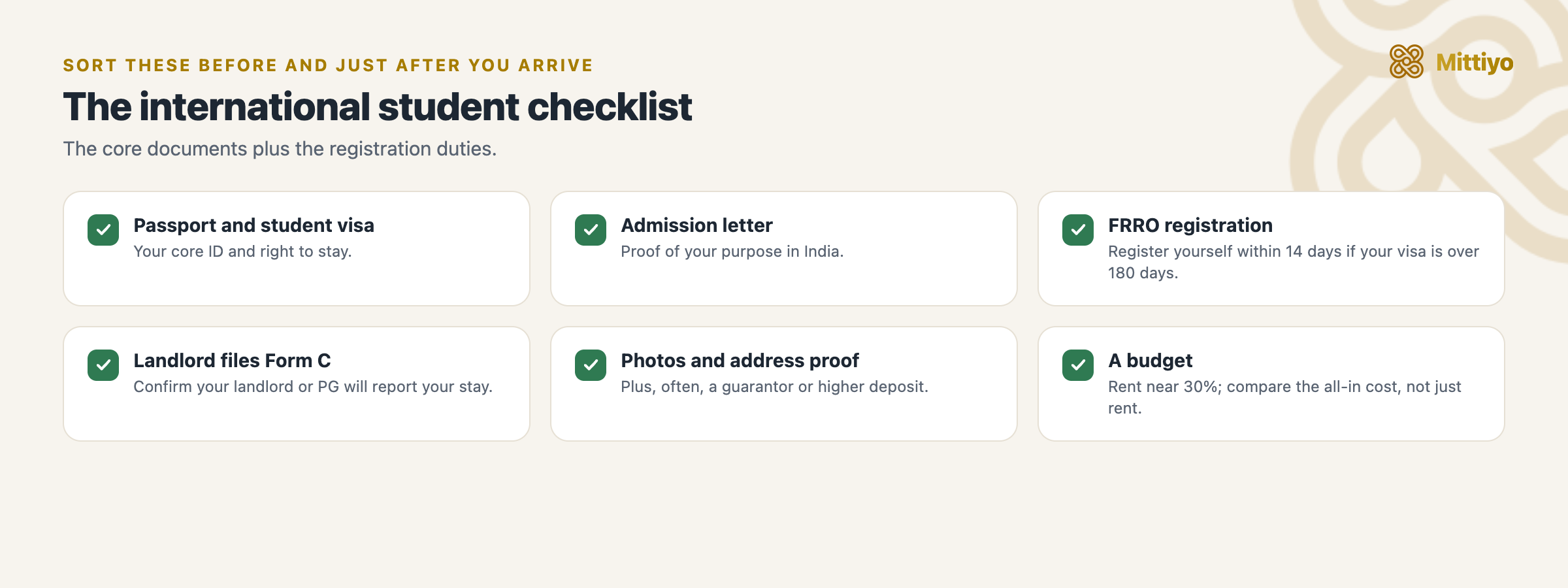 The core documents plus the registration duty. Sort these before and just after you arrive.
Documents. Your passport, student visa, and admission or enrolment letter are the core. Expect to also provide photographs, an address proof, and sometimes a local guarantor (often the university or a local contact) or a higher deposit, since you have no local rental history. You do not need a PAN card to rent.
A guarantor is a person who promises to cover the rent or damage if you cannot, giving a landlord confidence to rent to someone with no local rental history, which describes almost every arriving international student. If you default, the landlord can pursue your guarantor.
As a student, your realistic options are usually your university (some international offices act as an institutional guarantor or provide a letter), a local relative or family friend, or, if no guarantor is available, agreeing to a higher deposit or a few months’ rent in advance instead. Ask your university’s international office what they offer before you assume you need to find someone yourself.
Money. A hostel is usually cheapest; a PG bundles meals and wifi into one figure; a flat adds a deposit, utilities, internet, and maintenance. The big surprise is the security deposit on a private flat, which can run to several months’ rent, well beyond the one-month norm many students expect. Keep rent to roughly 30% of your monthly budget and compare the all-in cost, not just the headline rent. (See how much rent can you afford.)
Staying safe: students are a target
Scammers love international students, because you often book from abroad, sight unseen, and in a hurry before term starts. The classic trap is a cheap room or PG bed that asks for a booking deposit before you have seen it, to a personal account, for a place the “owner” does not actually control.
Protect yourself:
- Never pay a deposit for a place you have only seen online. Book a short, verified stay first if you must arrive before viewing.
- Verify the landlord or PG actually controls the property, and get a written agreement before any money moves.
- Be wary of below-market rooms and pressure to pay fast to “reserve” a bed.
- Pay only through traceable methods, never wire or send cash to a stranger.
(For the full playbook, see how to spot a rental scam.)
Key takeaways
- Start with a hostel or PG for safety and simplicity, then move to a flat once you know the city.
- A student visa usually means you must register with the FRRO within 14 days, and your landlord or PG must file Form C.
- Have your passport, student visa, and admission letter ready; expect a guarantor or higher deposit request.
- Deposits on private flats can be several months’ rent, budget for the all-in cost and keep rent near 30%.
- Never pay for a place sight unseen, students booking from abroad are a favourite scam target.
Choosing a neighbourhood you have never seen?
Arriving as a student, you have no idea which areas and buildings are safe, well-run, or good value. know.place is a map of honest, building-level rental experiences across India, where residents share what a place is really like, so you can choose with more than a listing to go on.
Explore know.placeThis guide is general information, not legal or immigration advice. FRRO rules vary by visa and nationality; verify your requirements on the e-FRRO portal or with your university’s international office.
Related guides: FRRO and Form C for foreign tenants · Renting in India as a foreigner · How to spot a rental scam · How much rent can you afford?
References
- Foreigners registration (FRRO), the 180-day rule and exemptions, Ministry of External Affairs
- e-FRRO portal and Form C, Bureau of Immigration
- The Model Tenancy Act, 2021, Ministry of Housing and Urban Affairs (deposit norms)