

Your deposit is your money. It is not a fee, and a landlord does not get to keep it because they feel like it. Yet withheld deposits are the single most common rental dispute in the US. The good news: the law is unusually favorable to tenants here, and most deposits get recovered without ever seeing a courtroom. Here is the process that works.
TL;DR: Look up your state’s return deadline (roughly 14 to 45 days). If it passed with no deposit and no itemized list, the landlord has likely already broken the rule that matters. Send a dated demand letter citing your state’s statute and its penalty, by certified mail. If that fails, small claims court is cheap, lawyer-free, and many states let you recover double or triple.
Step 0: know your state’s deadline (this decides everything)
Every step below turns on one fact: how long your state gives the landlord, and whether they also owe you an itemized list of deductions. The range is wide, roughly 14 to 45 days, and the penalties differ just as much.
- Look up your state in the security deposit laws by state hub (18 states covered, with the deadline, cap, interest rule, and penalty for each).
- Get the exact date with the deposit deadline tracker: pick your state and move-out date, and it returns the precise day the clock runs out.
Two things start that clock in many states: moving out and giving a forwarding address in writing. If you have not given a forwarding address, do it now, in writing, and keep a copy.
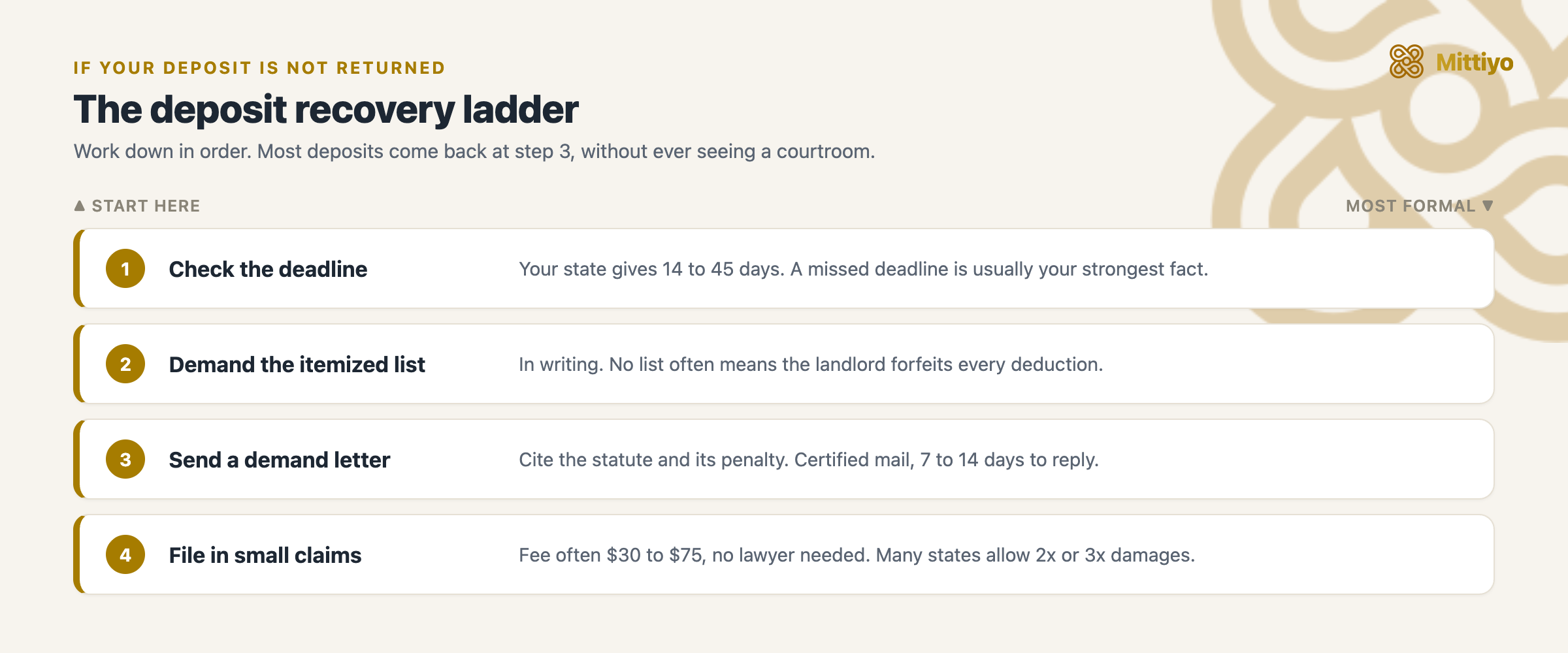
The four steps that get it back
1. Confirm the deadline has passed
If the deadline passed and you received neither the deposit nor a written itemized statement, the landlord is likely already in breach, and in many states that alone means they forfeit the right to keep any of it. That is the fact your whole case rests on, so pin down the date.
2. Ask for the itemized list in writing
If you got deductions but no breakdown, or a vague lump sum like “cleaning and repairs”, request an itemized written statement with amounts and reasons. Most states require one, and a lump sum usually does not meet the standard. If you got a list you disagree with, this is where your dated move-in and move-out photos do the work: they separate normal wear and tear from damage.
3. Send a demand letter (this is where most cases end)
A demand letter is short, factual, and unemotional, and it works more often than people expect, because a landlord who realises they missed a statutory deadline and now face a double or triple penalty would usually rather pay than go to court.
Include:
- Your name, the rental address, your move-out date, and the deposit amount.
- The date the deadline passed and that no deposit or itemized statement arrived.
- Your state’s statute by section, and the penalty it allows. This is the part that changes the landlord’s math.
- A clear demand for the amount, and a response window of 7 to 14 days.
- Your forwarding address, and a note that you will file in small claims otherwise.
Send it by certified mail with return receipt, so you can prove it was received, and keep a copy.
You do not have to draft it from scratch: the state-aware demand letter generator on the hub fills in your state’s deadline, statute reference, and penalty language, and every state guide has one too.
4. File in small claims court
If the letter goes unanswered, small claims is designed for exactly this: no lawyer needed, simplified procedure, a filing fee often around 30 to 75 dollars, and deposit cases are routine there. File in the county where the property is. Bring your lease, dated photos, the demand letter and its certified-mail receipt, any itemized statement, and a simple timeline of dates.
Each state guide in our cluster lists that state’s court name, dollar limit, and filing specifics.
What you can actually recover
More than the deposit, in many states. Depending on where you rent, a wrongful withholding can mean:
- The deposit or the balance you are owed.
- A penalty multiplier: commonly double or triple the amount, often keyed to bad faith or to missing the deadline. Massachusetts allows treble damages for several violations without needing to prove bad faith; Minnesota adds a penalty equal to the amount withheld plus up to 500 dollars for bad faith; Colorado allows up to three times for bad faith.
- Interest, where your state requires the deposit to earn it (see the deposit interest calculator).
- Court costs and attorney fees, in several states.
That multiplier is what changes the landlord’s math. A 1,500 dollar deposit is a nuisance to chase; a potential 4,500 dollar judgment plus fees is a reason for a landlord to settle the week your letter arrives.
Common excuses, and how to answer them
Most withheld-deposit disputes come down to the same handful of lines. Here is what each usually means and how to respond, in writing.
- “We had to repaint the whole flat.” Routine repainting after ordinary occupancy is usually normal wear and tear, and not a lawful deduction in most states. Ask what specific damage, beyond ordinary use, made it necessary.
- “Professional cleaning is standard.” In many states a landlord cannot charge a blanket cleaning fee if you left the place reasonably clean. Ask them to identify the actual condition being remedied.
- “The carpet needed replacing.” Carpet has a finite useful life and wears out on its own. Even where a stain is genuinely your fault, many states only allow the depreciated value, not a brand-new replacement charged to you.
- “I sent the itemized list.” Ask for a copy plus proof of when it was sent. If it went out after your state’s deadline, in many states it is too late and they forfeit the deductions.
- “I’m still getting quotes.” The deadline is the deadline. Most states do not pause it while a landlord shops around.
- “You broke the lease, so I’m keeping it.” Early termination and the deposit are separate questions. Any money you genuinely owe should be itemised against the deposit, not used as a reason to keep all of it without accounting.
- Silence. The most common response of all, and often the best fact for you: in many states, missing the deadline without a statement means forfeiting the right to deduct anything.
Answer each in writing, ask for specifics and documentation, and keep the tone factual. You are building the record you will show a judge.
If the landlord has moved, sold, or is a company
A few practical wrinkles:
- The property was sold. In many states the deposit and its obligations transfer to the new owner, and the outgoing landlord may remain liable if they failed to transfer it. Write to both.
- You cannot find them. Use the address on your lease, and check property records for the owner of record. Certified mail to the last known address usually satisfies the notice requirement even if unclaimed.
- It is a management company. Send the demand to both the company and the owner where you can identify them, and name the correct legal entity when you file.
- Multiple roommates. The deposit is usually a single sum; decide among yourselves who claims it, or file together. Do not let the landlord use disagreement between roommates as a reason to hold it.
Look up your state
Deadlines, caps, interest and penalties differ sharply. Start here:
Security deposit laws by state → covers Arizona, California, Colorado, Florida, Georgia, Illinois, Maryland, Massachusetts, Michigan, Minnesota, New Jersey, New York, North Carolina, Ohio, Pennsylvania, Texas, Virginia and Washington, each with the statute, the deadline, the penalty, and a ready demand letter.
Give yourself the best case, before you move out
- Photograph everything at move-in and again at move-out, dated, including inside cupboards and appliances.
- Complete any move-in condition checklist and keep your copy; some states require one.
- Give your forwarding address in writing, since it often starts the clock.
- Leave it clean and take meter readings; remove the easy excuses.
- Keep every receipt and message until the deposit lands.
This is general information, not legal advice; deposit rules, deadlines and penalties vary by state and change over time, so confirm the current rule for your state before acting. Last reviewed July 2026.
Related: Security deposit laws by state · Repairs and habitability · How to break a lease · Renters insurance explained
Free tools: Deposit deadline tracker · Deposit interest calculator · Notice to vacate generator · All free renter tools
Renting somewhere new?
know.place maps honest, structured experiences of specific buildings, the rent, deposit, water, and power, from people who have actually lived there, so you can vet a place before you sign.
References
- Consumer Financial Protection Bureau, help for renters: https://www.consumerfinance.gov/housing/housing-insecurity/help-for-renters/
- USA.gov, tenant rights and responsibilities: https://www.usa.gov/tenant-rights
- New York Attorney General, recovering security deposits and interest: https://ag.ny.gov/resources/individuals/tenants-homeowners/tenants/recovering-rent-security-deposits-and-interest
- Mass.gov, returning or getting back a security deposit: https://www.mass.gov/info-details/learn-about-returning-or-getting-back-a-security-deposit