Relocating to Bengaluru - whether from another Indian city or from abroad - involves more moving parts than most people anticipate. The city’s unique characteristics (an office-corridor-led housing market, water supply variability, traffic bottlenecks, and high upfront move-in costs) mean that preparation directly impacts how smoothly your move goes and how much money you spend in the process.
This checklist is organized chronologically: what to do before you arrive, during your first week, and in the weeks that follow. It covers housing search, utilities, transport, local documentation, daily life setup, and financial planning.
Phase 1: Before You Arrive (2-4 Weeks Prior)
Housing Research
- Identify 3-4 target localities based on your office location and commute preferences. Bengaluru’s traffic means commute distance matters far more than it does in most Indian cities. A 5 km commute can take 15 minutes off-peak or 60+ minutes during rush hour. Prioritize proximity to your workplace
- Research average rents for your preferred configuration (1BHK, 2BHK, etc.) in those areas. Cross-reference the major rental listing portals for asking prices, and check know.place for honest, building-level experiences of what residents actually pay and live with (and add your own once you have moved in). Rents vary significantly even within a single locality based on building age, floor, and amenities
- Budget for security deposit - Bengaluru’s market practice has long been around 10 months’ rent, the highest among Indian metros. On a Rs 25,000/month 2BHK, that is Rs 2,50,000 upfront. The Karnataka Rent (Amendment) Act 2025 (in force from January 2026) caps residential security deposits at two months’ rent. How it applies to the standard 11-month leave-and-license arrangement is still being tested in practice, so many landlords still ask for higher amounts, treat the figure as negotiable and budget for a realistic upfront sum while the position settles
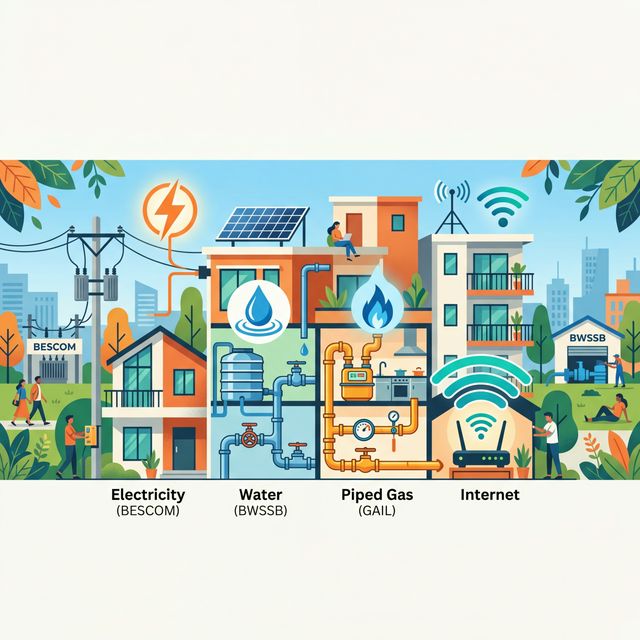
- Research water supply in your target localities. This is Bengaluru-specific and critical. Areas with BWSSB Cauvery water connection have reliable piped supply. Areas dependent on borewells or tanker water are significantly less convenient and can be expensive (tanker water costs Rs 500-1,200 per load). BWSSB coverage maps are available on the BWSSB website (bwssb.gov.in)
- Plan a house-hunting trip 1-2 weeks before your move date, if possible. Viewing apartments in person is far more reliable than photos. Aim to visit 8-10 properties over 2-3 days
- Consider temporary accommodation for the first 2-4 weeks while you search. Options include paying guest (PG) accommodations (Rs 8,000-15,000/month in most areas), co-living spaces (typically Rs 10,000-20,000/month), or serviced apartments (Rs 1,500-4,000/day). Making housing decisions under time pressure leads to overpaying or accepting unsuitable apartments
Documents to Gather and Carry
- Original Aadhaar card (or enrollment acknowledgment if you are updating your address). You will need this for local KYC, utilities, police verification, and banking
- PAN card - required for banking, tax records, and TDS compliance if your rent exceeds Rs 50,000/month under Section 194-IB of the Income Tax Act, 1961
- Passport (essential if relocating from abroad; also useful as an additional photo ID domestically)
- Passport-sized photographs - carry at least 15 copies. You will need them for police verification, BESCOM transfer, gas connection, bank account, metro smart card, and more
- Previous landlord reference if available, especially if you are moving from another metro
- Employer offer letter or joining letter on company letterhead - landlords in Bengaluru often ask for this, especially for high-deposit apartments. It serves as proof of income and employment stability
- Latest 3 months’ bank statements (some landlords request this to verify your ability to pay the deposit and ongoing rent)
- Vehicle documents (if bringing a vehicle from another state): RC, insurance, pollution certificate. You will need these for RTO transfer
Employer Coordination
- Get your joining date confirmed and request a joining letter on company letterhead. This letter is useful for renting, banking, and police verification
- Ask about relocation assistance - many Bengaluru IT companies offer temporary housing (1-2 weeks), broker contacts, relocation allowances (Rs 20,000-1,00,000 depending on the company and role), or corporate housing tie-ups
- Check for corporate housing programs - some companies have tie-ups with specific apartment complexes or co-living spaces that offer reduced deposits (3-5 months instead of 10) or waived brokerage
- Clarify HRA structure - understand your House Rent Allowance component for tax planning. Under Section 10(13A) of the Income Tax Act, HRA exemption calculation for Bengaluru uses the metro city formula (50% of basic salary as the maximum HRA exemption)
Logistics Planning
- Book packers and movers at least 2 weeks in advance. Get quotes from 3-4 providers. For inter-city moves, costs typically range from Rs 15,000 (1BHK, within South India) to Rs 60,000+ (3BHK, cross-country). Verify the company’s insurance coverage for damage during transit
- Arrange interim storage if your move-in date does not align with your arrival date. Several packers and movers offer warehouse storage at Rs 2,000-5,000 per month
- Notify your current utility providers (electricity, gas, internet) about disconnection - ensure final bills are settled and deposits refunded
- Set up mail forwarding with India Post if you receive physical mail at your current address (Speed Post redirection service is available for Rs 60 per month)
Phase 2: First Week in Bengaluru
Securing Housing
- Visit at least 8-10 properties before making a decision - photos often misrepresent apartment condition, especially regarding natural light, ventilation, and neighbourhood noise
- Check water supply at every property you visit: Is it Cauvery (BWSSB) or borewell? What is the water pressure like? Is there a sump and overhead tank? What is the backup arrangement during summer shortages? (Bengaluru faces acute water stress from March to May annually)
- Verify electricity meter reading and ask to see the last 3 months’ BESCOM bills. This tells you both the consumption pattern and whether there are any pending dues that should be cleared before you take possession
- Check mobile network coverage in the apartment - not just in the building compound. Some interior apartments in Bengaluru have poor network coverage, particularly for certain carriers
- Ask neighbors about the building’s maintenance quality, water reliability, power backup coverage (does the generator cover all apartments or only common areas?), and any known issues (pest problems, parking disputes, construction noise from nearby sites)
- Confirm all commercial terms in writing before paying the deposit: monthly rent, deposit amount, maintenance charges, parking, notice period, move-in date, repainting expectations, and included appliances
- Keep payment records for every transfer. Use bank transfer or UPI wherever possible and save receipts for deposit, rent, brokerage, and maintenance payments
- Conduct a joint inspection of the property before taking possession. Document the condition of every room, fixture, and appliance with date-stamped photographs. This documentation is your primary evidence if there is a deposit dispute at exit
Immediate Utility Setup
- Electricity (BESCOM): Note the meter reading on move-in day and check the last 2-3 bills for pending dues. Visit the local BESCOM office or use the BESCOM portal for transfer or billing changes where applicable
- Water (BWSSB): If the building has a Cauvery connection, check whether the connection is individual-metered or collective. For individual connections, transfer to your name through the BWSSB office (bwssb.gov.in). Many apartment complexes handle water billing collectively through maintenance charges
- Internet broadband: Order a connection immediately upon deciding your apartment - installation can take 3-7 days depending on the ISP and whether fiber infrastructure already exists in the building. Top ISPs by coverage: ACT Fibernet (strongest coverage in most Bengaluru localities), Airtel Xstream Fiber, Jio Fiber. Ask existing tenants in the building which ISP works best - coverage quality is hyper-local
- Piped gas: If available in your building (GAIL or Adani Total Gas), apply for a connection transfer. If not, book a new LPG cylinder through the distributor network: Indane (Indian Oil), Bharat Gas (BPCL), or HP Gas (Hindustan Petroleum). New connection requires a KYC form, Aadhaar, and a Rs 1,600-2,200 refundable deposit for the cylinder
- Mobile: If you do not already have a number, get one. Jio, Airtel, and Vi all offer quick e-KYC-based activation at local stores. If you already have a number from another circle, check coverage at your new address - switching to a Bengaluru-circle number may improve local service quality
Phase 3: First Two Weeks - Legal Registrations
Police Verification (Mandatory)
Police verification is mandatory for all tenants in Bengaluru. Both the landlord and tenant must submit verification forms. Failure to complete police verification can result in action under the Karnataka Police Act, 1963 and the relevant rules framed thereunder.
- Submit Form D at the nearest police station or online via the Karnataka State Police portal (ksp.karnataka.gov.in). Some police stations also accept submissions through the Suraksha app
- Documents required: Photo ID, local address proof, passport photos, landlord or property contact details, and in some stations, a copy of the employer joining letter
- Processing time: 2-3 weeks for domestic tenants. For foreign nationals, the verification process may take longer and involves additional documentation (passport, visa, FRRO registration)
- Verification visit: A police constable will visit your apartment to verify occupancy. Ensure someone is available during the visit
Other Government Registrations
- Aadhaar address update: If you want your Aadhaar to reflect your Bengaluru address, initiate the update online at UIDAI or at the nearest Aadhaar enrollment center using an accepted proof of address. A Bengaluru address on your Aadhaar simplifies future KYC processes
- Voter ID update (optional but recommended): Apply for address transfer via the NVSP portal (voters.eci.gov.in). You will need Form 6 (for new registration) or Form 8A (for address correction/transfer). Processing time varies: 15-45 days depending on the ERO’s schedule
- Driving license address update (if you hold an Indian DL): Apply at the nearest RTO or through the Parivahan portal (parivahan.gov.in). If you hold a DL from another state and plan to drive in Karnataka long-term, consider transferring it to the Karnataka RTO
- Vehicle RC transfer (if bringing a vehicle from another state): Under Rule 54 of the Central Motor Vehicles Rules, 1989, you must intimate the registering authority of both the old and new state within 12 months of the address change. The Karnataka RTO fee varies: Rs 2,000-5,000 depending on vehicle type. You will also need a valid insurance certificate, pollution certificate, and NOC from the original RTO
Phase 4: Transport Setup
Daily Commute Options
- Namma Metro: Get a Metro smart card at any metro station (Rs 50 deposit + recharge). The Green Line (north-south) and Purple Line (east-west) cover major corridors including Majestic, MG Road, Indiranagar, Whitefield, and Peenya. The smart card saves time versus buying single journey tokens daily and offers a small discount per ride
- BMTC Bus Pass: If your commute involves buses, a monthly pass (Vayu Vajra for airport, Volvo for AC routes) offers significant savings over daily tickets. The TUTI app (BMTC’s official app) provides route information and live bus tracking on some routes
- Two-wheeler/Car in Bengaluru: If you are bringing a vehicle from another state, initiate the RC transfer at the RTO within 12 months. If purchasing a vehicle locally, factor in insurance, fuel costs, and the reality of Bengaluru traffic - a two-wheeler is significantly more practical than a car for daily commuting in most parts of the city
- Ride-hailing apps: Download Namma Yatri (autorickshaws - typically cheapest and most reliable for short distances), Ola, Uber, and Rapido (bike taxis - fastest in traffic). Coverage and pricing vary by locality and time of day. Namma Yatri uses open pricing (driver sets the fare) without the surge pricing common on Ola and Uber
Commute Optimization
- Map your daily commute at different times of day. A route that takes 20 minutes at 7 AM may take 60 minutes at 9 AM. Many Bengaluru professionals adjust their work hours to avoid peak traffic (arriving by 8 AM and leaving by 5 PM, or arriving at 10:30 AM and leaving at 7:30 PM)
- Identify alternate routes - Google Maps and Apple Maps both offer real-time traffic data for Bengaluru, but neither accounts for the inner roads that experienced commuters use to avoid main road bottlenecks. Ask colleagues who live in your area for route tips
- Consider proximity over everything: The difference between a 3 km commute and a 10 km commute in Bengaluru can be 15 minutes versus 75 minutes during peak hours. In terms of annual time savings, living closer to work (even at a slightly higher rent) often represents a better financial decision than a cheaper apartment with a long commute
Phase 5: Settling In (Weeks 3-6)
Daily Life Setup
- Identify your nearest essentials:
- Grocery store / supermarket (D-Mart, More, Reliance Fresh, BigBasket warehouse, local kirana stores)
- Medical store / pharmacy (MedPlus, Apollo Pharmacy, or local options)
- Clinic or hospital (identify both a nearby clinic for routine needs and the nearest major hospital for emergencies)
- Laundry / dry cleaning service (most localities have multiple options; ask neighbours for recommendations)
- ATM and bank branch
- Set up grocery delivery accounts - BigBasket, Blinkit, Zepto, and Swiggy Instamart are the primary options. Delivery availability and speed vary by locality - test all four to see which is most reliable in your area. Subscription plans (BigBasket BBStar, Swiggy One) can save Rs 200-500/month on delivery charges if you order frequently
- Join your apartment’s resident WhatsApp group - this is the primary communication channel for maintenance issues, power outages, water supply updates, and community events. Ask your landlord or a neighbour for the group admin’s contact
- Set up home services - Urban Company (formerly UrbanClap) is the dominant platform for plumbing, electrical, cleaning, and appliance repair in Bengaluru. Having the app ready saves time when you inevitably need a repair in the first few weeks
Health and Safety
- Register with a nearby general physician / family doctor - ask neighbours for recommendations. Most localities have both clinics (walk-in, Rs 200-500 consultation) and chain clinics (Practo-listed, Rs 500-1,000 consultation). Having a regular doctor is especially important if you are managing any ongoing medical conditions
- Locate the nearest hospitals: Identify both the nearest government hospital (for emergencies - Karnataka has several BBMP health centers that provide basic care and can refer to larger government hospitals like Victoria Hospital, Bowring Hospital, or Jayadeva Institute) and the nearest private hospital (Manipal, Apollo, Fortis, Narayana Health - depending on your locality)
- Keep emergency numbers saved: Local police station, nearest fire station (101), ambulance (108 or 112 for the unified emergency helpline), and the Bengaluru City Police control room (080-22942222)
- Download safety apps: Suraksha (Karnataka Police safety app) and 112 India (unified emergency response)
Financial Planning
- Set up rent payment: Establish a standing instruction or auto-pay for monthly rent to avoid missed payments. Most landlords prefer bank transfer or UPI. Keep a record of every payment (screenshots, bank statements) - this serves as proof of payment in case of any future disputes
- TDS compliance (if applicable): If your monthly rent exceeds Rs 50,000, you are legally required under Section 194-IB of the Income Tax Act, 1961 to deduct TDS at 2% on the rent amount. The TDS must be deposited using Form 26QC within 30 days from the end of the month in which the deduction was made. Obtain and furnish Form 16C to the landlord. Non-compliance can result in interest under Section 201(1A) and penalty
- HRA documentation: If you receive HRA as part of your salary, start collecting rent receipts from month one - you will need these for tax filing. Rent receipts above Rs 5,000 per month require a revenue stamp affixed by the landlord. Maintain a folder (physical or digital) with all receipts organized by month. Under Section 10(13A) of the Income Tax Act, HRA exemption for Bengaluru uses the metro city formula
- Budget for monthly recurring expenses beyond rent:
| Expense | Typical Monthly Range |
|---|---|
| Maintenance charges | Rs 2,000 - 8,000 |
| Electricity (BESCOM) | Rs 500 - 3,000 |
| Water (BWSSB / tanker) | Rs 200 - 1,000 |
| Internet broadband | Rs 600 - 1,500 |
| Gas (LPG cylinder / piped) | Rs 400 - 800 |
| Groceries | Rs 4,000 - 10,000 |
| Transport (fuel / metro / ride-hailing) | Rs 2,000 - 8,000 |
Banking and Insurance
- Open a local bank account if you do not already have one. Most employers require a salary account with a specific bank. If you have flexibility, consider banks with strong digital infrastructure and widespread ATM networks in Bengaluru (HDFC, ICICI, SBI, Kotak)
- Set up UPI payments - this is the dominant payment mode for everything from rent to street food to auto-rickshaws in Bengaluru. Google Pay, PhonePe, and Paytm are the most widely accepted
- Consider renters’ insurance - while not common in India, some insurers (ICICI Lombard, HDFC Ergo) offer contents insurance that covers your personal belongings against theft, fire, and natural disasters. Premiums are typically Rs 1,500-5,000/year for Rs 5-10 lakh coverage
Bengaluru-Specific Considerations
Water Is a Critical Factor
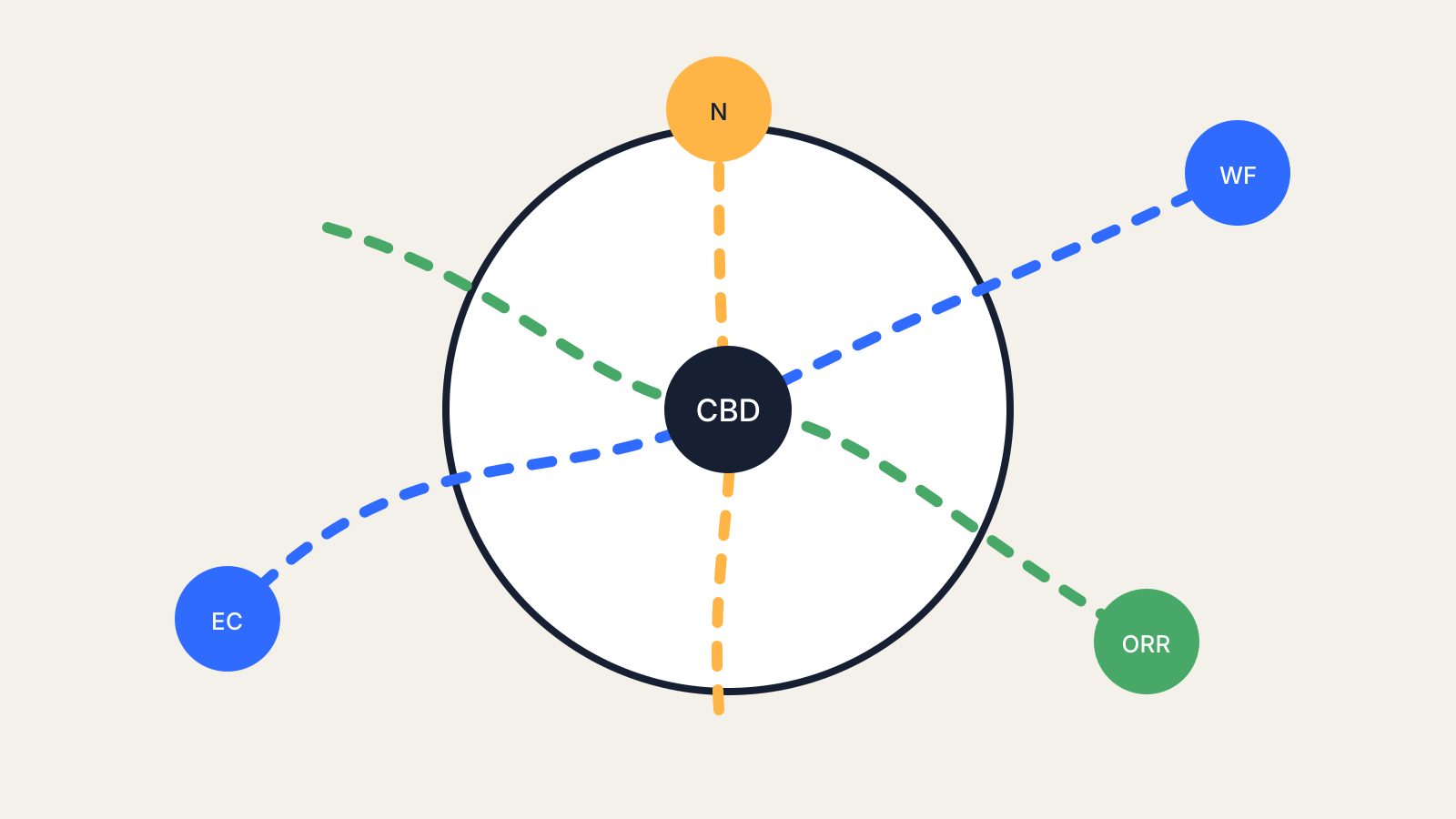
Unlike most Indian cities, Bengaluru’s water supply is not uniform across the city. The Cauvery water supply network (managed by BWSSB) covers the core areas but does not extend to many newer developments on the city’s periphery - particularly areas along the Outer Ring Road and beyond (parts of Whitefield, Sarjapur Road beyond a certain point, Yelahanka outskirts, and Devanahalli).
Areas dependent on borewells face several challenges: water quality may be poor (high TDS requiring an RO purifier), borewell yield declines over time (especially during summer), and the cost of drilling a new borewell falls on the building owners - which can result in special maintenance assessments for residents.
Areas dependent on tanker water face higher costs (Rs 500-1,200 per tanker load), unreliable supply during peak summer months (March-May), and the inconvenience of managing water storage.
Practical recommendation: When evaluating apartments, ask specifically about the water source. If the building relies on borewells, ask about water quality and summer reliability. If on tanker water, ask about the monthly cost and whether it is included in maintenance charges.
Traffic Determines Quality of Life
Bengaluru’s traffic is not merely inconvenient - it fundamentally affects your daily quality of life, your productivity, and your stress levels. The city consistently ranks among India’s most congested, with average peak-hour speeds of 12-18 km/h on many major roads.
Practical recommendation: Prioritize proximity to your workplace over apartment size or rent savings. Paying Rs 3,000-5,000 more per month for an apartment that is 3 km from your office (versus 12 km away) can save you 2-3 hours per day in commute time. Over a year, that is 500-750 hours - the equivalent of 60-90 full working days.
Weather and Wardrobe
Bengaluru’s climate is mild year-round (typically 15-35 degrees Celsius). You will need light layers for cooler mornings from October to February, but no heavy winter clothing. An umbrella and a light rain jacket are essential during the monsoon season from June to September. The city receives approximately 970 mm of annual rainfall, with occasional heavy downpours that cause waterlogging in low-lying areas.
Estimated First-Month Budget
| Item | Approximate Cost |
|---|---|
| Security deposit (10 months on Rs 25,000 rent) | Rs 2,50,000 |
| First month’s rent | Rs 25,000 |
| Broker commission (if applicable) | Rs 25,000 (1 month’s rent) |
| BESCOM deposit + transfer | Rs 618 - 2,000 |
| Internet installation | Rs 500 - 1,500 |
| LPG cylinder deposit | Rs 1,600 - 2,200 |
| Essential household items | Rs 5,000 - 20,000 |
| Temporary accommodation (2 weeks PG/co-living) | Rs 6,000 - 15,000 |
| Packers and movers (inter-city) | Rs 15,000 - 60,000 |
| Total first-month outlay | Rs 3,30,000 - 4,00,000 |
The security deposit is the largest component by far. Negotiating this down from 10 months to 7 months on a Rs 25,000 apartment saves Rs 75,000 in upfront cash. If you add broker commission savings by finding a direct listing (no broker), you can reduce your total first-month outlay by Rs 1,00,000 or more.
Just moved into a new home?
See what residents actually say about your building, the rent, the society, the infrastructure around it, before and after you move in. know.place is a map of honest, building-level rental experiences across India.
Explore know.placeReferences
- Income Tax Department - Tax Deducted at Source for individual tax filing and TDS context.
- BESCOM for electricity billing, outages, and consumer services.
- BWSSB for Bengaluru water supply, billing, tanker, and consumer services.
- Karnataka State Police for local police services and citizen forms.
- UIDAI for Aadhaar address update and accepted address-proof guidance.
- Parivahan Sewa for driving licence, vehicle registration, and address-change services.
- BMRCL Namma Metro route map for current metro corridor planning.
- BMTC for Bengaluru bus services and official route information.