

Coming home is not quite coming back to the same place. If you have spent years abroad, renting in India will feel familiar in its bones and unfamiliar in its details: the deposit is bigger than you remember, the lease is a strange 11 months, the building has rules you had forgotten existed, and the neighbourhood you pictured has quietly changed. None of it is difficult, but going in with Western expectations, or decade-old Indian ones, is a recipe for surprise.
This guide is for the returning NRI: what is genuinely easier for you than for a foreigner, what has probably drifted since you left, and how to settle in without overpaying or getting caught out.
First, the good news: no FRRO for you
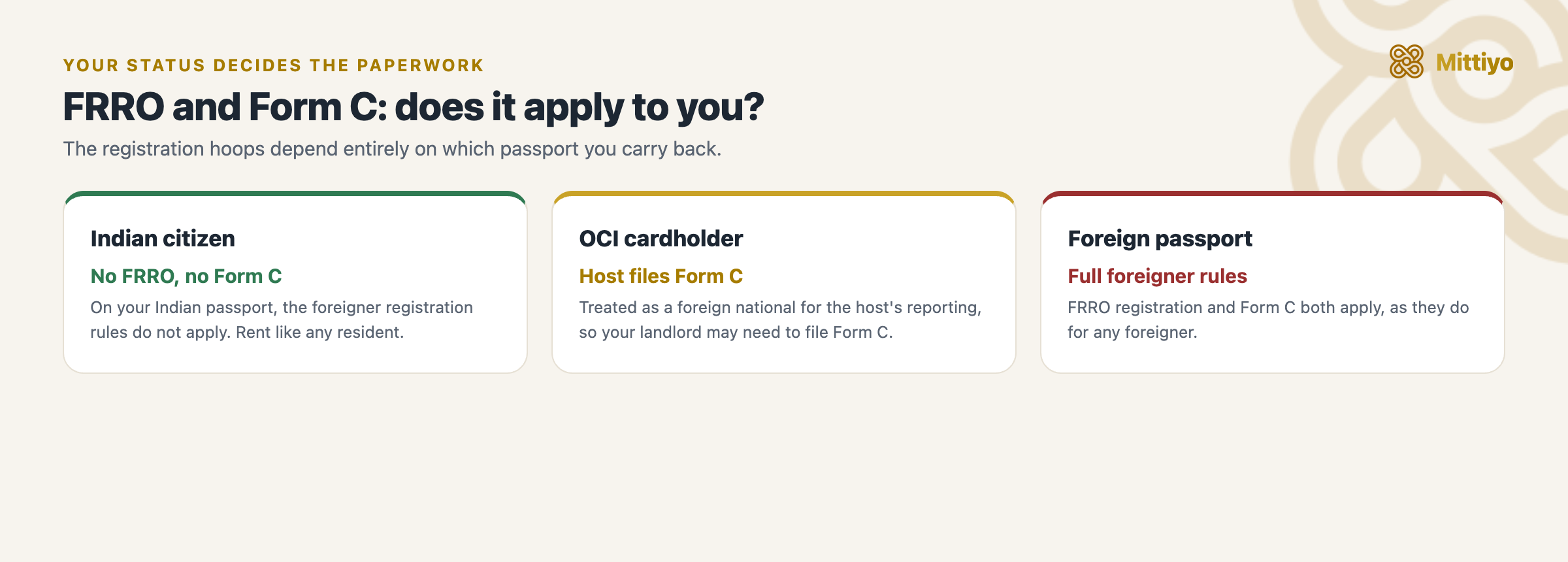 If you kept your Indian citizenship, the foreigner paperwork simply does not apply to you.
If you are returning as an Indian citizen on your Indian passport, the registration hoops that foreigners jump through, FRRO registration and the landlord’s Form C, do not apply to you. That is a genuine advantage: no 14-day clock, no reporting duty for your landlord.
Two caveats. If you took foreign citizenship and now hold a foreign passport, the full foreigner rules apply, see renting in India as a foreigner. If you hold an OCI card, you are treated as a foreign national for the host’s Form C reporting, so your landlord may still need to file it. Know your status before you assume.
These labels decide how much paperwork you face, so it is worth being precise:
- NRI (Non-Resident Indian): an Indian citizen living abroad, travelling on an Indian passport. For renting, you are simply an Indian citizen, no FRRO, no Form C. This is the easy case.
- OCI (Overseas Citizen of India): a person of Indian origin who took foreign citizenship and holds a foreign passport plus an OCI card. Despite the name, OCI is not citizenship, so for a host’s Form C reporting you count as a foreign national.
- Foreign passport, no OCI: the full foreigner rules apply, FRRO registration if your visa is over 180 days, and your landlord’s Form C.
If you are unsure, your passport is the tell: an Indian passport means the foreigner rules do not touch you.
What has probably changed since you left
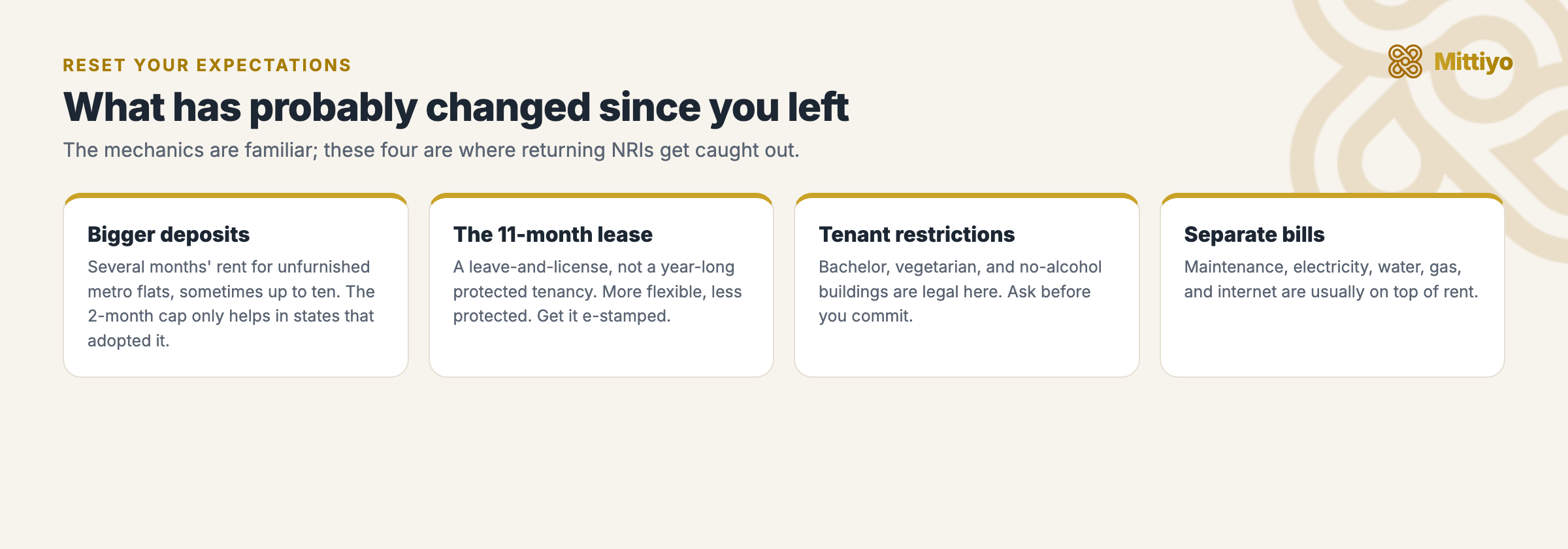 The mechanics are familiar; reset your expectations on the deposit, the lease, and the rules.
- The deposit is bigger. Unfurnished flats in metros can ask for several months’ rent, sometimes up to ten, far above both the Western one-to-two-month norm and what you may remember. The Model Tenancy Act’s two-month cap only helps in states that adopted it.
- The lease is 11 months. Written on a leave-and-license basis to avoid mandatory registration, so your tenure is more flexible and less protected than a Western lease. Get it e-stamped.
- Tenant restrictions persist. Many buildings still refuse bachelors, or are vegetarian-only or no-alcohol. India has no anti-discrimination rental law, so these are legal, ask upfront.
- Rent excludes the extras. Maintenance, electricity, water, gas, and internet are usually separate. Compare the all-in cost.
If you left India years ago, the 11-month agreement may be new to you. It is deliberate. Under the Registration Act, 1908, a lease of twelve months or more must be registered and can attract older rent-control protections that favour tenants. To sidestep that, landlords write agreements for eleven months on a leave-and-license basis, you are licensed to occupy the flat rather than granted a protected tenancy.
In practice these are renewed year after year, so it rarely means you must move. But your security of tenure is weaker than a formal lease, so read the notice, renewal, and lock-in clauses, and get the agreement e-stamped (the online way of paying the small state stamp duty that makes it valid evidence).
The documents (easier for you)
As an Indian citizen you travel light on paperwork compared with a foreigner:
- Your Indian passport or another government ID, and an address proof.
- Proof of employment or income, and you most likely already have a PAN.
- Landlords may still want a local reference, and a large deposit for an unfurnished place.
- If you hold an OCI card, keep it handy, and expect your host to file a Form C.
Get the agreement e-stamped, read the deposit, maintenance, and notice clauses, and do a move-in inventory to protect your refund.
Choosing where to live, again
Assume the city has moved on. Areas that were sleepy may now be gridlocked; new suburbs and metro lines have opened; rents and building quality swing sharply street by street. Do not lean on old memories or on family assumptions from ten years ago.
- Visit in person, ideally at the times of day you will be home.
- Ask current residents about water, power, traffic, and the society’s rules.
- Compare the all-in monthly cost, not the headline rent (see how much rent can you afford).
- Give yourself a short-term base first if you can, then commit once you have seen the ground truth.
Settling in: a few resets
- Payments. Formal deals use bank transfer, cheque, or UPI, set up UPI early, it runs everyday life here now. Insist on traceable payment and receipts.
- Verify ownership before paying, just as you would anywhere. Returning NRIs are targeted by fake-landlord scams too. (See how to spot a rental scam.)
- Reconnect slowly. Use a broker for local knowledge, lean on friends and family for leads, but verify independently rather than taking any deal on trust.
Key takeaways
- A returning NRI on an Indian passport skips FRRO and Form C, a real advantage; foreign-passport and OCI holders should check the foreigner rules.
- Expect a much larger deposit than in the West (several months, sometimes up to ten), and an 11-month leave-and-license lease.
- Building restrictions (bachelor, vegetarian, alcohol) are legal here, ask before you commit.
- Your documents are simpler as an Indian citizen; you likely already have a PAN.
- Do not trust old memories of neighbourhoods, visit, ask residents, and compare the all-in cost.
Back after years away, and out of touch with the ground?
Neighbourhoods and buildings change, and family advice can be a decade old. know.place is a map of honest, building-level rental experiences across India, where current residents say what an area and a building are really like, so you can choose on today's reality, not yesterday's memory.
Explore know.placeThis guide is general information, not legal or tax advice; your position can depend on your citizenship and residency status, so verify yours where it matters.
Related guides: Renting in India as a foreigner · NRI landlord guide: renting out property in India · How to get your security deposit back · How much rent can you afford?
References
- Foreigners registration (FRRO) and OCI, Ministry of External Affairs (FRRO/Form C apply to foreign nationals, not Indian citizens)
- The Model Tenancy Act, 2021, Ministry of Housing and Urban Affairs (recommended two-month deposit cap)
- The Registration Act, 1908 (compulsory registration for leases of twelve months or more)