
Tenant police verification is a mandatory security procedure in Karnataka that serves both public safety and individual protection purposes. While it is sometimes treated as a formality, the requirement exists for valid and substantial reasons - and the consequences of skipping it extend well beyond potential penalties to practical difficulties in everyday life.
The Legal Basis for Mandatory Verification
Unlike some compliance requirements that derive from a single clear statute, tenant police verification in Karnataka is enforced through a combination of legal authorities.
Karnataka Police Act, 1963
The Karnataka Police Act, 1963 grants the state police broad powers to maintain public order and prevent crime. Section 32 empowers the police to issue directions for the preservation of public order, and Section 31 allows the Commissioner of Police (in cities) and the Superintendent of Police (in districts) to issue orders regulating various activities within their jurisdiction. Tenant verification directives are issued under these general powers.
Police Orders Under Section 163 BNSS (Earlier Section 144 CrPC)
The enforceable hook behind most tenant-verification drives is a local police order. Police Commissioners and District Magistrates issue orders under Section 163 of the Bharatiya Nagarik Suraksha Sanhita, 2023 (which replaced Section 144 of the Code of Criminal Procedure) directing landlords to furnish the particulars of every new tenant. Disobeying an order that has been duly promulgated by a public servant is itself an offence under Section 223 of the Bharatiya Nyaya Sanhita, 2023 (earlier Section 188 of the IPC), punishable with a fine or short imprisonment. This is the provision under which landlords are actually penalised for skipping verification, and it is reinforced by the Karnataka Police Act and periodic state circulars.
Bharatiya Nagarik Suraksha Sanhita (BNSS), 2023
The BNSS, which replaced the Code of Criminal Procedure (CrPC) effective July 1, 2024, retains provisions under Chapter XI (Sections 170-190) regarding preventive action by police. These provisions support the police’s authority to maintain records of residents within their jurisdiction and to take preventive measures against potential security threats.
State Government Orders
The Karnataka state government has issued multiple Government Orders (GOs) reinforcing the mandatory nature of tenant verification, particularly after security incidents. These GOs are periodically updated and supplemented by circulars from the Director General of Police.
Why It Matters - Beyond Compliance
For Public Safety
Tenant verification creates a documented record of residential occupants that assists law enforcement in investigations. It provides a basic background check that can flag individuals with criminal records. It establishes a verifiable chain of occupancy for properties, which is critical for tracing individuals in criminal investigations. Major cities across India have documented cases where criminal activities were traced to unverified tenants - including cases involving terrorism, financial fraud, and organized crime.
For Landlords
Beyond legal compliance, tenant verification serves as a due diligence tool. The police database check can reveal if the tenant has prior criminal cases registered against them. In the event of criminal activity by an unverified tenant, the landlord faces questioning about why verification was not conducted - and may face legal consequences for negligence. Insurance claims related to property damage may be complicated if the landlord cannot demonstrate that basic tenant screening (including police verification) was completed.
For Tenants
A completed police verification provides several practical benefits. It serves as official address proof for the rental address, which is accepted for bank account opening, vehicle registration, passport address change, and other processes. It creates an official record of the tenancy, which can be useful in deposit refund disputes. It also establishes a clean record at the local police station, which simplifies future police clearance certificate applications.
Who Is Responsible?
Both the landlord and the tenant share the responsibility, though the primary obligation falls on the landlord as the property owner.
| Party | Obligation | Timeline |
|---|---|---|
| Landlord | Must ensure verification is initiated for every new tenant | Within 7-15 days of the tenant moving in |
| Tenant | Must provide accurate personal information, identity documents, and cooperate with the verification process | At the time of moving in |
| PG/Co-living operator | Must verify all residents and maintain records | Within 7 days of each resident moving in |
The 7-15 day timeline is enforced strictly in Bengaluru city limits. Some police stations issue show-cause notices to landlords who initiate verification more than 30 days after the tenant has moved in.
Method 1: Online Verification via KSP Portal (Recommended)
The Karnataka State Police has digitized the tenant verification process through the KSP portal, making it the most efficient method for compliance.
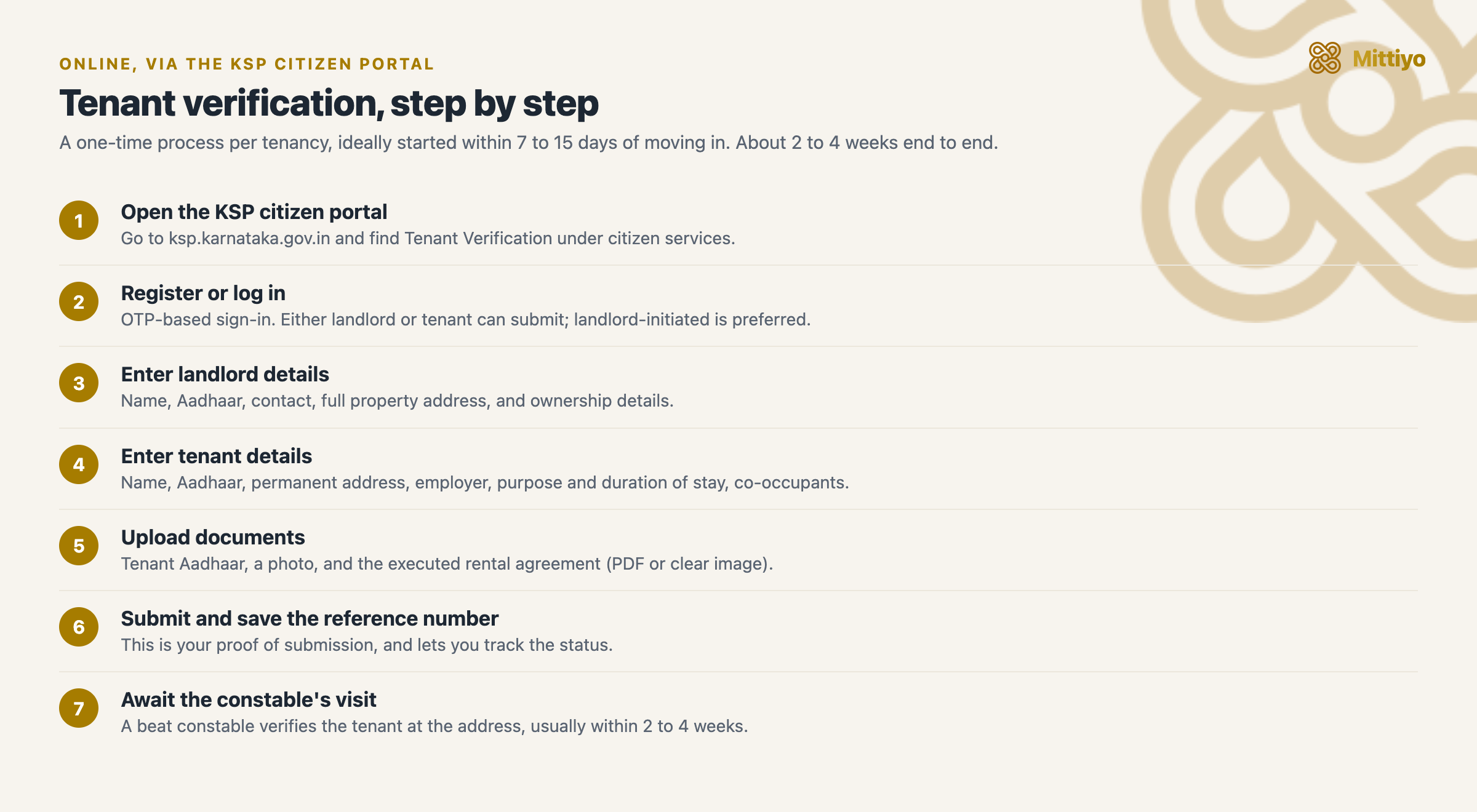 The online tenant-verification process, end to end.
Via KSP Portal (ksp.karnataka.gov.in)
Step 1: Access the portal Navigate to ksp.karnataka.gov.in and look for the “Citizen Services” or “e-Services” section. Select “Tenant Verification” or “Tenant Information” from the available services.
Step 2: Create an account or login If this is your first time, register with your mobile number. The portal uses OTP-based authentication. Both landlord and tenant can submit the form, though landlord-initiated submissions are preferred.
Step 3: Fill in the landlord information Enter the landlord’s full name (as on Aadhaar), Aadhaar number, mobile number, email address, complete property address including pin code, and property ownership details (sale deed number or khata number if available).
Step 4: Fill in the tenant information Enter the tenant’s full name, date of birth, Aadhaar number, permanent address, current mobile number, email address, employer name and address, designation, purpose of stay (employment, education, business, other), previous residential address, duration of intended stay, and number of co-occupants (family members or flatmates).
Step 5: Upload documents Upload scanned copies of the tenant’s Aadhaar card (front and back), one passport-sized photograph of the tenant, a copy of the executed rental agreement, and the landlord’s Aadhaar card and property ownership proof.
Document specifications: PDF or JPEG format, maximum file size typically 2-5 MB per document, legible and clear scans (photographs of documents are acceptable if clear).
Step 6: Submit and obtain reference number After submission, the portal generates a unique reference number. Save this number - it is your proof of submission and can be used to track the verification status.
Step 7: Await physical verification After submission, the local police station processes the application. A police constable will be assigned to visit the tenant’s residence for physical verification, typically within 2-4 weeks.
Via Suraksha App
The Karnataka Police Suraksha mobile application provides tenant verification functionality for some jurisdictions. Download the app from the Google Play Store or Apple App Store, navigate to tenant services, and follow the guided submission process. The app is particularly convenient for photograph uploads and real-time tracking.
Via Namma 100 / Bengaluru Police App
For properties within Bengaluru city limits, the Bengaluru City Police may offer additional channels through their own applications and portals. Check the Bengaluru City Police website (bengalurucitypolice.gov.in) for the latest available channels.
Method 2: Offline Verification (Police Station Visit)
The traditional offline method remains available and may be necessary in areas where the online portal has limited coverage or for landlords who prefer in-person submissions.
Step 1: Obtain Form D Form D (Tenant Information Form) is available at the nearest police station. It can also be downloaded from the KSP website. The form is typically a 2-4 page document requiring information about both the landlord and tenant.
Step 2: Fill in the form completely Complete every field in Form D. Incomplete forms are the most common reason for processing delays. Key sections include: landlord details (name, address, ID proof, ownership details), tenant details (name, permanent address, current address, employer, purpose of stay), property details (address, type - flat/independent house/PG, floor, total area), co-occupant details (family members or flatmates with their ID details), and vehicle details (if the tenant owns vehicles parked at the property).
Step 3: Attach required documents Photocopy and attach all supporting documents. Do not submit originals - they will not be returned. If the police station staff request originals for verification, provide them for inspection only and take them back.
Step 4: Submit at the jurisdictional police station The jurisdictional police station is determined by the property’s location. In Bengaluru, each area falls under a specific police station’s jurisdiction. Submit the completed Form D with attachments to the Station House Officer (SHO) or the designated constable handling tenant verification. Submission timings are typically during office hours (10 AM to 5 PM) on working days.
Step 5: Obtain acknowledgment receipt Insist on an acknowledgment receipt. This is your proof of submission and compliance. The receipt should contain the date of submission, a serial number or diary entry number, the receiving officer’s signature, and a stamp of the police station. If the station does not issue a formal receipt, note down the diary entry number and the receiving officer’s name.
Step 6: Await physical verification A constable will be assigned to visit the property for physical verification.
Documents Required - Complete Checklist
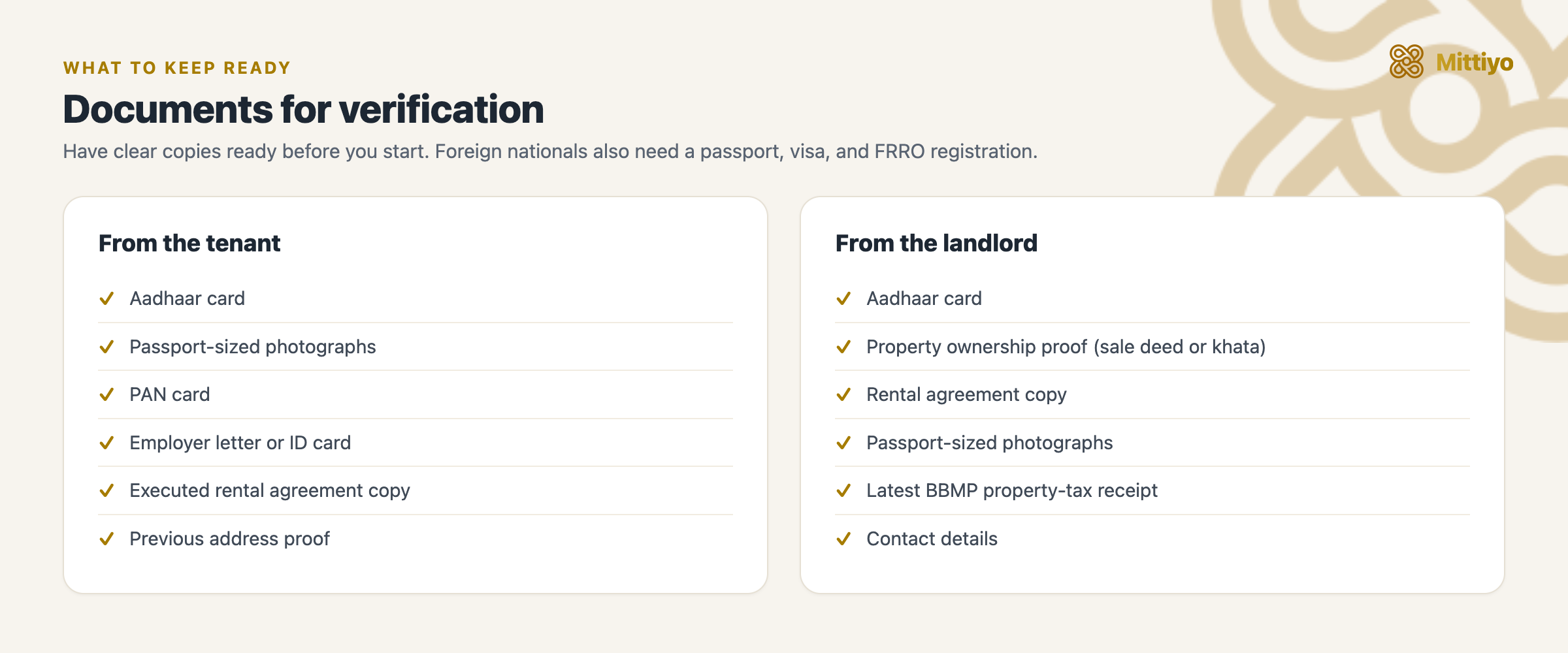 What to keep ready, for both parties.
From the Tenant
| Document | Purpose | Notes |
|---|---|---|
| Aadhaar card | Primary identity verification | Original for in-person, scan for online |
| Passport | Additional identity proof | Mandatory for NRIs and foreign nationals |
| PAN card | KYC linkage | Recommended but not always mandatory |
| Driving license | Alternate photo ID | If Aadhaar is not available |
| Passport-sized photographs (4-6) | Physical file and database | Recent photographs, white background |
| Employer ID card | Employment verification | Current employer |
| Offer letter or employer letter | Confirms employment | On company letterhead |
| Rental agreement copy | Confirms tenancy details | Executed copy with both signatures |
| Previous address proof | Establishes residential history | Utility bill, previous agreement, or bank statement |
| Vehicle RC copy | Vehicle registration at address | If tenant has vehicles at the property |
From the Landlord
| Document | Purpose | Notes |
|---|---|---|
| Aadhaar card | Identity verification | Original for in-person, scan for online |
| Property ownership proof | Establishes authority | Sale deed, khata, or tax receipt |
| Rental agreement copy | Confirms tenancy arrangement | Same copy as tenant |
| Passport-sized photographs (2-4) | Physical file | Recent photographs |
| BBMP property tax receipt | Property verification | Latest paid receipt |
| Contact details | Communication | Mobile number and email |
The Physical Verification Process
After the application is submitted (online or offline), the verification follows a structured process.
Stage 1: Application Review and Database Check (1-5 working days)
The jurisdictional police station reviews the submitted form and documents for completeness. The tenant’s details - name, Aadhaar number, date of birth - are checked against the Crime and Criminal Tracking Network and Systems (CCTNS), which is the national criminal records database. If any hits are found (FIRs registered, pending cases, warrants), the station will flag the case for detailed review.
Stage 2: Assignment and Scheduling
A police constable (usually the beat constable responsible for the property’s locality) is assigned to conduct the physical verification visit. The constable may call the tenant or landlord to schedule a convenient time, though unannounced visits also occur.
Stage 3: Physical Verification Visit
The constable visits the tenant’s residence and conducts the following checks: verifies the tenant is actually residing at the address, checks the tenant’s original ID documents against the submitted copies, confirms the living arrangement matches the agreement details (number of occupants, relationship to the agreement holder), checks the property’s physical condition and layout, and may speak with neighbors or the building security guard to confirm the tenant’s residence.
During the visit, the constable may ask the tenant routine questions about their employment, family, previous residence, and purpose of staying in Bengaluru. These are standard questions - answer truthfully and cooperatively.
Stage 4: Neighbor and Community Inquiry
In some cases, particularly for independent houses or properties without a society, the constable may conduct discreet inquiries with neighbors. This is standard procedure and not a cause for concern.
Stage 5: Report Submission
The constable submits a verification report to the Station House Officer. The report records whether the tenant was found at the address, whether the documents matched, any adverse information from the database check, and the constable’s observations.
Stage 6: Certificate or Acknowledgment
If everything is in order, the police station issues a verification certificate or updates the status on the KSP portal as “Verified.” If adverse information is found, the station may request additional information, conduct a more detailed inquiry, or in rare cases, inform the landlord of concerns.
Timeline Summary
| Step | Typical Duration | Notes |
|---|---|---|
| Form submission (online) | 15-30 minutes | Immediate confirmation |
| Form submission (offline) | 30-60 minutes | Including travel and waiting |
| Database check | 1-5 working days | Automated through CCTNS |
| Constable assignment | 3-7 working days | Depends on station workload |
| Physical verification visit | 1-3 weeks after submission | May be delayed during festivals or elections |
| Report completion | 2-4 weeks from submission | Total end-to-end timeline |
| Certificate availability (if issued) | 3-6 weeks | Not all stations issue formal certificates |
In high-turnover areas of Bengaluru (Whitefield, Electronic City, Marathahalli, HSR Layout, Koramangala), the volume of verification requests is high, and processing may take the longer end of these ranges.
Consequences of Non-Compliance
For Landlords
Legal consequences: Non-compliance with police verification can result in penal action under the Karnataka Police Act. While specific fines are prescribed through circulars rather than statute, landlords have been issued challans (penalty notices) and summoned to police stations for failing to verify tenants.
Liability in criminal cases: If an unverified tenant is involved in criminal activity (fraud, theft, assault, or worse), the landlord faces investigation into their role - or at minimum, their negligence. The question “Why was police verification not done?” becomes a formal inquiry, and the landlord may face charges of abetting or harboring under the Bharatiya Nyaya Sanhita (BNS), 2023, depending on the circumstances.
Insurance complications: Landlord insurance policies may include clauses requiring tenant verification. Failure to comply could void coverage for damages caused by the tenant.
For Tenants
Address proof difficulties: Without police verification, the rental address lacks official authentication. Banks, passport offices, and the RTO may require additional documentation or refuse to accept the rental address as valid proof.
Future rental complications: When moving to a new property, the new landlord may contact the previous area police station to check the tenant’s record. If no verification was conducted, it raises questions.
Visa and travel complications: For tenants applying for passports or visas, police clearance certificates are sometimes required. If the residential address was never verified by police, obtaining clearance becomes more complicated.
Special Cases
NRI Tenants or Foreign Nationals
Additional requirements apply for non-Indian tenants. Required documents include a valid passport with visa pages, visa copy (work visa, student visa, or employment visa), FRRO registration certificate (mandatory for stays exceeding 180 days under the Foreigners Act, 1946, and the Registration of Foreigners Rules, 1992), employer letter from the Indian entity, and additional photographs (6-8 copies).
The verification process is more detailed for foreign nationals. The police station may forward the application to the Foreigners Regional Registration Office (FRRO) or the Intelligence Bureau for additional checks. Processing time is typically 4-8 weeks.
PG and Co-Living Tenants
For Paying Guest (PG) accommodations and co-living spaces, the PG or co-living operator bears the primary responsibility for bulk verification of all residents. The operator must maintain a register of all occupants with their ID details, submit verification forms for each new resident, update the records when residents leave, and make the register available for police inspection.
Individual PG tenants should confirm with the operator that their verification has been completed and request a copy of the acknowledgment receipt. If the operator has not initiated verification, the tenant should raise this as a compliance issue.
Multiple Tenants in a Flat Share
When multiple tenants share a flat (common among working professionals in Bengaluru), each tenant must be individually verified. The landlord should submit separate Form D applications for each occupant. All tenants’ names should ideally appear on the rental agreement - if only one tenant is named on the agreement, the landlord should submit a separate Form D for each additional occupant with a note referencing the primary agreement.
Domestic Help Residing in Servant Quarters
If your domestic worker resides in the servant quarters of your property, police verification is recommended (and in many jurisdictions, mandatory). The process is the same as for tenants - submit Form D with the worker’s details and ID documents.
Tenants Who Have Already Moved Out
If a tenant moves out, the landlord should inform the police station that the tenancy has ended. This is done by submitting a “Tenant Vacating” intimation at the police station or through the KSP portal. This closes the verification record and prevents any future complications if the former tenant is involved in issues at the address.
Practical Tips
Keep copies of everything: Maintain photocopies of all submitted documents and the acknowledgment receipt. Store digital copies (scans or photographs) as backup.
Be proactive with the constable visit: If the constable has not visited within 3 weeks, follow up with the police station. A polite inquiry at the station or a call to the station’s general number can expedite the process.
Prepare for the visit: Ensure the tenant is available at the property during the scheduled visit. Keep original documents ready for the constable to verify. Have the rental agreement copy accessible.
Do not ignore the process: Even if your neighbors or previous landlords claim that verification is not enforced in your area, complete it anyway. Enforcement intensity varies by police station and by the political climate - a change in the local police inspector can suddenly increase enforcement.
Just moved into a new place?
Verification is one box to tick. Before the next move, or to understand your current building better, see what residents actually say about it on know.place: the rent, the deposit, the society, the water and power reality, building by building.
Explore know.placeKey Takeaways
- Tenant police verification is mandatory in Karnataka, enforced through the Karnataka Police Act, 1963, Supreme Court directions, and state government orders
- Both landlords and tenants share the responsibility - the landlord must initiate within 7-15 days of move-in
- Online submission via ksp.karnataka.gov.in is the fastest and most convenient method, generating an immediate reference number
- Both parties must provide Aadhaar, photographs, and the rental agreement copy as minimum documentation
- Physical verification by a police constable typically occurs within 2-4 weeks of submission
- Non-compliance can result in penalties for the landlord, and in serious cases, liability under the BNS if the unverified tenant is involved in criminal activity
- Completed verification serves as official address proof for the tenant and due diligence documentation for the landlord
- Keep the acknowledgment receipt as proof of compliance - it has practical value for bank accounts, vehicle registration, and passport applications
This guide is part of the Bengaluru Renter’s Handbook, our complete set of guides for moving in and settling down, from finding a place to the paperwork and utilities.
References
- Karnataka Police Act, 1963 - Sections 31, 32 (powers to issue directions for public order)
- Bharatiya Nagarik Suraksha Sanhita (BNSS), 2023 - Chapter XI (preventive action by police), effective July 1, 2024
- Bharatiya Nyaya Sanhita (BNS), 2023 - provisions on harbouring and abetment, effective July 1, 2024
- Foreigners Act, 1946 and the Registration of Foreigners Rules, 1992 - FRRO registration for foreign nationals staying beyond 180 days
- Code of Criminal Procedure, 1973, Section 144 (now Section 163 of the BNSS, 2023) - orders under which police direct landlords to furnish tenant particulars; Section 188 of the IPC (now Section 223 of the BNS, 2023) - penalty for disobeying such an order
- Crime and Criminal Tracking Network and Systems (CCTNS), National Crime Records Bureau - the criminal-records database used for verification
- Karnataka State Police citizen portal - online tenant verification
- Bengaluru City Police - city-specific services