
A fake rental listing is the most industrialised rental scam there is. It does not need a clever story or a long conversation, just a handful of attractive photos lifted from somewhere else, a rent set temptingly low, and a renter in a hurry. The photos do the persuading; the low price does the rushing. By the time most people think to check, they have already sent a token to “block” a flat that was never available.
The good news is that fake listings are also the easiest scam to defeat, because the same stolen photos that make them convincing are exactly what give them away. This guide shows you how a fake listing is built, the red flags inside it, and the one-minute check, a reverse image search, that exposes most of them before you lose a rupee.
How a fake listing works
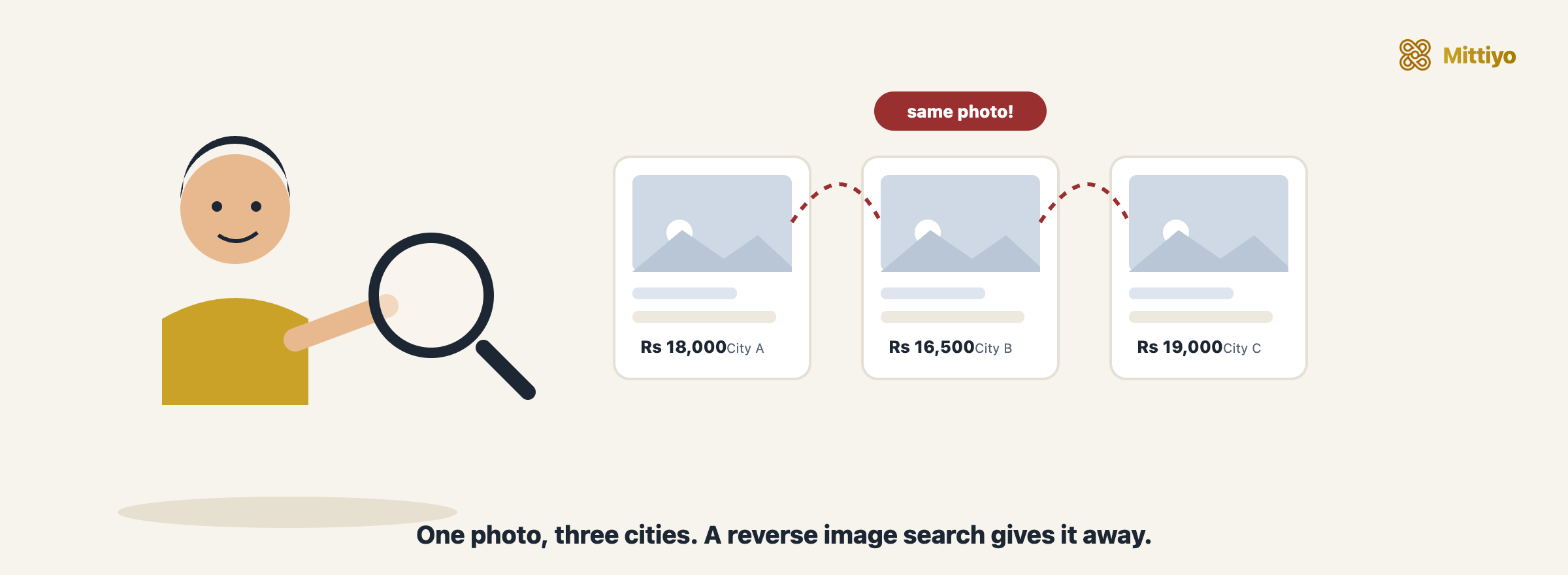
The mechanics are simple and repeatable:
- Borrow the photos. The scammer pulls bright, appealing images from a genuine rental or sale listing elsewhere, an interior-design page, or a property in another city.
- Underprice it. The rent is set noticeably below the market for that area and size, the bait that makes people enquire fast and think slow.
- Stay remote. When you enquire, the lister is friendly but cannot meet or show the flat right now, often with an absent-owner or busy-schedule excuse.
- Manufacture urgency. Several people are interested; the offer is only good today; decide quickly.
- Ask for money first. A token, booking, or deposit is demanded to “block” the flat, to a personal account or UPI handle, before any viewing or agreement.
- Vanish. Once the advance is paid, the lister goes quiet, or invents new fees.
The same flat, the same photos, are often posted many times across different sites and cities, each ad harvesting advances from a different victim.
What a fake listing looks like
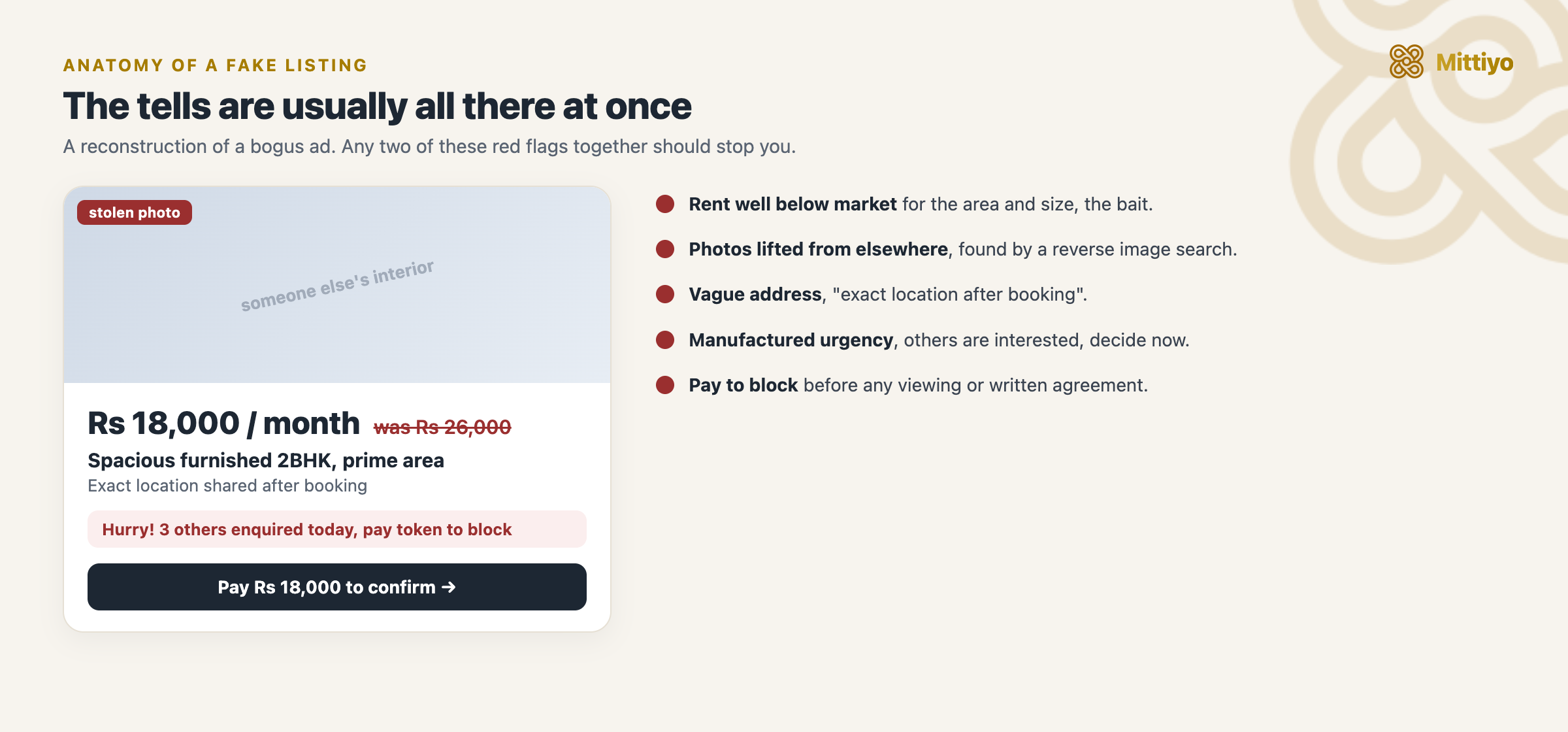 The tells are usually all present at once. Any two together should stop you.
Read a suspect listing the way you would read a contract, looking for what is missing as much as what is there:
- Rent well below market. The clearest bait. Compare against other listings for the same area and size.
- Photos that feel too good, or too generic. Magazine-perfect interiors, or images with a watermark, a different city’s skyline, or furniture that does not match the described flat.
- A vague or shifting address. “Prime area, exact location on booking.” A real listing names the locality and building.
- No in-person viewing. The lister cannot show the flat, or only offers pre-recorded clips.
- Urgency. Another tenant is ready; the deal expires today.
- Pay before you see it. A token or deposit demanded up front, to a personal account or UPI.
The one-minute check: reverse image search
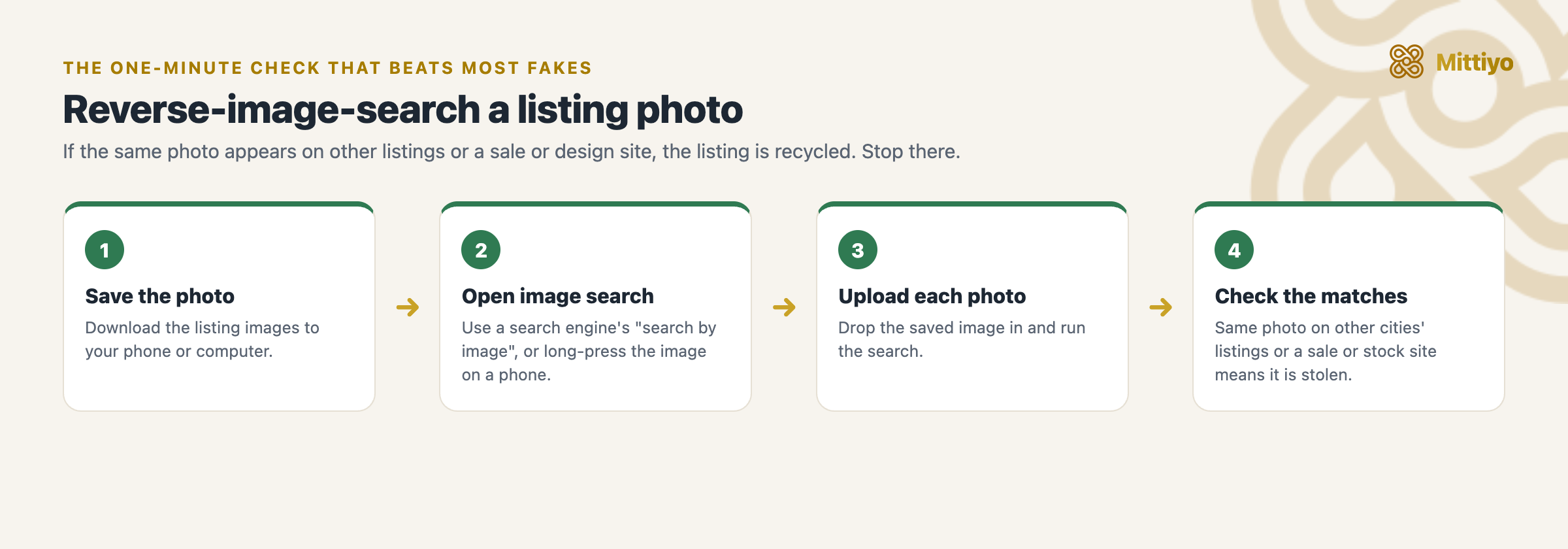 If the photo appears on other listings or a sale or design site, the listing is recycled. Stop there.
This single check exposes most fake listings, and it takes about a minute:
- Save the listing photos to your phone or computer.
- Open an image search tool. Most major search engines let you search by uploading an image; on a phone, you can often long-press an image to search it directly.
- Upload each photo and look at the results.
- Check where else it appears. If the same image shows up on other rental listings (especially in different cities), on a property-sale portal, or on a stock or interior-design page, it has been stolen. A genuine listing’s photos are usually unique to that ad.
Do this before you visit and long before you pay. It is the fastest, cheapest way to catch a fake.
Spotting fake photos
Because the photos carry the con, they are also where it breaks. Beyond a straight reverse image search, learn to read the images themselves.
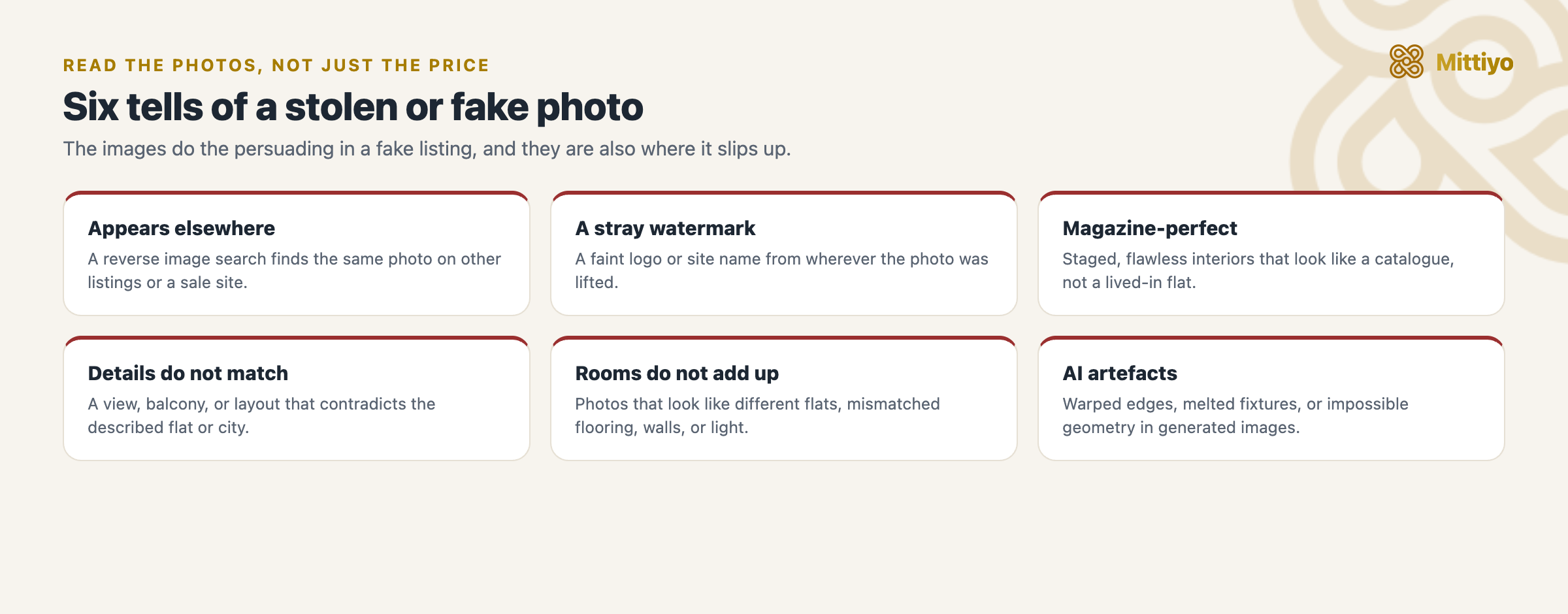 The images do the persuading, and they are also where a fake listing slips up.
Any single one of these is a reason to slow down; two together, walk away.
Reverse image search catches stolen photos, but scammers increasingly use AI-generated interiors that appear nowhere else, so a clean search result is no longer a clean bill of health. AI room images have their own tells:
- Geometry that does not resolve: window frames, tiles, or floorboards that bend or fail to line up; a wall that meets the ceiling at an impossible angle.
- Melting details: door handles, taps, plug sockets, and light switches that look smeared, warped, or half-formed.
- Nonsense text: book spines, wall art, or signage with letters that are not real words.
- Impossible reflections and shadows that fall the wrong way, or furniture legs that merge into the floor.
- Too perfect: no wear, no clutter, no personal objects, showroom lighting in every shot.
If the photos look flawless but a little dreamlike, and there is no real address or in-person viewing behind them, treat the whole listing as unverified until you have seen the actual flat live.
Six kinds of fake listing
The core trick, borrowed images plus a low price, wears different disguises. Recognising the shape helps you spot it faster.
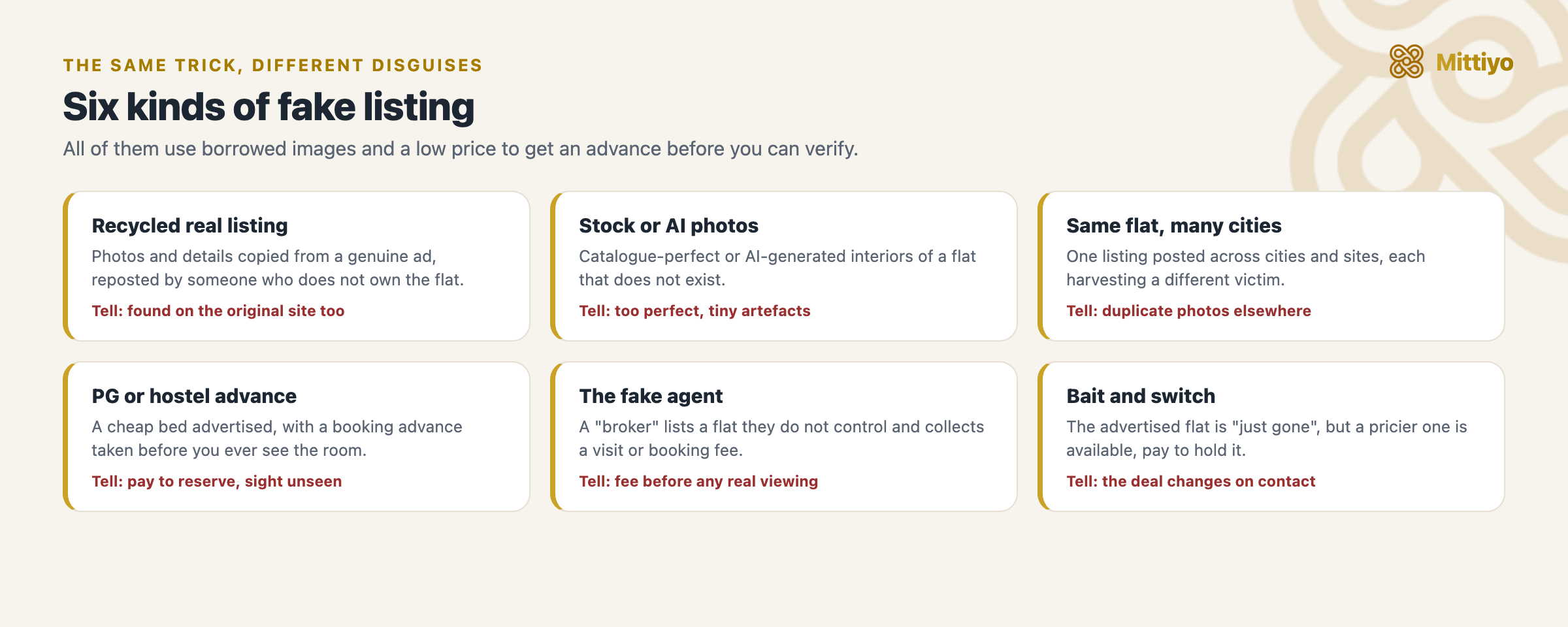 Different wrappers, one goal: an advance before you can verify.
Whichever version you meet, the defence is identical: see the property, verify the owner, and never pay before a real agreement.
Beyond the photos: verify the rest
A reverse image search catches most fakes, but for any listing you are serious about, verify the property and the person too:
- See it in person, or on a live video walkthrough of the actual flat where the lister walks to the door and reads out the flat number, never just photos or clips.
- Verify ownership before paying: ask for the sale deed or title, the latest property-tax receipt, and a utility bill in the owner’s name, and match the name to their government ID. An Encumbrance Certificate from the sub-registrar confirms the registered owner.
- Insist on a written, registered agreement (or a verifiable e-stamp) before any money moves.
- Pay only traceably, by bank transfer to an account in the verified owner’s name, never to a personal UPI handle to “block” a flat you have not seen.
For the absent-owner version of this scam, where the lister leans hard on a “transferred abroad” story, see the dedicated walkthrough: the “owner is abroad” rental scam.
A realistic example
Picture a typical case (an illustrative composite, not a real person). Rahul, searching for a flat before a job move, finds a furnished 2BHK listed at Rs 18,000, clearly under the Rs 26,000 similar flats nearby are asking. The photos are bright and modern. The lister replies quickly, says he is out of town for work, and offers to have a caretaker hand over the keys once Rahul pays one month’s rent to “confirm”. Two others are interested, he adds.
Rahul almost paid. Instead he saved one photo and searched it. The same image appeared on a furniture brand’s catalogue page and on two other rental ads in different cities. He stopped, reported the listing, and moved on. The whole check cost him sixty seconds and saved him Rs 18,000.
A second common shape is the PG bait: a bed advertised at Rs 6,000 with a Rs 3,000 “booking advance” demanded to a personal UPI to reserve it, before any visit. Searched, the photos turn up on a hostel-booking site in another city. Same pattern, different wrapper: a low price, an advance up front, and images that belong to someone else.
What to do if you have already paid
Speed is everything; the first hour is your best chance to stop the money.
- Call 1930 immediately, the national cyber-crime helpline (run by the Indian Cyber Crime Coordination Centre under the Ministry of Home Affairs), open 24x7.
- File a complaint at cybercrime.gov.in with the listing, your chat history, payment screenshots, and transaction IDs.
- Tell your bank or payment provider at once and ask them to freeze or recall the transaction.
- File a police complaint (FIR) at your local station or cyber cell.
- Report a fraudulent caller or SMS on Sanchar Saathi.
Key takeaways
- A fake listing runs on stolen photos and a below-market rent, the rest is just pressure to pay before you can check.
- The reverse image search is the single most powerful check, and it takes a minute. Do it before you visit or pay.
- Never pay a token or deposit before you have seen the property and signed a proper agreement.
- A low rent is a reason to verify harder, not hurry.
- If you have paid, call 1930 and report at cybercrime.gov.in in the first hour, and alert your bank.
Want to know a building before you ever message a listing?
Fake listings thrive because renters know nothing about the place. know.place is a map of honest, building-level rental experiences across India, where residents share what a building and its society are really like, so a too-good listing is easy to sanity-check. Rented somewhere before? Add your own experience and help the next person.
Explore know.placeThis guide is general information for awareness, not legal advice. If you have suffered a loss, report it through the official channels above without delay.
Related guides: Rental scams in India: the field guide · The “owner is abroad” scam · Security deposit rules
References and official channels
- National Cyber Crime Reporting Portal, Indian Cyber Crime Coordination Centre (I4C), Ministry of Home Affairs, and the 1930 cyber-fraud helpline
- Sanchar Saathi, Department of Telecommunications (report fraudulent communications and check SIMs issued on your ID)
- RBI Sachet, Reserve Bank of India (report and verify financial entities)