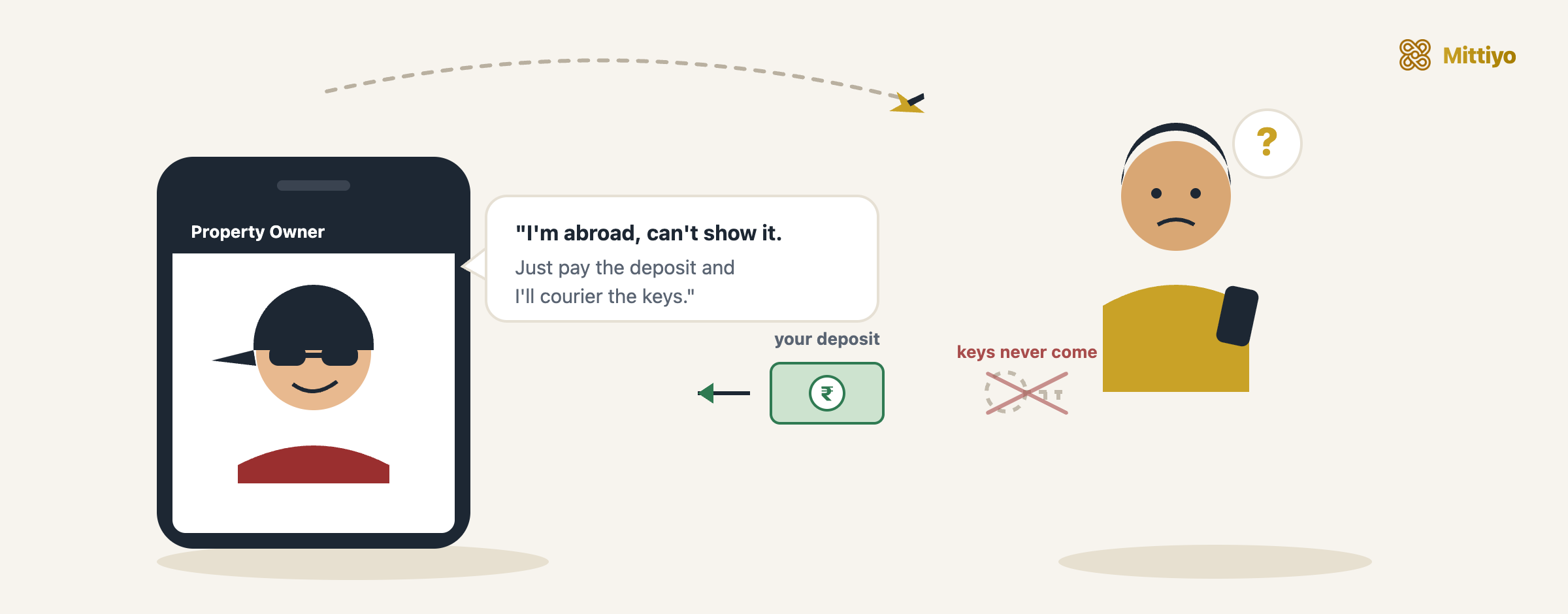
This is the rental scam that catches careful people, because every odd thing about it comes wrapped in a perfectly reasonable excuse. The owner is abroad, so of course they cannot show the flat. They are busy, so of course they want to move fast. They will courier the keys, so of course they need the deposit first. Each excuse, on its own, sounds fine. Together, they are a script designed to get you to pay for a flat you will never get.
Here is exactly how it runs, the messages you will actually receive, the red flags hiding inside them, and what to do at each stage, including if you have already paid.
How the scam unfolds
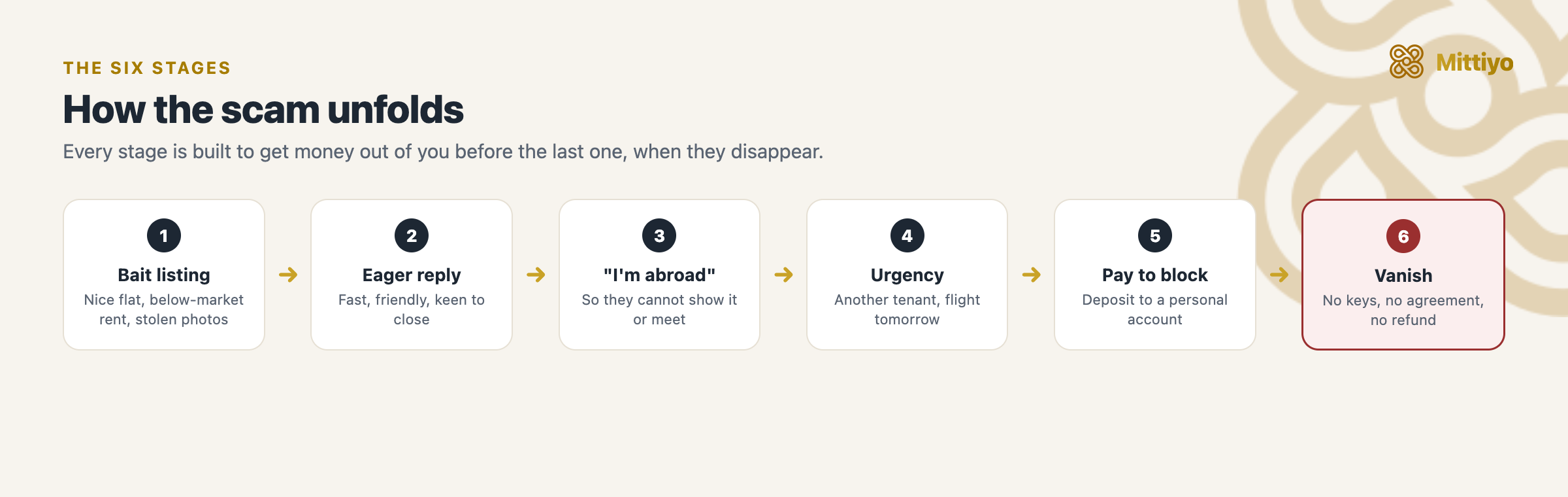 Six stages. The whole thing is engineered to get money out of you before stage six, when they disappear.
- The bait listing. An attractive flat appears at a slightly below-market rent, with good photos, often lifted from a genuine listing elsewhere.
- The eager reply. You enquire, and the “owner” responds fast and friendly, keen to close.
- The absent-owner story. They are abroad, transferred, or posted out of the city, and so cannot show the flat or meet you. This single line is the engine of the scam.
- Manufactured urgency. Another tenant is ready to pay today; they are flying out tomorrow; the offer is only good now.
- The payment ask. Pay a token or one month’s deposit to “block” the flat, to a personal account or UPI handle, and they will courier the keys.
- The vanish. Once you pay, they stop replying, block you, or invent new fees. No keys, no agreement, no refund.
The script, message by message
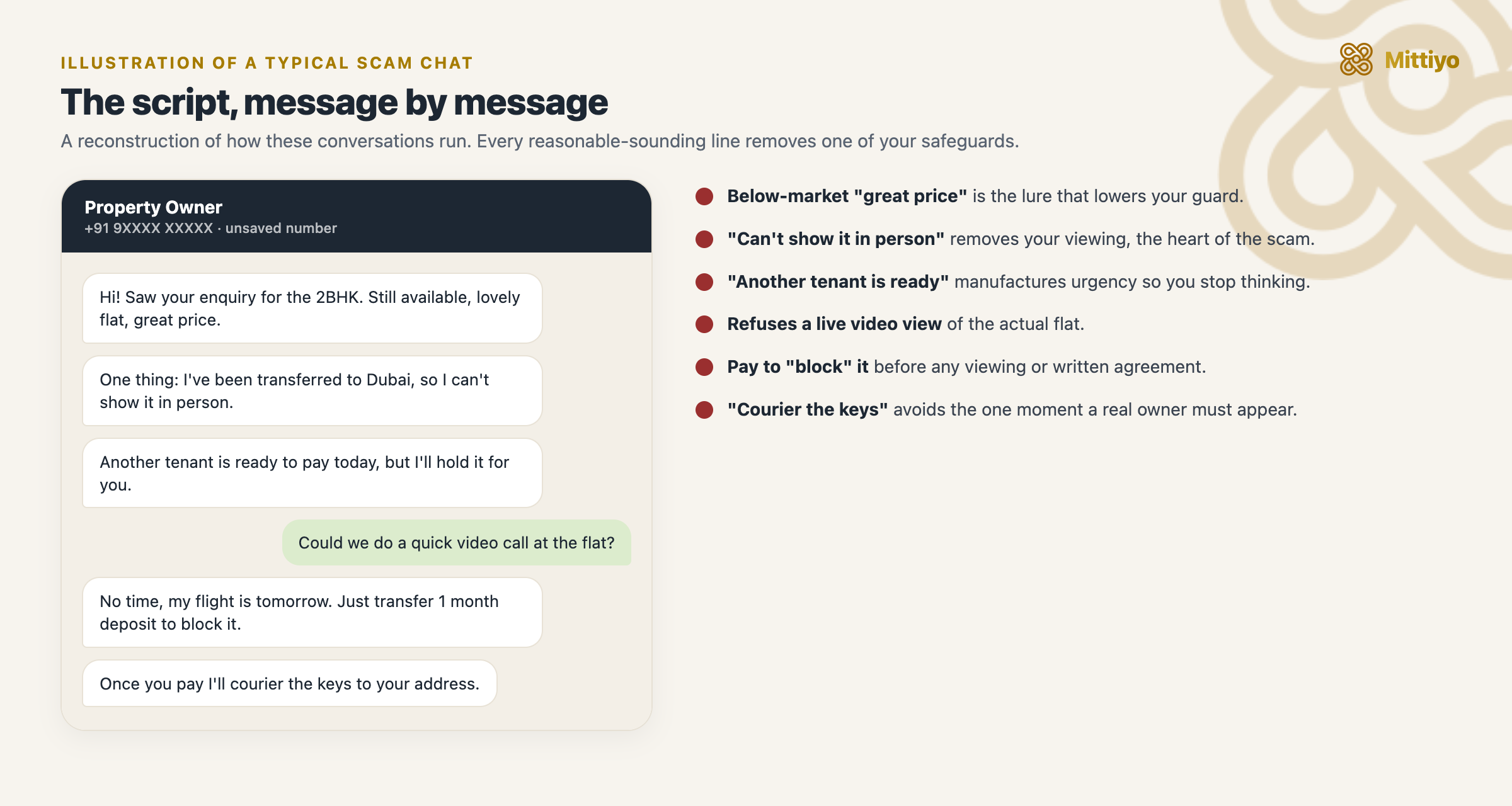 The messages sound reasonable one at a time. Lined up, every one is a red flag.
Read the conversation above line by line. “I have been transferred, I cannot show it” removes your viewing. “Another tenant is ready” removes your time to think. “Pay to block it” removes your money before any agreement. “I will courier the keys” removes the one moment, the handover, when a real owner has to show up. Each message quietly removes a safeguard. That is the whole trick.
A realistic example
Picture a typical case (an illustrative composite, not a real person). Priya is relocating to a new city for a job and finds a 2BHK listed at Rs 22,000 a month, around 15% below what similar flats nearby are asking. The “owner” replies within minutes, warm and helpful, and explains he was recently posted to Dubai, so a cousin will hand over the keys once things are settled. He sends four bright photos and a scanned rental agreement already filled in with her name. There is just one other person interested, he says, but he would rather give it to a working professional like her. To hold it, he asks for one month’s rent as a token to his personal UPI, after which he will courier the keys.
Every step had a reason, which is exactly why it worked. The low rent was “a quick deal”. The absent owner was “a transfer”. The advance was “to block it”. Priya paid Rs 22,000. The replies slowed, a “registration fee” was requested, and when she pushed back, the number went silent.
Where could it have been stopped? At any one of three points: when he could not show the flat live, when payment was to a personal UPI before any verified agreement, or when the rent was suspiciously low. Any single one of those, taken seriously, ends the scam. The danger is that, wrapped in friendly explanations, none of them feels alarming on its own. That is why the rule has to be mechanical: you verify regardless of how reasonable the story sounds.
The red flags
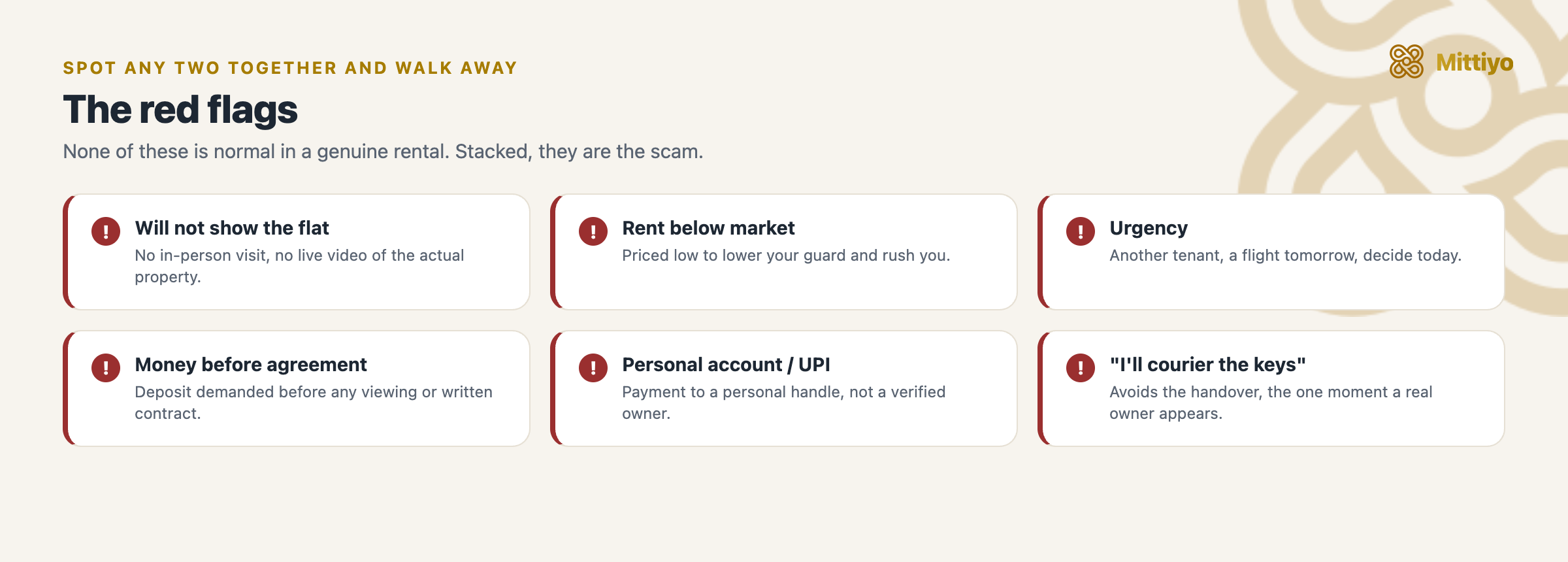 Spot any two of these together and treat the deal as a scam until proven otherwise.
- Cannot or will not show the flat in person or on a live video call of the actual property.
- Rent below market for the area and size, the lure.
- Urgency: another tenant, a flight tomorrow, decide today.
- Money before viewing or any written agreement.
- Payment to a personal account, UPI ID, or wallet, not a verified owner’s account.
- “I will courier the keys” instead of meeting you for the handover.
- Photos that appear on other listings, and reluctance to share original ownership documents.
A genuine absent owner is not always a scammer
It is worth saying plainly: plenty of property owners really do live abroad or in another city, and renting through a representative is completely normal. The absent-owner story is not, by itself, proof of fraud. What separates a real owner from a scammer is not where they are, but how they respond when you ask to verify.
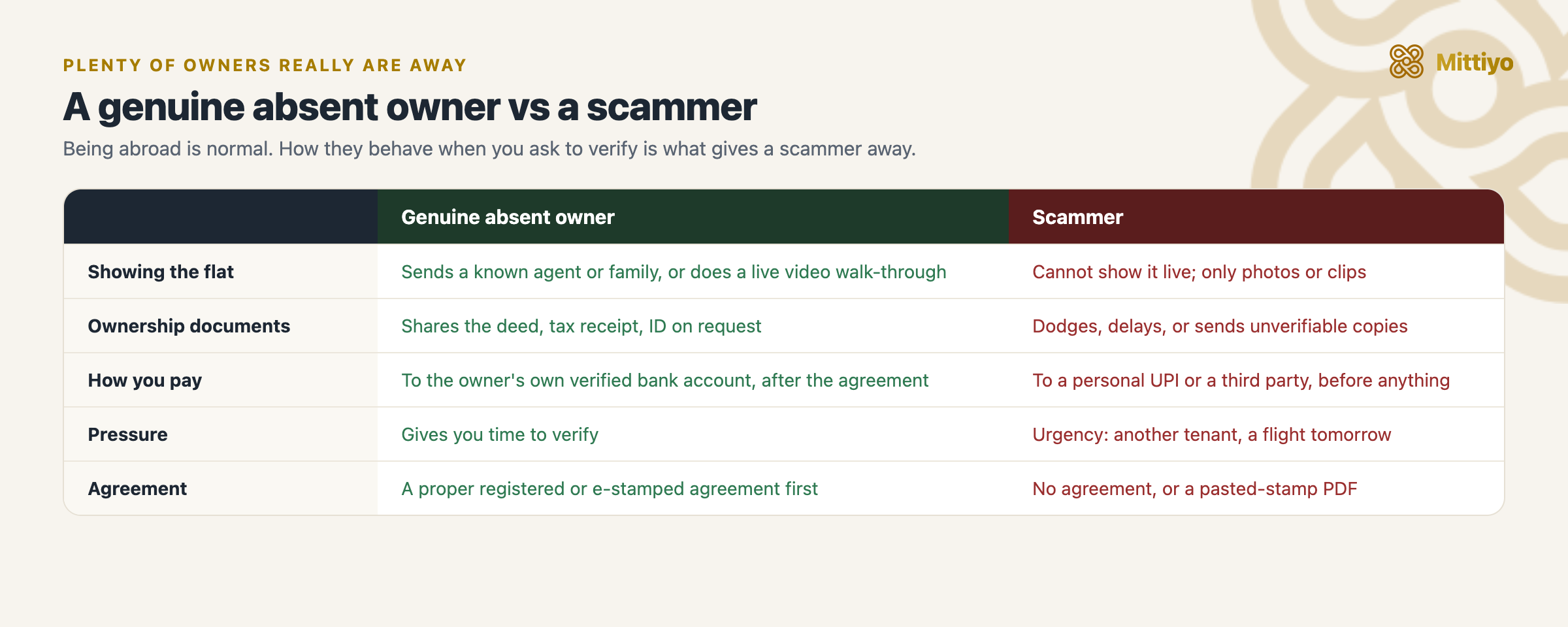 Being away is normal. Refusing every verification while demanding money up front is not.
A genuine owner who cannot be there will happily arrange a known agent or a family member to show you the flat, share ownership documents when asked, accept payment into their own verified account only after an agreement, and give you time. A scammer does the opposite at every line. So do not reject a listing just because the owner is away. Run the checks, and let their response decide.
Six variations of the same scam
The absent-owner story is a template, and scammers dress it in different costumes. Recognising the variation helps you spot it earlier.
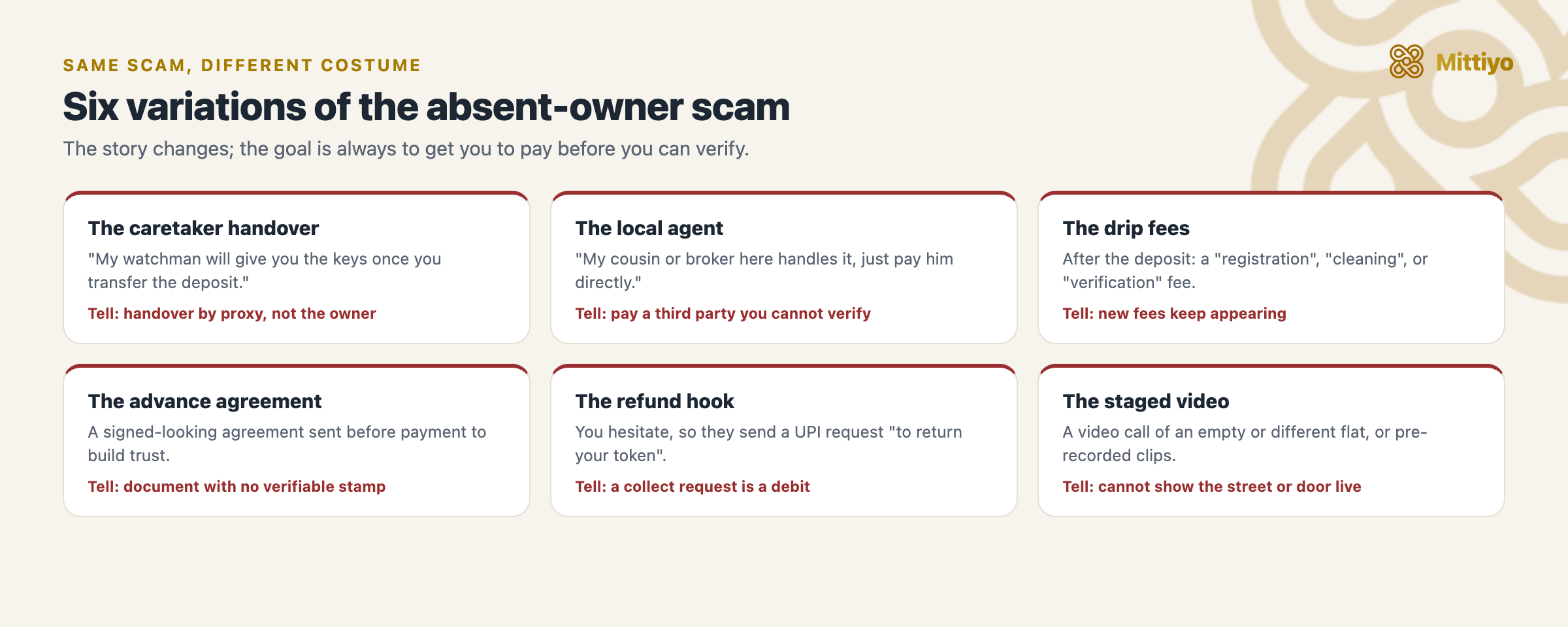 Different stories, identical goal: money before verification.
The caretaker handover
The “owner” says a watchman, caretaker, or society guard will hand you the keys once you transfer the deposit. The proxy explains away the owner’s absence, but you are still paying a stranger for keys to a flat no verified person has shown you.
The local agent or relative
A “cousin”, “manager”, or “broker” in your city will handle everything, so you should pay them directly. It feels safer because there is a local face, but the third party is part of the script, and the money still goes out before any verification.
The drip fees
After the deposit lands, new charges appear: a “registration fee”, a “cleaning fee”, a “society NOC fee”, a “token to release the keys from courier”. Each is small enough to feel reasonable, and there is always one more. A genuine let has no surprise fees after the agreement.
The advance agreement
To build trust, the scammer sends a signed-looking rental agreement, sometimes with your name already filled in, before you pay. A document is easy to fake; a verifiable e-stamp or a registered agreement is not. Treat an unverifiable PDF as decoration, not proof.
The refund hook
When you hesitate or ask for your money back, the scammer offers a refund through a UPI request you must “approve”. Approving a collect request sends money out, not in. This twist is common enough that it has its own section below.
The staged video call
Asked for a live view, the scammer shows a video that is pre-recorded, or a walk-through of an empty or different flat, and avoids panning to the street, the door number, or the building name. Insist they show the exact address and surroundings live, on the spot.
How to defeat it
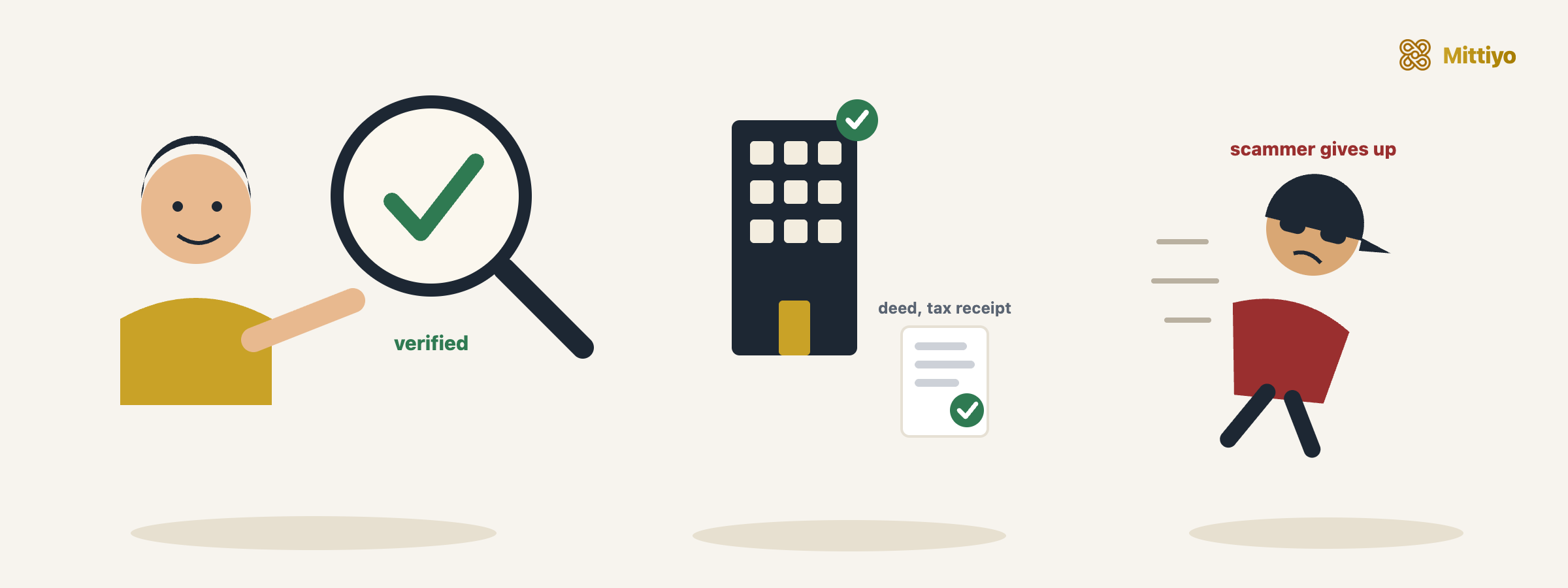
The scam dies the moment you insist on the things the absent-owner story is designed to skip:
- Demand a live view. An in-person visit, or at minimum a live video walkthrough of the actual flat (door number, street, surroundings), never pre-recorded clips. A real owner or their representative can arrange this. A scammer cannot.
- Verify ownership before paying a rupee. Ask for the sale deed or title, the latest property-tax receipt, and a utility bill in the owner’s name, and match the name to their government ID. An Encumbrance Certificate from the sub-registrar confirms the registered owner.
- Reverse-image-search the photos. If they show up on other listings, walk away.
- Never pay before a written, registered agreement and an actual viewing.
- Pay only traceably, to an account in the verified owner’s name. If someone insists you pay a stranger’s personal UPI to “block” a flat you have not seen, that is the scam.
Verifying ownership, step by step
If you take only one thing from this guide, make it this: confirm the person you are paying actually owns or controls the flat, before any money moves.
- Ask for ownership proof. A genuine owner can show the sale deed or title document, the latest property-tax receipt, and a recent electricity or water bill, all in the same name. Match that name against their government photo ID.
- Cross-check with an Encumbrance Certificate. An Encumbrance Certificate (EC), available from the sub-registrar’s office or your state’s property-registration portal, lists the registered transactions on a property and confirms the current owner. It is the strongest independent check a tenant has.
- Reverse-image-search the photos. Save the listing images and search by image. If the same photos turn up on other or older listings, the listing is recycled and the “owner” is not who they claim.
- Insist on a live, located view. A real-time video where they walk to the door, read out the flat number, and pan to the street and building name is hard to fake. Pre-recorded clips and still photos are not proof.
- Pay only after a real agreement, into the owner’s own account. A registered agreement or a verifiable e-stamp first, then a bank transfer to an account in the verified owner’s name. Never to a third party, never before the agreement.
Treat “the owner cannot show it in person” not as a small inconvenience, but as the single biggest reason to stop and verify.
If you have already paid
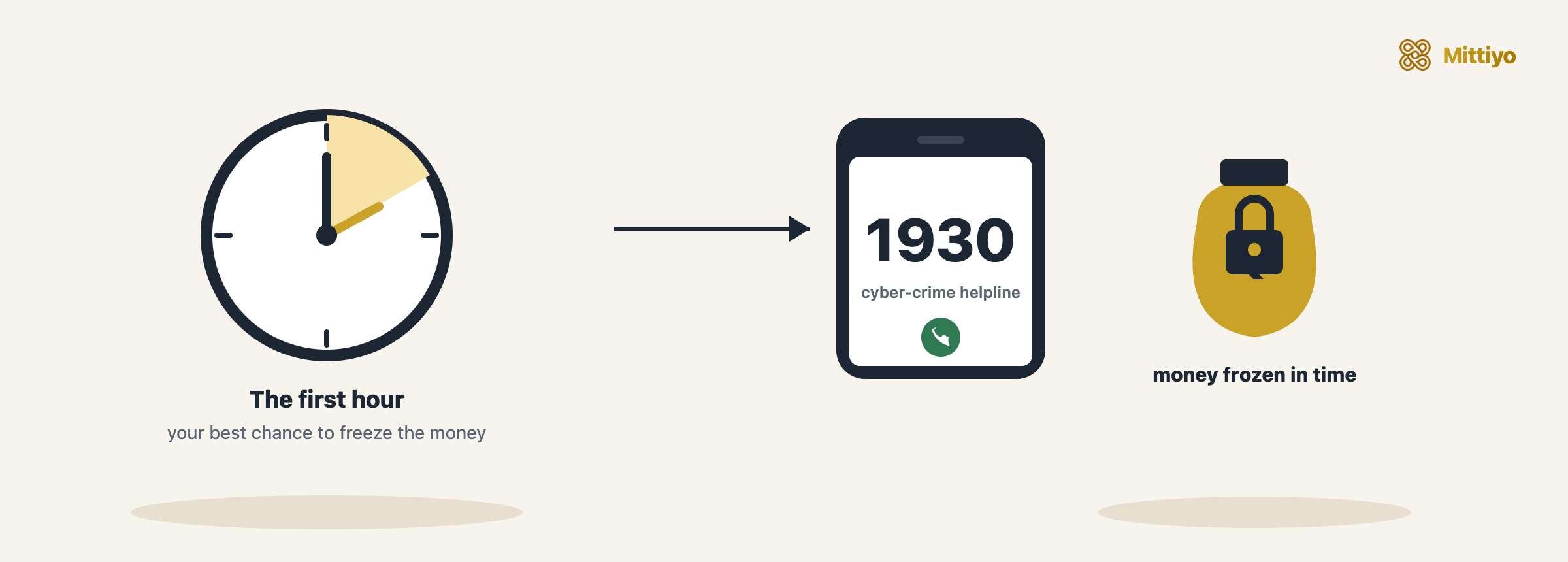
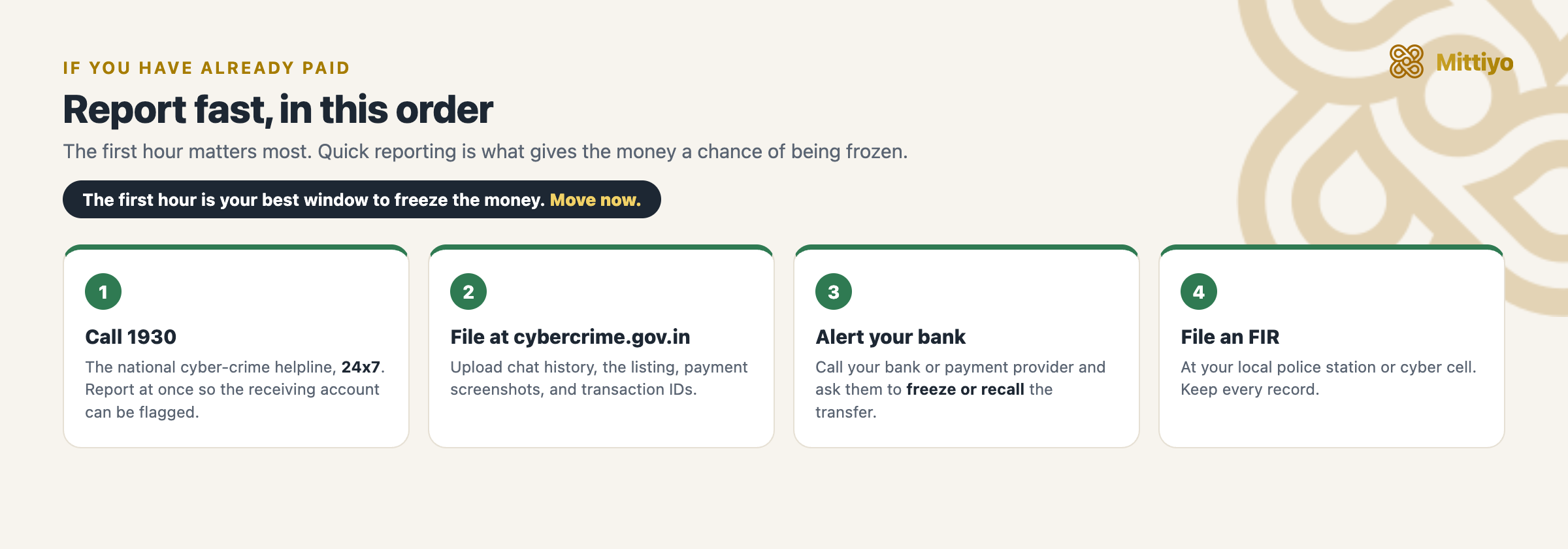 The first hour matters most. Reporting fast is what gives the money a chance of being frozen.
- Call 1930 immediately. This is the national cyber-crime helpline (run by the Indian Cyber Crime Coordination Centre under the Ministry of Home Affairs), open 24x7. The sooner you report, the better the chance the receiving account is flagged before the money is withdrawn.
- File a complaint at cybercrime.gov.in. Upload the chat history, the listing, payment screenshots, and transaction IDs.
- Tell your bank or payment provider at once and ask them to freeze or recall the transaction.
- File a police complaint (FIR) at your local station or cyber cell.
Scammers rarely keep the money in the account you paid. They move it fast, through a chain of mule accounts, everyday bank accounts, often belonging to other unwitting or complicit people, used purely to relay stolen funds and break the trail. Within hours it can be split, forwarded, and cashed out.
That is why reporting speed beats reporting completeness. When you call 1930 and file at cybercrime.gov.in quickly, the system can flag the receiving account and ask the bank to freeze the balance before it is drained onward. Once the money has passed through the mule chain and been withdrawn, tracing and recovering it becomes far harder. Report first, gather the finer details after.
Keep every record. Do not delete the chat or the listing, even though you will want to.
The UPI trap on the way out
A common final twist: after you ask for your money back, the scammer sends a UPI collect request dressed up as a refund, “just approve this to get your token back.” Approving it sends more of your money out.
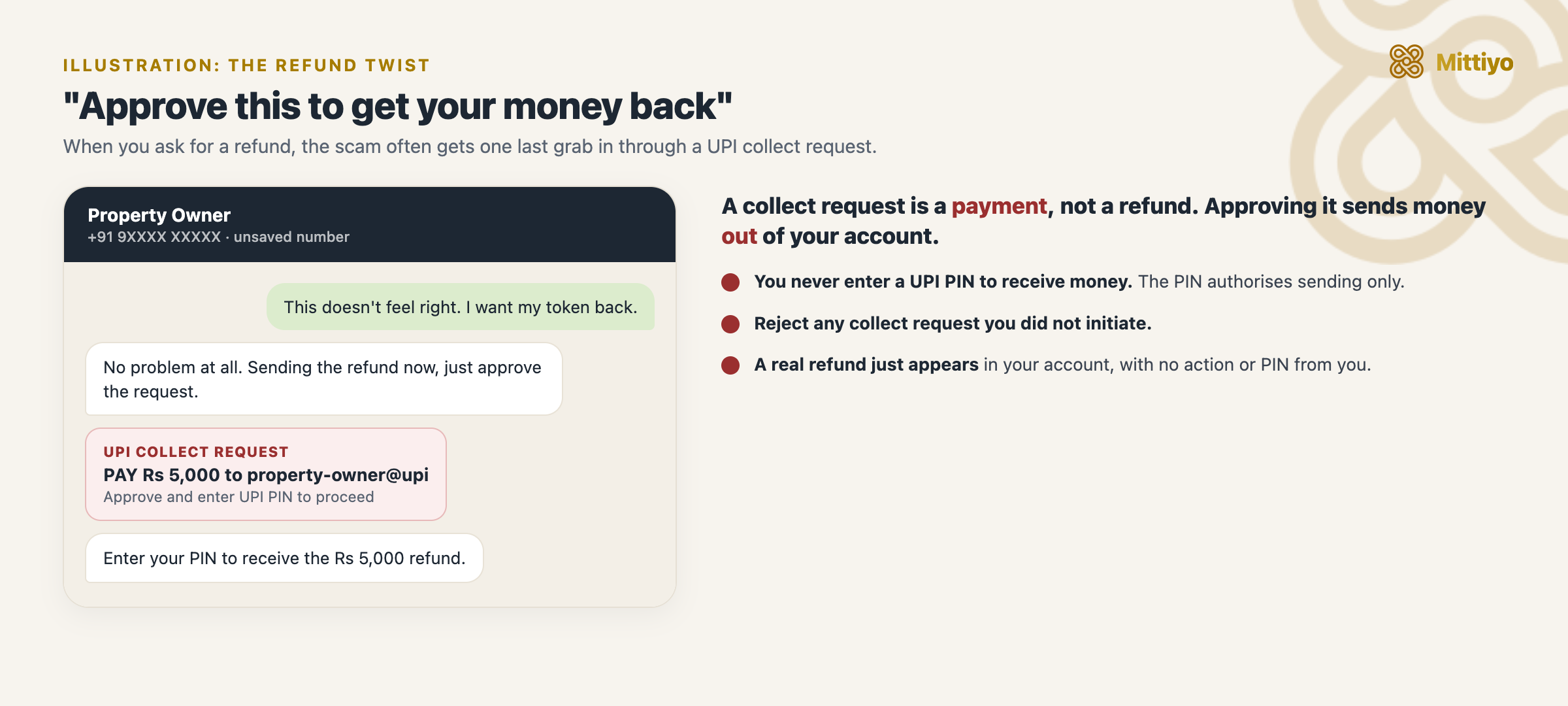 A real refund just appears in your account. A “refund” that needs your PIN is a fresh payment leaving it.
You never enter your UPI PIN to receive money. The PIN is only ever needed to send. Any request to enter your PIN, scan a QR, or approve a collect request “to receive a refund” or “to verify” is, by definition, a payment leaving your account. Reject it.
Key takeaways
- The absent-owner story exists to remove your in-person viewing and ownership checks. That is its only purpose.
- Being abroad is not the red flag. Refusing to let you verify while demanding money up front is.
- Never pay before you have seen the property and signed a written, registered agreement.
- Verify ownership independently: the sale deed, property-tax receipt, and an Encumbrance Certificate beat any document the “owner” sends you.
- The scam wears many costumes (caretaker, local agent, drip fees, advance agreement, refund hook, staged video), but all of them want money before verification.
- Spotting two red flags together is enough to walk away.
- If you have paid, call 1930 and report at cybercrime.gov.in in the first hour, and alert your bank.
- Never enter a UPI PIN to receive money, a refund request that needs your PIN is a fresh debit.
Not sure a building, or its owner, is what they claim?
Scammers rely on you knowing nothing about the place. know.place is a map of honest, building-level rental experiences across India, where residents share what a building and its society are really like. Rented somewhere before? Add your own experience and help the next person avoid a bad deal.
Explore know.placeThis guide is general information for awareness, not legal advice. If you have suffered a loss, report it through the official channels above without delay.
Related guides: Rental scams in India: the field guide · Security deposit rules · What is a leave and license agreement
References and official channels
- National Cyber Crime Reporting Portal, Indian Cyber Crime Coordination Centre (I4C), Ministry of Home Affairs, and the 1930 cyber-fraud helpline
- UPI FAQs, National Payments Corporation of India (the UPI PIN is needed only to send money, never to receive)
- Sanchar Saathi, Department of Telecommunications (report fraudulent communications and check SIMs issued on your ID)