
House-hunting puts you in exactly the position scammers want: in a hurry, competing with others, and ready to pay to lock down a place before someone else does. That urgency is the weapon. Almost every rental scam in India works by manufacturing a reason to pay before you have verified anything.
This is a field guide to the scams that are actually doing the rounds, how each one works, the red flag that gives it away, and the official channels to use if you have already lost money. Most of it comes down to one rule, so we will say it first.

The one rule that defeats most scams
Never pay anything before you have seen the property in person and signed a proper, written agreement. No token, no booking amount, no “blocking” fee, no deposit. Every common rental scam depends on breaking this rule. Hold to it and the rest is detail.
Why these scams work
If you have ever wondered how careful, intelligent people lose money to a scam that sounds obvious in hindsight, the answer is that it never sounds obvious in the moment. Rental fraud pulls four levers at once:
- Urgency. A deadline (“another tenant is ready today”) shuts down the slow, sceptical part of your thinking.
- Scarcity. A good flat at a good price feels like a rare find you must grab before someone else does.
- A plausible story. Every red flag arrives pre-wrapped in a reasonable explanation, so no single step feels wrong.
- Privacy. The conversation moves to a personal chat, away from any platform, listing, or witness.
You do not beat these with intelligence; you beat them with a rule that does not bend to the story. That is why “never pay before you see it and sign” works so well: it takes the decision out of the heat of the moment.
The scams, at a glance
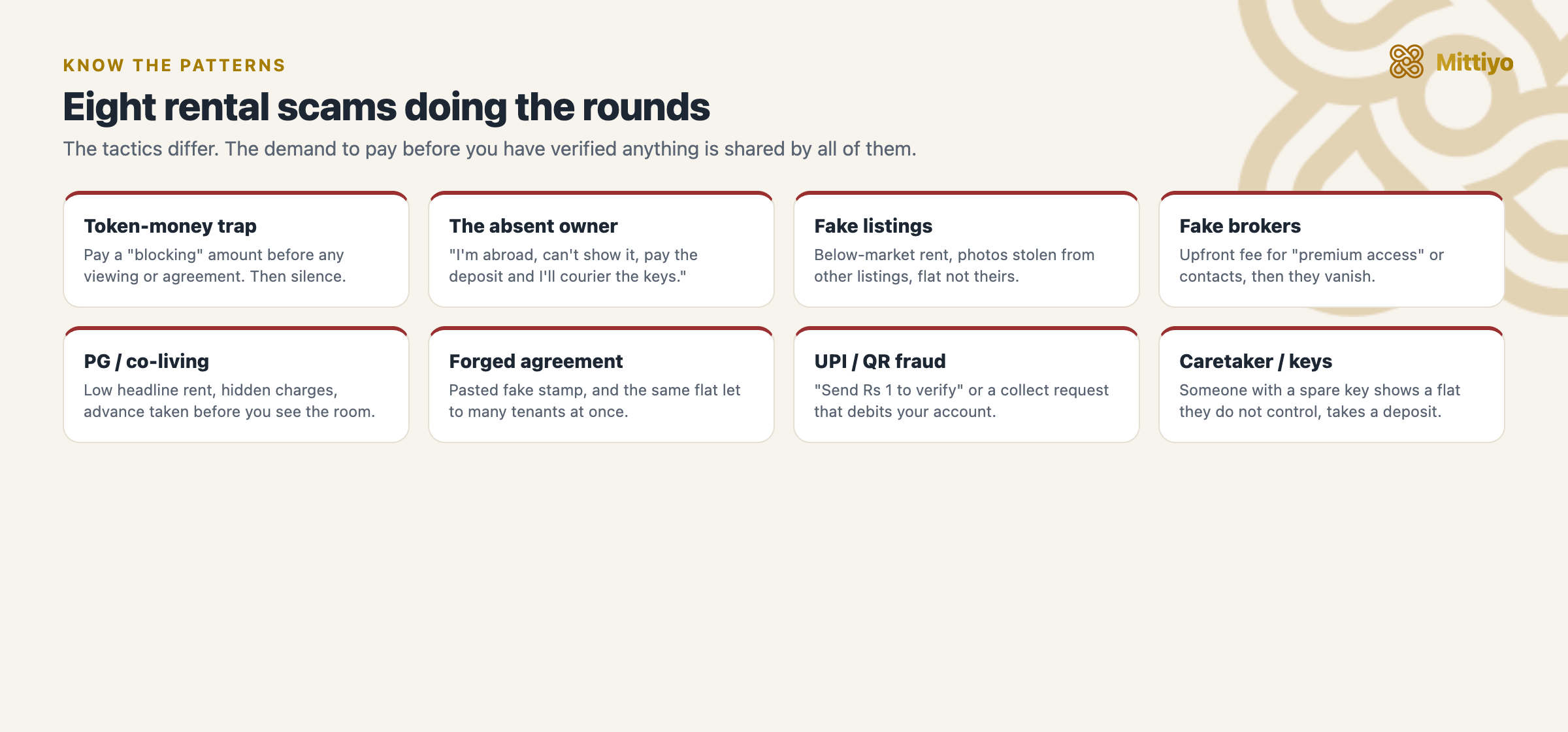 Eight patterns that account for most rental fraud. The tactics differ; the demand to pay early is shared.
1. The token-money / advance trap. A refundable “token” or booking amount is demanded to block the flat, before any viewing or agreement. Once paid, the contact goes dark.
2. The absent owner. The “owner” says they are abroad or transferred and cannot show the flat, so you should pay the deposit and they will courier the keys. This is common enough to deserve its own walkthrough: the “owner abroad, pay the deposit” scam.
3. Fake listings. A too-good flat at below-market rent, advertised with stolen photos lifted from other listings, to harvest advances for a property the scammer does not control. Walked through in detail here: the fake-listing scam.
4. Fake brokers and “premium access” fees. A “broker” charges upfront for premium or verified-listing access, or contact unlocks, then disappears or shows listings that do not exist.
5. PG and co-living booking scams. A low headline rent hides inflated separate charges, and a booking advance is collected before you ever see the room.
6. Forged agreements and double-letting. A soft-copy “agreement” with a pasted, unverifiable stamp is rushed to you, and the same flat is let to several tenants at once, each paying a deposit.
7. UPI and QR fraud. A “send Rs 1 to verify” request, a QR code to scan, or a collect request framed as a refund. Approving it debits your account. (You never enter a UPI PIN to receive money.)
8. The caretaker or keys scam. A caretaker, guard, or someone holding a spare key shows you a flat they do not control, collects a deposit, and vanishes.
Verify before you pay
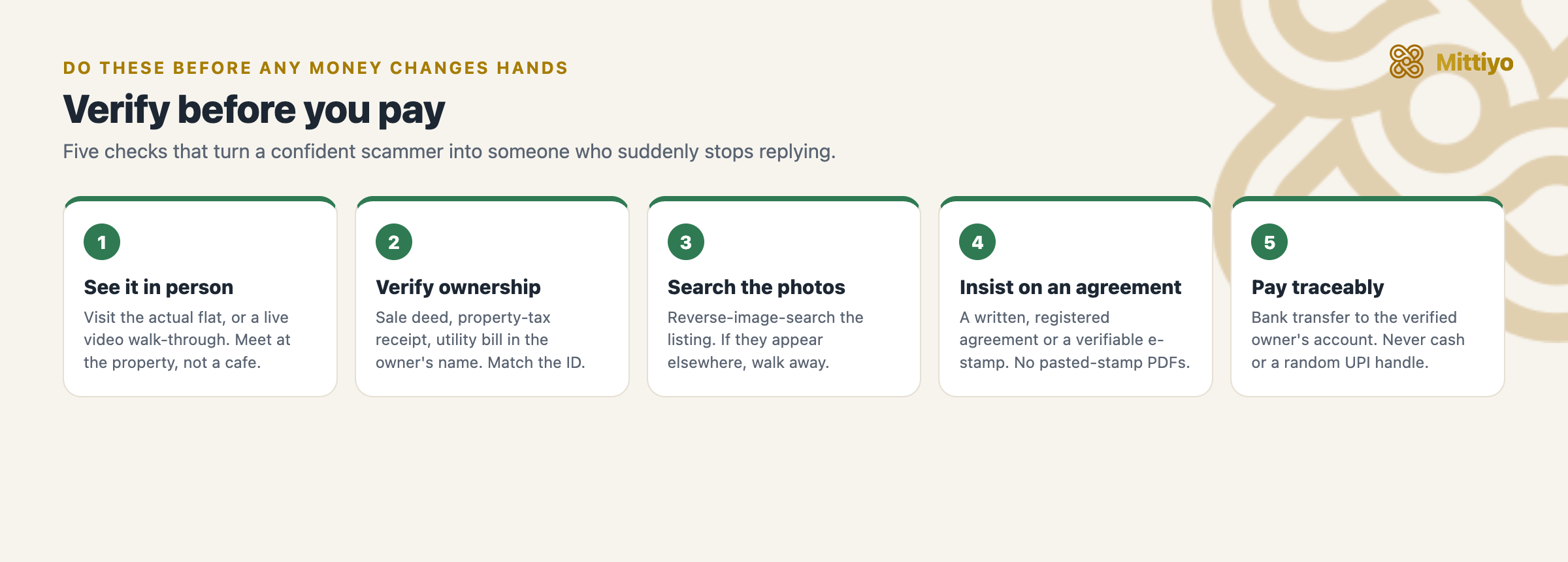 Five checks that turn a confident scammer into someone who suddenly stops replying.
- See it in person, or on a live video walkthrough of the actual flat, never just photos or pre-recorded clips. Meet at the property.
- Verify ownership: ask for the sale deed or title, the latest property-tax receipt, and a utility bill in the owner’s name. Cross-check the name against the owner’s government ID. For certainty, an Encumbrance Certificate from the sub-registrar shows the registered ownership history.
- Reverse-image-search the listing photos. If they appear on other or older listings, walk away.
- Insist on a written, registered agreement (or a genuine e-stamp with a verifiable number). Reject pasted-stamp PDFs.
- Pay traceably, by bank transfer to an account in the verified owner’s name. Never cash, never a random UPI handle, never to “block” a flat you have not seen.
An Encumbrance Certificate is an official record from the sub-registrar’s office that lists the registered transactions on a property, who bought and sold it, and any loans or legal charges registered against it, over a chosen period. In short, it shows who the law recognises as the owner, and whether the property is mortgaged.
For a renter it is the strongest ownership check available. You can apply for an EC online in many states (through the state registration department portal) or in person at the sub-registrar’s office, using the property details. If the name on the EC does not match the person collecting your deposit, stop. It is not something a genuine owner will object to you checking.
Memorise one line: you never need your UPI PIN to receive money. The PIN authorises money leaving your account, so it is only ever needed to send or pay.
That single fact defeats a whole family of scams. If a “landlord” sends you a collect request, asks you to scan a QR code, or tells you to enter your PIN to receive a refund or to verify yourself, approving it sends your money to them. Reject any collect request you did not start, never scan a QR to “get” money, and never share an OTP or PIN. Receiving money needs nothing more than your UPI ID or number.
If you have already been scammed
Speed is everything. The first hour after the fraud, often called the golden hour, is your best chance to get the money frozen at the receiving account before it is withdrawn. Report immediately; do not wait to gather every last detail first.
- Call 1930 immediately. This is the national cyber-crime helpline (operated by the Indian Cyber Crime Coordination Centre under the Ministry of Home Affairs), open 24x7.
- File a complaint at cybercrime.gov.in, the National Cyber Crime Reporting Portal. Upload your chat history, the listing, payment screenshots, and transaction IDs.
- Tell your bank or payment provider at once and ask them to freeze or recall the transaction.
- File a police complaint (FIR) at your local station or cyber cell.
- Report a suspicious caller or SMS on Sanchar Saathi (the Department of Telecommunications portal, which also lets you check the SIM cards issued in your name).
You can also report or verify dubious financial entities on RBI Sachet.
Why this is getting worse, and why verification wins
Online financial fraud in India has grown sharply: cyber-crime cases recorded by the National Crime Records Bureau crossed one lakh in a single year for the first time, and the amounts reported lost have risen many times over in just a few years. Rental fraud rides this same wave, because house-hunting combines money, urgency, and strangers.
The defence has not changed, though. Scammers need you to skip verification. When you insist on seeing the property, checking ownership, and paying only against a real agreement, the scam simply stops working. Honest landlords expect these checks. Only fraudsters are in a hurry to skip them.
Researching a building before you commit?
Scammers thrive on information gaps. know.place is a map of honest, building-level rental experiences across India, where residents share what a building, its rent, and its society are actually like, so you walk in knowing more than a listing can tell you. Rented somewhere before? Add your own experience to help the next person.
Explore know.placeThis guide is general information for awareness, not legal advice. If you have suffered a loss, report it through the official channels above without delay.
Related guides: The “owner abroad, pay the deposit” scam · The fake-listing scam · Security deposit rules · What is a leave and license agreement
References and official channels
- National Cyber Crime Reporting Portal, Indian Cyber Crime Coordination Centre (I4C), Ministry of Home Affairs, and the 1930 cyber-fraud helpline
- Sanchar Saathi, Department of Telecommunications (report fraudulent communications, check SIMs issued on your ID)
- RBI Sachet, Reserve Bank of India (report and verify financial entities)
- UPI FAQs, National Payments Corporation of India (the UPI PIN is needed only to send money, never to receive)