

Chennai has a fearsome reputation among renters, and it comes down to one word: advance. The city is famous for landlords demanding ten months or more upfront. That reputation is out of date, and more importantly it does not match what Tamil Nadu law actually says. Here is what renting in Chennai really costs in 2026, and the statute worth knowing before you negotiate.
TL;DR: Tamil Nadu law says it is unlawful to charge a deposit above three months’ rent (save an agreement to the contrary), and it must be refunded within one month of you vacating. Written agreements are compulsorily registered with the Rent Authority, which is unusual in India. A 1BHK runs roughly 10,000 to 20,000 rupees. Know these before you agree to a big advance.
The advance: what the law actually says
This is the section worth reading before any Chennai negotiation.
The Tamil Nadu Regulation of Rights and Responsibilities of Landlords and Tenants Act, 2017 deals with the deposit in Section 11:
11. (1) Save an agreement to the contrary, it shall be unlawful to charge a security deposit in excess of three times the monthly rent. (2) The security deposit shall be refunded to the tenant within one month after vacation of the premises, after making due deduction of any liability of the tenant.
Two things follow, and both are useful.
- Three months is the legal reference point, not ten. The old ten-month norm has no support in the statute, and in practice the market has already moved: three to six months is what you will usually be quoted today, with the IT corridor generally at the lower end.
- One month to refund, from the date you vacate. That is a concrete, statutory deadline you can point at, which is more than renters in most Indian cities have.
Read Section 11(1) carefully and you will spot the qualifier: “save an agreement to the contrary”. It means the three-month limit is a default, not an absolute ceiling: if your tenancy agreement itself provides for a larger deposit, that agreed figure can still stand. This is exactly why some Chennai landlords still ask for more and are not obviously breaking the law.
So what is it worth? Quite a lot, as a negotiating anchor. Three months is what the legislature considered reasonable, and saying so, politely and specifically, is a much stronger position than haggling on vibes. But do not go in believing a higher advance is automatically void, because the statute’s own wording does not say that. If the number matters to you, settle it before you sign, because once it is in the agreement it is the agreement that governs.
What you actually pay to move in
The listed rent is only the start. Moving into a Chennai flat usually means paying, upfront:
- The advance or security deposit, commonly three to six months’ rent (see the section above before you accept a big number).
- The first month’s rent.
- Brokerage, around one month’s rent plus 18 percent GST, if you use an agent.
- Stamp paper and registration for the agreement.
- Sometimes a society move-in charge or maintenance advance.
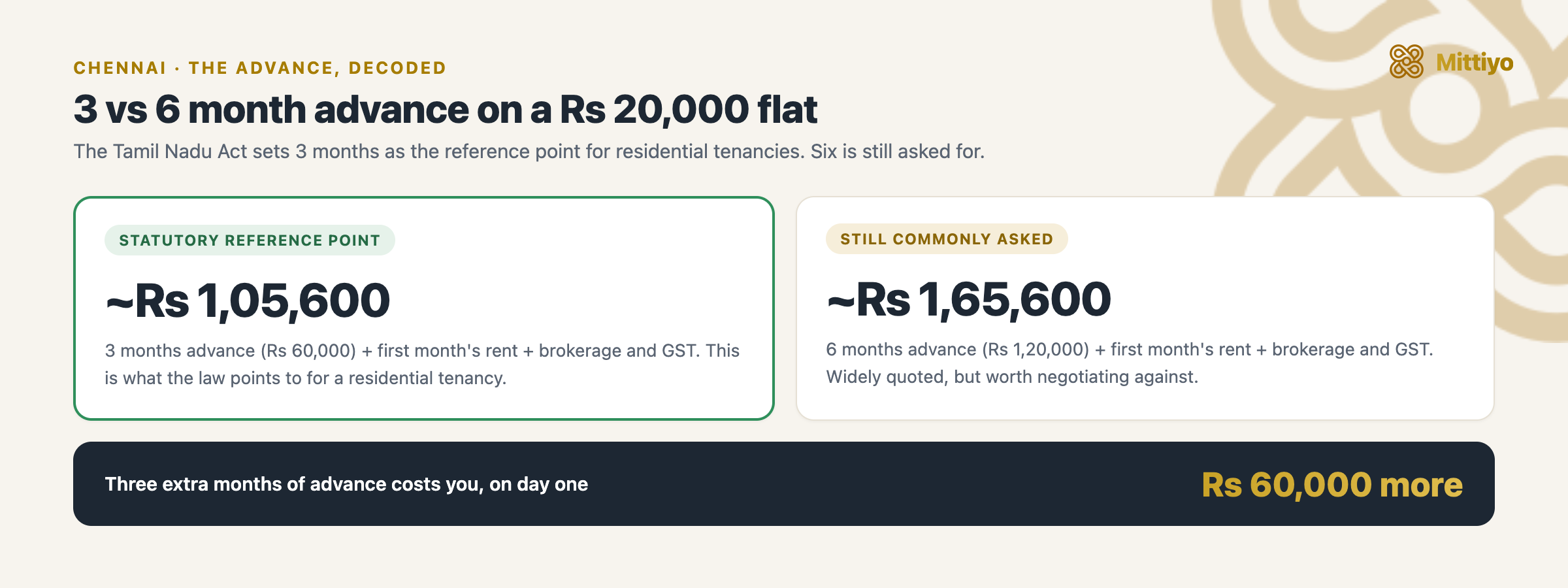
On a 20,000 rupee flat with a three-month advance and one month brokerage, that is 60,000 advance, 20,000 first month, roughly 23,600 including GST brokerage, and a couple of thousand for the agreement: about 105,000 rupees before you move in. At six months’ advance, the same flat costs about 165,000. That difference is exactly why the advance is worth negotiating.
Rent by area and BHK
These are typical 2026 monthly ranges; furnishing, the society’s amenities, floor, and distance from the tech parks all shift the number.
| Belt | Typical areas | 1BHK | 2BHK |
|---|---|---|---|
| IT corridor | OMR, Sholinganallur, Perungudi, Thoraipakkam | 12,000 to 20,000 | 18,000 to 35,000 |
| Well-connected mid | Velachery, Porur, Guindy | 11,000 to 19,000 | 18,000 to 30,000 |
| Established premium | Adyar, Anna Nagar, Besant Nagar | 16,000 to 28,000 | 25,000 to 50,000 |
| Value and outer | Tambaram, Pallikaranai, Ambattur | 8,000 to 14,000 | 12,000 to 22,000 |
Two patterns drive Chennai. First, OMR is a corridor, not a place: rents fall noticeably as you move outward from Perungudi toward Sholinganallur and beyond, so the same budget buys very different commutes. Second, and unusually for an Indian metro, the specific street matters more than the locality, because of flooding. Two flats a few hundred metres apart can have completely different monsoon experiences.
The agreement: registration is mandatory here
This is where Chennai genuinely differs from Mumbai, Pune, Hyderabad or Delhi-NCR, and where the common “11-month agreement” folklore misleads people.
Under Section 4 of the Tamil Nadu Act, no person may let or take premises on rent except by an agreement in writing, which must be informed to the Rent Authority by the landlord and tenant jointly. The Rent Authority then registers the agreement and issues a registration number. Tamil Nadu runs an official Rent Portal for exactly this, and the state’s own portal states that all tenancy agreements must be in writing and compulsorily registered with the Rent Authority.
Two more provisions worth knowing:
- Section 12: after signing, the landlord must give you one original signed and registered agreement within fifteen days. Ask for it; it is your right, not a favour.
- Section 15(4): if the landlord refuses to carry out agreed or scheduled repairs, you may get the work done and deduct it from rent, but not more than fifty per cent of one month’s rent in any single month.
Note that the 11-month convention used elsewhere in India exists to avoid compulsory registration under the Registration Act. In Tamil Nadu, the tenancy statute imposes its own registration requirement regardless, so a short term does not exempt you. Get it registered.
Brokerage, and how to avoid it
The traditional route is a broker charging around one month’s rent, sometimes up to two, plus 18 percent GST. On a 20,000 rupee flat that is roughly 23,600 rupees, and at two months it is nearly 47,000.
Broker-free and owner-direct listings exist in Chennai, particularly along OMR and in the larger gated societies, so it is worth looking before you commit. If you do use a broker, agree the fee and what it covers in writing before you view anything, and never pay brokerage before you have seen the agreement.
Which part of Chennai for whom
- IT professionals cluster along OMR (Perungudi, Thoraipakkam, Sholinganallur) to be near the tech parks, choosing how far out to go based on rent versus commute.
- Value-conscious renters with connectivity take Velachery, Porur or Guindy, which balance rent against access to both the corridor and the city.
- Families and long-term residents prefer Adyar, Anna Nagar and Besant Nagar: established, leafy, well-served, and priced accordingly.
- Budget renters look to Tambaram, Pallikaranai or Ambattur, accepting a longer commute for meaningfully lower rent.
The monthly budget beyond rent
- Society maintenance, from a few hundred rupees to a few thousand in an amenity-heavy society; sometimes on top of rent, sometimes included, so confirm which.
- Electricity, billed by TNEB, and high through Chennai’s long, humid summer with air conditioning.
- Water, the line item to scrutinise here: many buildings depend on tanker water for part of the year, and who pays for it varies. Ask directly.
- Internet and cooking gas, in your name and at your cost.
Common Chennai pitfalls
- Accepting a big advance without negotiating. Section 11(1) gives you a specific, credible anchor at three months. Use it before you sign, not after.
- Skipping Rent Authority registration. It is required here, and an unregistered tenancy leaves you without the statute’s protections and the registration number.
- Ignoring flooding history. Ask specifically about the street, not the area, and if you can, visit or ask neighbours about the last monsoon.
- Water arrangements. Tanker dependence and who pays for it is a real recurring cost; get it in writing.
- Summer electricity. Chennai’s heat makes the air-conditioning bill a genuine budget line; ask about the previous tenant’s typical bill.
- Deposit deductions at exit. A dated move-in inventory with photos is your best protection, and Section 11(2) gives you a one-month refund deadline to point at.
Key takeaways
- The ten-month advance is folklore; the statute’s reference point is three months, with the important caveat that an agreement to the contrary can override it, so negotiate before signing.
- The advance must be refunded within one month of vacating, under Section 11(2).
- Written agreements are compulsorily registered with the Rent Authority, and you are owed an original within fifteen days.
- Rent falls sharply as you move outward along OMR; the specific street matters because of flooding.
- Budget for tanker water and summer electricity, and document the flat’s condition on day one.
This guide is general information for Indian renters, not legal advice; statutes are amended, rules are applied differently in practice, and market rates change, so confirm the current position for your specific flat and read the Act itself before relying on any section. Last reviewed July 2026.
Related: Renting in Hyderabad · Renting in Mumbai · Renting in Pune · Renting in Delhi-NCR · Bengaluru renter handbook · Tenant police verification in India
Free tools: Rent affordability calculator · Rent receipt generator · All free renter tools
Renting somewhere new?
know.place maps honest, structured experiences of specific buildings, the rent, deposit, water, and power, from people who have actually lived there, so you can vet a place before you sign.
References
- Tamil Nadu Rent Portal, Housing and Urban Development Department (official portal for tenancy registration with the Rent Authority): https://www.tenancy.tn.gov.in/
- Tamil Nadu Rent Portal, Acts and Rules (the Tamil Nadu Regulation of Rights and Responsibilities of Landlords and Tenants Act, 2017 and the Rules, 2019): https://www.tenancy.tn.gov.in/Home/Acts
- Ministry of Housing and Urban Affairs, Model Tenancy Act, 2021: https://mohua.gov.in/cms/modeltenancyact.php