

Hyderabad has quietly become one of India’s best-value big-city rental markets: a serious IT economy without Bengaluru’s brutal ten-month deposit or Mumbai’s rents. But the corridor around Gachibowli and HITEC City has its own price gradient, and the paperwork has Telangana-specific quirks. Here is what renting in Hyderabad actually costs in 2026.
TL;DR: Expect rent plus a two to three month deposit (much gentler than Bengaluru), often about one month brokerage, and an 11-month agreement on stamp paper. A 1BHK runs roughly 10,000 to 22,000 rupees depending on area. Police verification is mandatory and is the landlord’s job.
What you actually pay to move in
The listed rent is only the start. Moving into a Hyderabad flat usually means paying, upfront:
- The security deposit, commonly two to three months’ rent.
- The first month’s rent, often in advance.
- Brokerage, around one month’s rent plus 18 percent GST, if you use an agent.
- Stamp paper and, sometimes, registration for the agreement.
- Sometimes a society move-in charge or maintenance advance.
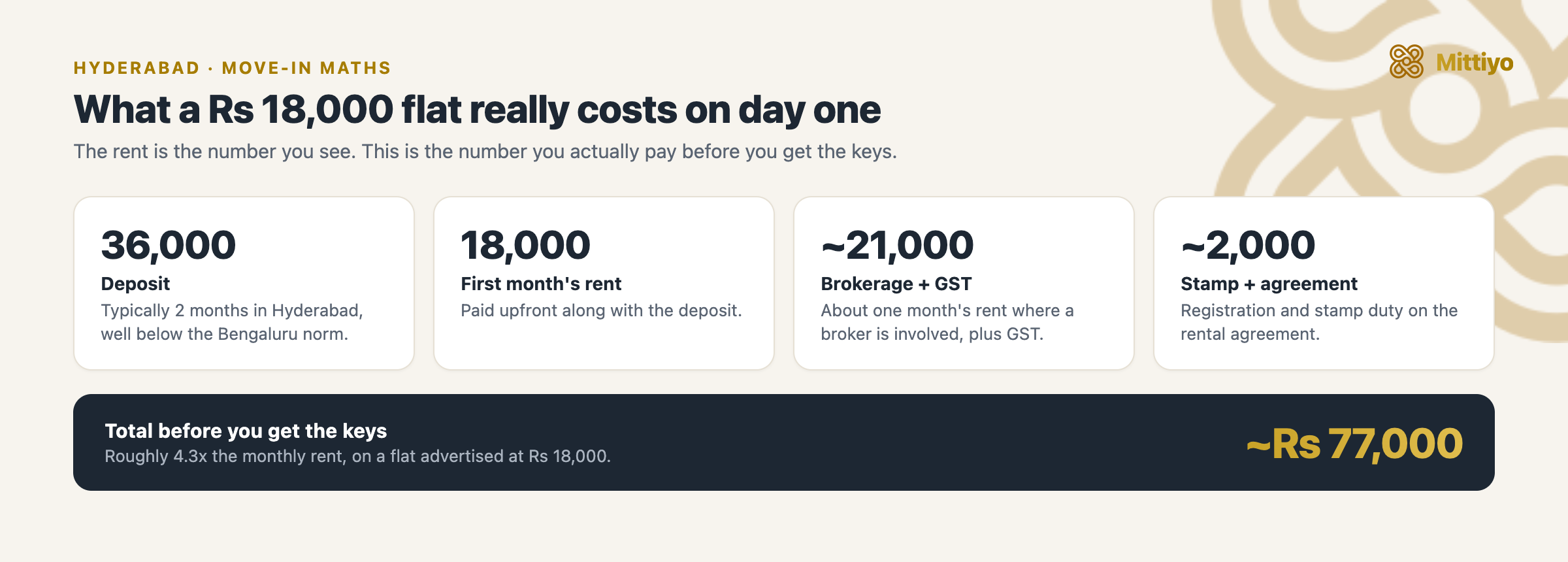
On an 18,000 rupee flat with a two-month deposit and one month brokerage, that is 36,000 deposit, 18,000 first month, roughly 21,000 including GST brokerage, and a couple of thousand for the agreement: about 77,000 rupees before you move in. That is a real number, but it is roughly a third of what the same rent would demand in Bengaluru under a ten-month deposit.
Rent by area and BHK
Hyderabad’s rent map follows its IT map. These are typical 2026 monthly ranges; furnishing, the society’s amenities, floor, and metro access all shift the number.
| Belt | Typical areas | 1BHK | 2BHK |
|---|---|---|---|
| Prime IT corridor | Gachibowli, Financial District | 15,000 to 22,000 | 24,000 to 40,000 |
| HITEC City belt | Madhapur, Hitech City, Kondapur | 13,000 to 20,000 | 18,000 to 32,000 |
| Value with metro | Miyapur, Kukatpally, Nizampet | 9,000 to 15,000 | 14,000 to 24,000 |
| Central / older city | Begumpet, Ameerpet, Secunderabad | 10,000 to 18,000 | 16,000 to 28,000 |
Two patterns drive the market. First, there is a steep gradient across the IT corridor itself: a comparable 2BHK can cost noticeably less in Kondapur than in Gachibowli or Madhapur, for a modest addition to your commute, which is why Kondapur is the classic value pick. Second, the metro (Blue Line through Hitech City and Madhapur) is a genuine lever: being walkable to a station changes your daily life in a city where corridor traffic is heavy.
The security deposit
The deposit is the biggest single figure to plan for and to document.
- How much: two to three months is standard in Hyderabad. This is the city’s quiet advantage, and it is worth appreciating: Bengaluru’s traditional ten months makes the same rent cost several times more on day one.
- It is refundable: you get it back when you vacate, less lawful deductions for damage beyond normal wear and any unpaid dues. It is not a fee.
- Document it: the agreement should state the deposit, what may be deducted, and when it will be returned. A dated move-in inventory with photos is your best protection against unfair deductions at exit.
Brokerage, and how to avoid it
The traditional route is a broker charging around one month’s rent plus 18 percent GST, sometimes negotiable to half a month. On an 18,000 rupee flat that is roughly 21,000 rupees.
Hyderabad’s IT corridor has a large broker-free and owner-direct rental scene, particularly in the big societies around Gachibowli, Kondapur and Miyapur, and plenty of renters here pay no brokerage at all. If you do use a broker, agree the fee and what it covers in writing before viewing, and never pay brokerage before you have seen the agreement.
The agreement and registration
Most Hyderabad residential rentals use an 11-month agreement on stamp paper. That term is a long-standing convention: under the Registration Act, a lease of 12 months or longer generally must be registered, so the 11-month framing keeps registration optional. Telangana’s older rent-control statute, the Telangana Buildings (Lease, Rent and Eviction) Control Act, 1960, still sits in the background; the state has not adopted the central Model Tenancy Act.
Whatever the term, get the agreement in writing, properly stamped, with the rent, deposit, notice period, and deduction rules all stated. Stamp duty and registration charges are payable to the Telangana Registration and Stamps department, and the rate is set by the state, so confirm the current figure with them or your service provider rather than relying on a number from a listing site. A properly stamped written agreement is your main proof of the tenancy and the deposit.
Police verification
Tenant police verification is mandatory in Telangana, and it is the landlord’s responsibility, not yours. It can be filed through the Telangana Police online route or at the local police station, and you cooperate by providing ID, address proof, and photographs. Complete it, ask for a copy of the acknowledgement, and treat it as a normal part of moving in. For the full process and documents, see our guide to tenant police verification in India.
Which part of Hyderabad for whom
- IT professionals at the big campuses pick Gachibowli, Madhapur or the Financial District to keep the commute short, paying the most for it.
- Value-conscious professionals take Kondapur or Nizampet: much of the same access to the corridor, noticeably lower rent.
- Metro-first renters and students lean to Miyapur and Kukatpally, where rent is lowest with a straight metro run into the corridor.
- Families often prefer the gated societies of Kondapur, Gachibowli and Nizampet for schools, parks and security, accepting higher maintenance for the amenities.
The monthly budget beyond rent
Plan for recurring costs beyond rent:
- Society maintenance, from a few hundred rupees in a small building to a few thousand in an amenity-heavy corridor society; sometimes on top of rent, sometimes included, so confirm which.
- Electricity, billed by TSSPDCL, and higher through Hyderabad’s long, hot summer with air conditioning running.
- Water, often covered by maintenance in societies, but worth checking in standalone buildings, some of which rely on tankers.
- Internet and cooking gas, in your name and at your cost.
Common Hyderabad pitfalls
- Assuming the whole corridor costs the same. The Gachibowli-to-Kondapur gradient is real; shifting a few kilometres can cut rent meaningfully.
- Summer electricity. Air conditioning through a Hyderabad summer is a genuine line item; ask about the previous tenant’s typical bill.
- Water source. Ask whether the building is on municipal supply or borewell, and whether tankers are used in summer.
- Society move-in rules. Many societies want their own formalities and charges before you move in; ask before you commit.
- Deposit deductions at exit. The most common dispute is over the deposit; a dated move-in inventory with photos is your best protection.
Key takeaways
- The upfront lump sum is the real hurdle, but Hyderabad’s two to three month deposit makes it far lighter than Bengaluru.
- Rent tracks the IT corridor: Gachibowli and Madhapur at the top, Kondapur the value pick, Miyapur and Kukatpally cheapest with metro access.
- The deposit is refundable and must be documented with its deduction rules.
- Use a written, properly stamped agreement; 11 months keeps registration optional, 12 months or more generally requires it.
- Police verification is mandatory and is the landlord’s duty; keep the acknowledgement.
This guide is general information for Indian renters, not legal advice; rules, stamp duty and market rates change, so confirm the current position for your specific flat and area. Last reviewed July 2026.
Related: Renting in Chennai · Renting in Mumbai · Renting in Pune · Renting in Delhi-NCR · Bengaluru renter handbook · Tenant police verification in India
Free tools: Rent affordability calculator · Rent receipt generator · All free renter tools
Renting somewhere new?
know.place maps honest, structured experiences of specific buildings, the rent, deposit, water, and power, from people who have actually lived there, so you can vet a place before you sign.
References
- Telangana Registration and Stamps Department (stamp duty and registration of documents): https://registration.telangana.gov.in/
- Ministry of Housing and Urban Affairs, Model Tenancy Act, 2021: https://mohua.gov.in/cms/modeltenancyact.php
- The Registration Act, 1908 (leases of 12 months or more require registration), India Code: https://www.indiacode.nic.in/handle/123456789/2190