

Renting in India is easy to do and full of things nobody warns you about. There is no legal barrier to a foreigner renting a home here, and the actual mechanics, find a place, sign an agreement, pay, move in, are simple enough. What trips up newcomers is everything around the edges: a security deposit several times larger than back home, a lease deliberately written for eleven months, a legal form your landlord must file about you, and building rules that would be unlawful in many countries.
This guide is the orientation nobody hands you: how the process actually works, what the money looks like, the documents you need, the paperwork your landlord owes the authorities, the restrictions to expect, and how to avoid the scams that disproportionately target foreigners. Two topics, the Form C registration and the deposit-refund fight, are deep enough to have their own guides, linked below.

This is the main guide, and it covers the essentials for any foreigner renting in India. Depending on your situation, one of these companion guides goes deeper:
- Coming to study? See international students renting in India.
- An Indian-origin person moving back? See moving back to India as an NRI, your paperwork is often lighter.
- Sorting out registration? See FRRO and Form C for foreign tenants.
- Worried about the deposit? See how to get your security deposit back.
How renting in India is different
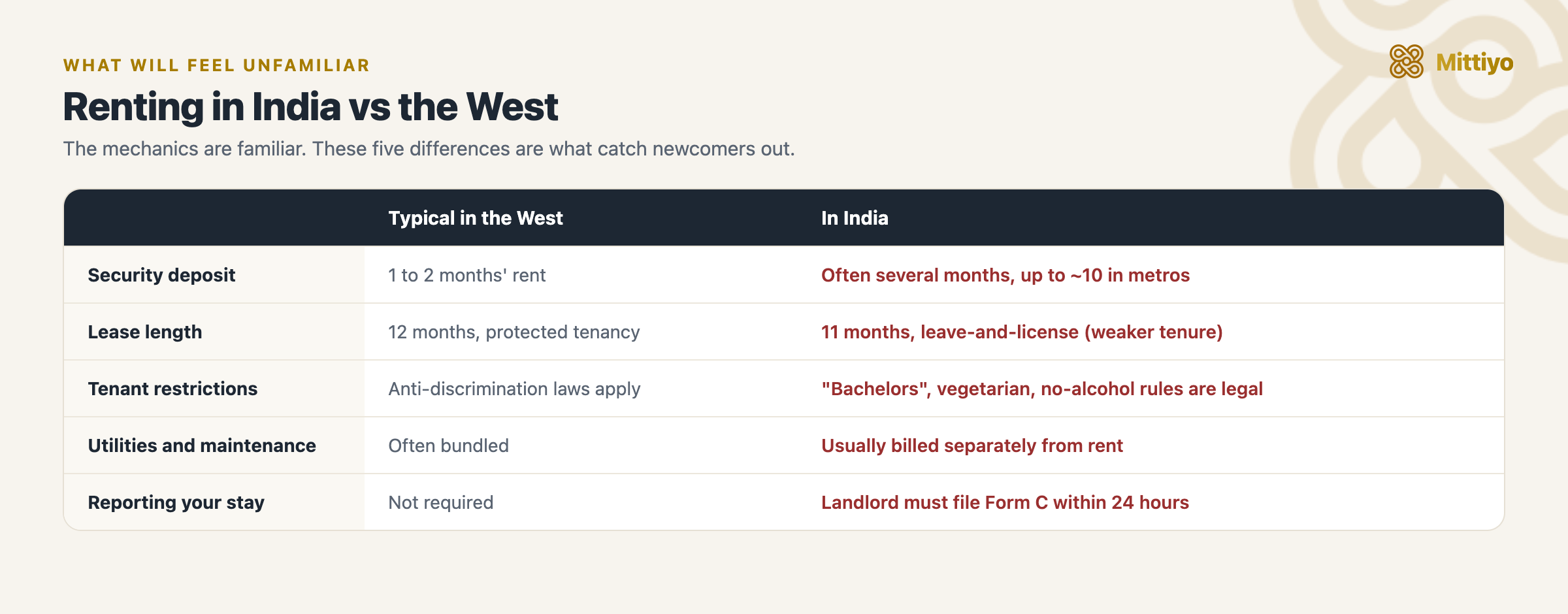 The mechanics are familiar; the deposit size, the lease structure, and the building rules are not.
If you are coming from the US, UK, or Europe, four things will feel unfamiliar:
- The deposit is much bigger. Not one month, often several (see below).
- The lease is eleven months, not a year, by design.
- Building rules can be strict and personal, including who is allowed to rent at all.
- Rent usually excludes the extras, maintenance charges, electricity, water, gas, and internet are typically separate.
None of it is a dealbreaker. It is just different, and knowing it in advance saves you money and surprise.
The money: deposits and what rent includes
The security deposit is the single biggest financial difference. Where a Western landlord asks for one to two months, an Indian landlord, especially for an unfurnished flat in a metro, has historically asked for six to ten months’ rent up front. Furnished flats and broker-mediated deals are often gentler, around two to three months.
The Model Tenancy Act, 2021 recommends capping residential deposits at two months’ rent, but it is a model law that binds only the states that have adopted it, so across much of the country the higher customary deposits still rule. The deposit is refundable when you leave, minus legitimate deductions (unpaid rent or bills, real damage). Getting a full, timely refund is a common friction point, so photograph the flat and agree a written inventory at move-in. (For the full playbook, see how to get your security deposit back.)
On top of rent, budget for society maintenance charges, electricity, water, gas, and internet, which are usually billed separately. Confirm line by line what your rent does and does not include.
The documents you need
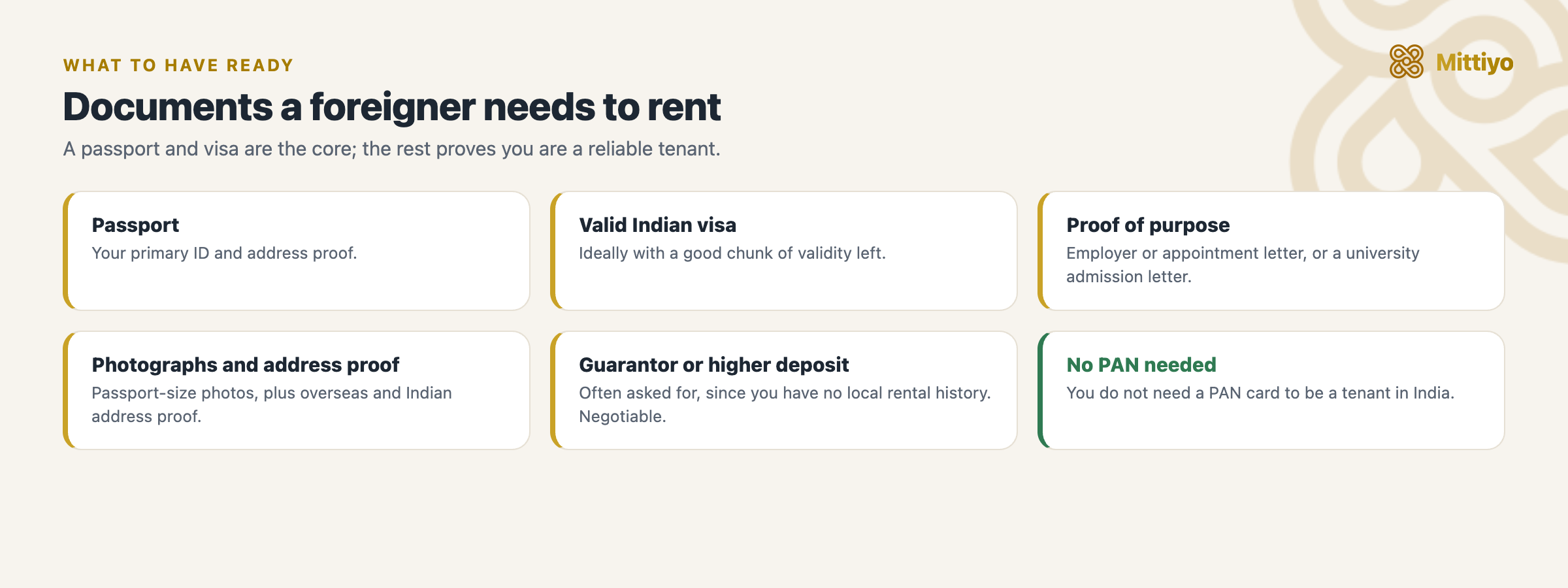 A passport and visa are the core; the rest is about proving you are a reliable tenant.
Landlords typically ask for:
- Your passport and a valid Indian visa.
- Proof of purpose: an employer or appointment letter, or a university admission letter.
- Passport-size photographs and, often, an overseas and Indian address proof.
- Sometimes a local guarantor or reference, or a higher deposit, since you have no local rental history.
You do not need a PAN card to be a tenant. Keep copies of everything, and confirm your landlord will file your Form C (next section).
The paperwork: the 11-month lease and Form C
Two pieces of paperwork define renting here.
The 11-month leave-and-license agreement. Under the Registration Act, 1908, a lease of twelve months or more must be registered and can trigger rent-control protections. To avoid that, agreements are written for eleven months on a “leave and license” basis, which makes you a licensee rather than a protected long-term tenant. They are routinely renewed, but your security of tenure is weaker than a Western lease. Get the agreement e-stamped, read the deposit, maintenance, and notice clauses, and consider registering it voluntarily for stronger standing.
A lease gives a tenant a legal interest in the property and, historically, strong protection against eviction. A leave and license is narrower: the owner simply “licenses” you to occupy the flat for a fixed period, without handing you those tenancy rights. You get a place to live; the owner keeps control and avoids the older rent-control regime.
For you as a renter this means two things. Your tenure is less protected than a Western lease, so read the notice and renewal terms carefully. But it is also standard and legitimate, nearly all urban residential renting in India runs on 11-month leave-and-license agreements. It is normal; just know what it is.
Stamp duty is a small state tax you pay to make a document legally valid evidence. E-stamping is the online way of paying it, you get a computer-generated stamp certificate (in most states through the authorised agency) instead of buying physical stamp paper. Your rental agreement should be printed on or attached to this e-stamp certificate and signed by both parties.
An unstamped or under-stamped agreement can be hard to rely on in a dispute, so insist the agreement is properly e-stamped for the correct value. The cost is modest and is usually the tenant’s to bear, but agree who pays before signing.
Form C, your landlord’s legal duty. When a foreigner stays at a property, the landlord or host must report your stay to the authorities, generally within 24 hours, using Form C (now Form III under the Immigration and Foreigners Act, 2025). This is the landlord’s obligation, not yours, and it applies to private landlords, not just hotels. Separately, if your visa is for more than 180 days, you must register with the FRRO yourself, usually within 14 days of arrival. Because some landlords are unfamiliar with Form C, confirm they will file it before you commit. (Full detail: FRRO and Form C for foreign tenants.)
The rules in this guide apply to foreign nationals, anyone on a foreign passport. Two edge cases matter:
- OCI (Overseas Citizen of India) cardholders are people of Indian origin who hold a foreign passport with lifelong-visa privileges. Convenient as that is, an OCI cardholder is still a foreign national for host-reporting, so your landlord may still need to file Form C. OCI is not Indian citizenship.
- Indian citizens returning from abroad (NRIs) travel on an Indian passport and are not foreigners, so Form C and FRRO do not apply to them. If that is you, the returning-NRI guide is the right one.
If you are unsure which bucket you fall into, check before you assume, it changes your paperwork.
The restrictions nobody warns you about
This is where India surprises Western renters most. Many buildings and landlords impose restrictions that would be unlawful elsewhere:
- “Bachelors not allowed.” Many societies refuse single or unmarried tenants and prefer families; some set gender rules.
- Vegetarian-only and no-alcohol buildings. In parts of west and south India, some societies prohibit cooking or eating meat, and some ban alcohol.
- Rules on guests, visitors, and pets, set by the landlord or the housing society.
India has no dedicated anti-discrimination law for the rental market, so these restrictions are legal and common. Ask about them before you fall in love with a flat.
The rental process, step by step
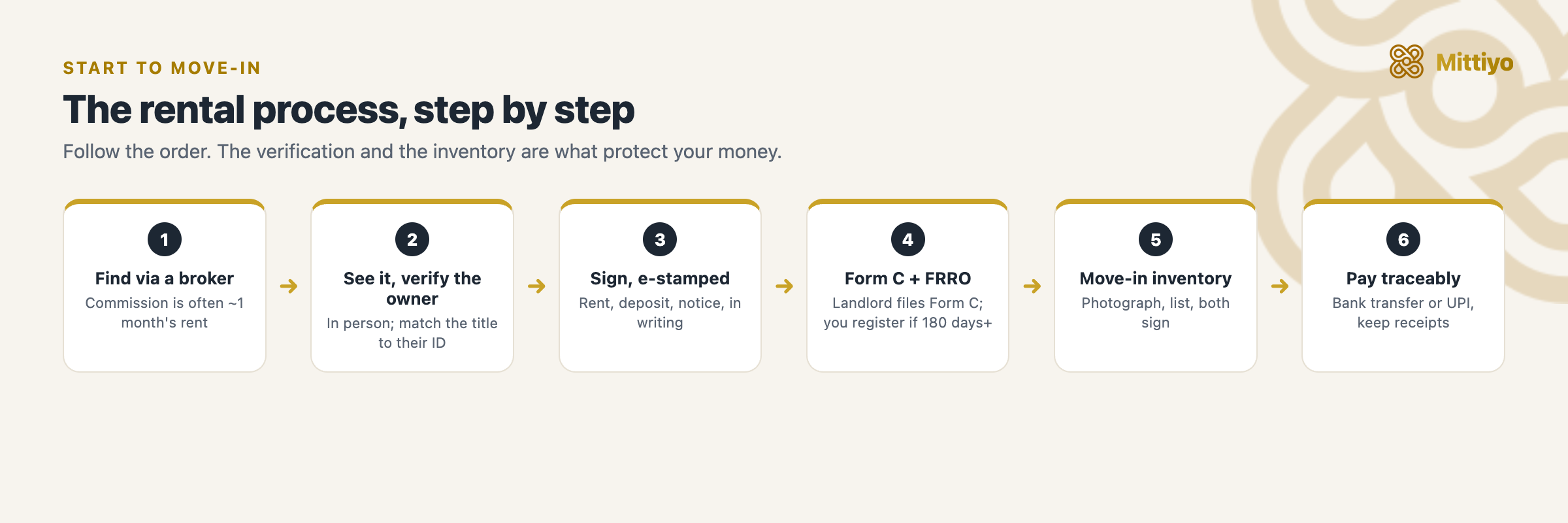 Follow the order. The verification and the inventory are what protect your money.
- Find a place. Most rentals go through a local broker or agent, whose commission is commonly about one month’s rent; agree who pays before you start.
- See it in person and verify the owner. Never pay for a flat you have only seen online. Ask for a property-tax receipt or title and match the name to the landlord’s ID.
- Negotiate and sign an e-stamped agreement. Settle rent, deposit, maintenance, notice period, and any lock-in, in writing.
- Complete Form C (landlord) and your FRRO registration if your visa is over 180 days.
- Do a move-in inventory. Photograph the flat, list existing damage and fixtures, and have both sides sign it, this is what protects your deposit refund.
- Pay traceably. Cheque, bank transfer, or UPI with receipts. Avoid large cash.
Staying safe: scams target foreigners
Fake-landlord and advance-deposit scams disproportionately target foreigners, who cannot easily verify local ownership and may be pressured to wire a deposit before arriving. The rule is simple: see the property in person or on a live video, verify the owner, and never pay a deposit before a written agreement. If someone claims to be abroad and asks you to wire money to “hold” a flat, walk away. (See how to spot a rental scam and, for the classic version, the “owner is abroad” scam.)
Key takeaways
- A foreigner can rent freely in India; the mechanics are simple, the customs are not.
- Expect a large security deposit (often several months, sometimes up to ten in metros); the two-month cap applies only in states that adopted the Model Tenancy Act.
- Agreements are 11 months by design, and you are a licensee, not a protected tenant. Get it e-stamped.
- Your landlord must file Form C within 24 hours; if your visa is over 180 days, you must register with the FRRO.
- Expect building restrictions (bachelor, vegetarian, alcohol) that are legal here, and verify ownership and never wire a deposit to avoid scams.
New to a city in India and don't know the buildings?
As a newcomer you have no local read on which buildings and landlords to trust. know.place is a map of honest, building-level rental experiences across India, where residents say what a building, its rent, and its society are actually like, before you sign or wire anything.
Explore know.placeThis guide is general information, not legal advice; rules vary by state, visa, and nationality, so verify your specific position and consult a professional where needed.
Related guides: FRRO and Form C for foreign tenants · How to get your security deposit back · How to spot a rental scam · Apartment viewing checklist
References
- The Model Tenancy Act, 2021, Ministry of Housing and Urban Affairs (recommended two-month deposit cap; a model law states must adopt)
- The Registration Act, 1908 (compulsory registration for leases of twelve months or more)
- e-FRRO portal and Form C, Bureau of Immigration (the landlord’s duty to report a foreign tenant)
- The Immigration and Foreigners Act, 2025 (the current law on foreigner registration, replacing the Foreigners Act, 1946)