

Arizona keeps its security deposit rules in one tidy statute, and they favor renters who know the clock. The state caps what a landlord can hold, forces the money back fast once you ask for it, and doubles the penalty when a landlord keeps it without cause. This guide walks through every part with the section numbers so you can check the law yourself.
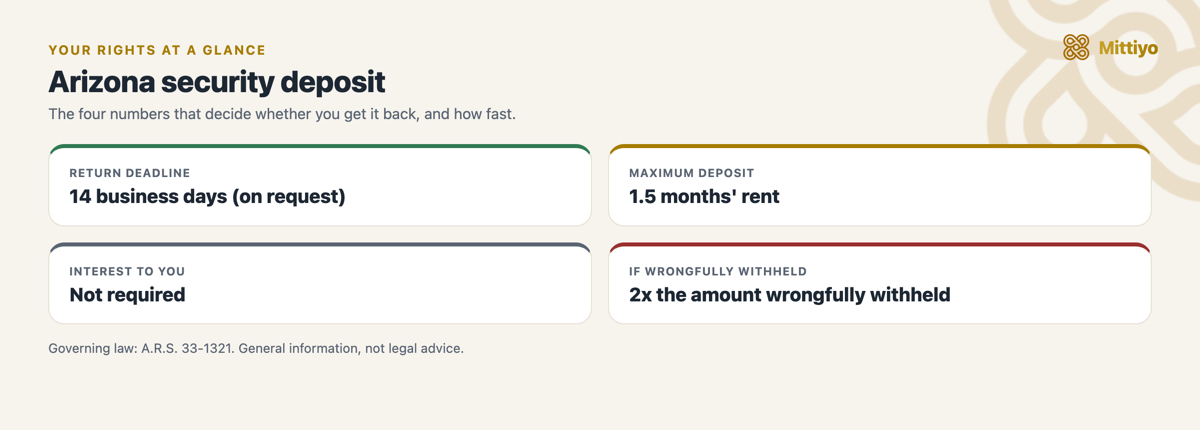
TL;DR: An Arizona landlord can hold no more than one and one-half months’ rent. After the tenancy ends, you return possession, and you demand your deposit, the landlord has 14 business days to send an itemized list of any deductions and return the balance. Miss that, and you can recover the amount wrongfully withheld plus twice that amount in damages.
How much can a landlord charge in Arizona
The cap is one and one-half months’ rent. Under A.R.S. 33-1321(A), a landlord cannot demand or receive security worth more than that, whatever they choose to call it. Add up every refundable charge held against your tenancy, and the total cannot cross the 1.5-month line.
Fees are the part renters misread. A landlord can charge a nonrefundable fee, but only if the purpose is stated in writing and the fee is labeled nonrefundable. This is 33-1321(B), and it has teeth: any fee or deposit that is not designated as nonrefundable in writing is refundable. So a vague cleaning or admin fee with nothing in writing is money you are owed back, not money the landlord gets to keep.
Arizona also gives you a move-in tool. Under 33-1321(C), the landlord must provide a move-in form so you can document existing damage, and written notice that you may be present at the move-out inspection. Fill that form in carefully; it is the record that decides most disputes.
When you must get your deposit back
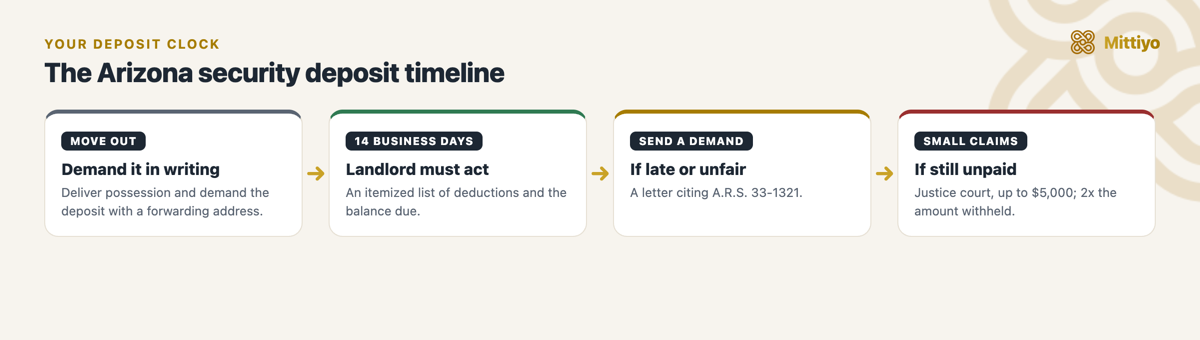
The clock is 14 business days, and three things have to happen before it starts: the tenancy ends, you deliver possession back to the landlord, and you demand the deposit. Once all three are done, 33-1321(D) gives the landlord 14 days, excluding Saturdays, Sundays, and legal holidays, to provide an itemized list of every deduction and return the balance due.
Business days matter here. Fourteen business days is close to three calendar weeks, so count carefully and do not assume the landlord is late a day early. And because the tenant’s demand is one of the triggers, make it in writing and include a forwarding address. That single step starts the clock cleanly and removes any excuse that the landlord did not know where to send the money.
A worked example
Say your deposit was $1,500. The lease ends, you hand back the keys, and you send a written demand with your forwarding address. Fourteen business days pass. The landlord returns nothing and sends no itemized list.
Under 33-1321(E) you can recover the money wrongfully withheld, the full $1,500, plus damages equal to twice that amount, another $3,000. That is $4,500 in total. The double-damages piece is calculated on the amount wrongfully withheld, so the more the landlord tries to keep without cause, the larger the penalty grows.
Interest and how your deposit is held
Arizona sets no interest requirement. Your deposit does not have to accrue or pay interest to you, and the statute is silent on where the landlord must hold it. What the statute does police is the fee label: a charge only stays with the landlord if it was put in writing as nonrefundable, so the written-fee rule from 33-1321(B) is the real protection, not interest.
What a landlord can and cannot keep
A landlord can deduct for unpaid rent and for actual damage beyond ordinary use. A landlord cannot charge you for normal wear and tear, the ordinary aging that comes from simply living in a place. Everything kept must appear on the itemized list.
Common landlord tactics, and how to beat them
A few moves come up again and again. A landlord charges a flat cleaning or repainting fee against every tenant regardless of condition; a routine repaint is normal upkeep, not your damage. A landlord keeps a “nonrefundable” fee that was never put in writing; under 33-1321(B) that fee is refundable, so ask for it back. A landlord bills the full cost of a carpet or paint job that was already worn; those costs should be prorated for age, not charged to you in full.
Your two strongest cards are the move-in form and your written demand. The move-in form fixes the condition of the unit on the day you arrived, and the written demand starts the 14 business-day clock and creates the record you will need if the landlord stalls.
If your landlord wrongfully keeps it
The remedy sits in A.R.S. 33-1321(E). If the landlord fails to comply with the return rules in subsection D, you may recover the property and money due to you together with damages equal to twice the amount wrongfully withheld. Read that carefully: you get the withheld amount back and, on top of it, a penalty of double that amount.
Two conditions have to be met first. The tenancy has to have ended with you delivering possession, and you have to have demanded the deposit. Once those are met and the 14 business days pass with no itemized list and no return, the penalty is on the table.
How to write a demand letter
Before you file, send a written demand. In Arizona it does double duty: it is the demand that starts the clock, and it is the letter that often produces a check within days. Fill in the tool below and it builds the letter for you.
Fill in your details and the letter below updates live. Copy it, then paste into an email or print and post it.
[Date]

To: [Landlord name and address]

Re: Return of security deposit, [rental address]

To whom it may concern,

I rented [rental address] and moved out on [move-out date], returning possession and giving my forwarding address at [your forwarding address]. Under Arizona's Residential Landlord and Tenant Act (A.R.S. 33-1321), you had 14 business days to return my [$ amount] security deposit with an itemized list of any deductions. That deadline has passed.

Please return the [$ amount] you owe me within 10 days of this letter. If you do not, I will file in justice court small claims for the deposit plus damages equal to twice the amount wrongfully withheld, as allowed by A.R.S. 33-1321.

Sincerely,
[Your name]
This is a template to adapt, not legal advice. Keep a copy and send it so you can prove delivery (email, or post with tracking).
Taking it to small claims court in Arizona
If the demand letter does not work, deposit cases go to the small claims division of the justice court. The limit is $5,000, which comfortably covers a deposit plus the double-damages penalty, and it costs about $58 to file. Arizona small claims is built for people without lawyers: under A.R.S. 22-512, attorneys are not allowed unless both parties agree in writing, so you will not be outgunned by a landlord’s lawyer.
When you go, bring your lease, proof you paid the deposit, dated move-in and move-out photos, the move-in form, the itemized list the landlord sent or proof that none came, and a copy of your written demand.
Local rules: Arizona is uniform
Deposit rules in Arizona are set by the Residential Landlord and Tenant Act and apply the same everywhere in the state. No Arizona city imposes a stricter deposit cap, a different return deadline, or its own interest rule, so the 33-1321 rules in this guide hold whether you rent in Phoenix, Tucson, Mesa, or a small town.
How to get your deposit back
- Fill in the move-in form and take dated photos the day you arrive, so you have a before-and-after record.
- When you leave, deliver possession and send a written demand for the deposit with your forwarding address, which starts the 14 business-day clock.
- Count the deadline in business days, not calendar days, and know an itemized list is due with any deductions.
- If the deadline passes, send a demand letter citing A.R.S. 33-1321.
- If that fails, file in justice court small claims for the deposit plus twice the amount wrongfully withheld.
Key takeaways
- A landlord can hold no more than one and one-half months’ rent, and any fee not labeled nonrefundable in writing is refundable.
- The return clock is 14 business days, and it only starts once the tenancy ends, you deliver possession, and you demand the deposit.
- Missing the deadline exposes the landlord to the amount wrongfully withheld plus twice that amount in damages.
- Arizona requires no interest, so the written-fee rule is your main protection against surprise charges.
- Deposit claims go to justice court small claims, where the $5,000 limit fits easily and attorneys are barred unless both sides agree.
This guide is general information, not legal advice; landlord-tenant rules change and can vary by city, so confirm against the sources below or a local attorney. Last reviewed July 2026.
Renting somewhere new?
know.place maps honest, structured experiences of specific buildings, the rent, deposit, water, and power, from people who have actually lived there, so you can vet a place before you sign.
Related: Security deposit laws by state · How much rent can you afford? · Apartment viewing checklist
Free tools: Deposit interest calculator · Notice to vacate generator
References and resources
- A.R.S. 33-1321, Arizona security deposit statute: https://www.azleg.gov/ars/33/01321.htm
- A.R.S. 22-503, small claims jurisdiction ($5,000 limit): https://www.azleg.gov/ars/22/00503.htm
- A.R.S. 22-512, small claims attorneys rule: https://www.azleg.gov/ars/22/00512.htm
- Arizona Courts, Landlord and Tenant Obligations: https://www.azcourts.gov/legalinfohub/Legal-Info-Sheets/Landlord/Tenant-Disputes-amp-Eviction/Landlord-and-Tenant-Obligations/1000
- Maricopa County Justice Courts, Small Claims: https://justicecourts.maricopa.gov/case-types/small-claims
- HUD Arizona tenant rights: https://www.hud.gov/states/arizona/renting/tenantrights