

California rewrote its deposit rules with AB 12, and the change matters to every renter in the state. Your landlord now holds less of your money, must account for it fast, and faces real penalties for keeping it without cause. This guide walks through the cap, the return deadline, what counts as a fair deduction, and the exact steps to get your money back.
TL;DR: In California your landlord must return your deposit with an itemized statement within 21 days of move-out, and for most landlords the deposit is capped at one month’s rent.
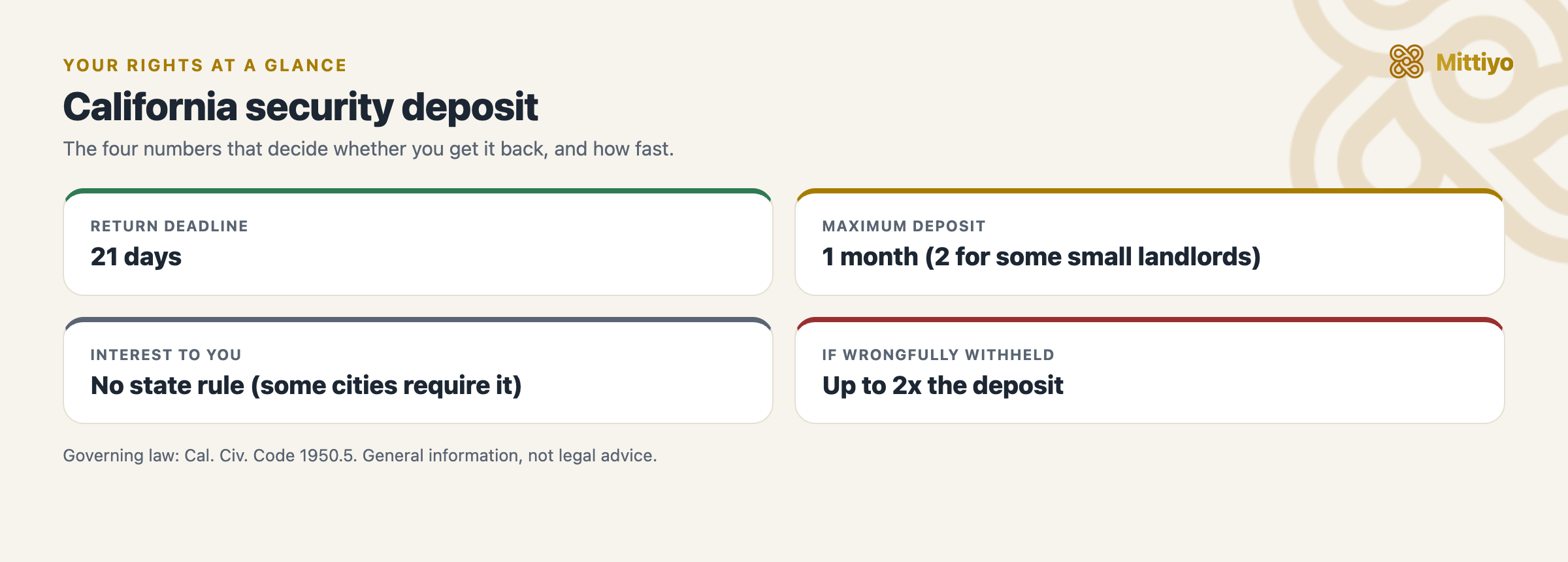
How much can a landlord charge in California
Under AB 12, most landlords may collect no more than one month’s rent as a security deposit, and that limit applies whether the unit is furnished or unfurnished.
There is one narrow exception. A small landlord, defined as someone who owns no more than two residential rental properties that together hold no more than four units, may collect up to two months’ rent. Even then, if you are an active service member, your deposit is capped at one month’s rent regardless of who owns the building.
The cap counts everything. A landlord cannot get around it by labeling money as last month’s rent, a cleaning fee, or a pet deposit. Add all of those together and the total still cannot exceed the applicable limit.
When you must get your deposit back
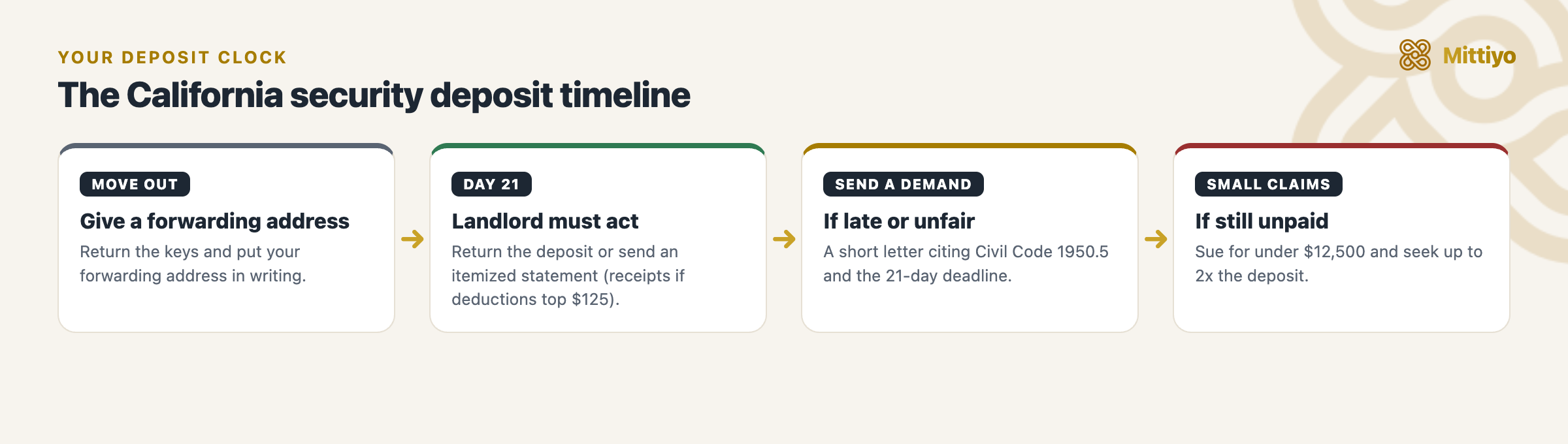
The clock is 21 calendar days. Within 21 days after you vacate and return possession, the landlord must return your full deposit or send you an itemized statement listing each deduction, with whatever balance is left.
The statement has to be specific. If the deductions for repairs and cleaning add up to more than $125, the landlord must attach copies of receipts or invoices showing what the work actually cost. A round number with no paperwork does not meet the standard.
Give the landlord a forwarding address in writing so they know where to send the money. If you do not provide one, the landlord can mail the deposit and statement to the unit you just left.
A worked example
Say you paid a $2,000 deposit. On inspection, the landlord finds a genuinely damaged interior door and pays $250 to repair it, keeping the receipt. Within 21 days you get an itemized statement, the $250 invoice, and a check for $1,750. That is a clean, lawful deduction, and you have no claim.
Now change the facts. The landlord keeps $600, sends no itemization, no receipts, and nothing arrives until day 30. That is a different situation. You gave a proper forwarding address, the deadline passed, and the withholding looks like it was made in bad faith. In that case you can seek the return of the deposit plus statutory damages of up to twice the deposit amount, along with your actual damages. On a $2,000 deposit, the statutory piece alone can reach $4,000, which is why landlords who follow the rules do the math and pay on time.
Interest on your deposit
California has no statewide requirement that landlords pay interest on deposits. Some cities impose one anyway.
San Francisco requires landlords to pay annual interest on deposits, at a rate the SF Rent Board sets each year, which has recently been around 5%. Berkeley requires interest on units covered by its rent ordinance, paid to tenants each December. Los Angeles requires annual interest on Rent Stabilization Ordinance units that a landlord has held for a year or more.
Rates change every year, so if you rent in one of these cities, check the current rate published by your local rent board rather than assuming last year’s figure.
What a landlord can and cannot keep
California limits deductions to three categories: unpaid rent, cleaning needed to return the unit to the condition it was in when you moved in, and repair of damage beyond normal wear and tear. Anything outside those three is not a valid deduction, and ordinary wear and tear can never be charged to you.
Use your pre-move-out inspection right
California gives you a tool most states do not. You can request an initial inspection no earlier than two weeks before you leave. The landlord must give you 48 hours’ notice and hand you an itemized list of the deductions they currently propose to make.
That list is your chance to act. If the landlord flags a dirty oven or a scuffed wall, you can clean or fix it yourself before the final walkthrough and avoid the charge entirely. Renters who use this right routinely shrink their deductions to zero. Do not skip it.
Common landlord tactics, and how to beat them
A blanket cleaning or repainting fee written into the lease is not allowed. The landlord can only charge for cleaning that returns the unit to move-in condition, not for a standard turnover.
Carpet and paint wear out. When a landlord tries to charge you for replacing carpet or repainting, they can only claim the prorated remaining life of the item, not the full cost of something that was already partway through its lifespan.
Vague, round-number deductions fail the law. A “$500 cleaning” with no itemization and no receipts does not survive the itemization requirement or the $125 receipt rule.
Going silent works in your favor, not the landlord’s. If the landlord blows the 21-day deadline, you lose nothing; their position gets weaker. And a lease cannot waive your rights under Civil Code 1950.5. Any clause that tries to sign away these protections is unenforceable.
If your landlord wrongfully keeps it
Bad-faith retention carries a specific penalty. If a court finds the landlord kept your deposit in bad faith, it may award statutory damages of up to twice the amount of the security, in addition to your actual damages. That penalty is the reason a firm, well-documented demand often ends the dispute before it reaches a courtroom.
How to write a demand letter
Keep it short and factual. Name Civil Code 1950.5, state the 21-day deadline and that it passed, list the amount owed, give the landlord a 10-day window, and say you will file in small claims if they do not pay.
California courts expect you to ask for the money first, so this letter is not optional throat-clearing; it is the step judges want to see. The Judicial Branch also offers a free official demand-letter generator built specifically for security deposits, so you do not have to draft from scratch.
[Date] · To: [Landlord/manager name and address] · Re: Return of security deposit, [rental address]
I rented [address] and moved out on [date], returning possession and giving my forwarding address at [your address]. Under California Civil Code section 1950.5, you had 21 calendar days to return my [$ amount] deposit with an itemized statement of any deductions. That deadline has passed [or: the deductions listed are for normal wear and tear, which is not deductible].
Please return the [$ amount] you owe me within 10 days. If you do not, I will file in small claims court for the deposit plus statutory damages of up to twice the deposit and my court costs, as allowed by Civil Code 1950.5.
[Signature] · [Name] · [Phone] · [Email]
Taking it to small claims court in California
If the demand letter does not work, small claims court is built for this. As an individual you can sue for less than $12,500 (businesses are limited to less than $6,250). Filing fees scale with the claim: $30 for claims up to $1,500, $50 for claims up to $5,000, and $75 for claims up to $12,500. If the fee is a hardship, request a fee waiver.
You do not need a lawyer, and in California small claims you generally cannot bring one. Come prepared. Bring your lease, proof you paid the deposit, dated move-in and move-out photos, your forwarding address, the itemized statement (or proof that none ever arrived), and a copy of your demand letter. Organized documentation is what wins these cases.
How to get your deposit back
- Take dated move-in and move-out photos of every room, so you can prove the condition on both ends.
- Request the pre-move-out inspection two weeks before you leave, and fix anything on the landlord’s list to avoid the charges.
- Give a written forwarding address and mark the 21-day deadline on your calendar.
- If the deadline passes or the deductions are unfair, send the demand letter citing Civil Code 1950.5.
- If the landlord still refuses, file in small claims court.
Key takeaways
- For most landlords, the deposit is capped at one month’s rent under AB 12; a small landlord may charge up to two months, but service members are always capped at one.
- The landlord has 21 calendar days to return your deposit or send an itemized statement, with receipts required once repair and cleaning deductions exceed $125.
- Only unpaid rent, cleaning to move-in condition, and damage beyond normal wear and tear can be deducted; ordinary wear and tear cannot.
- Bad-faith withholding exposes the landlord to statutory damages of up to twice the deposit, plus your actual damages.
- Use your pre-move-out inspection right, put your demand in writing, and take unresolved disputes to small claims court.
This guide is general information, not legal advice; landlord-tenant rules change and can vary by city, so confirm against the sources below or a local attorney. Last reviewed July 2026.
Renting somewhere new?
know.place maps honest, structured experiences of specific buildings, the rent, deposit, water, and power, from people who have actually lived there, so you can vet a place before you sign.
Related: Security deposit laws by state · How much rent can you afford? · Apartment viewing checklist
Free tools: Deposit interest calculator · Notice to vacate generator
References and resources
- Cal. Civ. Code section 1950.5 (the deposit statute): https://leginfo.legislature.ca.gov/faces/codes_displaySection.xhtml?lawCode=CIV§ionNum=1950.5
- California Courts self-help, Guide to security deposits: https://selfhelp.courts.ca.gov/guide-security-deposits-california
- California Attorney General, Landlord/tenant disputes: https://oag.ca.gov/consumers/general/landlord-tenant-disputes
- California Courts self-help, Small claims: https://selfhelp.courts.ca.gov/small-claims
- California Courts, free security-deposit demand-letter tool: https://selfhelp.courts.ca.gov/form/demand-letter-for-security-depos
- HUD California tenant resources: https://www.hud.gov/states/california