

Colorado just tightened its deposit rules in the renter’s favor: a new one-month cap took effect on January 1, 2026, on top of a long-standing triple-damages penalty for a landlord who keeps a deposit without cause. There is one procedural step you must not skip, a seven-day notice before you file. This guide walks through every part with the section numbers so you can check the law yourself.
TL;DR: As of January 1, 2026, a Colorado landlord can hold no more than one month’s rent. The deposit is due back within one month of your lease ending, up to 60 days if the lease says so. Willful retention costs the landlord three times the amount plus attorney fees, but you must give a seven-day written notice before you file.
How much can a landlord charge in Colorado
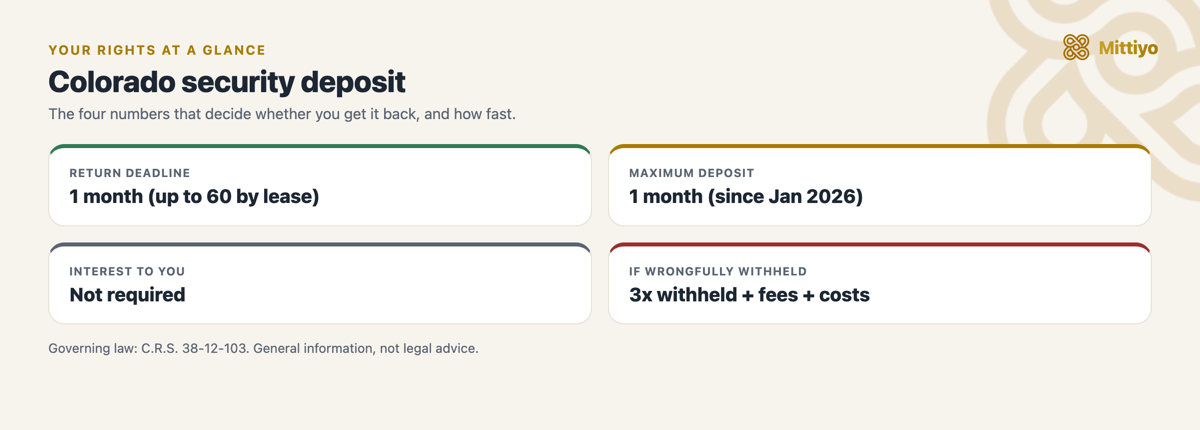
The cap is new. Under a 2025 law, House Bill 25-1249, effective January 1, 2026, a Colorado landlord can require no more than one month’s rent as a security deposit. Before that, Colorado had no statewide cap, so a lease signed earlier may still show a larger deposit.
If your lease was signed on or after the effective date and you were charged more than one month’s rent, the excess is money you can demand back. The same law also expanded the definition of normal wear and tear, which narrows what a landlord can lawfully deduct.
When you must get your deposit back
The clock is one month. Under C.R.S. 38-12-103, the landlord must return the full deposit within one month after your lease ends or you surrender and the landlord accepts the unit, whichever happens last. The lease can specify a longer period, but it can never exceed 60 days.
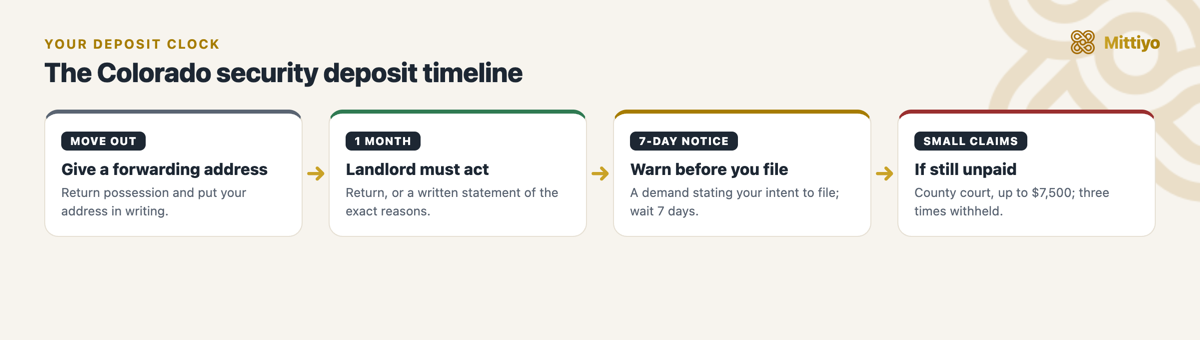
If the landlord keeps any part for damage, they must give you, within that same deadline, a written statement listing the exact reasons for retaining any portion. Miss the deadline entirely, and the landlord forfeits the right to keep any of it. Give the landlord a forwarding address in writing when you leave so the return and statement reach you.
A worked example
Say your deposit was $1,500. Your lease ends, you give a forwarding address, and one month passes with no return and no written statement of reasons.
Under C.R.S. 38-12-103, willful retention makes the landlord liable for three times the amount wrongfully withheld, plus reasonable attorney fees and court costs. Three times $1,500 is $4,500, plus fees. One important step first: you must send the landlord written notice of your intention to file at least seven days before you actually sue.
Interest and how your deposit is held
Colorado does not require a landlord to pay you interest on a residential deposit, and does not require a separate account. What the statute polices is the deadline and the penalty. In fact, Colorado tilts the courtroom toward the tenant: in any action you bring, the landlord bears the burden of proving that withholding the deposit, or any part of it, was not wrongful.
What a landlord can and cannot keep
A landlord can deduct for unpaid rent, unpaid utilities, abandonment, and the cost of repairing damage beyond normal wear and tear. A landlord cannot charge you for normal wear and tear, the ordinary aging that comes from simply living in a place, and the 2025 law widened what counts as wear and tear in the tenant’s favor.
Common landlord tactics, and how to beat them
A few moves come up again and again. A landlord charges more than one month on a new lease; since January 2026 that is over the cap, so the excess is refundable. A landlord keeps money with a vague reason; the statute requires a written statement of the exact reasons, and missing the deadline forfeits the right to keep any of it. A landlord bills a routine repaint or a worn carpet; those are wear and tear, not your damage.
Your strongest cards are the deadline and the burden of proof. If the landlord misses the one-month deadline or cannot prove the deduction was not wrongful, the treble penalty is on the table, as long as you gave the seven-day notice first.
If your landlord wrongfully keeps it
The remedy sits in C.R.S. 38-12-103. Willful retention of a deposit in violation of the statute makes the landlord liable for three times the amount wrongfully withheld, together with reasonable attorney fees and court costs. And the landlord, not you, bears the burden of proving the withholding was not wrongful.
There is one procedural hurdle to respect. You must give the landlord written notice of your intention to file legal proceedings at least seven days before you file. It is a simple step, but skipping it can cost you the treble-damages remedy, so build it into your demand letter and wait the seven days.
How to write a demand letter
Before you file, send a written demand. In Colorado it also satisfies the seven-day notice requirement if it states your intention to file. Fill in the tool below and it builds the letter for you.
Fill in your details and the letter below updates live. Copy it, then paste into an email or print and post it.
[Date]

To: [Landlord name and address]

Re: Return of security deposit, [rental address]

To whom it may concern,

I rented [rental address] and moved out on [move-out date], returning possession and giving my forwarding address at [your forwarding address]. Under Colorado's security deposit statute (C.R.S. 38-12-103), you had one month to return my [$ amount] security deposit with a written statement of the exact reasons for any deductions. That deadline has passed.

Please return the [$ amount] you owe me within 10 days of this letter. If you do not, I will file in county court small claims for three times the amount wrongfully withheld, plus attorney fees and costs, as allowed by C.R.S. 38-12-103.

Sincerely,
[Your name]
This is a template to adapt, not legal advice. Keep a copy and send it so you can prove delivery (email, or post with tracking).
After you send it, wait at least seven days before filing, so the notice requirement is met.
Taking it to small claims court in Colorado
If the demand letter does not work and the seven days have passed, deposit cases go to the small claims division of the county court. The limit is $7,500, which comfortably covers a deposit plus triple damages, and you do not need a lawyer; lawyers are generally not allowed in Colorado small claims unless both sides agree.
When you go, bring your lease, proof you paid the deposit, a copy of your written forwarding address and your seven-day notice, dated move-in and move-out photos, the landlord’s statement of reasons or proof that none came, and a copy of your demand letter.
Local rules: Colorado is uniform
Deposit rules in Colorado are set by C.R.S. 38-12-103 and following, and apply the same everywhere in the state. No Colorado city sets a stricter deposit cap or a different return deadline, so the new one-month cap, the one-month return, and the triple-damages penalty hold whether you rent in Denver, Colorado Springs, Boulder, or a mountain town.
How to get your deposit back
- Keep your move-in condition record and take dated photos of the unit.
- Give the landlord a written forwarding address when you leave, and keep a copy.
- Know the deadline: one month, or up to 60 days if the lease says so.
- If the deadline passes, send a demand letter citing C.R.S. 38-12-103 that also states your intention to file, then wait seven days.
- If that fails, file in the county court small claims division for three times the amount wrongfully withheld.
Key takeaways
- As of January 1, 2026, the cap is one month’s rent, where Colorado previously had none.
- The deposit is due back within one month of your lease ending, up to 60 days only if the lease says so.
- Colorado requires no interest, but the landlord bears the burden of proving a deduction was not wrongful.
- Willful retention costs the landlord three times the amount plus attorney fees, but you must give a seven-day written notice before filing.
- Deposit claims go to county court small claims, where the $7,500 limit covers them.
This guide is general information, not legal advice; landlord-tenant rules change and can vary by city, so confirm against the sources below or a local attorney. Last reviewed July 2026.
Related: Security deposit laws by state · How much rent can you afford? · Apartment viewing checklist
Free tools: Deposit interest calculator · Notice to vacate generator
Renting somewhere new?
know.place maps honest, structured experiences of specific buildings, the rent, deposit, water, and power, from people who have actually lived there, so you can vet a place before you sign.
References and resources
- C.R.S. 38-12-103, return of security deposit: https://law.justia.com/codes/colorado/title-38/tenants-and-landlords/article-12/part-1/section-38-12-103/
- C.R.S. 38-12-102.5, maximum security deposit amount: https://law.justia.com/codes/colorado/title-38/tenants-and-landlords/article-12/part-1/section-38-12-102-5/
- Colorado General Assembly, HB25-1249 Tenant Security Deposit Protections: https://leg.colorado.gov/bills/HB25-1249
- Colorado General Assembly, Renters’ Rights law summary: https://content.leg.colorado.gov/sites/default/files/renters_rights_-_colorado_law_summary.pdf
- Colorado Judicial Branch, Small claims: https://www.courts.state.co.us/Forms/SubCategory.cfm?Category=SmallClaims
- HUD Colorado tenant resources: https://www.hud.gov/states/colorado/renting