

Florida gives you a clear set of deadlines to get your security deposit back, and the money often turns on whether your landlord hits them. The rules live in Florida Statutes section 83.49, and they run on two tracks depending on whether the landlord wants to keep any of your money. Miss the deadlines as a landlord, and you lose the right to deduct. Know them as a tenant, and the advantage is yours.
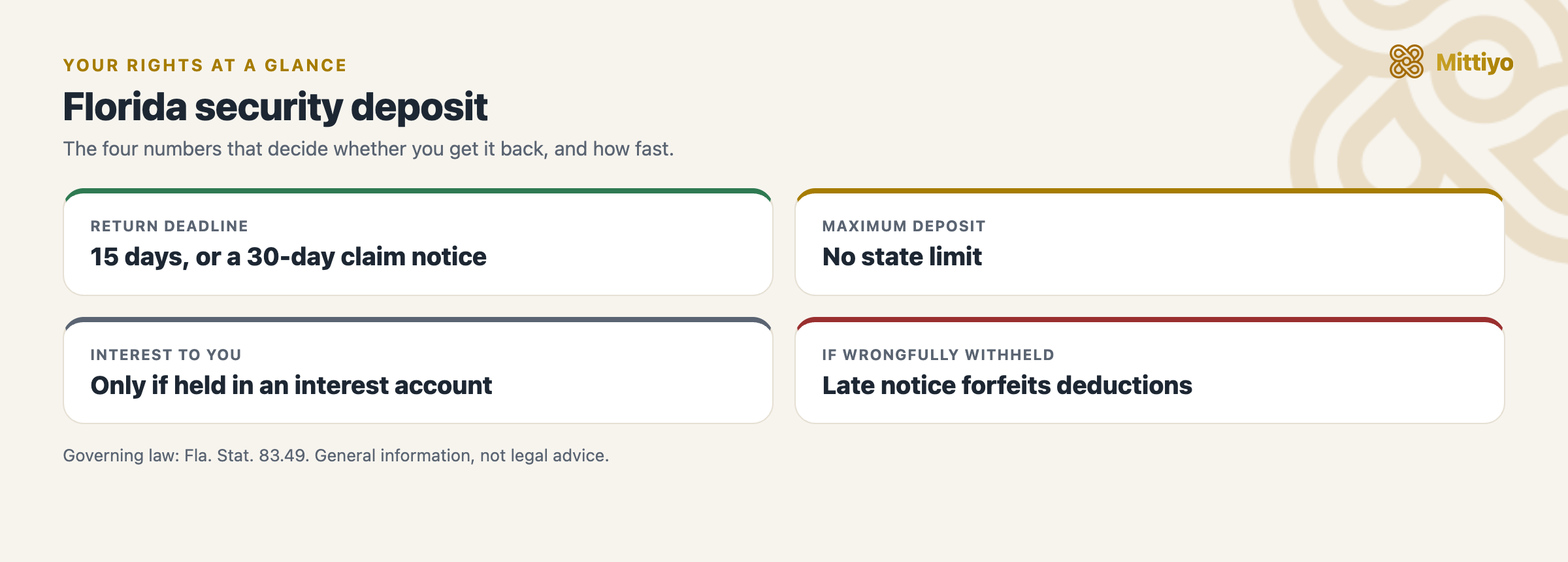
TL;DR: If your landlord keeps none of your deposit, you get the full amount back within 15 days of moving out. If they want to deduct, they must send you a written claim notice within 30 days, and you then have 15 days to object in writing. Florida sets no cap on the deposit amount.
How much can a landlord charge in Florida
Florida sets no statutory cap on security deposits. The amount is whatever your lease says, so what you pay is set by the market and by what you negotiate. Many landlords ask for one month of rent, some ask for more, and there is no state ceiling to point to. This is different from states that cap deposits at one or two months of rent, so read your lease closely before you sign.
When you must get your deposit back
Florida runs two separate timelines, and which one applies depends on the landlord.
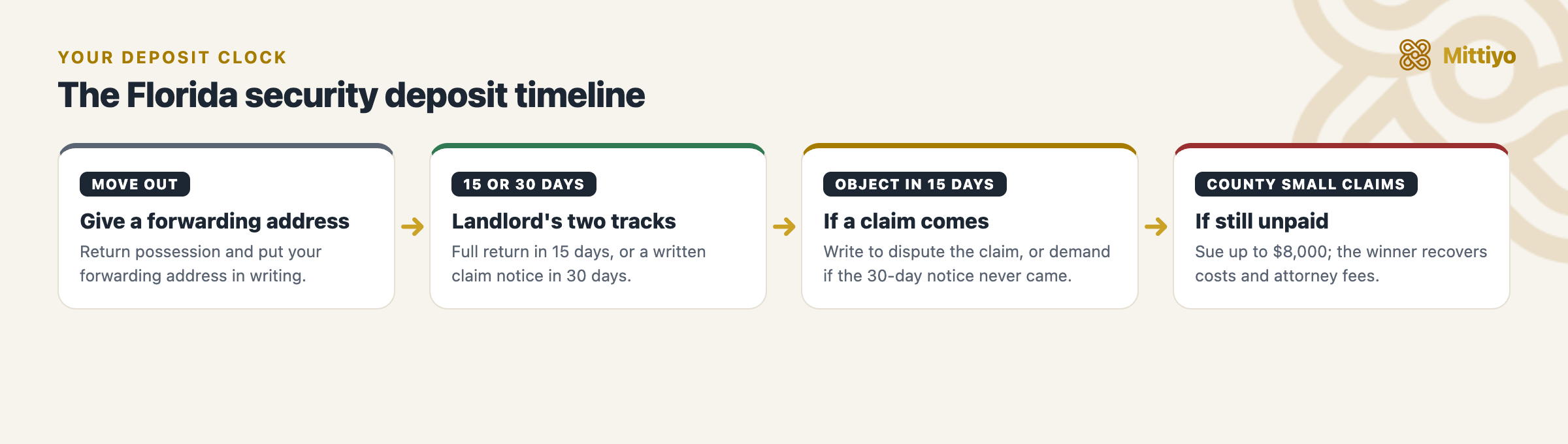
If the landlord does not intend to keep any part of your deposit, they must return the full amount within 15 days of you vacating. No notice, no deductions, just your money back.
If the landlord does intend to deduct, the path changes. They must send you a written notice of intention to impose a claim within 30 days of you moving out. Under section 83.49 this notice goes by certified mail to your last known address, or by email under the current statute. The notice must state the reason for the claim and the amount.
Once you receive that notice, you have 15 days to object in writing. If you do not object within 15 days, the landlord may deduct the claimed amount and must remit the balance to you within 30 days of sending the notice. If you do object, the dispute is not resolved by silence, and either side can take it to court.
A worked example
Say you paid a $1,600 deposit. Three things can happen.
The landlord sends no claim notice. You are owed the full $1,600 back within 15 days of moving out.
The landlord sends a written claim within 30 days for $400 of real damage, and you do not object within 15 days. The landlord keeps $400 and you get $1,200 back.
The landlord misses the 30-day notice entirely. They forfeit the right to deduct anything, even if there was real damage, and they owe you the full $1,600.
The deadline is doing the heavy lifting here. A landlord who lets the clock run out loses the deductions they might otherwise have won.
Interest and how your deposit is held
Florida gives the landlord three ways to hold your deposit, and they pick one:
- A separate non-interest-bearing account in a Florida bank, held only for tenant deposits.
- A separate interest-bearing account in a Florida bank. Here you are owed interest, either at least 75% of the annualized average interest rate for that account or 5% simple interest per year, the landlord’s choice.
- A surety bond, plus 5% simple interest paid to you.
Interest is only owed under the interest-bearing account option or the surety bond option. Under the non-interest account, you get no interest. Whichever method the landlord uses, they must tell you which one within 30 days of receiving your deposit.
What a landlord can and cannot keep
A landlord can deduct for unpaid rent and for damage beyond normal wear and tear. A landlord cannot charge you for normal wear and tear, which is the ordinary aging that comes from simply living in the home.
Your 15-day objection window is the key move
Once the landlord’s claim notice reaches you, the 15-day objection window is your most important step. Send a written objection inside those 15 days and you preserve your claim to the money. Silence does the opposite: if you let 15 days pass without objecting, the landlord can deduct the claimed amount. A timely written objection keeps the money in play and pushes an unresolved dispute toward court, where the numbers get tested. Do not miss it.
Common landlord tactics, and how to beat them
A few moves come up again and again, and Florida law answers each one.
A blanket cleaning or painting fee charged to every tenant is not a real claim. Paint and carpet wear out over time, so a fair charge is prorated for their age and remaining life, not billed at full replacement cost against you.
A vague claim notice with no real basis is weak. The notice has to state the reason and the amount, and an objection forces the landlord to back it up.
A landlord who misses the 30-day notice forfeits deductions, full stop. That single missed deadline can hand you the entire deposit.
And a lease cannot sign away your rights. Any clause that tries to waive your protections under Chapter 83 does not hold up, so a “no refund” line in the lease means nothing.
If your landlord wrongfully keeps it
If the landlord fails to send the required notice of intention to impose a claim within 30 days, they forfeit the right to impose a claim and cannot deduct from your deposit. They still may sue you separately for damages after returning the deposit, but they lose the deposit-deduction route. In any court action over the deposit, the prevailing party recovers court costs and reasonable attorney fees, which raises the stakes for a landlord holding money they should have returned.
How to write a demand or objection letter
A short, dated letter creates a record and often gets you paid without a filing.
[Date] · To: [Landlord/manager name and address] · Re: Security deposit, [rental address]
I rented [address] and moved out on [date]. Under Florida Statutes section 83.49, if you did not intend to make a claim you owed my full [$ amount] deposit within 15 days, and if you did, you owed me a written notice of intention to impose a claim within 30 days. [I have received no notice and the 30 days have passed, so you have forfeited the right to deduct.] OR [I object in writing to your claim of $___ because it is for normal wear and tear.]
Please return the [$ amount] you owe me within 10 days. If you do not, I will file in county small claims court to recover it plus court costs and attorney fees.
[Signature] · [Name] · [Phone] · [Email]
Taking it to small claims court in Florida
If the letter does not work, small claims is your next step. Small claims cases are heard in county court, and the small-claims track is capped at $8,000 under Florida Small Claims Rule 7.010(b). Filing fees are tiered by the amount you claim and run about $300 for claims from $2,500 to $8,000, with lower fees for smaller amounts. You do not need a lawyer.
Bring your evidence: the lease, proof you paid the deposit, dated move-in and move-out photos, the landlord’s claim notice, your written objection, and a copy of your demand letter. A tidy paper trail is what wins these cases.
Local rules: Florida is uniform
Florida law preempts local regulation of security deposits to the state under section 83.425, so a city or county cannot set stricter deposit rules of its own. The section 83.49 rules apply statewide, which means the 15-day return, the 30-day claim notice, and your 15-day objection window are the same in Miami, Tampa, Orlando, and everywhere else in the state.
How to get your deposit back
- Take dated move-in and move-out photos of every room, so you can prove the condition of the home.
- Give your landlord a written forwarding address, so the return payment and any claim notice reach you.
- Know the deadlines: 15 days for a full return, or a 30-day claim notice if the landlord intends to deduct.
- Object in writing within 15 days if you disagree with a claim, or send a demand letter if the 30-day notice never came.
- File in county small claims court if the money is not returned.
Key takeaways
- Florida sets no cap on how much a landlord can charge for a deposit.
- No deductions means a full return within 15 days; deductions mean a written claim notice within 30 days.
- You have 15 days to object in writing once you get a claim notice, and that objection protects your money.
- A landlord who misses the 30-day notice forfeits the right to deduct anything.
- Deposit rules are uniform statewide, and the prevailing party in court recovers costs and attorney fees.
This guide is general information, not legal advice; landlord-tenant rules change and can vary by city, so confirm against the sources below or a local attorney. Last reviewed July 2026.
Renting somewhere new?
know.place maps honest, structured experiences of specific buildings, the rent, deposit, water, and power, from people who have actually lived there, so you can vet a place before you sign.
Related: Security deposit laws by state · How much rent can you afford? · Apartment viewing checklist
Free tools: Deposit interest calculator · Notice to vacate generator
References and resources
- Fla. Stat. section 83.49 (the deposit statute): https://www.flsenate.gov/Laws/Statutes/2025/83.49
- Fla. Stat. section 83.425 (state preemption of local tenancy rules): https://www.flsenate.gov/Laws/Statutes/2025/83.425
- The Florida Bar, Rights and Duties of Tenants and Landlords: https://www.floridabar.org/public/consumer/tip014/
- Florida Courts, Small claims: https://www.flcourts.gov/Courts-System/florida-courts-help/other-resources/small-claims
- Florida Attorney General, Consumer protection: https://www.myfloridalegal.com/consumer-protection
- HUD Florida tenant resources: https://www.hud.gov/states/florida