

Your security deposit is often the largest sum you hand a landlord, and Georgia law is specific about how it must be held and when it comes back to you. A 2024 law added a cap that did not exist before, so the rules for a new lease are different from what they were a few years ago. This guide walks through every rule, with the exact code sections and a demand-letter template.
TL;DR: In Georgia, your landlord must return your deposit within 30 days after regaining possession, with a written statement of any deductions. Since July 1, 2024, deposits are capped at two months’ rent for leases entered into or renewed on or after that date.
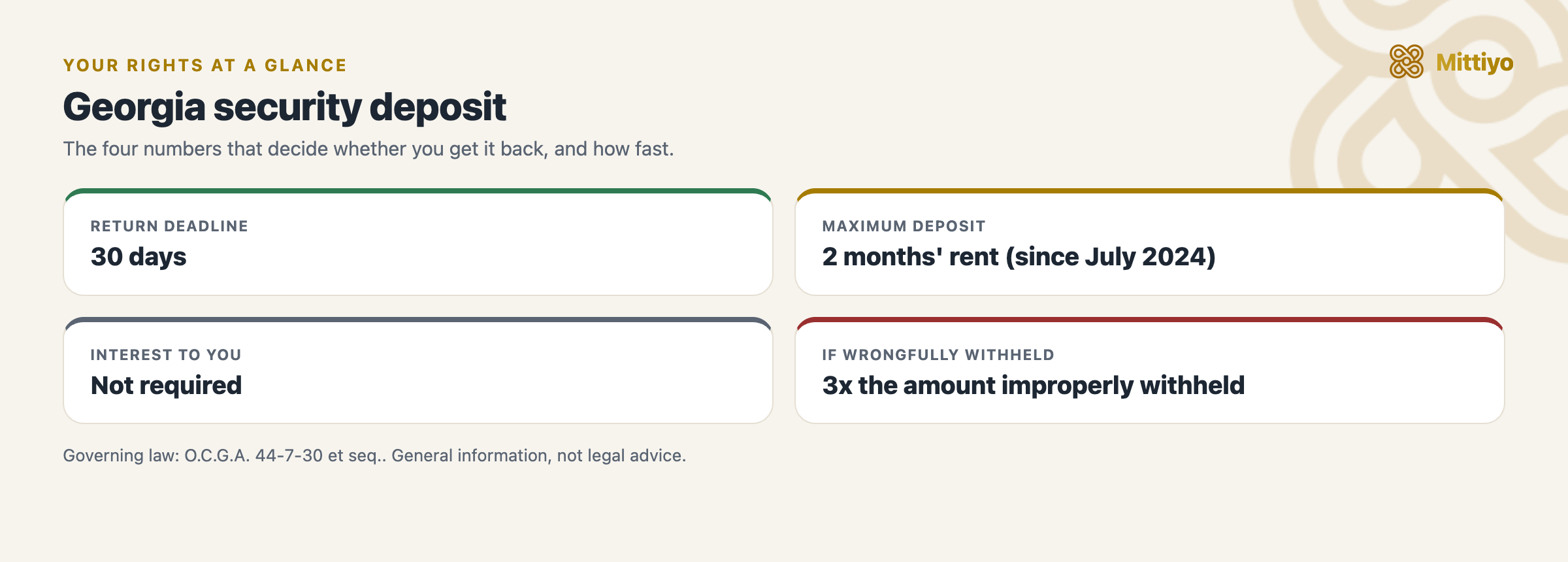
Georgia caps a security deposit at two months’ rent under O.C.G.A. section 44-7-30.1. That cap was added by HB 404, the “Safe at Home Act,” and took effect July 1, 2024. It applies to leases entered into or renewed on or after that date. Before HB 404, Georgia had no statutory cap, so a landlord could ask for any amount the market would bear.
The money is not the landlord’s to spend while you live there. The deposit must be held in an escrow account at a state or federally regulated bank, and the landlord must give you written notice of where that account is located. As an alternative, the landlord may post a surety bond instead of using an escrow account. Either way, the deposit stays segregated from the landlord’s own funds until you move out and the accounting is done.
When you must get your deposit back
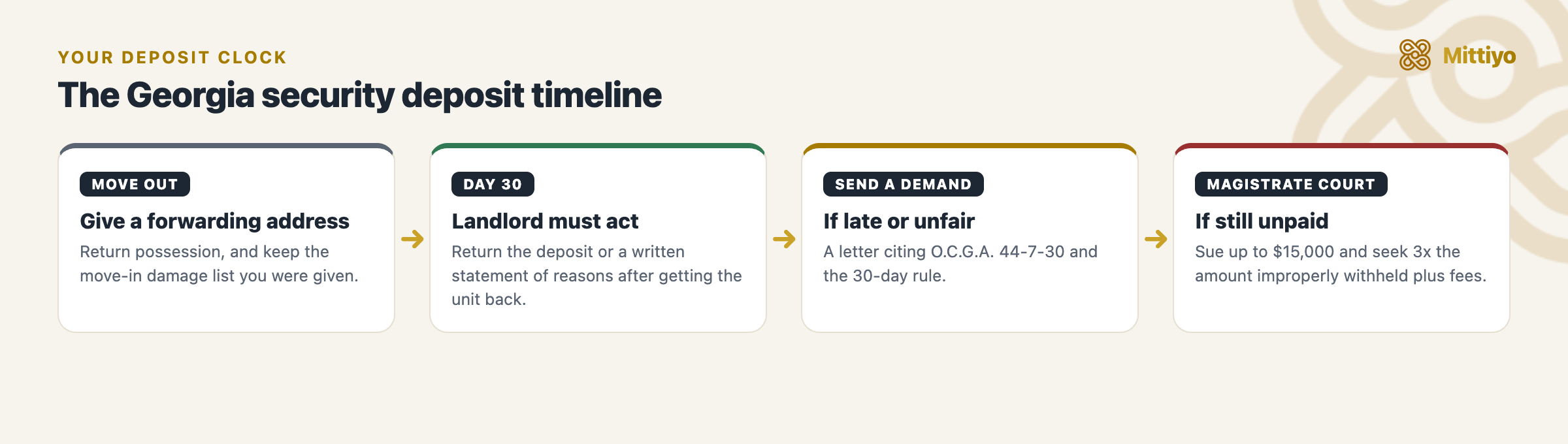
Within 30 days after the landlord obtains possession of the premises, they must return your deposit, or return the balance along with a written statement of the reasons for any deductions. This deadline lives in O.C.G.A. section 44-7-34. The clock starts when the landlord regains possession, which is normally when you have moved out and handed back the keys, not the day your lease says it ends.
The written statement matters as much as the money. If a landlord keeps part of your deposit, they owe you an itemized reason for each deduction. A refund that arrives with no explanation, or a silent partial refund, does not meet the standard the statute sets.
The move-in and move-out condition lists
Georgia builds two inspections into the deposit process, and both protect you.
Before you pay the deposit, the landlord must give you a written list of any existing damage in the unit, and you keep that list. This is required by O.C.G.A. section 44-7-33(a). That document is your record that the scuffed floor or cracked tile was there before you arrived, so it cannot be charged to you later.
The second inspection happens on the way out. Within 3 business days after you move out, the landlord inspects the unit and lists any new damage. You then have the right to inspect within 5 business days and to note your dissent on the list if you disagree with what the landlord recorded. Keeping your copy of the move-in list is your strongest protection, because it is the direct comparison a court will look at.
A worked example
Say you paid an $1,800 deposit. You move out, hand back the keys, and give a forwarding address. Thirty-one days later the landlord has kept $700 with no valid written statement of deductions. Because that retention is in bad faith, you can seek three times the $700 wrongfully withheld, which is $2,100, plus your attorney fees, on top of getting the deposit sorted out. A $700 dispute becomes a $2,100 penalty claim, which is exactly why the statute pushes landlords to account for every dollar on time.
Interest on your deposit
Georgia does not require a landlord to pay interest on your security deposit. Some states mandate it; Georgia is not one of them. If your lease promises interest, that promise is enforceable as a contract term, but the statute itself does not add any.
What a landlord can and cannot keep
A Georgia landlord may deduct from your deposit for unpaid rent and for actual damage to the unit beyond normal wear and tear. What they may not deduct for is normal wear and tear itself, the ordinary aging that comes from simply living in a home.
Common landlord tactics, and how to beat them
A few deductions come up again and again, and most do not hold up.
A blanket cleaning or painting fee charged to every tenant regardless of condition is not a valid deduction; the landlord has to point to actual damage or a genuine cost tied to your tenancy. Carpet and paint wear out on a schedule, so if either is charged, the cost should be prorated for the item’s age and remaining life, not billed to you at full replacement price. Vague deductions with no itemization fail the written-statement requirement outright.
The strongest point is procedural. A landlord who skips the required move-in and move-out condition lists forfeits the right to keep any part of your deposit under O.C.G.A. section 44-7-35(a). And a lease cannot sign these rights away; a clause that tries to waive the condition lists, the 30-day return, or the deposit cap is not enforceable against you.
If your landlord wrongfully keeps it
Georgia gives this rule real teeth. Under O.C.G.A. section 44-7-35(b), a landlord who retains your deposit in bad faith is liable for three times the sum improperly withheld, plus reasonable attorney fees. That is a strong incentive to settle rather than gamble in court.
There is a second, separate consequence under section 44-7-35(a). A landlord who fails to give you the required move-in or move-out lists, or who fails to deliver the itemized statement within the deadline, forfeits both the right to keep any of your deposit and the right to sue you for damage to the unit. Missing the paperwork is not a small slip; it wipes out the landlord’s whole claim.
How to write a demand letter
If the 30 days pass and your money has not come back, put your demand in writing before you file. A dated letter creates a record, sets a clear deadline, and helps prove bad faith if a judge has to weigh it.
Fill in your details and the letter below updates live. Copy it, then paste into an email or print and post it.
[Date]

To: [Landlord name and address]

Re: Return of security deposit, [rental address]

To whom it may concern,

I rented [rental address] and moved out on [move-out date], returning possession and giving my forwarding address at [your forwarding address]. Under O.C.G.A. section 44-7-34, you had 30 days after regaining possession to return my [$ amount] security deposit with a written statement of any deductions. That deadline has passed.

Please return the [$ amount] you owe me within 10 days of this letter. If you do not, I will file in magistrate court for the deposit, three times the amount wrongfully withheld, and my attorney fees, as allowed by section 44-7-35.

Sincerely,
[Your name]
This is a template to adapt, not legal advice. Keep a copy and send it so you can prove delivery (email, or post with tracking).
Taking it to small claims court in Georgia
If the letter does not work, small claims is built for exactly this. Georgia small claims cases are heard in magistrate court, and the limit is $15,000, so a security deposit fits easily inside it. You file in the county where the landlord resides, and you do not need a lawyer. Filing fees are set per county and commonly run about $50 to $80.
Come prepared. Bring your lease, proof that you paid the deposit, the move-in and move-out condition lists, dated photos of the unit, and a copy of your demand letter. That paper trail is what turns a he-said dispute into a clear showing that the money is owed.
Local rules: Georgia is uniform
The HB 404 two-month cap and the 30-day return rule apply across the whole state, and no Georgia city sets a stricter deposit cap. There is one wrinkle worth knowing. Section 44-7-36 exempts a small landlord, defined as a natural person who owns ten or fewer rental units and does not use a management company, from the escrow-account and condition-list requirements. Even for that exempt landlord, though, the 30-day return rule and the two-month cap still apply. Every landlord in Georgia owes you your deposit back on time and cannot charge more than two months’ rent.
How to get your deposit back
- Keep your move-in damage list and take dated photos of the unit the day you arrive, so you have a before-and-after record.
- Give your landlord a written forwarding address when you move out, so there is no excuse for not sending the deposit.
- Know the 30-day deadline; it starts when the landlord regains possession, not when the lease ends.
- Send a written demand letter if the deadline passes, giving a firm 10-day window to pay.
- File in magistrate court if the demand is ignored, and bring your full paper trail.
Key takeaways
- Georgia caps security deposits at two months’ rent for leases entered into or renewed on or after July 1, 2024, under O.C.G.A. section 44-7-30.1.
- Your landlord has 30 days after regaining possession to return the deposit or the balance with a written statement of deductions.
- Bad-faith retention costs the landlord three times the amount wrongfully withheld plus attorney fees, under section 44-7-35(b).
- Skipping the required move-in or move-out lists forfeits the landlord’s right to keep any of your deposit, under section 44-7-35(a).
- Small claims for a deposit go to magistrate court, with a $15,000 limit and no lawyer required.
This guide is general information, not legal advice; landlord-tenant rules change and can vary by city, so confirm against the sources below or a local attorney. Last reviewed July 2026.
Renting somewhere new?
know.place maps honest, structured experiences of specific buildings, the rent, deposit, water, and power, from people who have actually lived there, so you can vet a place before you sign.
Related: Security deposit laws by state · How much rent can you afford? · Apartment viewing checklist
Free tools: Deposit interest calculator · Notice to vacate generator
References and resources
- O.C.G.A. Title 44, Chapter 7, Article 2 (sections 44-7-30 to 44-7-37): https://law.justia.com/codes/georgia/title-44/chapter-7/article-2/
- Georgia HB 404, the Safe at Home Act (2024): https://www.legis.ga.gov/legislation/64244
- Georgia Landlord-Tenant Handbook (Dept of Community Affairs): https://dca.georgia.gov/housing-choice-voucher/landlords/georgia-landlord-tenant-handbook
- Georgia Attorney General, Landlord-tenant issues and handbook: https://consumer.georgia.gov/consumer-topics/landlord-tenant-issues-and-handbook
- Georgia Courts, navigating the courts (self-help): https://georgiacourts.gov/a2j/self-help-resources/navigating-the-courts/
- HUD Georgia tenant resources: https://www.hud.gov/states/georgia