

Getting your security deposit back in Illinois comes down to two state statutes and, if you live in Chicago, a city ordinance that is stricter than both. Landlords count on tenants not knowing the deadlines. Once you do, the law is firmly on your side.
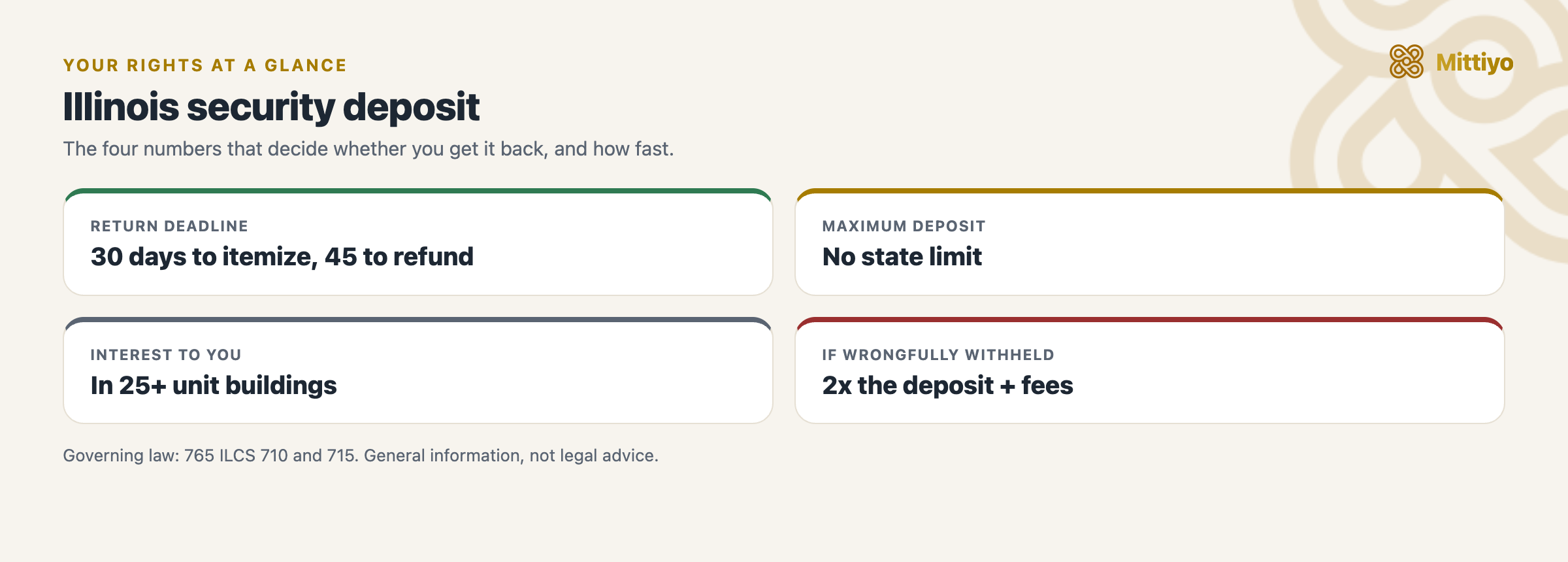
TL;DR: Illinois sets no cap on your deposit. If your landlord keeps any part for damage, they must send an itemized statement with receipts within 30 days of move-out; if they miss that, they owe the full deposit back within 45 days. A bad-faith violation lets you recover twice the deposit plus court costs and attorney fees. Chicago’s ordinance is tighter still.
How much can a landlord charge in Illinois
Illinois has no statewide cap on the deposit amount. A landlord can ask for one month, two months, or more, and state law does not set a ceiling. What the market and your negotiation allow is the only practical limit.
Chicago does not set a dollar cap either, but its ordinance adds handling rules that state law does not. In the city, the deposit is your money held in trust, and the landlord has to keep it in a specific kind of account and give you a receipt. More on that below.
When you must get your deposit back
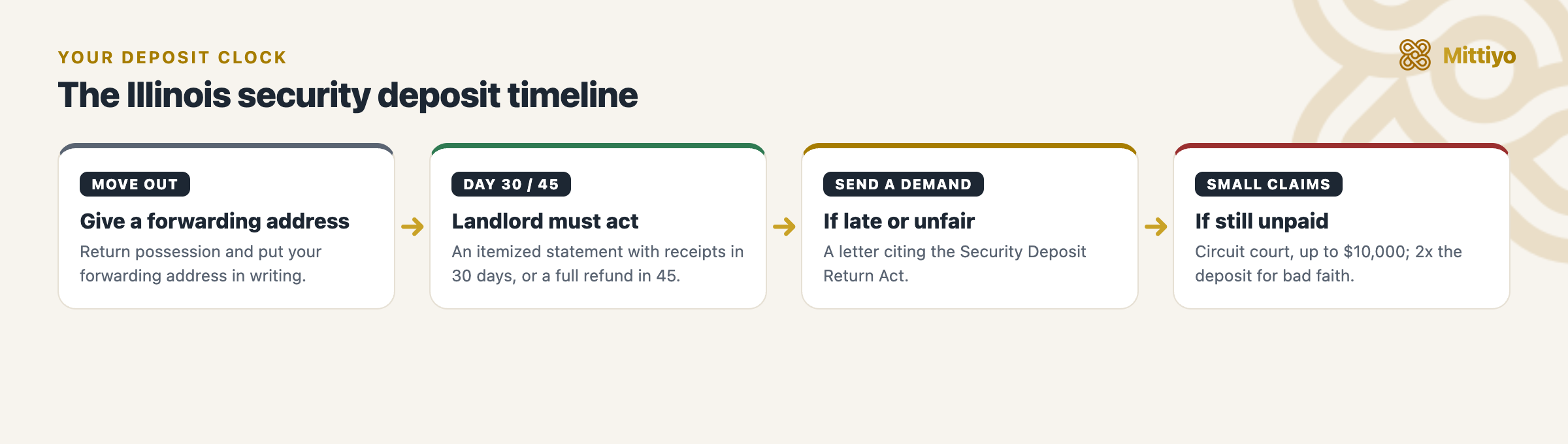
The Security Deposit Return Act (765 ILCS 710) sets the clock. If your landlord intends to keep any part of the deposit for damage, they must deliver an itemized statement of the damages, along with paid receipts, within 30 days of the day you vacate. If they only have estimates when the 30 days run, they can send the estimates and follow with the actual paid receipts within 30 days of the estimate.
Here is the part landlords forget: if they do not furnish that itemized statement within 30 days, they lose the right to deduct at all. They must return your full deposit within 45 days of move-out. No statement means no deductions.
For years the Return Act only covered buildings of five or more units. That changed. Public Act 103-406 removed the old five-unit threshold effective January 1, 2024, so the Return Act now applies to every residential lessor in Illinois, whatever the building size. A small two-flat landlord is now on the same clock as a large complex.
Always give your landlord a written forwarding address when you move out. The deadlines run whether or not they know where to send the check, but a written address removes their excuse and starts your paper trail.
A worked example
Say your deposit was $1,500. You move out, leave the unit clean, and give a written forwarding address. Thirty days pass and your landlord sends no itemized statement. Forty-five days pass and no refund arrives.
At that point the landlord has forfeited any right to deduct, and the failure looks like bad faith. Under the Return Act you can sue for an amount equal to twice the deposit: 2 x $1,500 = $3,000. On top of that you recover your court costs and reasonable attorney fees. The landlord who tried to quietly keep $1,500 now faces $3,000 plus your filing fee and any legal costs.
Interest and how your deposit is held
State interest is narrow. Under the Security Deposit Interest Act (765 ILCS 715), only buildings of 25 or more units owe interest, and only on a deposit held more than 6 months. The rate is set by the state each year; the 2026 rate published by IDFPR is 0.005%. The landlord pays it yearly or credits it against your rent. If your building has fewer than 25 units, no state interest is owed at all.
Chicago is separate and stricter. The city’s ordinance requires the deposit be held in a segregated, federally-insured, non-interest-bearing account kept apart from the landlord’s own assets, and the landlord must give you a receipt. Chicago also requires interest paid annually on deposits held 6 or more months, at the city-set rate; for 2026 that rate is 0.01%.
What a landlord can and cannot keep
A landlord can deduct for unpaid rent and for actual damage beyond ordinary use. A landlord cannot deduct for the normal aging of a home that happens no matter who lives there. That single distinction decides most disputes.
Common landlord tactics, and how to beat them
The most common trick is a flat cleaning or repainting fee taken from every tenant regardless of condition. Routine cleaning and repainting between tenants is normal wear and tear, not a chargeable damage. If they cannot show real damage, they cannot keep the money.
The second is sending no itemized statement at all and simply banking the deposit. This is the landlord’s weakest position, because missing the 30-day statement deadline forfeits the right to deduct and triggers the full 45-day refund duty. That 30-day itemized-statement duty is your strongest lever; use it.
The third is charging full replacement cost for something with years of life already used, like billing you for a whole carpet that was already half worn. Deductions should be prorated for age and remaining life, not charged as if the item were new.
If your landlord wrongfully keeps it
Illinois gives you two penalty routes. Under the Return Act (765 ILCS 710/1.1), a landlord who fails to comply in bad faith is liable to you for an amount equal to twice the deposit, plus court costs and reasonable attorney fees. That is the main hammer for a wrongful withholding.
Separately, under the Interest Act (765 ILCS 715/2), a landlord in a 25-plus-unit building who willfully fails to pay the interest owed is liable for an amount equal to the full deposit, plus court costs and attorney fees. These are different violations, and in the right facts you can raise both.
How to write a demand letter
Before you sue, send a written demand. It is the normal first step, it often works on its own, and it shows a judge you gave the landlord a fair chance.
Fill in your details and the letter below updates live. Copy it, then paste into an email or print and post it.
[Date]

To: [Landlord name and address]

Re: Return of security deposit, [rental address]

To whom it may concern,

I rented [rental address] and moved out on [move-out date], returning possession and giving my forwarding address at [your forwarding address]. Under the Illinois Security Deposit Return Act (765 ILCS 710), you had 30 days to return my [$ amount] security deposit with an itemized statement of any deductions, or to return the full deposit within 45 days. That deadline has passed.

Please return the [$ amount] you owe me within 10 days of this letter. If you do not, I will file in small claims court for the deposit plus damages equal to twice the deposit, court costs, and attorney fees, as allowed by 765 ILCS 710/1.1.

Sincerely,
[Your name]
This is a template to adapt, not legal advice. Keep a copy and send it so you can prove delivery (email, or post with tracking).
Taking it to small claims court in Illinois
If the demand letter does not work, you file in the small claims division of your county’s circuit court. The small claims limit is $10,000 under Illinois Supreme Court Rule 281, which comfortably covers a deposit plus double damages. Filing fees vary by county, usually somewhere between about $100 and $250, and you do not need a lawyer.
Bring your evidence organized: the signed lease, proof you paid the deposit, dated move-in and move-out photos, the itemized statement if you got one or proof that none came, and a copy of your demand letter. A clean paper trail wins these cases.
Local rules: Chicago and beyond
Illinois state law is the floor, not the ceiling. Chicago’s Residential Landlord and Tenant Ordinance is stricter across the board: segregated federally-insured accounts, mandatory receipts, annual interest, a 45-day refund with a 30-day itemized statement, and penalties that can reach twice the deposit plus the deposit itself. Owner-occupied buildings of six units or fewer are exempt from the RLTO.
Chicago is not alone. Cook County, Evanston, Oak Park, and Mount Prospect each have their own ordinances with their own rules. Always check your specific city and county, because a local ordinance can give you more than the state statute does.
How to get your deposit back
- Take dated photos and video at move-in and again at move-out, covering every room, so you can prove the condition you left.
- Give your landlord a written forwarding address when you hand back the keys, and keep a copy.
- Know your deadlines: the itemized statement is due within 30 days, and if it never comes, the full refund is due within 45 days.
- Send a written demand letter citing the Security Deposit Return Act and the 30/45-day rule, giving 10 days to pay.
- If they still refuse, file in your county circuit court’s small claims division for the deposit plus double damages, costs, and fees.
Key takeaways
- Illinois sets no cap on the deposit amount, but the return deadlines are strict.
- A landlord who keeps any part must send an itemized statement within 30 days, or return the full deposit within 45 days.
- Since January 1, 2024, the Return Act applies to every residential landlord in Illinois, whatever the building size.
- A bad-faith violation lets you recover twice the deposit plus court costs and attorney fees.
- Chicago and several other localities have their own stricter ordinances, so always check your city.
This guide is general information, not legal advice; landlord-tenant rules change and can vary by city, so confirm against the sources below or a local attorney. Last reviewed July 2026.
Renting somewhere new?
know.place maps honest, structured experiences of specific buildings, the rent, deposit, water, and power, from people who have actually lived there, so you can vet a place before you sign.
Related: Security deposit laws by state · How much rent can you afford? · Apartment viewing checklist
Free tools: Deposit interest calculator · Notice to vacate generator
References and resources
- 765 ILCS 710, Security Deposit Return Act: https://law.justia.com/codes/illinois/chapter-765/act-765-ilcs-710/
- 765 ILCS 715, Security Deposit Interest Act: https://law.justia.com/codes/illinois/chapter-765/act-765-ilcs-715/
- Illinois Attorney General, Landlord and Tenant Rights and Laws: https://illinoisattorneygeneral.gov/Page-Attachments/LandlordAndTenantRightsLaws.pdf
- Illinois Courts, Small Claims FAQ: https://www.illinoiscourts.gov/faq/small-claims/
- City of Chicago, Residential Landlord and Tenant Ordinance (RLTO): https://www.chicago.gov/city/en/depts/doh/provdrs/renters/svcs/residential-landlord-and-tenant-ordinance.html
- HUD Illinois tenant resources: https://www.hud.gov/states/illinois