

Indiana’s deposit law is short, and its power comes from one plain sentence: miss the 45-day deadline, and you forfeit the entire deposit, not just what was in dispute. Pair that with a filing trap that catches people who do not know about it, and this guide is built to make sure you do not fall into it.
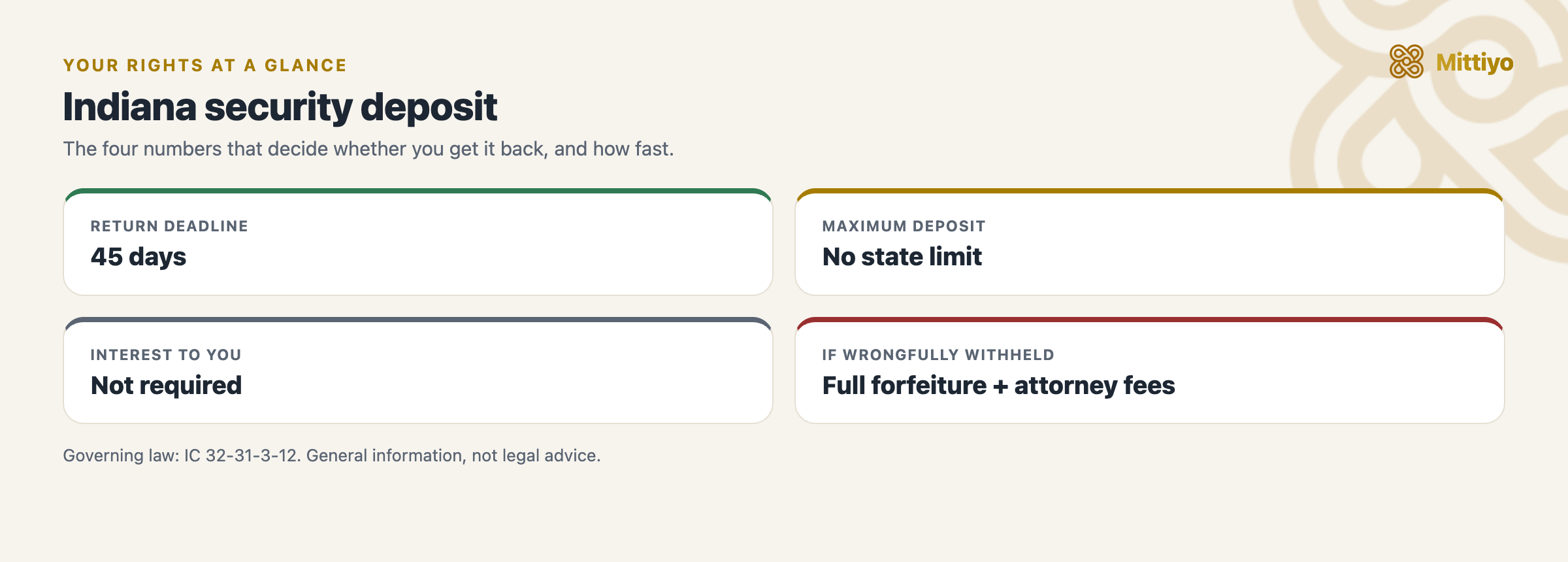
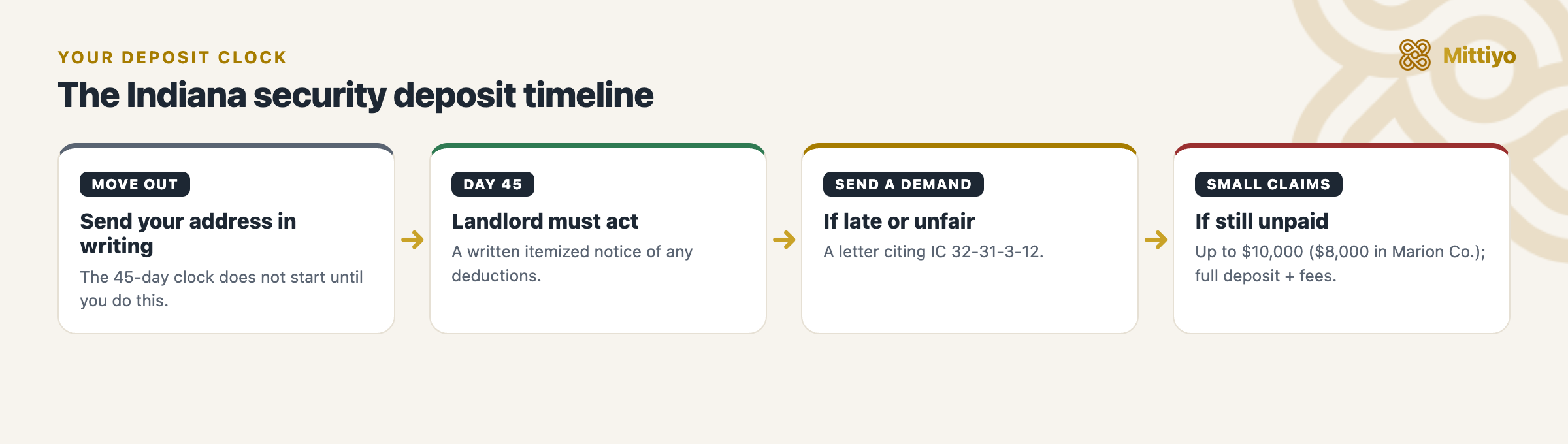
TL;DR: An Indiana landlord has 45 days after your lease ends and you hand back the unit to return your deposit or send an itemized notice of deductions, but only once you have given them your forwarding address in writing. Miss that deadline, and Indiana law makes the landlord forfeit the whole deposit plus your reasonable attorney’s fees, a stronger remedy than the doubling penalties most other states use.
Does the 45-day clock start if I never gave a forwarding address?
Not in any way that protects you. Under IC 32-31-3-12(a), the landlord “is not liable under this chapter until the tenant supplies the landlord in writing with a mailing address” to send the notice and deposit to. This is the detail that catches the most Indiana renters off guard. If you never sent one, a landlord can argue they were never obligated to act, no matter how long they hold your money.
Once your written address is on record, the landlord has 45 days after the rental agreement’s termination and the delivery of possession to send a written notice itemizing any deductions, along with the amount due. Each item must be spelled out. The practical fix is simple: send your address by text, email, or letter, ideally the day you move out, in a form you can prove you sent, and keep a copy. If you have not done this yet, do it now.
What happens when the address goes out on move-out day and the landlord stays silent?
Say your deposit was $900. You move out, send your forwarding address in writing the same day by text and email, and 45 days pass with no notice and no refund.
Because Indiana’s remedy is forfeiture rather than a multiplier, you are not limited to double or triple the disputed amount, you can recover the entire $900 deposit, plus your reasonable attorney’s fees if you needed to hire one to enforce the claim. This is one of the stronger tenant remedies among the states in this series, precisely because it does not require you to prove bad faith, only that the 45-day notice never came.
What can the landlord actually take out of the deposit?
Under IC 32-31-3-12(a), a landlord may apply the deposit only to accrued rent, to damages the landlord has suffered or will reasonably suffer from your noncompliance with the law or the rental agreement, and to unpaid utility or sewer charges you owed under the lease. Nothing in the statute allows a deduction for ordinary wear and tear.
Is there a cap on the deposit, and does it earn interest?
There is no statewide cap. IC 32-31-3, Indiana’s security deposit chapter, does not set a maximum, so the amount is whatever your lease specifies. Indiana also does not require the deposit to be held in a separate or interest-bearing account, so do not expect a disclosure about where your money sits, and Indiana does not require interest on a security deposit.
Can I skip my last month’s rent and let the deposit cover it?
Only if your landlord specifically agrees to that in writing; without that agreement, stopping your last rent payment on the theory that “they’ll just keep the deposit anyway” can itself put you in breach. Treat the deposit and your final rent as separate obligations.
What is my remedy if the deadline passes?
IC 32-31-3-12(b) states plainly: “If a landlord fails to comply with subsection (a), a tenant may recover all of the security deposit due the tenant and reasonable attorney’s fees.” This is a forfeiture remedy, not a multiplier, and it applies whenever the landlord misses the 45-day window or never sends the required itemized notice, once you have supplied your written forwarding address. Subsection (c) also preserves either side’s right to pursue other damages they are entitled to beyond this section.
How do I press the claim, from demand letter to township court?
Start with a letter that cites your proof of the forwarding address. Fill in the tool below and it drafts one for you.
Fill in your details and the letter below updates live. Copy it, then paste into an email or print and post it.
[Date]

To: [Landlord name and address]

Re: Return of security deposit, [rental address]

To whom it may concern,

I rented [rental address] and moved out on [move-out date], returning possession and giving my forwarding address at [your forwarding address]. Under Indiana Code 32-31-3-12, you had 45 days to return my [$ amount] security deposit with a written itemized notice of any deductions, once I have supplied a forwarding address in writing. That deadline has passed.

Please return the [$ amount] you owe me within 10 days of this letter. If you do not, I will file in small claims court for the full amount of the security deposit and reasonable attorney's fees, as allowed by IC 32-31-3-12(b).

Sincerely,
[Your name]
This is a template to adapt, not legal advice. Keep a copy and send it so you can prove delivery (email, or post with tracking).
If the letter goes unanswered, file in small claims court. In 91 of Indiana’s 92 counties, this is a docket of the circuit or superior court with a $10,000 limit. Marion County (Indianapolis) is the exception: it runs nine separate township-based small claims courts, each capped at $8,000, so file in the township where the dispute arose.
Your evidence folder should hold the lease, proof of the deposit you paid, the screenshot of your text or copy of your letter showing you sent your forwarding address in writing, dated move-in and move-out photos, and the landlord’s itemized notice, if any arrived.
Key takeaways
- Indiana sets no cap on the deposit amount and requires no separate account.
- The landlord’s 45-day clock to send an itemized notice does not start until you supply a written forwarding address, so send yours immediately.
- Missing the deadline forfeits the landlord’s entire right to withhold, not just the disputed portion, plus reasonable attorney’s fees.
- No interest is required, and you cannot apply the deposit to rent unless the landlord agrees.
- Small claims court is $10,000 in most counties, $8,000 in Marion County’s township courts.
This guide is general information, not legal advice; landlord-tenant rules change and can vary by city, so confirm against the sources below or a local attorney. Last reviewed July 2026.
Renting somewhere new?
know.place maps honest, structured experiences of specific buildings, the rent, deposit, water, and power, from people who have actually lived there, so you can vet a place before you sign.
Related: Security deposit laws by state · How much rent can you afford? · Apartment viewing checklist
Free tools: Deposit interest calculator · Notice to vacate generator
Sources
- IC 32-31-3-12, return of deposits, deductions, liability: https://law.justia.com/codes/indiana/title-32/article-31/chapter-3/section-32-31-3-12/
- Indiana Code Title 32, Article 31, Chapter 3, security deposits: https://law.justia.com/codes/indiana/title-32/article-31/chapter-3/
- FindLaw, Indiana Small Claims Courts: https://www.findlaw.com/state/indiana-law/indiana-small-claims-courts.html