

Massachusetts has some of the strictest security deposit rules in the country, and they punish sloppy landlords hard. The law caps the deposit, forces it into a separate bank account that pays you interest, and awards a tenant triple damages for a range of violations, with no need to prove bad faith. This guide walks through every part with the section numbers so you can check the law yourself.
TL;DR: A Massachusetts landlord can hold no more than one month’s rent, must keep it in a separate interest-bearing Massachusetts bank account, and must return it with interest within 30 days of your tenancy ending. A wide range of violations, including a late return, entitle you to three times the deposit plus interest, costs, and attorney fees.
How much can a landlord charge in Massachusetts
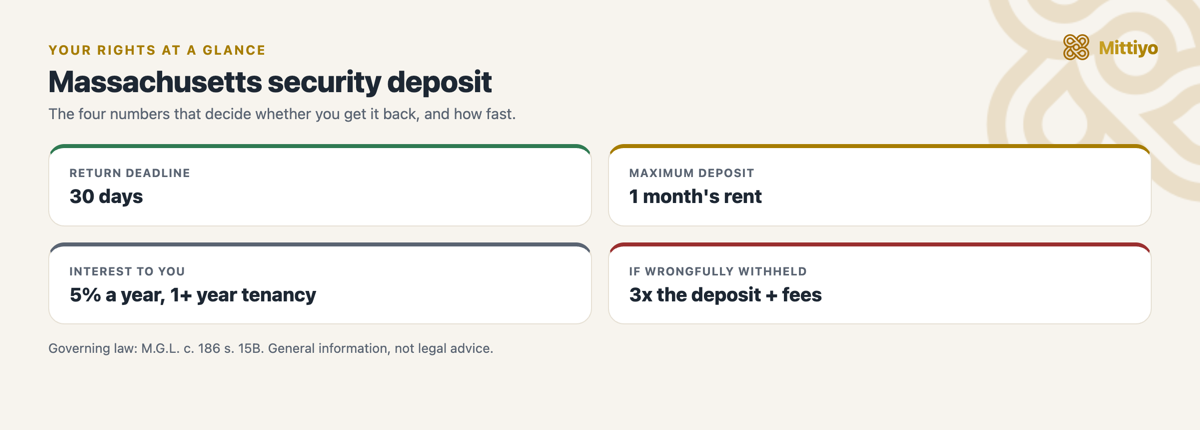
The cap is one month’s rent. Under G.L. c. 186, section 15B, a landlord cannot require a security deposit larger than one month’s rent, and cannot demand more than a fixed set of move-in payments: first month’s rent, last month’s rent, a security deposit of up to one month, and the actual cost of a new lock and key. Anything beyond that list, or any deposit over one month’s rent, is unlawful.
That closed list is unusually strict, and it means the common practice in other states of stacking fees does not fly in Massachusetts. If you were charged more, the excess is money you can demand back.
When you must get your deposit back
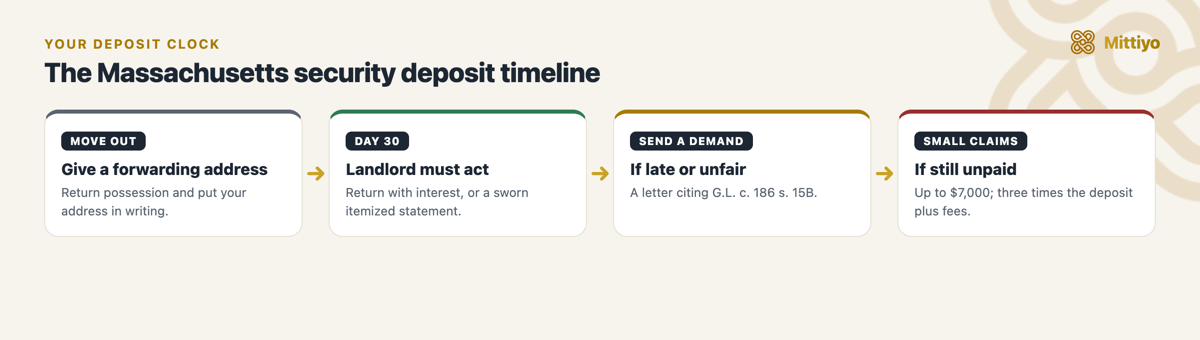
The clock is 30 days. Within 30 days after your tenancy ends, the landlord must return the deposit plus any interest owed, minus lawful deductions. If the landlord keeps any part for damage, they must give you a sworn, itemized statement of the damages, signed under the pains and penalties of perjury, along with documentation such as receipts or estimates.
Give the landlord a forwarding address in writing when you leave, so the return and statement reach you. The 30-day deadline is firm, and a landlord who misses it, or who keeps money without the sworn itemized statement, loses the right to keep any of the deposit and is exposed to the triple-damages penalty below.
A worked example
Say your deposit was $1,800. Your tenancy ends, you give a forwarding address, and 30 days pass with no return and no sworn itemized statement.
Under G.L. c. 186, section 15B, you are entitled to three times the deposit, plus the 5 percent interest, court costs, and reasonable attorney fees. Three times $1,800 is $5,400, plus interest and fees. The penalty is not discretionary and does not require you to prove the landlord acted in bad faith or that you lost money; strict noncompliance is enough.
Interest and how your deposit is held
Massachusetts treats your deposit as your money, held in trust. The landlord must place it in a separate, interest-bearing account in a Massachusetts bank, apart from their own funds, and within 30 days of receiving it give you written notice of the bank’s name and address and the account number.
Interest is owed too. If you live in the apartment for at least a year, the landlord must pay you 5 percent a year, or the actual rate the bank pays if lower, each year on the anniversary of the tenancy, and again when you leave. Failing to hold the deposit properly, or to pay the interest, is itself a violation that can trigger the triple-damages remedy.
What a landlord can and cannot keep
A landlord can deduct for unpaid rent, unpaid increases in real estate taxes you agreed to pay, and the reasonable cost of repairing damage beyond normal wear and tear. A landlord cannot charge you for normal wear and tear, the ordinary aging that comes from simply living in a place, and every deduction has to appear in the sworn itemized statement.
Common landlord tactics, and how to beat them
A few moves come up again and again. A landlord asks for a deposit over one month’s rent, or extra fees on top of first, last, and deposit; that is unlawful in Massachusetts, so the excess is refundable. A landlord never gives you the statement of condition at move-in, or the bank account details; those are violations in their own right. A landlord keeps money with an unsigned or non-itemized deduction; the statute requires a sworn, itemized statement, so a vague deduction does not meet the standard.
The strictness of the law is your strongest card. Because the triple-damages penalty attaches to technical violations without any need to prove bad faith, a Massachusetts landlord who cuts corners is highly exposed, which is exactly why a firm demand letter settles most of these cases.
If your landlord wrongfully keeps it
The remedy sits in G.L. c. 186, section 15B(6) and (7). A landlord who fails to return the deposit within 30 days, fails to hold it in a proper separate account, fails to give the required statement of condition or bank information, or uses a lease with an unlawful deposit clause, forfeits the right to keep any of the deposit and is liable for three times the deposit, together with 5 percent interest, court costs, and reasonable attorney fees.
The key thing to remember is how automatic this is. The tenant does not have to show the landlord acted in bad faith, and does not have to show a financial loss. Strict noncompliance with the statute is enough to unlock the triple damages.
How to write a demand letter
Before you file, send a written demand. It costs a stamp, creates a paper trail, and often produces a check within days. Fill in the tool below and it builds the letter for you.
Fill in your details and the letter below updates live. Copy it, then paste into an email or print and post it.
[Date]

To: [Landlord name and address]

Re: Return of security deposit, [rental address]

To whom it may concern,

I rented [rental address] and moved out on [move-out date], returning possession and giving my forwarding address at [your forwarding address]. Under Massachusetts General Laws chapter 186, section 15B, you had 30 days to return my [$ amount] security deposit with a sworn, itemized statement of any deductions. That deadline has passed.

Please return the [$ amount] you owe me within 10 days of this letter. If you do not, I will file in small claims court for three times the deposit, plus interest, costs, and attorney fees, as allowed by G.L. c. 186 s. 15B.

Sincerely,
[Your name]
This is a template to adapt, not legal advice. Keep a copy and send it so you can prove delivery (email, or post with tracking).
Taking it to small claims court in Massachusetts
If the demand letter does not work, deposit cases go to small claims court, held in the District Court or the Boston Municipal Court for your area. The small claims limit is $7,000, which comfortably covers a deposit plus triple damages, and you do not need a lawyer. The filing fee is modest and scales with the amount you claim.
When you go, bring your lease, proof you paid the deposit, the statement of condition and bank notice if you received them or proof that you did not, dated move-in and move-out photos, the landlord’s itemized statement or proof that none came, and a copy of your demand letter.
Local rules: Massachusetts is uniform
Deposit rules in Massachusetts are set by G.L. c. 186, section 15B and apply the same everywhere in the state. No Massachusetts city imposes a stricter deposit cap or a different return deadline, so the one-month cap, the separate-account rule, the 30-day return, and the triple-damages penalty hold whether you rent in Boston, Worcester, Cambridge, or a small town.
How to get your deposit back
- At move-in, keep the statement of condition, the deposit receipt, and the bank account notice, and take dated photos of the unit.
- Give the landlord your forwarding address in writing when you leave.
- Know the 30-day deadline for the return and the sworn itemized statement.
- If the deadline passes, send a demand letter citing G.L. c. 186, section 15B.
- If that fails, file in small claims court for three times the deposit plus interest and fees.
Key takeaways
- A landlord can hold no more than one month’s rent, and cannot stack extra fees beyond first, last, deposit, and a new lock.
- The deposit must sit in a separate interest-bearing Massachusetts bank account, and earns you 5 percent a year if you stay at least a year.
- The landlord has 30 days after your tenancy ends to return it with a sworn, itemized statement of any deductions.
- A wide range of violations, including a late return, entitle you to three times the deposit plus interest, costs, and attorney fees, with no need to prove bad faith.
- Deposit claims go to small claims court, where the $7,000 limit easily covers them.
This guide is general information, not legal advice; landlord-tenant rules change and can vary by city, so confirm against the sources below or a local attorney. Last reviewed July 2026.
Related: Security deposit laws by state · How much rent can you afford? · Apartment viewing checklist
Free tools: Deposit interest calculator · Notice to vacate generator
Renting somewhere new?
know.place maps honest, structured experiences of specific buildings, the rent, deposit, water, and power, from people who have actually lived there, so you can vet a place before you sign.
References and resources
- G.L. c. 186 section 15B, Massachusetts security deposit statute (Justia mirror): https://law.justia.com/codes/massachusetts/part-ii/title-i/chapter-186/section-15b/
- Mass.gov, Massachusetts law about tenants’ security deposits: https://www.mass.gov/info-details/massachusetts-law-about-tenants-security-deposits
- MassLegalHelp, Getting your security deposit back: https://www.masslegalhelp.org/housing-apartments-shelter/security-deposits/getting-your-security-deposit-back
- Massachusetts Court System, Small claims: https://www.mass.gov/small-claims
- Mass.gov, Learn about returning or getting back a security deposit: https://www.mass.gov/info-details/learn-about-returning-or-getting-back-a-security-deposit
- HUD Massachusetts tenant resources: https://www.hud.gov/states/massachusetts/renting