

Minnesota gives renters one of the fastest deposit returns in the country, just 21 days, along with interest and a built-in penalty for a landlord who ignores the deadline. The rules all sit in one statute. This guide walks through every part with the section numbers so you can check the law yourself.
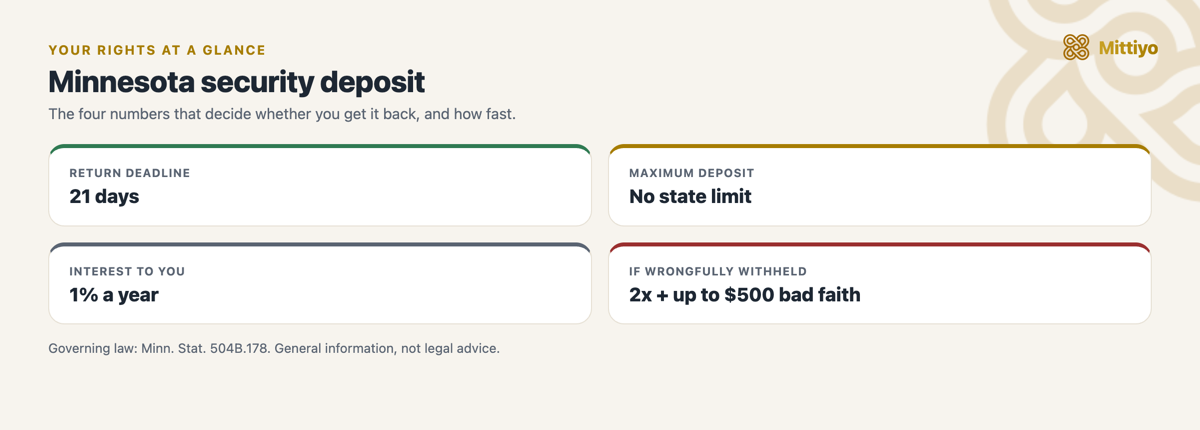
TL;DR: Minnesota sets no cap on the deposit, but it earns 1 percent interest, and the landlord has just 21 days after you move out and give a forwarding address to return it or explain any deduction. Miss that, and you can recover the amount owed plus a penalty equal to it, plus up to $500 more for bad faith.
How much can a landlord charge in Minnesota
Minnesota has no statutory cap on the deposit amount. A landlord can ask for one month, two months, or more, and state law does not set a ceiling. What the market and your negotiation allow is the only practical limit.
What Minnesota does regulate is what happens to the money after that: it must earn interest, and it must come back fast. Those rules live in Minn. Stat. 504B.178, and they are where your leverage sits.
When you must get your deposit back
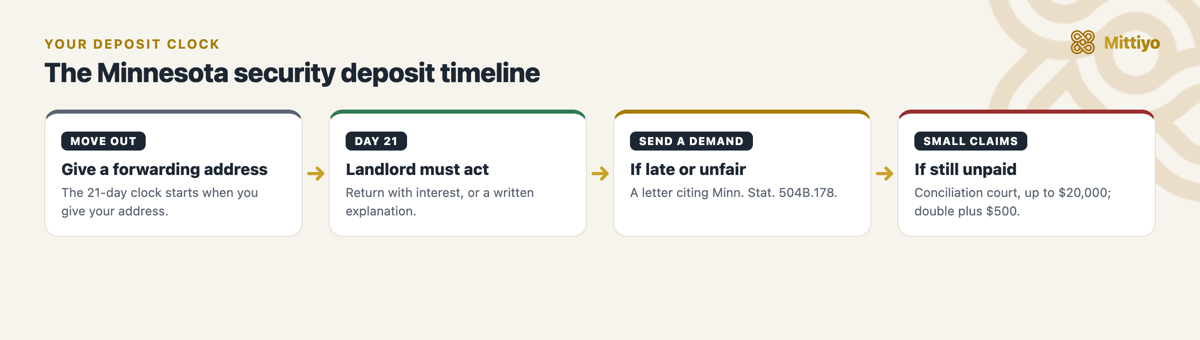
The clock is 21 days, and it is one of the shortest deadlines in the country. Under Minn. Stat. 504B.178, within 21 days after your tenancy ends and you give the landlord a forwarding or new address, the landlord must either return the deposit with the interest it earned, or send you a written statement explaining the reason for keeping any part of it, along with any balance owed.
Give your forwarding address in writing when you leave, because the 21-day clock is tied to it. If the landlord neither returns the deposit nor sends the written explanation in time, they are exposed to the penalty below.
A worked example
Say your deposit was $1,000. You move out, give a forwarding address, and 21 days pass with no return and no written explanation.
Under Minn. Stat. 504B.178 you can recover the amount owed, $1,000, plus a penalty equal to that amount, another $1,000, for $2,000 in total. And because the landlord sent no explanation within 21 days, the court will presume bad faith, which can add up to $500 more in punitive damages unless the landlord proves they acted in good faith.
Interest and how your deposit is held
Your deposit earns interest in Minnesota. Under Minn. Stat. 504B.178, it accrues simple, non-compounded interest at 1 percent a year, starting the first day of the month after you paid it, and that interest is paid back to you together with the deposit.
The statute also protects the money if the property changes hands: when the landlord’s interest in the building ends, they must, within 60 days, either transfer your deposit with interest to the new owner or return it to you. So the deposit follows you, or the ownership, rather than disappearing.
What a landlord can and cannot keep
A landlord can withhold only what is reasonably necessary to cover unpaid rent or other money you owe under the lease, and the cost of repairing damage beyond ordinary wear and tear. A landlord cannot charge you for normal wear and tear, the ordinary aging that comes from simply living in a place, and any deduction must appear in the written explanation.
Common landlord tactics, and how to beat them
A few moves come up again and again. A landlord tries to keep your deposit as an automatic last month’s rent; Minnesota limits a landlord’s ability to withhold the deposit for last month’s rent, so read the rule before you assume. A landlord sends a vague deduction with no explanation; the statute requires a written statement of the reason, and missing it within 21 days triggers the penalty and a presumption of bad faith. A landlord bills a routine repaint or a worn carpet; those are wear and tear, not your damage.
Your strongest card is the tight 21-day clock paired with the bad-faith presumption. If no explanation arrives in time, the law starts by assuming the landlord acted in bad faith, and it is on them to prove otherwise.
If your landlord wrongfully keeps it
The remedy sits in Minn. Stat. 504B.178. A landlord who fails to return the deposit or send the required written explanation within 21 days is liable to you for the amount wrongfully withheld, plus a penalty equal to that amount. On top of that, if the landlord acted in bad faith, you can recover punitive damages of up to $500.
The bad-faith piece is powerful because of the presumption: if the landlord sent no explanation within 21 days, the court assumes bad faith unless the landlord can prove good faith. So the same missed deadline that triggers the double recovery also opens the door to the extra $500.
How to write a demand letter
Before you file, send a written demand. It costs a stamp, creates a paper trail, and often produces a check within days. Fill in the tool below and it builds the letter for you.
Fill in your details and the letter below updates live. Copy it, then paste into an email or print and post it.
[Date]

To: [Landlord name and address]

Re: Return of security deposit, [rental address]

To whom it may concern,

I rented [rental address] and moved out on [move-out date], returning possession and giving my forwarding address at [your forwarding address]. Under Minnesota's security deposit statute (Minn. Stat. 504B.178), you had 21 days to return my [$ amount] security deposit with a written statement of any deductions. That deadline has passed.

Please return the [$ amount] you owe me within 10 days of this letter. If you do not, I will file in conciliation court for the deposit plus a penalty equal to the amount withheld, and up to $500 in punitive damages for bad faith, as allowed by Minn. Stat. 504B.178.

Sincerely,
[Your name]
This is a template to adapt, not legal advice. Keep a copy and send it so you can prove delivery (email, or post with tracking).
Taking it to small claims court in Minnesota
If the demand letter does not work, deposit cases go to conciliation court, which is Minnesota’s small claims court, and every county has one. The limit is $20,000, which more than covers a deposit plus penalties, and you do not need a lawyer.
When you go, bring your lease, proof you paid the deposit, a copy of your written forwarding address, dated move-in and move-out photos, the landlord’s written explanation or proof that none came, and a copy of your demand letter.
Local rules: Minnesota is uniform
Deposit rules in Minnesota are set by Minn. Stat. 504B.178 and apply the same everywhere in the state. No Minnesota city sets a different deposit interest rule or a different 21-day deadline, so the rules in this guide hold whether you rent in Minneapolis, Saint Paul, Rochester, or a small town.
How to get your deposit back
- Keep your move-in condition record and take dated photos of the unit.
- Give the landlord a written forwarding address when you leave, which starts the 21-day clock.
- Know the 21-day deadline for the return or the written explanation.
- If the deadline passes, send a demand letter citing Minn. Stat. 504B.178.
- If that fails, file in conciliation court for the deposit plus the equal penalty and any bad-faith punitive damages.
Key takeaways
- Minnesota sets no cap on the deposit, but it earns 1 percent simple interest.
- The landlord has just 21 days after you move out and give a forwarding address to return it with interest or explain any deduction.
- Missing that deadline makes the landlord liable for the amount owed plus a penalty equal to it.
- A landlord who sends no explanation is presumed to have acted in bad faith, adding up to $500 in punitive damages.
- Deposit claims go to conciliation court, where the $20,000 limit more than covers them.
This guide is general information, not legal advice; landlord-tenant rules change and can vary by city, so confirm against the sources below or a local attorney. Last reviewed July 2026.
Related: Security deposit laws by state · How much rent can you afford? · Apartment viewing checklist
Free tools: Deposit interest calculator · Notice to vacate generator
Renting somewhere new?
know.place maps honest, structured experiences of specific buildings, the rent, deposit, water, and power, from people who have actually lived there, so you can vet a place before you sign.
References and resources
- Minn. Stat. 504B.178, interest and withholding of security deposits: https://www.revisor.mn.gov/statutes/cite/504B.178
- LawHelp Minnesota, Security deposits: https://www.lawhelpmn.org/self-help-library/fact-sheet/security-deposits
- HOME Line Minnesota, Security deposits (statewide tenant advocacy): https://homelinemn.org/form-letters/security-deposits/
- Minnesota Judicial Branch, Conciliation Court: https://www.mncourts.gov/Help-Topics/Conciliation-Court.aspx
- Minn. Stat. 504B.178 (Justia mirror): https://law.justia.com/codes/minnesota/chapters-500-515b/chapter-504b/section-504b-178/
- HUD Minnesota tenant resources: https://www.hud.gov/states/minnesota/renting