

Your security deposit is your money. In New York, the law is unusually strong about giving it back on a clock, and it punishes landlords who ignore that clock. If you know two numbers, you know most of what protects you.
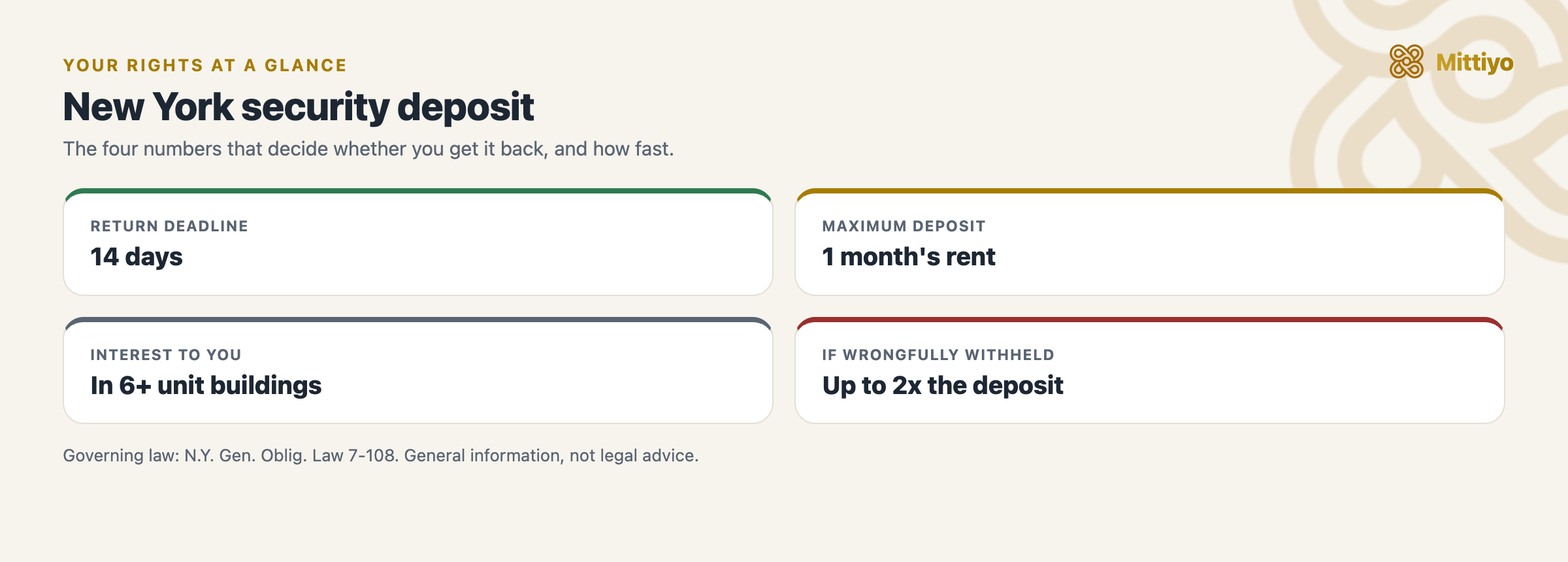
TL;DR: A New York landlord can charge at most 1 month’s rent as a deposit. After you move out, they have 14 days to send an itemized statement and return the balance. Miss that deadline and the landlord forfeits any right to keep deductions, so you get the full deposit back.
How much can a landlord charge in New York
Since the 2019 Housing Stability and Tenant Protection Act (HSTPA), a security deposit in New York cannot be more than 1 month’s rent. That is a hard cap on residential tenancies.
The same law closed a common workaround. A landlord cannot collect last month’s rent and a separate security deposit on top of it. One month of your rent, held as a deposit, is the ceiling. Two narrow exceptions sit outside this rule: seasonal-use units and owner-occupied cooperative units.
When you must get your deposit back
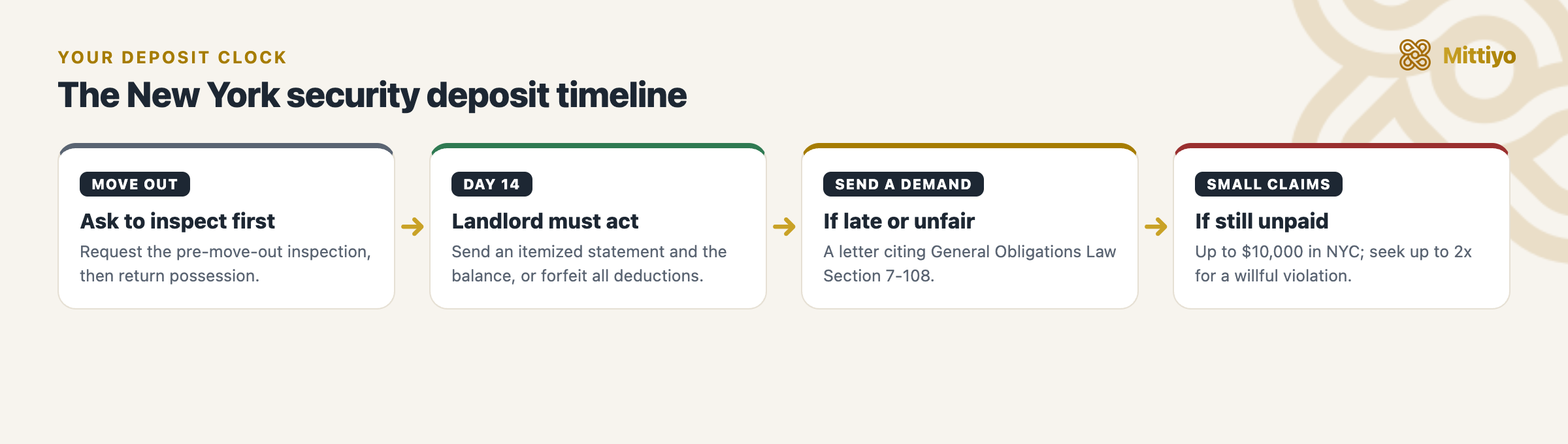
The return clock is short and strict. Within 14 days after you vacate the unit, the landlord must give you an itemized statement listing any deductions and return whatever is left of your deposit.
Here is the part that gives the rule teeth. If the landlord fails to provide both the itemized statement and the deposit within those 14 days, they forfeit any right to keep any portion of it. Missing the deadline does not just cost them a late fee. It means every deduction they wanted to make is gone, and they owe you the entire deposit back.
A worked example
Say you paid an $1,800 deposit. Three things can happen.
First, the honest path. The landlord inspects, finds $200 of real damage beyond wear and tear, sends you an itemized statement showing that $200, and returns $1,600 within 14 days. That is exactly how the rule is meant to work, and you have no claim.
Second, the silent landlord. Day 14 passes and you have received nothing: no statement, no check. By missing the deadline, the landlord forfeits every deduction. The $200 they wanted to keep no longer counts. They owe you the full $1,800.
Third, the willful path. The landlord keeps your money on purpose, invents charges, or ignores your demands. Now you can seek punitive damages of up to twice the deposit. On an $1,800 deposit, that is up to $3,600 in punitive damages, on top of getting your deposit back.
New in 2025: broader coverage
Effective November 15, 2025, New York expanded these Section 7-108 deposit protections to cover rent-stabilized tenants, who had previously sat outside the section. This came in under Chapter 436 of the Laws of 2025.
The core rules did not change. The 1-month cap, the 14-day return, the itemization requirement, and the pre-move-out inspection right all stayed the same. More tenants are simply covered now.
Interest on your deposit
For buildings with 6 or more units, the deposit must be held in an interest-bearing New York bank account. That interest belongs to you, not the landlord. The landlord may keep 1% of the deposit per year as an administrative fee, and the rest of the interest is yours.
Smaller buildings do not owe you interest. They must still hold your deposit in trust, kept separate from the landlord’s own funds and never commingled with them. This is set out in General Obligations Law Section 7-103.
What a landlord can and cannot keep
A landlord can deduct three kinds of things: unpaid rent, unpaid utilities you actually owed, and damage beyond normal wear and tear. Those are the legitimate reasons to hold back part of your deposit.
A landlord cannot charge you for ordinary wear and tear, the everyday aging that comes from simply living in a home. And the landlord carries the burden of proving that any given deduction is justified. If they cannot prove it, they cannot keep it.
Use your pre-move-out inspection right
New York gives you a way to fix problems before they cost you. You may request an inspection between two weeks and one week before your tenancy ends.
Once you ask, the landlord must give you at least 48 hours written notice of the inspection. After it, they must provide an itemized statement of proposed repairs or cleaning. That statement is your chance: you can address the issues yourself before you leave and protect your deposit from those exact deductions.
Common landlord tactics, and how to beat them
A few moves come up again and again, and each one has a clear answer.
- A blanket cleaning or painting fee is not allowed. Routine repainting and standard cleaning are the landlord’s cost, not a line item on your deposit.
- Carpet and paint can only be charged on a prorated basis. A landlord cannot bill you for a brand-new carpet when the old one was already years into its life.
- Vague deductions fail. “Cleaning” or “repairs” with no itemization does not meet the standard the law requires.
- Missing the 14-day deadline forfeits all deductions. This is the strongest card you hold; keep track of the date you moved out.
- A lease cannot sign away your Section 7-108 rights. Any clause that tries to waive these protections is void, so a signature on such a term does not bind you.
If your landlord wrongfully keeps it
New York backs these rules with real consequences. A landlord who willfully violates the deposit rules is liable for punitive damages of up to twice the deposit, separate from returning what they owe you.
And you do not always need to prove willfulness to win. Missing the 14-day itemization deadline forfeits the landlord’s right to keep any of the deposit on its own, regardless of intent.
How to write a demand letter
A written demand is the normal first step, and it does two jobs. It often shakes the money loose without a court date, and it creates a paper trail that helps show a willful violation if you later go after the 2x punitive damages.
[Date] · To: [Landlord/manager name and address] · Re: Return of security deposit, [rental address]
I rented [address] and moved out on [date]. Under New York General Obligations Law Section 7-108, you had 14 days to return my [$ amount] deposit with an itemized statement of any deductions. That deadline has passed with no itemized statement, so you have forfeited the right to keep any part of it [or: the deductions you listed are for normal wear and tear, which is not deductible].
Please return the [$ amount] you owe me within 10 days. If you do not, I will file in small claims court for the deposit plus punitive damages of up to twice the deposit for a willful violation, as allowed by Section 7-108.
[Signature] · [Name] · [Phone] · [Email]
Taking it to small claims court in New York
If the demand letter does not work, small claims court is built for exactly this. In New York City, you can sue in the Civil Court small claims part for up to $10,000. Nassau and Suffolk district courts also go up to $10,000. Upstate, City Courts handle claims up to $5,000, and Town and Village courts up to $3,000.
The NYC filing fee is small: $15 for claims up to $1,000, and $20 for claims over $1,000 up to $10,000. You do not need a lawyer. Bring your lease, proof that you paid the deposit, dated photos of the unit, the itemized statement (or proof that none ever came), and your demand letter.
How to get your deposit back
- Take dated photos of every room at move-in and again at move-out. This is the evidence that decides most disputes.
- Request the pre-move-out inspection between two weeks and one week before you leave, then fix anything the landlord flags.
- Give the landlord a written forwarding address and mark the 14-day deadline on your calendar the day you move out.
- If the money or the itemized statement is missing, send the demand letter and give a firm 10-day window.
- If they still refuse, file in small claims court with your lease, payment proof, photos, and demand letter.
Key takeaways
- A New York deposit is capped at 1 month’s rent, and last month’s rent cannot be charged on top of it.
- The landlord has 14 days after you leave to send an itemized statement and return the balance.
- Miss that 14-day deadline and the landlord forfeits every deduction, so you get the full deposit back.
- Only unpaid rent, owed utilities, and damage beyond normal wear and tear can be deducted, and the landlord must prove it.
- A willful violation exposes the landlord to punitive damages of up to twice the deposit.
This guide is general information, not legal advice; landlord-tenant rules change and can vary by city, so confirm against the sources below or a local attorney. Last reviewed July 2026.
Renting somewhere new?
know.place maps honest, structured experiences of specific buildings, the rent, deposit, water, and power, from people who have actually lived there, so you can vet a place before you sign.
Related: Security deposit laws by state · How much rent can you afford? · Apartment viewing checklist
Free tools: Deposit interest calculator · Notice to vacate generator
References and resources
- N.Y. Gen. Oblig. Law Section 7-108 (deposit cap, 14-day return, forfeiture, inspection, penalty): https://www.nysenate.gov/legislation/laws/GOB/7-108
- N.Y. Gen. Oblig. Law Section 7-103 (trust account, interest, 1% admin fee): https://www.nysenate.gov/legislation/laws/GOB/7-103
- New York Attorney General, Residential Tenants’ Rights Guide: https://ag.ny.gov/publications/residential-tenants-rights-guide
- NY Homes and Community Renewal, Fact Sheet 9 (security deposits): https://hcr.ny.gov/fact-sheet-9
- NYC Housing Preservation and Development, Tenants’ rights and responsibilities: https://www.nyc.gov/site/hpd/services-and-information/tenants-rights-and-responsibilities.page
- HUD New York tenant resources: https://www.hud.gov/states/new_york