

Your security deposit is your money. North Carolina law treats it that way: it caps how much a landlord can hold, sets a hard clock on returning it, requires the deposit to sit in a protected account, and penalizes a landlord who wrongfully keeps it. This guide walks through each rule with the exact figures, a worked example, a demand-letter template, and the steps to sue if it comes to that.
TL;DR: A North Carolina landlord can hold between 1.5 and 2 months’ rent depending on your lease term (2 weeks’ rent for week-to-week), and must return the balance with a written itemization within 30 days after you move out and hand back possession.
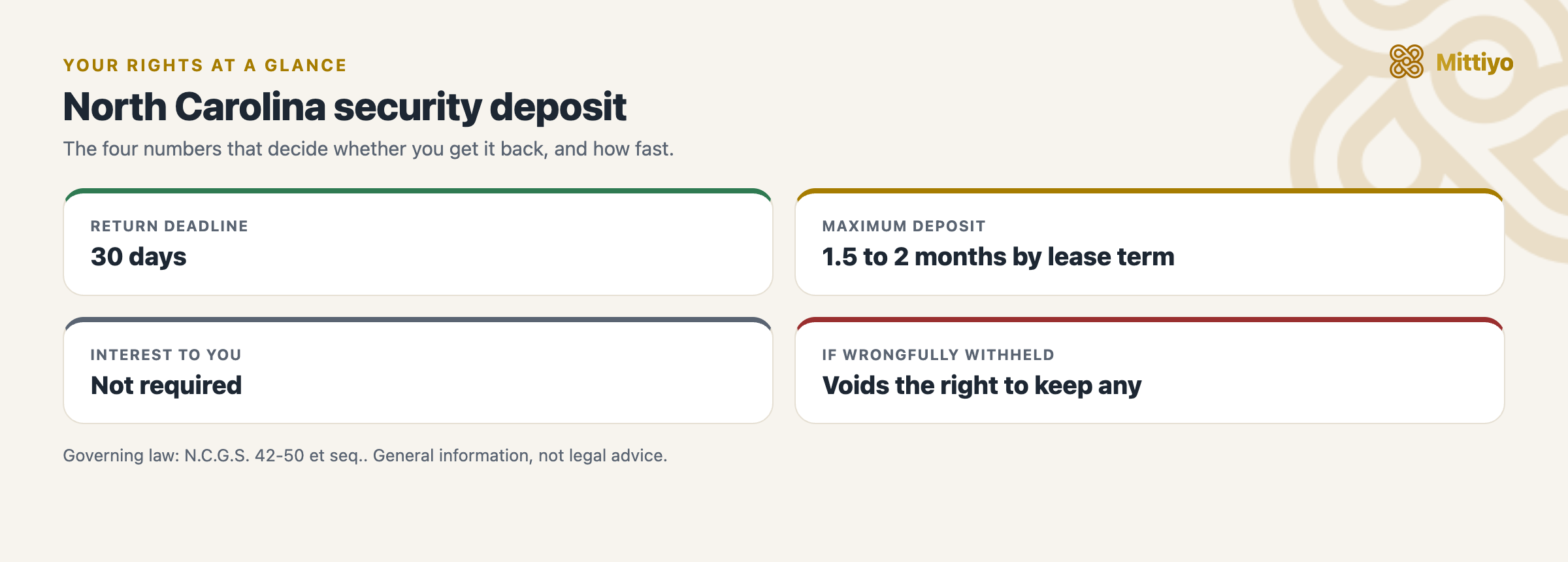
The cap on your deposit depends on the length of your lease term:
- Week-to-week tenancy: no more than 2 weeks’ rent.
- Month-to-month tenancy: no more than 1.5 months’ rent.
- A term longer than month-to-month (for example, a standard one-year lease): no more than 2 months’ rent.
On top of the security deposit, a landlord may charge a reasonable nonrefundable pet fee. That pet fee is separate from the deposit and does not count against the caps above. If your landlord collected more than the limit for your lease term, the excess is money you can demand back.
When you must get your deposit back
The clock starts once the tenancy ends and you deliver possession. From that point:
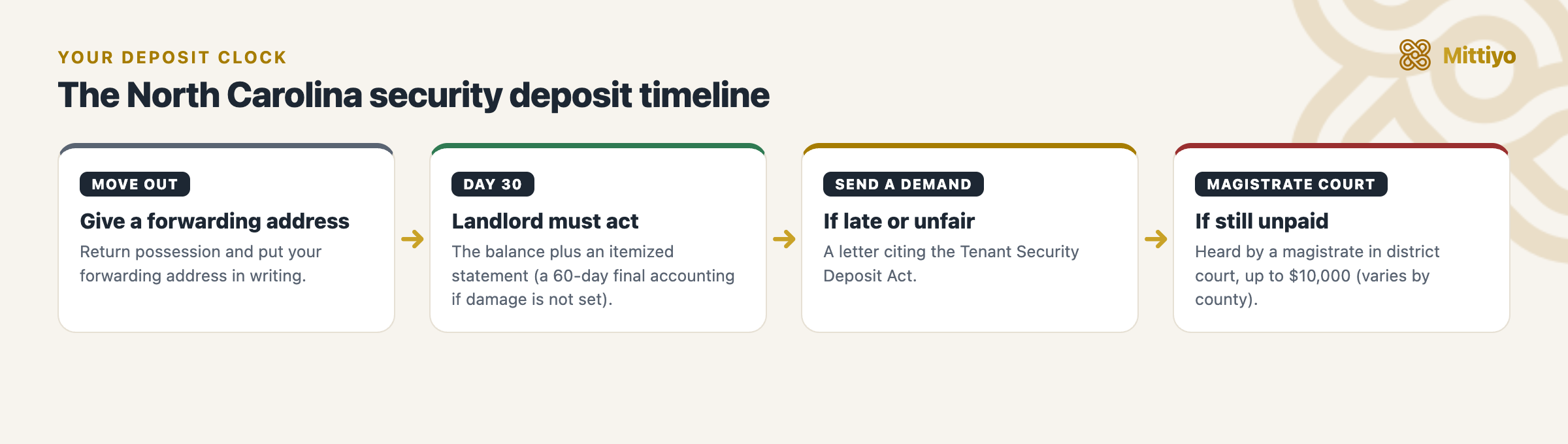
- Within 30 days, the landlord returns the balance of your deposit along with a written itemization of any deductions.
- If the extent of the damage cannot be determined within 30 days, the landlord must give you an interim accounting within 30 days and a final accounting within 60 days.
- If your address is unknown, the landlord may apply the deposit toward permitted charges after 30 days, but must hold any remaining balance for 6 months for you to claim.
The itemization is not optional. A landlord who keeps part of your deposit owes you a written breakdown of exactly what was subtracted and why. This is set out in N.C.G.S. 42-52.
A worked example
Say you paid a $1,500 deposit on a one-year lease. You move out, hand back the keys, and give your landlord a forwarding address. Thirty days pass. You hear nothing: no check, no itemization, no interim accounting.
That silence has teeth. A landlord’s willful failure to comply with the Act voids the landlord’s right to keep any part of the deposit. So instead of the landlord getting to argue over a few hundred dollars in claimed damage, the landlord loses the right to keep any of it. You recover the full $1,500, plus damages, and the court may award attorney fees on a finding of willful noncompliance.
Where your deposit must be held
North Carolina does not let a landlord mix your deposit into a personal account. The deposit must sit in a trust account at a licensed, federally insured North Carolina banking institution, or the landlord may instead furnish a bond for the amount.
The landlord must tell you the name and address of the bank holding the deposit, or of the bonding insurance company, within 30 days after the lease begins. This is required by N.C.G.S. 42-50. An out-of-state account is allowed only if the landlord is bonded. If your landlord never gave you this disclosure, that is a violation of the Act, and it matters if you end up in court.
Interest on your deposit
North Carolina does not require a landlord to pay you interest on your security deposit. Any interest the account earns belongs to the landlord unless your lease says otherwise. Do not expect an interest payment as part of your return.
What a landlord can and cannot keep
A landlord can only use your deposit for the specific purposes the statute permits, such as unpaid rent and the cost of repairing actual damage beyond normal wear and tear. A landlord cannot charge you for normal wear and tear, and cannot deduct more than the actual amount of the damage.
Common landlord tactics, and how to beat them
- A blanket cleaning or painting fee. Routine cleaning and repainting between tenants is normal wear and tear, not a chargeable deduction. A flat fee applied regardless of the unit’s condition does not survive scrutiny.
- Charging full price for carpet or paint. Carpet and paint wear out on a schedule. If a deduction is legitimate at all, it should be prorated for the age and remaining life of the item, not billed at full replacement cost.
- Vague deductions. “Repairs: $600” is not an itemization. You are owed a specific breakdown of what was damaged and what each fix cost.
- Skipping the paperwork. Missing the bank-disclosure requirement or failing to send a proper itemization can void the landlord’s right to keep anything.
- A lease clause that “waives” your rights. A lease cannot sign away the protections of the Act. Any clause that tries to do so is unenforceable.
If your landlord wrongfully keeps it
The penalty for a bad-faith landlord is strong. A landlord’s willful failure to comply with the Act voids the landlord’s right to keep any part of the deposit. You may then sue for the deposit itself plus damages, and on a finding of willful noncompliance the court may award you attorney fees. This is set out in N.C.G.S. 42-55. That fee provision is what makes it realistic to get a lawyer to take a deposit case, and what pressures a landlord to settle rather than fight.
How to write a demand letter
Before you file anything, send a short written demand. It is fast, it is free, and it often gets the deposit back without a court date. Keep it factual and set a deadline.
Fill in your details and the letter below updates live. Copy it, then paste into an email or print and post it.
[Date]

To: [Landlord name and address]

Re: Return of security deposit, [rental address]

To whom it may concern,

I rented [rental address] and moved out on [move-out date], returning possession and giving my forwarding address at [your forwarding address]. Under the North Carolina Tenant Security Deposit Act (G.S. 42-52), you had 30 days to return my [$ amount] security deposit with a written itemization of any deductions. That deadline has passed.

Please return the [$ amount] you owe me within 10 days of this letter. If you do not, I will file in small claims court to recover the deposit plus damages and attorney fees, as allowed by G.S. 42-55.

Sincerely,
[Your name]
This is a template to adapt, not legal advice. Keep a copy and send it so you can prove delivery (email, or post with tracking).
Taking it to small claims court in North Carolina
If the demand letter does not work, small claims is your next step. In North Carolina, small claims cases are heard by a magistrate in district court. The limit is up to $10,000, though the exact cap is set per county and can be lower, so check your county before you file. Filing and service fees run roughly $96 plus sheriff service, so confirm the current figure with the clerk of court in your county.
You do not need a lawyer. Bring your lease, proof you paid the deposit, dated move-in and move-out photos, the itemization the landlord sent (or proof that none ever came), and a copy of your demand letter. A magistrate rules based on the paper trail, so the tenant who shows up organized usually wins.
Local rules: North Carolina is uniform
Deposit rules are set by state law in Chapter 42 and apply the same in Charlotte, Raleigh, Durham, and every other city in the state. No North Carolina city sets a stricter deposit cap or a different return rule. Wherever you rent in the state, the same 30-day deadline and the same caps by lease term apply.
How to get your deposit back
- Take dated photos at move-in and again at move-out, covering every room.
- Give your landlord a written forwarding address so the 30-day clock starts and there is no excuse to hold the balance.
- Know the 30-day deadline and mark it, along with the 60-day final accounting date if damage is still being assessed.
- Send a demand letter with a 10-day deadline if the deposit or itemization does not arrive.
- File in small claims if the landlord still refuses, and bring your full paper trail.
Key takeaways
- The cap is 1.5 to 2 months’ rent depending on your lease term, or 2 weeks’ rent for a week-to-week tenancy, plus a reasonable nonrefundable pet fee.
- The landlord has 30 days to return the balance with a written itemization, with a 60-day final accounting if damage cannot be assessed in time.
- Your deposit must be held in a trust account, and the landlord must disclose the bank within 30 days of the lease starting.
- A landlord’s willful noncompliance voids the right to keep any of the deposit and can trigger attorney fees.
- North Carolina requires no interest, and its rules apply uniformly statewide.
This guide is general information, not legal advice; landlord-tenant rules change and can vary by city, so confirm against the sources below or a local attorney. Last reviewed July 2026.
Renting somewhere new?
know.place maps honest, structured experiences of specific buildings, the rent, deposit, water, and power, from people who have actually lived there, so you can vet a place before you sign.
Related: Security deposit laws by state · How much rent can you afford? · Apartment viewing checklist
Free tools: Deposit interest calculator · Notice to vacate generator
References and resources
- North Carolina Tenant Security Deposit Act, N.C.G.S. sections 42-50 to 42-56: https://www.ncleg.gov/EnactedLegislation/Statutes/HTML/ByArticle/Chapter_42/Article_6.html
- N.C.G.S. 42-51 (permitted uses and caps), FindLaw text: https://codes.findlaw.com/nc/chapter-42-landlord-and-tenant/nc-gen-st-sect-42-51/
- North Carolina Department of Justice, Renting a home: https://ncdoj.gov/protecting-consumers/home-repair-and-products/renting-a-home/
- North Carolina Courts, Small claims: https://www.nccourts.gov/help-topics/lawsuits-and-small-claims/small-claims
- HUD North Carolina tenant resources: https://www.hud.gov/states/north-carolina