

Oregon’s deposit statute is one of the more detailed in the country, and two of its features stand out: if a landlord simply fails to send you a written accounting at move-out, that alone doubles what they owe you, no need to prove bad faith, and a landlord generally cannot raise your deposit at all during your first year. This guide walks through the statute in full, starting with the accounting.
TL;DR: After you move out, an Oregon landlord has 31 days to send a written accounting and return whatever they are not claiming. If they miss that accounting entirely, you can recover double the amount withheld, and the same doubling applies separately for anything withheld in bad faith. Separately, they cannot raise or add to your deposit during your first year of tenancy except in narrow cases like adding a pet.
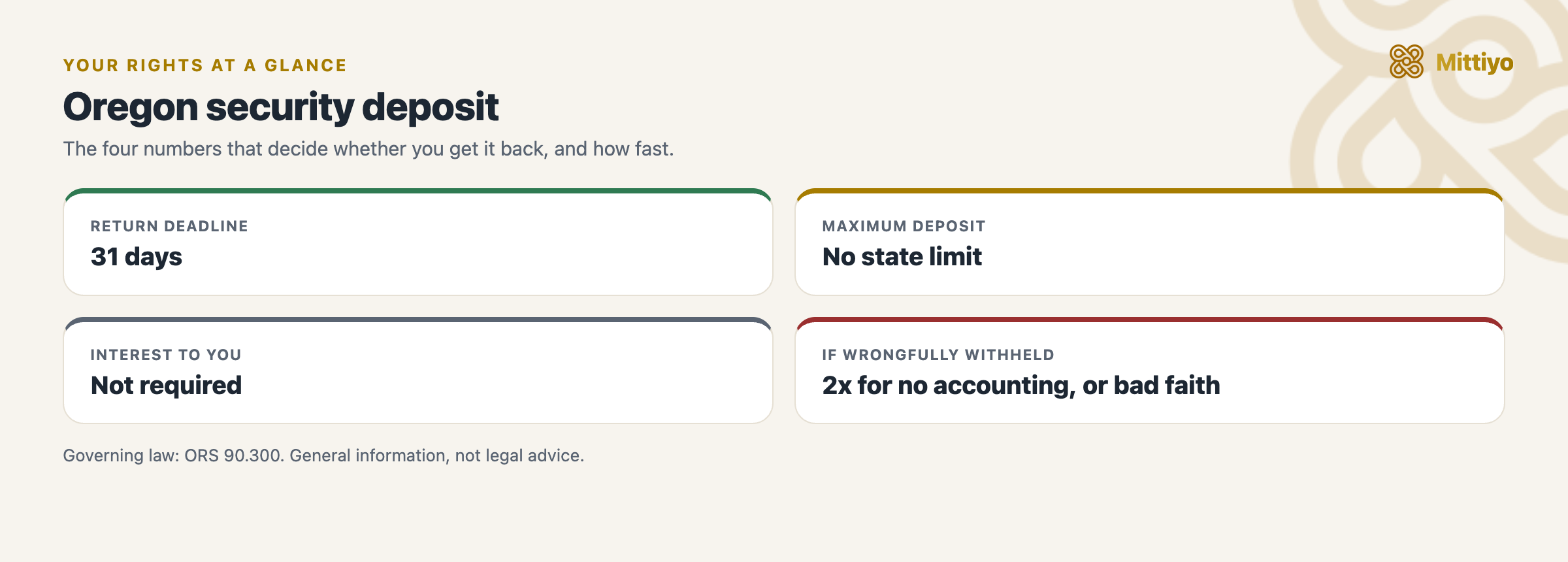
The 31-day written accounting is the center of Oregon’s deposit law
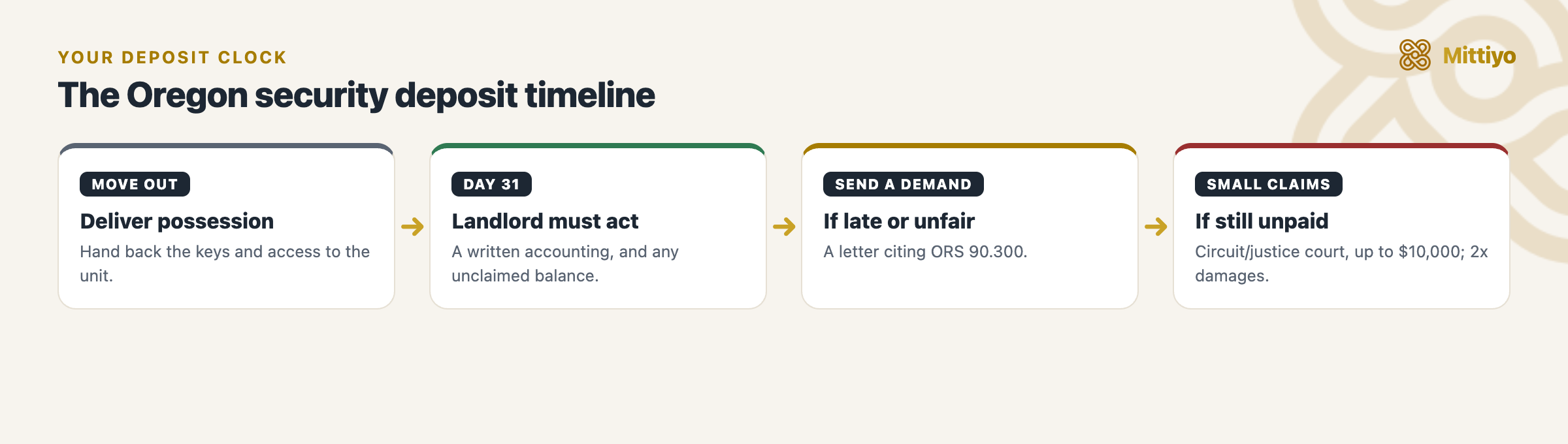
Everything starts with a clock of 31 days. Under ORS 90.300(12) and (13), within 31 days after your tenancy terminates and you deliver possession, the landlord must give you a written accounting stating specifically the basis for any deduction, and must return the portion of the deposit they are not claiming. These can arrive together or separately, but both have to happen within the 31-day window.
Two separate routes to double damages
ORS 90.300(16) sets out two independent triggers for double damages. If the landlord fails to return the deposit as required, or in bad faith fails to return any portion due, you may recover an amount equal to twice whatever was withheld without a written accounting, or twice whatever was withheld in bad faith. These are separate tracks: the first does not require proving bad faith at all, only that the accounting was missing, which makes Oregon one of the more tenant-favorable states in this series on the accounting requirement specifically.
What a $1,400 deposit looks like when no accounting arrives
Say your deposit was $1,400. You move out, hand back the keys, and 31 days pass with no written accounting and no refund at all.
Because Oregon’s penalty under ORS 90.300(16) applies to any amount “withheld without a written accounting,” you do not need to prove the landlord acted in bad faith, only that the accounting never came. You can recover double the amount withheld, $2,800 on the full deposit, in addition to whatever legitimate deductions might otherwise have applied. If instead the landlord sent an accounting but withheld $300 for something you can show was ordinary wear and tear, and you can demonstrate bad faith, that $300 can also be doubled to $600.
The first-year freeze on new or increased deposits
There is no statewide cap on the amount. What Oregon does regulate closely is when a landlord can change it. Under ORS 90.300(5), a landlord generally cannot change your rental agreement to require a new or increased deposit during the first year of your tenancy. The narrow exception is if you and the landlord agree to modify the lease for something like a pet, and the added deposit relates specifically to that change. If a landlord does require a new or increased deposit after your first year is up, you must be given at least three months to pay it, not a lump sum on short notice.
Oregon also bars a pet security deposit for a service animal or companion animal that a tenant with a disability requires as a reasonable accommodation, under ORS 90.300(4).
No interest, but your deposit outranks the landlord’s creditors
Oregon does not require a landlord to pay interest on a residential security deposit. Your deposit does, however, have priority over the claims of a landlord’s creditors, including in a bankruptcy, under ORS 90.300(2)(a), so it cannot be swept up in a landlord’s financial troubles.
Which deductions an accounting can legitimately list
Under ORS 90.300(7), a landlord may claim from the deposit only what is reasonably necessary to remedy your default under the lease, including unpaid rent, and to repair damage you caused beyond ordinary wear and tear. The statute is unusually specific about some deductions: machine carpet cleaning can be charged if your written lease allows it and the carpet was professionally cleaned or replaced before you moved in, and the landlord can charge a reasonable hourly rate for their own labor on repairs, not just outside contractor invoices.
From a missing accounting to a small claims filing
Start by checking whether your deposit was ever increased during your first year without your agreement; if so, that increase may not be valid. When you move out, give the landlord your forwarding information and deliver possession, since the 31 days run from there. If the accounting never arrives, or a deduction looks wrong, a written demand citing ORS 90.300 is worth sending before you file anything. Fill in the tool below and it drafts the letter for you.
Fill in your details and the letter below updates live. Copy it, then paste into an email or print and post it.
[Date]

To: [Landlord name and address]

Re: Return of security deposit, [rental address]

To whom it may concern,

I rented [rental address] and moved out on [move-out date], returning possession and giving my forwarding address at [your forwarding address]. Under Oregon's security deposit statute (ORS 90.300), you had 31 days to return my [$ amount] security deposit with a written accounting stating the specific basis for any deduction. That deadline has passed.

Please return the [$ amount] you owe me within 10 days of this letter. If you do not, I will file in small claims division of the circuit or justice court for the deposit plus double the amount withheld without a written accounting, or withheld in bad faith, as allowed by ORS 90.300(16).

Sincerely,
[Your name]
This is a template to adapt, not legal advice. Keep a copy and send it so you can prove delivery (email, or post with tracking).
If the letter does not work, file in the small claims division of your circuit or justice court for the deposit and double damages. The current limit is $10,000; if your claim is $750 or less, you must use small claims, and larger claims up to $10,000 can choose to file there. You do not need a lawyer.
Bring your lease, proof of the deposit you paid, dated move-in and move-out photos, the landlord’s written accounting (or proof none arrived), and your demand letter.
Oregon deposit rules in five lines
- Any amount withheld without a written accounting doubles automatically; any amount withheld in bad faith doubles separately.
- The landlord has 31 days after your tenancy ends and you deliver possession to send a written accounting and return any unclaimed portion.
- Oregon generally bars a landlord from raising your deposit during your first year of tenancy.
- No statewide cap and no interest requirement apply, but the deposit has priority over a landlord’s creditors.
- Small claims claims go through the circuit or justice court, with a $10,000 limit.
This guide is general information, not legal advice; landlord-tenant rules change and can vary by city, so confirm against the sources below or a local attorney. Last reviewed July 2026.
Renting somewhere new?
know.place maps honest, structured experiences of specific buildings, the rent, deposit, water, and power, from people who have actually lived there, so you can vet a place before you sign.
Related: Security deposit laws by state · How much rent can you afford? · Apartment viewing checklist
Free tools: Deposit interest calculator · Notice to vacate generator
Sources
- ORS 90.300, security deposits and prepaid rent: https://oregon.public.law/statutes/ors_90.300
- Oregon Judicial Department, small claims: https://www.courts.oregon.gov/courts/multnomah/go/pages/smallclaims.aspx