

Texas gives renters one of the more tenant-friendly deposit rules in the country, but only if you know how to trigger it. The law sets no ceiling on the deposit, yet it puts a hard 30-day clock on the refund and hands you a stacked penalty when a landlord keeps your money without cause. The catch is that the clock does not start on its own. You have to hand the landlord a written forwarding address first.
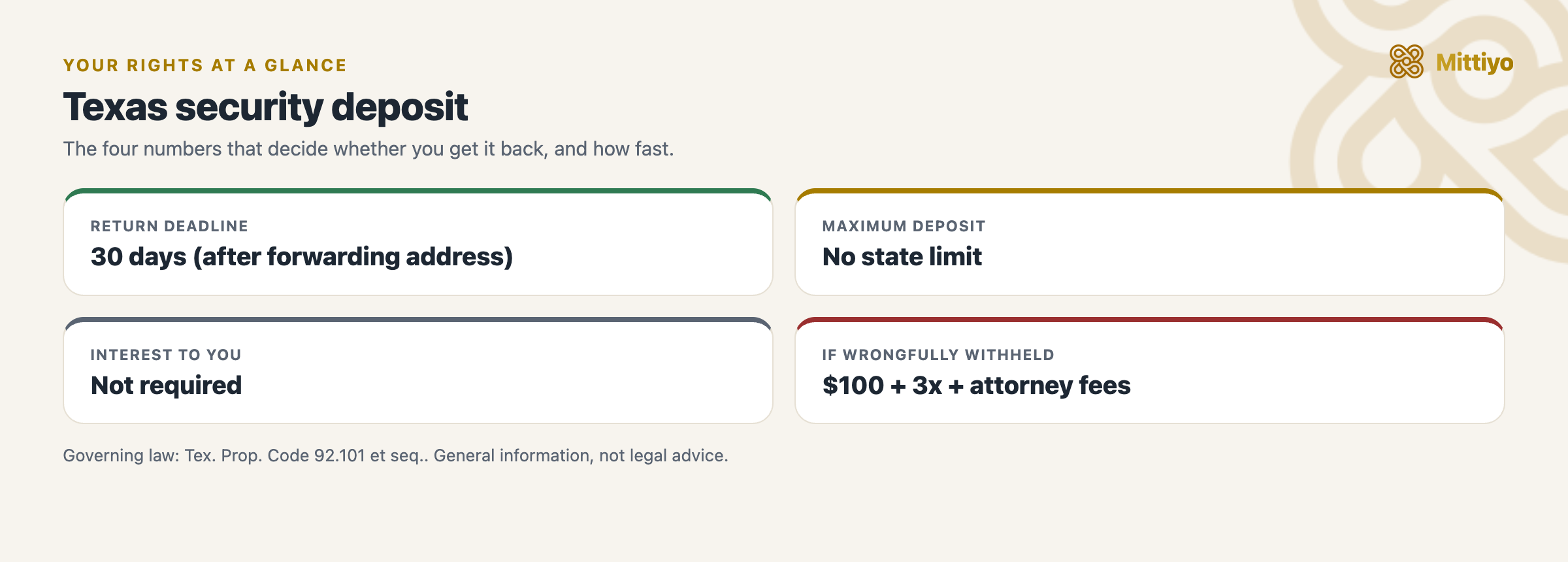
TL;DR: Texas has no cap on the deposit amount. Your landlord must refund it, with an itemized list of any deductions, on or before the 30th day after you move out, but that duty is only triggered once you give a written forwarding address. Miss that step and the clock never starts.
How much can a landlord charge in Texas
Texas sets no statutory cap on a security deposit. There is no one-month or two-month limit written into the Property Code, so the amount is whatever your lease states and whatever you agree to sign. In practice most landlords ask for one month’s rent, sometimes more for a higher-risk tenant or a pet, but that is market custom, not a legal ceiling. Read the deposit figure in your lease carefully, because that number is the one the law will hold your landlord to when it comes time to refund.
When you must get your deposit back
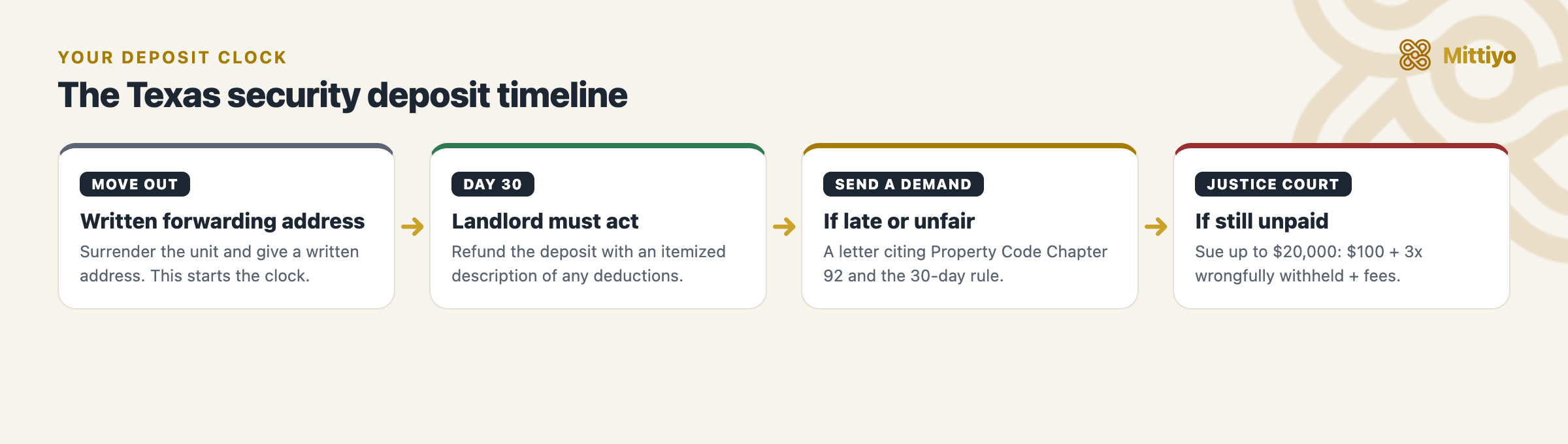
Your landlord must refund the deposit on or before the 30th day after you surrender the unit. That is the core deadline in Property Code section 92.103.
There is one step you control that makes the whole thing work. The landlord’s duty to refund, and the duty to give you a written itemized description of any deductions, is not triggered until you give a written forwarding address. This is the trigger tenants most often miss. Say it in writing, keep a copy, and the clock starts.
Failing to give a forwarding address does not forfeit your right to the refund. It only stalls the clock. Your deposit is still yours, but the 30-day duty and the penalties that back it up do not kick in until the landlord has an address to send the money to. Give the address the day you hand back the keys, and put it in writing every time.
A worked example
Say your deposit was $1,500. You move out clean, hand back the keys, and give your landlord a written forwarding address the same day. Thirty days pass. No check arrives, no itemized list, nothing. Then a letter shows up keeping $900 with no breakdown of what it covers.
That is bad-faith retention. Here is the math the law lets you claim:
- The $100 flat penalty
- Three times the $900 wrongfully withheld, which is $2,700
- Your reasonable attorney fees
So on a $1,500 deposit where $900 was kept in bad faith, you can seek $100 plus $2,700, which is $2,800, plus fees, on top of getting the money you were actually owed. The penalty is built to make wrongful withholding hurt.
Interest on your deposit
Texas does not require a landlord to pay interest on your security deposit, and it does not require the deposit to be held in a separate account. Your landlord can keep the money in a general account and owes you nothing extra for the time it sat there. That is a difference worth knowing if you have rented in a state that does mandate interest.
What a landlord can and cannot keep
A landlord can deduct for damages and charges you owe under the lease. That means the cost of repairing harm you caused, or unpaid fees the lease makes you responsible for. What a landlord cannot deduct is normal wear and tear, the ordinary aging of a home from you simply living in it.
There is one narrow exception to the itemized-list rule. If you owe rent that is not in dispute when you surrender the unit, the landlord does not have to give you an itemized description of deductions. Outside that case, the itemized list is required whenever any amount is withheld.
The bad-faith presumption works for you
Texas builds in a presumption that tilts the field toward the tenant. Under Property Code section 92.109, a landlord who fails to refund the deposit or to give you a written itemized description on or before the 30th day is presumed to have acted in bad faith.
That word “presumed” is doing heavy lifting. It means you do not have to prove the landlord’s state of mind. Once the deadline passes with no refund and no list, bad faith is assumed, and the burden shifts to the landlord to prove that keeping any part of the deposit was reasonable. In a dispute, that is a powerful place to stand. The landlord has to explain themselves; you do not have to read their mind.
Common landlord tactics, and how to beat them
A few moves come up again and again. None of them hold up when you know the rule.
- The blanket cleaning or painting fee. A flat charge to repaint or deep-clean as a matter of course is not a valid deduction. Paint and carpet age out through normal use, and that aging is the landlord’s cost, not yours.
- Charging full price for carpet or paint. Even where a replacement is fair, the cost should be prorated for the age and remaining life of the item, not billed to you at full new-item price.
- Vague round-number deductions. A tidy “$500 for cleaning and repairs” with no breakdown is exactly what the itemized-list rule exists to stop. Ask for the itemized description you are owed.
- Going silent. A landlord who simply stops responding is not running out the clock in their favor. Silence past the 30th day triggers the bad-faith presumption and works against them.
One more thing to hold onto: a lease cannot waive your rights under Chapter 92. A clause that tries to sign away the 30-day rule or the penalties is not enforceable.
If your landlord wrongfully keeps it
When a landlord retains a deposit in bad faith, the law stacks the liability. They owe you $100, plus three times the portion of the deposit wrongfully withheld, plus your reasonable attorney fees.
There is a second, separate hit for the paperwork failure. A landlord who acts in bad faith by not giving you the written itemized description forfeits the right to keep any of the deposit at all, and forfeits the right to sue you for damages to the unit. On top of that, you can recover your reasonable attorney fees. So the failure to document is not a small technicality. It can cost the landlord the entire deposit and their counterclaim.
How to write a demand letter
Before you file anything, send a written demand. Keep it short and factual. Name Texas Property Code Chapter 92, state that the 30-day deadline has passed, give the exact amount owed, and set a short deadline to pay. Send it so you have proof of delivery, and keep a copy. Many landlords pay once they see you know the statute by name. The Texas State Law Library provides a demand-letter template you can adapt.
[Date] · To: [Landlord/manager name and address] · Re: Return of security deposit, [rental address]
I rented [address] and surrendered it on [date], giving you my written forwarding address at [your address]. Under Texas Property Code Chapter 92, you had until the 30th day after I surrendered the unit to refund my [$ amount] deposit with an itemized description of any deductions. That deadline has passed [or: the deductions are for normal wear and tear, which is not deductible].
Please refund the [$ amount] you owe me within 10 days. If you do not, I will file in justice (small claims) court for the deposit, the $100 penalty, three times the amount wrongfully withheld, and my attorney fees, as allowed by section 92.109.
[Signature] · [Name] · [Phone] · [Email]
Taking it to small claims court in Texas
If the demand letter does not work, your deposit suit goes to your county justice of the peace court, usually called justice court or small claims court. The limit there is $20,000, so a deposit claim fits well inside it. You do not need a lawyer to file.
Filing and service fees are set per county and commonly run roughly $50 to $120. Check your local justice court or eFileTexas for the exact figures where you live. When you go, bring your evidence: the lease, proof you paid the deposit, dated move-in and move-out photos, a copy of the written forwarding address you gave, the itemized description the landlord sent or proof that none ever came, and your demand letter. That paper trail is what wins a deposit case.
How to get your deposit back
- Take dated photos at move-in and again at move-out, room by room, so you can prove condition on both ends.
- Give a written forwarding address. This is the step that starts the clock. Do it in writing and keep a copy.
- Know the 30-day deadline. The refund and the itemized list are due on or before the 30th day after you surrender the unit.
- Send the demand letter if the deadline passes, citing Chapter 92 and the amount owed.
- File in justice court if the landlord still will not pay, using your photos, lease, and demand letter as evidence.
Key takeaways
- Texas sets no cap on the deposit; the lease amount is what governs.
- The 30-day refund clock only starts once you give a written forwarding address.
- Bad-faith retention costs the landlord $100 plus three times the amount wrongfully withheld plus your attorney fees.
- Miss the 30-day list-or-refund deadline and the landlord is presumed to have acted in bad faith, with the burden on them.
- Deposit suits go to justice (small claims) court, where the $20,000 limit leaves plenty of room.
This guide is general information, not legal advice; landlord-tenant rules change and can vary by city, so confirm against the sources below or a local attorney. Last reviewed July 2026.
Renting somewhere new?
know.place maps honest, structured experiences of specific buildings, the rent, deposit, water, and power, from people who have actually lived there, so you can vet a place before you sign.
Related: Security deposit laws by state · How much rent can you afford? · Apartment viewing checklist
Free tools: Deposit interest calculator · Notice to vacate generator
References and resources
- Texas Property Code, Chapter 92 (Subchapter C, security deposits): https://statutes.capitol.texas.gov/Docs/PR/htm/PR.92.htm
- Texas State Law Library, Security deposits: https://guides.sll.texas.gov/landlord-tenant-law/security-deposits
- Texas State Law Library, Security deposit refunds: https://guides.sll.texas.gov/landlord-tenant-law/security-deposit-refunds
- Texas State Law Library, Small claims cases: https://guides.sll.texas.gov/small-claims
- Texas Attorney General, Renter’s rights: https://www.texasattorneygeneral.gov/consumer-protection/home-real-estate-and-travel/renters-rights
- HUD Texas tenant resources: https://www.hud.gov/states/texas