

Washington hands renters a protection most states do not: the move-in checklist. Get that one document signed and a landlord cannot dip into your deposit for damage at all. Add a firm 30-day return deadline and a double-damages penalty for an intentional refusal, and a Washington renter who knows the rules is in a strong position. This guide walks through every part with the section numbers.
TL;DR: A Washington landlord who takes a deposit must give you a signed move-in checklist, or they cannot withhold anything for damage. After you move out, they have 30 days to send a full itemized statement and return the balance. Miss that, and you recover the deposit; an intentional refusal can cost the landlord up to twice the deposit plus attorney fees.
How much can a landlord charge in Washington
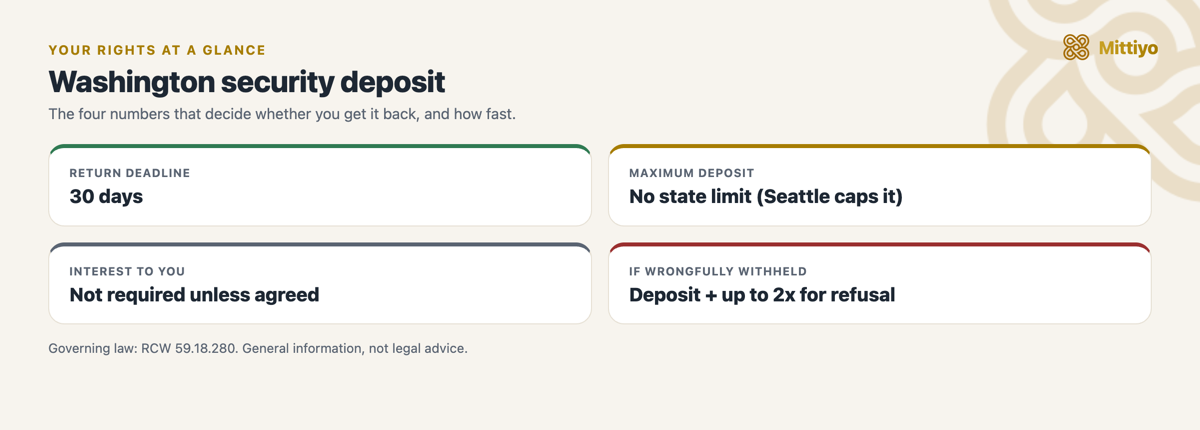
Washington sets no statewide cap on the deposit amount. A landlord can ask for one month, two months, or more, and state law does not set a ceiling. Cities can be stricter: in Seattle, the deposit and any non-refundable move-in fees together cannot exceed one month’s rent, and a renter on a lease of six months or longer can pay the deposit, fees, and last month’s rent in six equal monthly installments.
The bigger Washington rule is not the amount but the checklist. Under RCW 59.18.260, a landlord who collects a deposit has to put the rental agreement in writing and give you a written checklist or statement describing the condition of the unit at move-in, signed by both of you. No signed checklist, no lawful withholding for damages. That single document is the most powerful protection a Washington renter has, so insist on it and keep your copy.
When you must get your deposit back
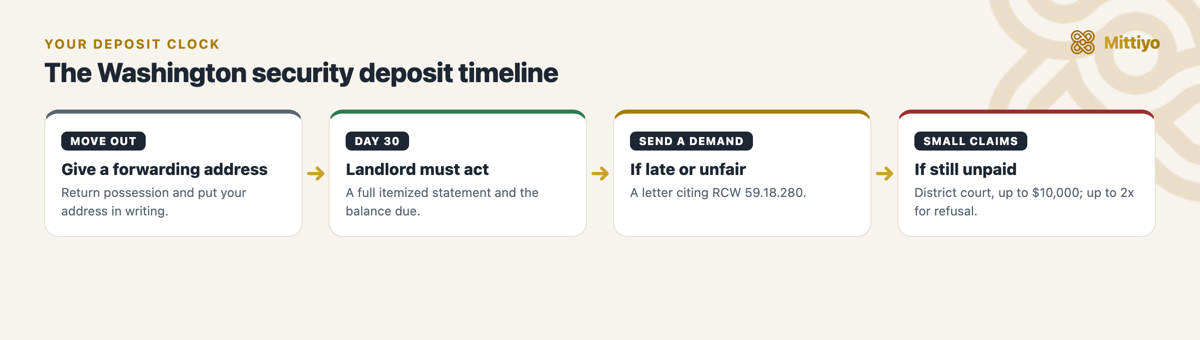
The clock is 30 days. Under RCW 59.18.280, within 30 days after the rental agreement ends and you vacate, the landlord must give you a full and specific written statement of the basis for keeping any of the deposit, along with the documentation supporting the deductions, and return whatever is left. A 2023 amendment set this deadline at 30 days.
Deliver your forwarding address in writing when you leave, so the statement and refund reach you and the landlord has no excuse. If the landlord misses the 30-day window without a valid reason, they lose the right to keep any of the deposit.
A worked example
Say your deposit was $1,500. You move out, hand back the keys, and give your forwarding address in writing. Thirty days pass with no statement and no refund.
You can recover the full $1,500 for the missed deadline. If you can show the landlord intentionally refused to return it, the court may award up to twice the deposit, another $1,500, for a total of $3,000, plus your court costs and reasonable attorney fees. And if the landlord never gave you a signed move-in checklist, they had no right to withhold for damage in the first place, which makes the refusal hard to defend.
Interest and how your deposit is held
Washington does not require a landlord to pay you interest on a residential deposit. Any interest the money earns belongs to the landlord unless your rental agreement says otherwise, so check your lease.
Where the money sits is regulated, though. Under RCW 59.18.270, the landlord must hold your deposit in a trust account with a bank or escrow company and give you a written receipt stating the name and address of the institution where it is kept. Your deposit is not supposed to sit in the landlord’s personal account.
What a landlord can and cannot keep
A landlord can deduct for unpaid rent and for damage beyond normal wear and tear, but only if there is a signed move-in checklist to measure against. A landlord cannot charge you for normal wear and tear, the ordinary aging that comes from simply living in a place, and cannot withhold for damage at all without that checklist.
Common landlord tactics, and how to beat them
A few moves come up again and again. A landlord withholds for damage with no signed move-in checklist; under RCW 59.18.260 they cannot, so point to the missing document. A landlord sends a vague deduction with no proof; the law requires a full and specific statement with documentation, so a lump sum does not meet the standard. A landlord bills the full cost of a worn carpet or a routine repaint; those are age and upkeep, not your damage.
Your strongest cards are the signed checklist and the 30-day statement. Together they decide almost every Washington deposit dispute in the renter’s favor when the landlord cuts corners.
If your landlord wrongfully keeps it
The remedy sits in RCW 59.18.280. If the landlord fails to give the required statement and refund within 30 days, you can recover the full amount of the deposit. If the court finds the landlord intentionally refused to return what was due, it may in its discretion award up to two times the deposit, plus the costs of suit and reasonable attorney fees.
Note the two tiers. The plain missed deadline gets your deposit back; the intentional refusal is what unlocks the doubling. A landlord who withheld for damage with no signed checklist, or who sent no statement at all, is squarely in intentional-refusal territory.
How to write a demand letter
Before you file, send a written demand. It costs a stamp, creates a paper trail, and often produces a check within days. Fill in the tool below and it builds the letter for you.
Fill in your details and the letter below updates live. Copy it, then paste into an email or print and post it.
[Date]

To: [Landlord name and address]

Re: Return of security deposit, [rental address]

To whom it may concern,

I rented [rental address] and moved out on [move-out date], returning possession and giving my forwarding address at [your forwarding address]. Under Washington's Residential Landlord-Tenant Act (RCW 59.18.280), you had 30 days to return my [$ amount] security deposit with a full and specific written statement of any deductions. That deadline has passed.

Please return the [$ amount] you owe me within 10 days of this letter. If you do not, I will file in district court small claims for the deposit, up to twice the deposit for an intentional refusal, plus costs and attorney fees, as allowed by RCW 59.18.280.

Sincerely,
[Your name]
This is a template to adapt, not legal advice. Keep a copy and send it so you can prove delivery (email, or post with tracking).
Taking it to small claims court in Washington
If the demand letter does not work, deposit cases go to the small claims department of your district court. An individual can sue for up to $10,000, which comfortably covers a deposit plus double damages, and you do not need a lawyer; in fact lawyers generally cannot appear in Washington small claims without the judge’s permission.
When you go, bring your lease, the signed move-in checklist, proof you paid the deposit, dated move-in and move-out photos, the landlord’s statement or proof that none came, and a copy of your demand letter.
Local rules: state floor, city extras
Washington’s state rules are the floor, and some cities add to them. Seattle caps the deposit plus non-refundable move-in fees at one month’s rent, requires installment options, and bars a landlord from charging interest or refusing a tenant who pays in installments. Tacoma and other cities have their own renter protections too. Always check your city, because a local ordinance can give you more than the state statute does.
How to get your deposit back
- Insist on a signed move-in checklist and take dated photos the day you arrive, so the condition is fixed on the record.
- Give the landlord your forwarding address in writing when you leave.
- Know the 30-day deadline for the full statement and the return.
- If the deadline passes, send a demand letter citing RCW 59.18.280 and, if it applies, the missing checklist.
- If that fails, file in your district court small claims department for the deposit and, for an intentional refusal, up to twice the deposit.
Key takeaways
- A landlord who takes a deposit must give you a signed move-in checklist, or they cannot withhold any of it for damage.
- The landlord has 30 days after you move out to send a full itemized statement and return the balance.
- A missed deadline gets your deposit back; an intentional refusal can cost the landlord up to twice the deposit plus attorney fees.
- Washington requires no interest to the tenant, but the deposit must sit in a trust account you are told about.
- Deposit claims go to district court small claims, where an individual’s $10,000 limit easily covers them.
This guide is general information, not legal advice; landlord-tenant rules change and can vary by city, so confirm against the sources below or a local attorney. Last reviewed July 2026.
Renting somewhere new?
know.place maps honest, structured experiences of specific buildings, the rent, deposit, water, and power, from people who have actually lived there, so you can vet a place before you sign.
Related: Security deposit laws by state · How much rent can you afford? · Apartment viewing checklist
Free tools: Deposit interest calculator · Notice to vacate generator
References and resources
- RCW 59.18.280, deposit return and penalties: https://app.leg.wa.gov/rcw/default.aspx?cite=59.18.280
- RCW 59.18.260, move-in checklist requirement: https://app.leg.wa.gov/rcw/default.aspx?cite=59.18.260
- RCW 59.18.270, deposit held in trust account: https://app.leg.wa.gov/rcw/default.aspx?cite=59.18.270
- Washington Courts, Small Claims Court: https://www.courts.wa.gov/newsinfo/resources/?fa=newsinfo_jury.scc&altMenu=smal
- Seattle SDCI, Deposit Returns: https://www.seattle.gov/sdci/codes/common-code-questions/deposit-returns
- HUD Washington tenant resources: https://www.hud.gov/states/washington/renting