
The security deposit is often the largest single financial transaction in a rental arrangement. In Bengaluru, where 10 months’ deposit is the prevailing market standard, a tenant renting a 2BHK at Rs 30,000 per month is paying Rs 3,00,000 upfront as a refundable deposit. For many tenants, particularly those relocating to Bengaluru for the first time, this amount represents a significant portion of their savings.
Despite the financial magnitude of these transactions, security deposits in Karnataka operate in a space where market practice has outpaced statutory regulation. Understanding the legal framework, what the law actually says, what it does not say, and what rights and remedies are available, is essential for both tenants and landlords.
The Legal Framework Governing Security Deposits
What the Law Actually Says
Here is what might surprise many renters and landlords in Bengaluru: no Karnataka statute mandates a specific security deposit amount for private residential rentals.
The relevant legal provisions are:
| Source | Provision | Impact |
|---|---|---|
| Indian Contract Act, 1872 | Section 10, parties may agree to any terms with free consent | Deposit amount is contractual, whatever both parties agree to |
| Indian Contract Act, 1872 | Section 73, compensation for breach of contract | Governs the landlord’s right to claim damages from the deposit |
| Indian Contract Act, 1872 | Section 74, reasonable penalty, not forfeiture | Prohibits disproportionate forfeiture of deposit |
| Transfer of Property Act, 1882 | Section 105, defines “lease” and the relationship of lessor and lessee | Establishes the tenancy framework |
| Transfer of Property Act, 1882 | Section 108(m), tenant liable for damage beyond fair wear and tear | Defines what the deposit can be used for |
| Transfer of Property Act, 1882 | Section 108(q), tenant must restore possession on termination | Governs return of property and deposit at lease end |
| Karnataka Rent Act, 1999 | No provision specifying a maximum deposit amount | No statutory cap in Karnataka |
| Model Tenancy Act, 2021 | Section 8, recommends max 2 months for residential | Advisory only, not binding in Karnataka |
The security deposit is, at its core, a contractual arrangement governed by the Indian Contract Act, 1872. Section 10 of that Act establishes that all agreements are contracts if they are made by the free consent of parties competent to contract, for a lawful consideration and with a lawful object. Since collecting a deposit is neither unlawful nor opposed to public policy, parties are free to agree on any amount.
 India Code (indiacode.nic.in), the official repository where the statutes cited here, such as the Transfer of Property Act and the Indian Contract Act, are published. Source: Government of India.
Section 108(m) of the Transfer of Property Act: The Critical Provision
The most important statutory provision governing what a deposit can be used for is Section 108(m) of the Transfer of Property Act, 1882. This section states that the lessee is bound to keep and restore the property in as good condition as it was in at the commencement of the lease, subject to “the changes caused by reasonable wear and tear or irresistible force.”
This provision creates two important legal principles:
- The tenant is not an insurer of the property. Damage caused by natural aging, normal use, or force majeure is not the tenant’s responsibility.
- The burden of proving damage beyond wear and tear rests on the landlord. If a landlord claims deductions from the deposit, they must demonstrate that the damage exceeds what would be expected from normal occupancy over the lease period.
Section 74 of the Indian Contract Act: Protection Against Forfeiture
Section 74 provides that when a contract specifies a sum to be paid as penalty for breach, the party complaining of the breach is entitled only to “reasonable compensation not exceeding the amount so named.” This means a landlord cannot forfeit the entire deposit for a minor breach; the deduction must be proportionate to the actual loss suffered.
The Supreme Court in Maula Bux v. Union of India (AIR 1970 SC 1955) held that Section 74 applies to all stipulations by way of penalty, and the party seeking to forfeit must prove actual loss or damage. This principle has been consistently applied in deposit forfeiture disputes.
The Model Tenancy Act, 2021: An Advisory Framework
The Model Tenancy Act (MTA), 2021 was passed by the Central Government as a model framework for states to adopt. Section 8 of the MTA recommends that security deposits for residential premises should not exceed two months’ rent. However, the MTA is not a directly enforceable statute, it requires state legislatures to adopt it through their own legislation. As of the date of this article, Karnataka has not adopted the MTA provisions regarding deposit caps.
While the MTA’s 2-month recommendation lacks legal force in Karnataka, it serves as a useful reference point in negotiations, signaling a recognized policy direction toward lower deposits.
The 10-Month Bengaluru Norm: Origins and Reality
How It Developed
The 10-month deposit standard in Bengaluru is a market practice that emerged over several decades due to a combination of factors:
- High tenant turnover: Bengaluru’s economy is driven by the IT and technology sector, which brings a large, mobile workforce. Landlords historically faced frequent vacancies and sought higher deposits as financial security.
- Interest-free capital: The deposit functions as an interest-free loan to the landlord, often deployed for personal investments, fixed deposits, or further property purchases. This economic incentive reinforced the practice.
- Yield arbitrage: Rental yields in Bengaluru have historically been low (2-3% of property value). Higher deposits compensated landlords for the gap between rental income and property holding costs.
- Self-reinforcing norm: Once the 10-month standard became widespread, it became the default expectation. Individual landlords followed the practice because “everyone does it,” and tenants accepted it because alternatives were scarce.
How Bengaluru Compares to Other Indian Cities
| City | Typical Security Deposit | Governing Practice |
|---|---|---|
| Bengaluru | 10 months’ rent | Market practice, no statutory cap |
| Mumbai | 3-6 months’ rent | Maharashtra Rent Control Act regime |
| Delhi NCR | 2-3 months’ rent | Market practice, MTA influence |
| Hyderabad | 2-3 months’ rent | Market practice |
| Pune | 3-6 months’ rent | Maharashtra norms |
| Chennai | 3-6 months’ rent | Tamil Nadu norms |
| Kolkata | 2-3 months’ rent | West Bengal tenancy laws |
Bengaluru’s deposit standard is the highest among all major Indian metros by a significant margin. For a tenant earning Rs 80,000 per month and renting at Rs 25,000 per month, a 10-month deposit of Rs 2,50,000 represents over three months’ gross salary locked up without interest.
The Financial Impact on Tenants
The practical consequences of the 10-month deposit norm deserve attention:
- Opportunity cost: Rs 3,00,000 held for 11 months at even a conservative 7% fixed deposit rate represents approximately Rs 19,250 in foregone interest for the tenant.
- Barrier to mobility: Tenants who want to shift apartments must arrange a new deposit before recovering the existing one, effectively requiring double the deposit amount during transition periods.
- Disproportionate burden on new migrants: Professionals relocating to Bengaluru from cities with lower deposit norms face an unexpectedly large upfront cash requirement, sometimes needing to take personal loans.
What Can a Landlord Deduct From Your Deposit?
The security deposit is held as a safeguard against specific, legally recognized risks. A landlord’s right to make deductions from the deposit is not absolute, it is constrained by both statutory provisions and contractual terms.
1. Unpaid Rent or License Fees
If the tenant owes any rent at the time of vacating, the landlord is entitled to deduct the outstanding amount from the deposit. This is the most straightforward deduction and is rarely disputed, provided both parties agree on the outstanding amount.
Legal basis: The rental agreement itself (contractual obligation), supported by Section 73 of the Indian Contract Act (compensation for loss caused by breach).
2. Unpaid Utility Bills
Outstanding electricity (BESCOM), water (BWSSB), piped gas, internet, or maintenance charges that the tenant was contractually obligated to pay can be deducted.
Best practice: Before vacating, the tenant should obtain final bills from all utility providers and settle them directly. This eliminates disputes about estimated versus actual charges. Keep receipts of all final payments.
3. Damage Beyond Normal Wear and Tear
This is where the vast majority of deposit disputes arise. Section 108(m) of the Transfer of Property Act requires the tenant to maintain the property “as good a condition as it was in at the commencement of the lease,” subject to “the changes caused by reasonable wear and tear.”
 The line the law draws between ageing and damage.
What usually counts as “normal wear and tear” (ideally not deducted):
- Fading or discoloration of paint over the lease period
- Minor scuff marks on walls from furniture placement
- Worn-out door hinges, handles, or latches from daily use
- Faded curtains or blinds (if landlord-provided)
- Minor stains on older fixtures or countertops
- Yellowing of white fittings from age
- Gradual deterioration of bathroom silicone or caulking
- Light scratches on flooring from normal foot traffic
- Fading of wooden surfaces from sunlight exposure
What usually counts as “damage” (fair to deduct, with evidence):
- Broken windows, mirrors, or glass fixtures
- Large holes in walls (beyond normal picture-hanging)
- Damaged kitchen countertops or bathroom fittings from misuse
- Stained or damaged flooring requiring replacement
- Missing inventory items (in furnished apartments)
- Broken tiles from impact
- Damaged electrical fixtures from misuse
- Pet damage to flooring, doors, or walls
- Water damage from tenant negligence (e.g., leaving taps running)
The “Mandatory Painting” Dispute
One of the most contentious deposit deductions in Bengaluru is the landlord’s insistence that the tenant must pay for repainting the apartment at exit. The legal position is nuanced:
- If the agreement explicitly requires the tenant to repaint at exit, the clause is generally enforceable as a contractual obligation.
- If the agreement is silent on repainting, the landlord can claim repainting costs only if the walls are damaged beyond normal wear and tear. Simple fading or minor scuff marks from normal occupancy do not justify repainting at the tenant’s expense.
- Even where repainting is required, the cost must be reasonable. Courts have held that landlords cannot claim premium-grade painting costs when standard painting was the original condition.
The Madras High Court in K. Saravanan v. S. Karthikeyan held that normal wear and tear of paint during a tenancy period does not constitute damage, and deducting repainting costs from the deposit in such cases is unjustified.
The Landlord’s Obligations at Exit
When a tenant vacates, the landlord has specific obligations regarding the deposit:
1. Conduct a Joint Inspection
Both landlord and tenant (or their authorized representatives) should conduct a walk-through of the property together. During this inspection:
- Note any damage beyond normal wear and tear
- Compare the current condition with the condition at move-in (using move-in photographs as reference)
- Agree on items that need repair
- Document findings in writing, signed by both parties
2. Prepare an Itemized Deduction List
If the landlord claims deductions, they must prepare a detailed, itemized list specifying:
- Each item of damage claimed
- The estimated repair cost for each item
- Supporting documentation (photographs, vendor quotes)
A blanket statement like “Rs 30,000 deducted for repairs” without itemization is insufficient and legally challengeable.
3. Provide Receipts for Repairs
If repairs are carried out, the landlord should provide actual invoices or receipts from the contractor or vendor. Estimated costs without actual invoices weaken the landlord’s position in any subsequent dispute.
4. Return the Balance Within the Agreed Timeline
Most rental agreements specify a deposit return timeline, typically 30 to 60 days from the date of vacating. If the agreement is silent, a reasonable period is considered to be 30 days, based on general contractual principles and the MTA’s guidance.
Interest on delayed refund: While no Karnataka statute explicitly provides for interest on delayed deposit refunds, courts have awarded interest in cases of unreasonable delay, typically at 6-9% per annum from the date the refund became due.
What to Do If Your Deposit Is Not Returned
If a landlord refuses to return the deposit, makes unjustified deductions, or simply stops responding, the tenant has several legal remedies, arranged here from least to most formal.
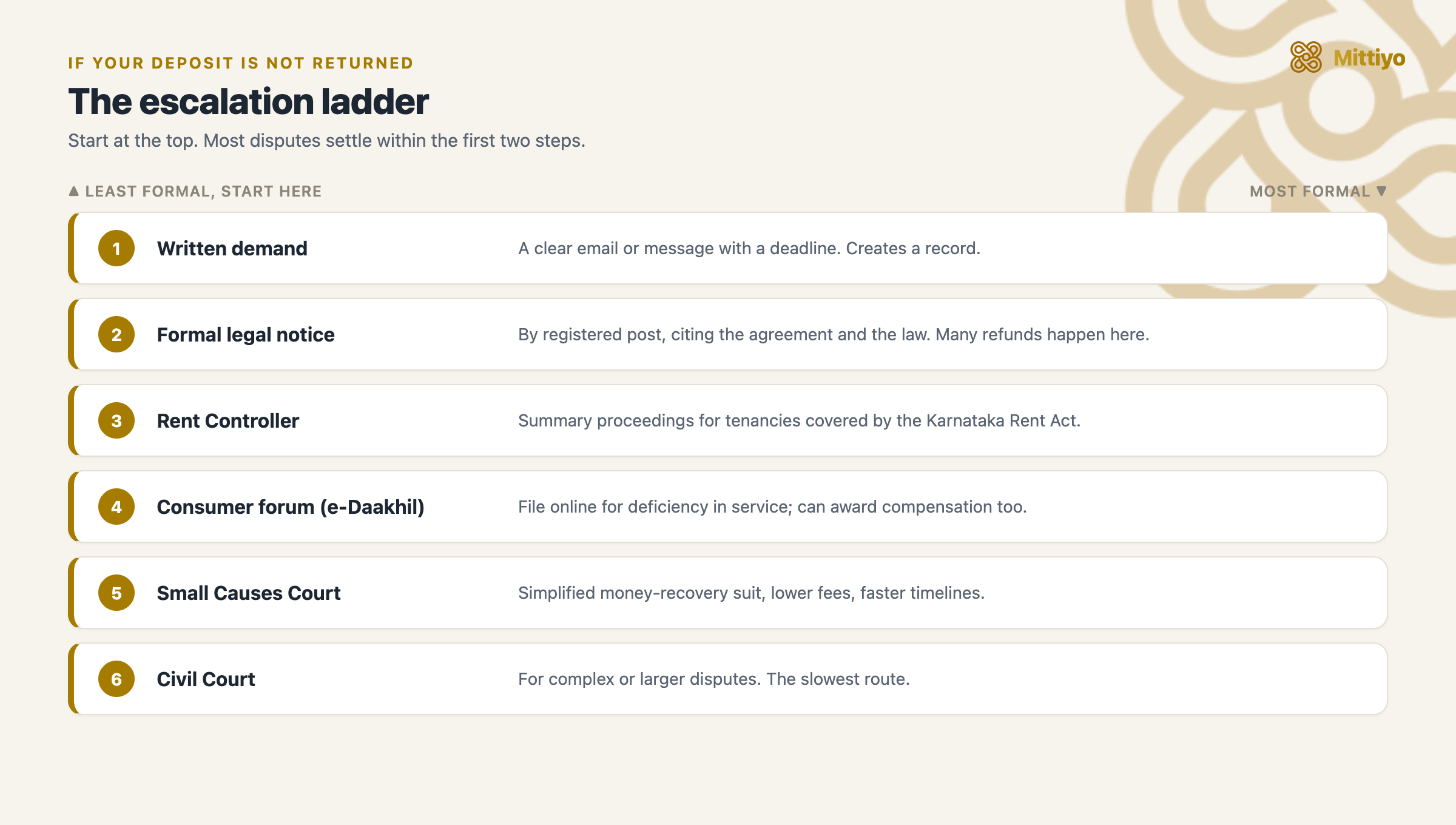 Work down the ladder; most disputes end at the first two rungs.
Step 1: Written Communication and Demand
Before any formal legal action, send a clear written communication (email or WhatsApp message) to the landlord requesting the deposit refund with a deadline. This creates a documented record. If informal communication fails, escalate to a formal legal notice.
Step 2: Send a Legal Notice
Draft a formal legal notice (can be done by a lawyer or self-drafted) requesting the return of the deposit within 15-30 days. The notice should:
- Reference the rental agreement (date, parties, property address)
- State the deposit amount paid
- Reference the date of vacating and any joint inspection conducted
- Demand the specific amount to be refunded
- Cite the legal basis: Section 73 of the Indian Contract Act (compensation for breach), Section 108(m) of the Transfer of Property Act (wear and tear distinction)
- Warn of legal action if the amount is not refunded within the specified period
Send the notice via registered post or speed post (for proof of delivery) and retain the postal receipt and tracking record. An email copy is advisable as additional evidence.
A significant percentage of deposit disputes resolve at the legal notice stage, many landlords refund upon receiving a formal notice, recognizing that contesting a clear legal claim is not in their interest.
Step 3: Approach the Rent Controller
Under the Karnataka Rent Act, 1999, the Rent Controller has jurisdiction over disputes arising from tenancies that fall under the Act. File an application at the Rent Controller’s office having jurisdiction over the property. The proceedings are summary in nature and are typically faster than civil court proceedings.
Limitation: The Karnataka Rent Act does not cover all tenancies, its applicability depends on the type and terms of the tenancy. Leave and License agreements may fall outside its scope depending on the specifics.
Step 4: File a Consumer Complaint
If the landlord-tenant relationship involves a “service” component, particularly common where the landlord manages multiple rental properties commercially or where maintenance services were promised, a complaint can be filed at the Consumer Disputes Redressal Commission under the Consumer Protection Act, 2019.
Filing can be done online through the e-Daakhil portal. Jurisdiction is determined by claim amount:
- Up to Rs 1 crore: District Consumer Disputes Redressal Commission
- Rs 1 crore to Rs 10 crore: State Consumer Disputes Redressal Commission
The Consumer Forum has the power to award compensation for “deficiency in service” and mental harassment, in addition to ordering the refund of the deposit amount.
Step 5: Small Causes Court
For straightforward money recovery, the Small Causes Court in Bengaluru can hear the case under the simplified procedure of Order XXXVII of the Code of Civil Procedure (Summary Suit). Advantages include:
- Simplified procedure with shorter timelines
- Lower court fees
- Decisions are generally final (limited appeal)
Step 6: Civil Court
For complex cases involving disputed facts, contested agreements, or larger amounts, a regular civil suit can be filed at the civil court having territorial jurisdiction. While this is the slowest route (2-5 years for disposal), it provides the most comprehensive judicial examination of the dispute.
Negotiating a Better Deposit
While the 10-month norm is deeply entrenched in Bengaluru, it is negotiable. Here are strategies that tenants have successfully used:
Offer a Longer Lock-in Period
Landlords accept lower deposits from tenants who commit to staying longer (2-3 years). The landlord’s primary concern is vacancy, a committed tenant reduces this risk. A 2-year lock-in with an 8-month deposit may be more attractive to a landlord than a 1-year term with a 10-month deposit.
Provide Employer Backing
A letter from your employer confirming your tenure, designation, and income reassures landlords about financial reliability. Large, established employers carry implicit credibility. Some corporate relocation programs include deposit assistance or employer guarantees.
Propose a Phased Deposit
Pay 6-7 months upfront and the remaining amount over the next 2-3 months. This eases the tenant’s immediate cash burden while the landlord still receives the full deposit. Structure this as written instalments within the agreement.
Reference the Model Tenancy Act
While not binding, citing the MTA’s 2-month recommendation establishes that your request for a reduced deposit has a national policy basis. It demonstrates awareness and signals that you are an informed tenant.
Show Financial Stability
Proactively providing bank statements, a credit score, or a stable employment history can address the landlord’s underlying concern (tenant default risk) more effectively than a higher deposit.
Negotiate Other Terms in Exchange
If the landlord insists on 10 months, negotiate concessions elsewhere: a lower rent, inclusion of maintenance, annual rent escalation cap, or a longer notice period for the landlord (giving you more time to recover the deposit before moving).
Protecting Yourself: Documentation Best Practices
At Move-In
- Photograph everything: Take detailed, dated photographs of every room, wall, fixture, appliance, and fitting. Include close-ups of any existing damage. Store these with timestamps.
- Create a written inventory: For furnished apartments, list every item with its condition. Both parties should sign this inventory.
- Keep the original agreement: Ensure you have an original signed copy of the rental agreement with the deposit amount clearly stated.
- Payment proof: Pay the deposit via bank transfer (NEFT, IMPS, or UPI) and retain the transaction record. Avoid cash payments, they create evidentiary gaps.
During Tenancy
- Maintain communication records: Save all WhatsApp messages, emails, and SMS exchanges with the landlord.
- Document maintenance requests: Record any damage or maintenance issues you report to the landlord, including their responses.
- Pay rent digitally: Maintain a consistent digital payment trail for monthly rent.
At Move-Out
- Photograph the exit condition: Take comprehensive photographs on the day of vacating, comparable to the move-in photographs.
- Conduct the joint inspection: Insist on a walk-through with the landlord. If the landlord refuses or is unavailable, conduct the inspection independently and send photographs to the landlord with a written summary.
- Submit a written vacating notice: Even if you inform the landlord verbally, follow up with a written notice (email or registered letter) specifying your last day of occupancy and requesting the deposit refund.
- Settle all dues: Clear all utility bills and obtain no-dues certificates from BESCOM, BWSSB, and the apartment association before vacating.
- Get a written acknowledgment: Request a signed acknowledgment from the landlord confirming the date of vacating and the condition of the property.
Key Takeaways
- Bengaluru’s 10-month deposit is a market practice, not a legal requirement; no Karnataka statute caps the deposit amount
- The Model Tenancy Act’s 2-month recommendation is advisory and has not been adopted as binding law in Karnataka
- Section 108(m) of the Transfer of Property Act distinguishes “damage” from “reasonable wear and tear”; landlords can deduct only for the former
- Section 74 of the Indian Contract Act protects tenants against disproportionate forfeiture, penalty must be proportionate to actual loss
- Landlords must return deposits within the contractually agreed timeline (typically 30-60 days) with itemized deductions and supporting invoices
- Tenants have multiple legal remedies if deposits are unjustly withheld: legal notice, Rent Controller, Consumer Forum (e-Daakhil), Small Causes Court, or civil court
- Document the property condition with dated photographs at move-in and move-out, this is your strongest evidence in any dispute
- Pay deposits and rent via bank transfer, digital payment trails are critical for any future claim
Worried about your deposit?
Deposit disputes often trace back to the building and the landlord. Before you sign, see what residents say about a building, its deposit terms, refund track record, and the society, on know.place, a map of honest, building-level rental experiences across India.
Explore know.placeReferences
- Indian Contract Act, 1872, Sections 10 (valid contracts), 73 (compensation for breach), 74 (penalty proportionate to loss). Available at: indiacode.nic.in
- Transfer of Property Act, 1882, Sections 105 (definition of lease), 108(m) (tenant’s obligation and wear-and-tear exception), 108(q) (restoration of possession). Available at: indiacode.nic.in
- Karnataka Rent Act, 1999, Governs landlord-tenant relationships in Karnataka; does not prescribe deposit caps. Available at: dpal.karnataka.gov.in
- Model Tenancy Act, 2021, Section 8 (security deposit cap recommendation of 2 months for residential premises). Central Government advisory framework. Available at: mohua.gov.in
- Consumer Protection Act, 2019, Provides for consumer dispute redressal commissions at district, state, and national levels. e-Daakhil portal: edaakhil.nic.in
- Indian Stamp Act, 1899, Section 35 (admissibility of instruments not duly stamped). Available at: indiacode.nic.in
- Maula Bux v. Union of India, AIR 1970 SC 1955, Supreme Court held that Section 74 of the Indian Contract Act limits forfeiture to reasonable compensation for actual loss
- Code of Civil Procedure, 1908, Order XXXVII (Summary Suit procedure in Small Causes Court). Available at: indiacode.nic.in