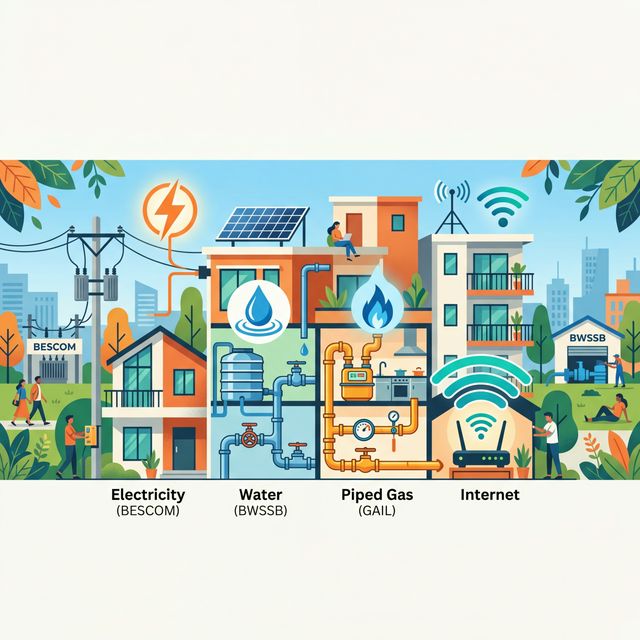
Moving into a new rental property in Bengaluru involves establishing or transferring multiple utility connections. The process ranges from straightforward (internet setup can happen in a day) to bureaucratic (BESCOM name transfer requires an office visit with specific documents). Getting utilities set up correctly from the start prevents billing disputes, protects you during landlord conflicts, and avoids the cascade of problems that arise from deferred setup - a BESCOM transfer that is “planned for next week” often becomes a dispute point months later.
This guide covers the four major utility categories - electricity, water, gas, and internet - with detailed procedures, document requirements, timelines, costs, and practical strategies for each. It also addresses common complications and how to navigate them.
BESCOM (Electricity)
BESCOM (Bangalore Electricity Supply Company Limited) provides electricity supply across Bengaluru and surrounding areas. The BESCOM service area covers Bengaluru Urban, Bengaluru Rural, Ramanagara, Chitradurga, Davanagere, Tumkur, and Kolar districts. Within Bengaluru city, BESCOM is the sole electricity distribution company.
Why Electricity Transfer Matters
Having the BESCOM connection in your name is not merely administrative convenience - it is a critical legal and practical protection.
Legal Protection: Under Section 29 of the Karnataka Rent Act, 1999, cutting off essential services (including electricity) is a criminal offense. However, when the connection is in the landlord’s name, the landlord has a practical (if illegal) ability to request BESCOM to disconnect. When the connection is in your name, the landlord has no standing to request disconnection - you are the registered consumer, and only you can request changes to the account.
Billing Transparency: When the connection is in your name, you receive bills directly from BESCOM. You can verify consumption, check tariff application, and dispute incorrect bills directly with BESCOM. When the landlord handles billing, you depend on the landlord’s honesty in communicating actual charges. Some landlords charge a flat monthly “electricity charge” that may exceed actual consumption.
Deposit Recovery: BESCOM collects a consumer security deposit when a connection is established or transferred. This deposit is refundable when you transfer the connection back (to the landlord or the next tenant) or close it. If the connection is in the landlord’s name, you have no claim to this deposit.
Option 1: Transfer the Connection to Your Name (Recommended)
This is the strongly recommended approach for any tenancy expected to last more than a few months.
Documents Required:
Rental Agreement: A copy of the rental agreement (registered or unregistered) establishing your tenancy. The agreement should mention the property address matching the BESCOM service address.
Landlord’s NOC: A No Objection Certificate from the landlord specifically authorizing the name transfer of the BESCOM connection. The NOC should mention the property address, the existing RR number, and the landlord’s consent for the transfer. Some BESCOM offices accept a simple letter; others have a prescribed format. It is advisable to call the subdivision office beforehand to ask about the required NOC format.
Identity Proof: Your Aadhaar card. BESCOM uses Aadhaar as the primary identity verification document.
Previous Consumer’s Last Paid Bill: The most recent BESCOM bill paid by the previous consumer (the landlord or the previous tenant). If you do not have a physical copy, the RR (Revenue Register) number is sufficient - BESCOM can look up the account using the RR number. The RR number is a unique identifier for each BESCOM connection and is printed on every bill.
Passport-Size Photograph: One recent photograph.
Process:
Visit the local BESCOM subdivision office. You can find your jurisdictional subdivision by entering your area on the BESCOM website or by calling the BESCOM helpline (1912).
Request the name transfer application form. This is typically a one-page form requiring the existing RR number, existing consumer name, new consumer name, address, and reason for transfer.
Submit the completed form with all documents.
Pay the name transfer fee. For LT (Low Tension) domestic connections, the fee is approximately Rs 618 (this includes administrative charges and may vary slightly). There may be additional charges if the existing consumer has pending dues - these must be cleared before the transfer.
BESCOM processes the transfer within 3 to 7 working days. A new RR number or updated account in your name is created.
After the transfer, verify that your name appears on the next bill and that the meter reading at the time of transfer matches your records.
Online Services: BESCOM’s online portal (bescom.karnataka.gov.in) and mobile app (Mithra) support bill payment, consumption tracking, and some complaint filings. However, name transfers currently require a physical visit to the subdivision office.
Option 2: Continue with the Landlord’s Name
If the landlord refuses to provide an NOC for name transfer, or if the tenancy is very short-term (1 to 3 months), you may continue with the connection in the landlord’s name. In this case, take specific precautions.
Meter Reading Documentation: On move-in day, photograph the BESCOM meter with the reading clearly visible, along with the date. Do the same on move-out day. These photographs establish your actual consumption period and prevent disputes over pre-existing or post-vacating consumption.
Written Agreement on Billing: The rental agreement should specify how electricity is charged. Common arrangements include direct bill payment (tenant pays the BESCOM bill based on actual consumption), flat monthly charge (a fixed amount per month, regardless of consumption - risky for the tenant if actual consumption is lower), and included in rent (electricity charges are factored into the rent - the simplest approach but the tenant has no visibility into actual consumption). The direct bill payment approach is the most transparent. Request the landlord to share each month’s BESCOM bill (or provide the RR number so you can check bills online).
Direct Payment at BESCOM: Even when the connection is in the landlord’s name, you can pay the bill directly at the BESCOM office, online, or through the BESCOM app using the RR number. This ensures that the bill is always current and prevents the landlord from claiming that you owe for unpaid electricity.
Meter Reading Practices
| Timing | Action | Purpose |
|---|---|---|
| Move-in day | Photograph meter reading with date | Establish baseline consumption |
| Monthly | Check consumption via BESCOM app or website using RR number | Monitor usage and catch anomalies |
| Before any dispute | Photograph meter reading immediately | Preserve evidence of consumption at dispute date |
| Move-out day | Photograph final meter reading | Establish final consumption for settlement |
Understanding Your BESCOM Bill
BESCOM bills contain several components that tenants should understand.
Energy Charges: Based on consumption slabs. For LT-2(a) domestic connections (the standard residential category), the slab structure provides lower per-unit rates for lower consumption and progressively higher rates for higher consumption. Understanding the slab structure helps you estimate your monthly bill and identify any overcharging.
Fixed Charges: A flat monthly charge based on the sanctioned load (in kW). For most residential connections, this is a modest amount.
FPPCA (Fuel Price and Power Purchase Cost Adjustment): A per-unit surcharge that varies quarterly based on BESCOM’s fuel and power purchase costs. This is set by the Karnataka Electricity Regulatory Commission (KERC).
Electricity Tax: A state government tax applied on electricity consumption.
Meter Rent: A small monthly charge for the meter (if owned by BESCOM).
Common BESCOM Complications
Pending Dues from Previous Consumer: BESCOM may refuse to process a name transfer if the existing consumer (landlord or previous tenant) has pending dues. In this case, the pending dues must be cleared first. Negotiate with the landlord about who bears this cost - typically, it is the landlord’s responsibility for dues accrued before your tenancy.
Shared Meter: In some older buildings and independent house portions, a single meter serves multiple units. BESCOM permits application for a separate meter, but this requires the landlord’s cooperation (or a court order) and involves installation costs.
Load Enhancement: If you plan to use high-consumption appliances (air conditioners, electric cooking appliances), check that the sanctioned load is sufficient. A typical 2BHK apartment has a sanctioned load of 3 to 5 kW. Running two ACs, a microwave, and an electric oven simultaneously on a 3 kW connection will trip the MCB. Load enhancement can be requested through BESCOM (additional charges apply).
BWSSB (Water Supply)
BWSSB (Bangalore Water Supply and Sewerage Board) manages piped Cauvery water supply and sewerage services in Bengaluru. Understanding the water supply landscape is essential because water availability varies dramatically across the city and significantly affects livability.
Water Supply Sources in Bengaluru
Bengaluru’s water comes from three primary sources, each with different characteristics and tenant implications.
BWSSB Cauvery Water: Piped water from the Cauvery river, treated and distributed by BWSSB. Available in older and central parts of the city (Jayanagar, Basavanagudi, Rajajinagar, Malleswaram, Indiranagar, Koramangala, and parts of Whitefield and Electronic City that have received recent extensions). Supply is typically 2 to 4 hours per day, with the timing varying by zone. The supply is metered and billed bimonthly.
Borewell Water: Groundwater pumped from borewells drilled on the property. Common in outer areas, new developments, and localities not covered by BWSSB’s piped network. Borewell water quality varies widely - some areas have good quality, while others have hard water (high TDS), iron content, or other quality issues. There is no metering or billing - the cost is the electricity for running the pump motor, plus periodic borewell maintenance.
Water Tanker: Commercially purchased water delivered by tankers. Used as a supplement in areas with insufficient BWSSB or borewell supply, and as the primary source in areas with no other option. Costs range from Rs 500 to Rs 1,500 per tanker load (approximately 6,000 to 12,000 liters) depending on the locality, distance from the water source, and demand-supply dynamics (prices spike in summer).
Apartment Complexes - Water Management
In most apartment complexes, water management is handled by the apartment owners’ association (AOA) or the property management company.
How it works: The BWSSB connection is in the building’s name (or the association’s name). BWSSB supplies water to the complex’s sump. The association pumps water to overhead tanks and distributes it to individual apartments. Water charges are included in the monthly maintenance billed by the association. Individual apartments may or may not have water meters - in many complexes, water charges are a flat rate per apartment regardless of consumption.
Tenant’s Responsibilities: Pay the monthly maintenance on time (which includes water charges). Do not waste water (many associations have rules and penalties for water wastage). Report any leaks or plumbing issues promptly.
What to Verify Before Moving In: Whether the complex has a BWSSB connection, borewell, or both (dual source is ideal for reliability). The daily water supply hours. Whether the complex has a water treatment plant (STP) for treated wastewater recycling. Whether there is a water tanker backup arrangement during supply disruptions.
Independent Houses - Water Management
For independent houses or portions of houses, the water situation is more directly affected by the landlord’s cooperation.
BWSSB Connection: The BWSSB connection is in the property owner’s (landlord’s) name. Tenants generally cannot get the connection transferred to their own name for rented premises. However, tenants can take several practical steps.
Paying Bills Directly: The BWSSB account number (printed on the bill) allows anyone to pay the bill - you do not need to be the account holder. Pay the BWSSB bill directly using the account number through the BWSSB online portal (bwssb.karnataka.gov.in), the BWSSB mobile app, or at authorized payment centers. This ensures the bill is always current and prevents the landlord from letting the bill lapse (which could lead to disconnection).
BWSSB Billing Details: BWSSB bills are issued bimonthly. The tariff is slab-based - domestic consumption up to 8 kiloliters (KL) per month (16 KL per bimonthly bill) is at the lowest slab rate. Consumption above 8 KL per month attracts progressively higher rates. The sewerage charge is 60% of the water charge (levied on top of the water charge). This slab structure means that keeping consumption below 8 KL per month (approximately 267 liters per day) results in a significantly lower per-unit cost.
Borewell Properties: For properties relying solely on borewell water, document the arrangement in the rental agreement with specifics: How many hours per day is the motor run? Who bears the electricity cost for the motor? Is there a backup arrangement (tanker) if the borewell yield drops? What happens during summer when groundwater levels fall?
Water Quality Considerations
Bengaluru’s water quality varies by source and locality. Cauvery water is treated by BWSSB and is generally safe for drinking (though many residents use additional filtration). Borewell water quality varies widely - common issues include high TDS (total dissolved solids), hardness (calcium and magnesium), iron content (causing rust-colored water and staining), and in some areas, fluoride or nitrate contamination.
If the property relies on borewell water, consider getting the water tested at a laboratory (BWSSB’s water quality lab offers testing services, and private labs like Sri Rama Testing Laboratories and Bangalore Test House also provide this service). Based on the results, determine whether a water purifier (RO, UV, or both) is necessary.
Cost Implication: A good RO water purifier costs Rs 8,000 to 20,000 for purchase, plus annual maintenance of Rs 2,000 to 4,000 for filter and membrane replacement. For short tenancies, purifier rental services (Rs 500 to 800 per month) may be more practical.
Piped Gas (PNG)
Piped Natural Gas (PNG) is available in parts of Bengaluru through GAIL Gas Limited (a subsidiary of GAIL India) and authorized city gas distribution (CGD) entities. PNG provides a continuous gas supply through underground pipelines, eliminating the need for LPG cylinder refills.
Availability
PNG availability in Bengaluru is limited compared to cities like Mumbai, Delhi, and Pune, where piped gas coverage is extensive. As of mid-2025, PNG is available in select areas of Bengaluru - primarily in larger apartment complexes that were connected during construction and in some localities where GAIL Gas has laid distribution pipelines.
How to Check Availability: Visit the GAIL Gas website (gailgas.com) or the website of the local CGD entity. Enter your address or area to check if PNG infrastructure exists in your locality. Alternatively, check with the apartment association or neighboring residents.
New PNG Connection for Tenants
If PNG is available in your area and the property does not already have a connection (or the previous tenant’s connection has been disconnected), you can apply for a new connection.
Documents Required:
- Rental agreement (as proof of address and occupancy)
- Identity proof (Aadhaar card)
- Landlord’s NOC for gas connection installation
- Passport-size photograph
Process:
- Apply online at the CGD entity’s website or visit the local customer service center.
- Pay the security deposit and installation charges. Security deposits for domestic PNG connections range from Rs 2,000 to Rs 5,000, and installation charges depend on the distance from the main pipeline to your apartment.
- A surveyor visits the property to assess the installation route and feasibility.
- Installation is scheduled, typically within 2 to 4 weeks. The installation involves running a gas pipe from the building’s main gas line (if available) or the street-level pipeline to your kitchen, installing a gas meter, and connecting the stove regulator.
- After installation, the gas supply is activated, and billing starts (based on metered consumption).
Costs: PNG is priced per Standard Cubic Meter (SCM). Residential domestic PNG prices in Bengaluru are determined by the CGD entity and typically range from Rs 40 to Rs 55 per SCM. An average household cooking with PNG consumes approximately 12 to 20 SCM per month, resulting in a monthly gas bill of Rs 500 to Rs 1,100.
Transferring an Existing PNG Connection
If the previous tenant or landlord had a PNG connection and it is still active, you can request a name transfer.
Process:
- Request the previous consumer or landlord to initiate the transfer by contacting the CGD entity.
- Submit your documents (rental agreement, ID proof).
- Pay the transfer fee (typically Rs 200 to Rs 500).
- The CGD entity updates the billing name and account details.
LPG Cylinder Alternative
If PNG is not available in your area (which is the case for most Bengaluru rentals), you will use LPG cylinders. The three major LPG distributors are Indane (Indian Oil Corporation), HP Gas (Hindustan Petroleum), and Bharat Gas (Bharat Petroleum).
Transferring Your Existing LPG Connection: If you have an existing LPG connection in another city or locality, contact your current distributor to request a transfer. You need your existing consumer number, the new address, and proof of address (rental agreement). For a complete, step-by-step authoritative walkthrough of this process for Indane, HP, and Bharat Gas, see our LPG Connection Transfer Guide: India Edition. The transfer is processed within 1 to 2 weeks, and your nearest distributor in the new area will service your account.
New LPG Connection: If you do not have an existing connection, apply at the nearest distributor. Submit your identity proof, address proof, and a passport-size photograph. A new connection includes a regulator, hose pipe, and one cylinder. The initial cost is approximately Rs 1,500 to Rs 2,000 (exclusive of the cylinder price). Subsequent cylinder refills are ordered through the distributor.
Apartment Manifold Systems: Some apartment complexes have a shared LPG manifold system - a bank of cylinders at a central location with pipelines to individual apartments. In such systems, the association manages the LPG supply, and individual tenants do not need their own cylinders. The gas cost is included in the maintenance charges or billed separately by the association.
Internet and Broadband
Internet connectivity is arguably the most straightforward utility to set up in Bengaluru, with multiple providers offering quick installation and competitive pricing.
Major ISPs in Bengaluru
ACT Fibernet: One of the most popular fiber-to-the-home (FTTH) providers in Bengaluru. Operates its own fiber network across the city with extensive coverage in residential areas. Known for consistent speeds and relatively good customer service. Plans range from 40 Mbps to 300 Mbps, with monthly costs of Rs 600 to Rs 1,500. actcorp.in
Airtel Xstream Fiber: Leverages Airtel’s extensive telecom infrastructure. Provides FTTH connections with bundled OTT content (Disney+ Hotstar, etc. depending on the plan). Plans range from 40 Mbps to 300 Mbps, with monthly costs starting at Rs 699. airtel.in
Jio Fiber: Relies on Jio’s nationwide fiber network. Offers plans with bundled content and smart home devices on premium tiers. Plans range from 30 Mbps to 300 Mbps, with monthly costs starting at Rs 399 for lower-speed plans. jio.com
BSNL Bharat Fibre: The government telecom provider. Has been expanding its FTTH network. Generally offers the most affordable plans but may have slower installation and customer service response in some areas. Plans start at Rs 399 for 30 Mbps. bsnl.co.in
Choosing the Right ISP
Step 1 - Check Availability: Before comparing plans, check which ISPs actually serve your apartment. Not all ISPs cover all localities. Visit each ISP’s website and enter your address for a serviceability check. In some buildings, only one or two ISPs have fiber infrastructure - checking availability narrows your options immediately.
Step 2 - Ask the Neighbors: Online reviews and advertised speeds often diverge from real-world performance. Ask existing tenants in the building or neighbors about their actual experience - speed consistency, downtime frequency, and customer service responsiveness. This is the most reliable source of information.
Step 3 - Check for Existing Wiring: If the previous tenant had a fiber connection from a specific ISP, the fiber cable to the apartment may already be in place. Activating an existing line is faster (often same-day) and avoids the need for new cable routing through the building’s ducting.
Step 4 - Installation Timeline: New installations typically take 3 to 7 days from the date of application. Some ISPs offer same-day or next-day installation in well-covered areas. If you need internet immediately upon moving in (for remote work, for example), apply for the connection a week before your move-in date if possible.
Installation Process
- Apply online on the ISP’s website, mobile app, or by calling the customer care number.
- Select your plan based on speed, data limit (most urban plans are now unlimited), and any bundled services.
- Schedule the installation. A technician visit is required for FTTH connections.
- The technician runs the fiber cable from the building’s fiber junction point (OLT) to your apartment, installs the ONT (Optical Network Terminal) box, and sets up the WiFi router.
- Pay the installation fee. Many ISPs waive the installation fee for annual plan subscriptions. For monthly plans, installation fees range from Rs 500 to Rs 1,500.
- The technician activates the connection and hands over the WiFi router credentials.
Work-from-Home Considerations
If you work from home, internet reliability is not just a convenience - it directly affects your income and professional reputation. Consider these factors.
Backup Connection: Having a secondary internet connection or a reliable 4G/5G mobile hotspot eliminates the risk of complete internet loss. Some remote workers maintain two ISPs (for example, ACT Fibernet as primary and Jio Fiber as backup on a basic plan). The cost of a basic backup plan (Rs 400 to 600 per month) is modest insurance against work disruption.
Router Quality: ISP-provided routers are often basic. If you have a larger apartment or need consistent coverage across rooms, consider investing in a quality WiFi 6 router or a mesh WiFi system. Cost: Rs 3,000 to Rs 8,000 for a good WiFi 6 router; Rs 8,000 to Rs 15,000 for a mesh system.
Wired Connection for Critical Work: For video conferencing and work that demands consistent bandwidth, a wired Ethernet connection from the router to your workstation eliminates WiFi variability. Run an Ethernet cable from the ONT or router to your desk.
UPS for Router: During power outages, your internet goes down even if the ISP’s network is fine - because the ONT and router need electricity. A small UPS (Rs 2,000 to Rs 4,000) can keep your router running for 2 to 4 hours during power cuts.
DTH and Cable TV
Traditional television is increasingly optional for younger demographics who rely on streaming services via their internet connection. However, for those who want DTH or cable TV, here is a brief overview.
DTH Providers: Tata Play, Airtel Digital TV, Dish TV, and DD Free Dish (free-to-air, no monthly charges) are the major options. DTH requires a dish antenna (installed on the balcony or rooftop) and a set-top box. Monthly costs range from Rs 200 to Rs 600 depending on the channel package.
IPTV: Some ISPs (like ACT and Airtel) offer IPTV services that deliver television channels through the fiber internet connection, eliminating the need for a separate dish antenna. This is a convenient option if your ISP supports it.
Streaming-Only Approach: Most young professionals and families in Bengaluru rely on streaming platforms (Netflix, Amazon Prime Video, Disney+ Hotstar, JioCinema) accessed through their internet connection and a smart TV or streaming device (Chromecast, Fire TV Stick). Monthly streaming costs for 2 to 3 platforms total Rs 500 to Rs 1,000.
First-Week Utility Setup Timeline
| Priority | Utility | Action | Timeline | Dependencies |
|---|---|---|---|---|
| Day 1 | Electricity (BESCOM) | Visit subdivision office for name transfer | 3-7 days processing | Landlord NOC required |
| Day 1 | Water (BWSSB) | Verify supply hours, photograph meter reading | Immediate | None (managed by landlord/association) |
| Day 1-2 | Internet | Apply online, schedule installation | 1-7 days | Serviceability check |
| Day 2-3 | Gas (PNG or LPG) | Apply for new connection or transfer | 1-4 weeks | Landlord NOC for PNG |
| Day 1 | All utilities | Photograph all meter readings | Immediate | None |
Utility Disputes: Prevention and Resolution
Common Disputes and Prevention
Electricity Billing Disputes: When the connection is in the landlord’s name and the landlord charges a flat monthly rate, the tenant may be overcharged. Prevention: insist on actual bill payment (based on BESCOM bill) rather than flat charges. If that is not possible, periodically check the consumption using the RR number on the BESCOM website.
Water Shortage Disputes: “You are using too much water” is a common landlord complaint, especially in borewell-dependent properties. Prevention: document the water arrangement in the agreement with specific terms. If water tankers are needed, clarify who bears the cost and the frequency.
Internet Installation Damage: ISP technicians sometimes drill holes for cable routing that the landlord objects to. Prevention: discuss the installation routing with the landlord before the technician visit. Ask the technician to use existing cable ducts wherever possible.
Utility Dues at Move-Out: The landlord may claim that you owe for utilities consumed after your move-out date. Prevention: photograph all meters on your last day. Clear all bills before move-out. Get a written acknowledgment from the landlord that all utility dues are settled.
BESCOM Complaint Mechanism
For electricity-related complaints (billing errors, supply issues, meter problems), BESCOM provides multiple channels.
Helpline: Call 1912 for general complaints, outage reporting, and billing queries. Available 24/7.
Mobile App (Mithra): Download the BESCOM Mithra app for bill payment, consumption tracking, and complaint registration. Complaints filed through the app are tracked with a reference number.
Online Portal: bescom.karnataka.gov.in provides bill viewing, payment, and complaint registration.
Physical Visit: For complex issues (meter disputes, name transfer, load changes), visit the jurisdictional subdivision office.
BWSSB Complaint Mechanism
For water supply complaints, BWSSB offers the following channels.
Helpline: 1916 for water supply complaints and emergencies (pipe bursts, no supply).
Online Portal: bwssb.karnataka.gov.in for bill payment, account information, and complaint registration.
Physical Visit: Visit the divisional office or zone office for account-related issues, connection transfers, or tariff disputes.
Key Takeaways
- Transfer the BESCOM electricity connection to your name on day one. This is the single most important utility action for tenant protection. The process requires a landlord NOC, rental agreement, and approximately Rs 618.
- Document all meter readings (BESCOM, BWSSB, gas) with date-stamped photographs on both move-in and move-out days. These readings are your protection against billing disputes.
- Water supply arrangements in Bengaluru vary dramatically by property - BWSSB Cauvery, borewell, or tanker. Verify the source, supply hours, and storage capacity before committing to a rental. For borewell properties, document the arrangement in the agreement.
- Check internet ISP availability for your specific apartment before choosing a plan. Ask neighbors about real-world performance, not just advertised speeds.
- For piped gas (PNG), check availability through GAIL Gas or the local CGD entity. Most Bengaluru rentals still use LPG cylinders - transfer your existing connection or get a new one within the first week.
- Include utility payment terms in the rental agreement - specify who pays each utility, how billing is handled, and the process for settling utility dues at move-out. Vague arrangements lead to disputes.
- For work-from-home setups, invest in a backup internet connection, a quality router, and a UPS for the router. The combined cost (Rs 5,000 to Rs 15,000) is modest compared to the risk of work disruption.
- Pay utility bills directly where possible (BESCOM using RR number, BWSSB using account number) rather than routing through the landlord. Direct payment ensures bills are current and creates a verifiable payment record.
Moving into a new flat in Bengaluru?
See what residents actually say about your building, the rent, the society, the infrastructure around it, before and after you move in. know.place is a map of honest, building-level rental experiences across India.
Explore know.placeReferences
- BESCOM (Bangalore Electricity Supply Company Limited) - bescom.karnataka.gov.in, Helpline: 1912
- BWSSB (Bangalore Water Supply and Sewerage Board) - bwssb.karnataka.gov.in, Helpline: 1916
- Karnataka Rent Act, 1999 (Karnataka Act 34 of 2001), Section 29 - indiacode.nic.in
- Karnataka Electricity Regulatory Commission (KERC) - kerc.karnataka.gov.in
- Electricity Act, 2003 - indiacode.nic.in
- GAIL Gas Limited - gailgas.com
- LPG Services (Indane, HP, Bharat Gas) - mylpg.in
- ACT Fibernet - actcorp.in
- Airtel Xstream Fiber - airtel.in
- Jio Fiber - jio.com
- BSNL Bharat Fibre - bsnl.co.in