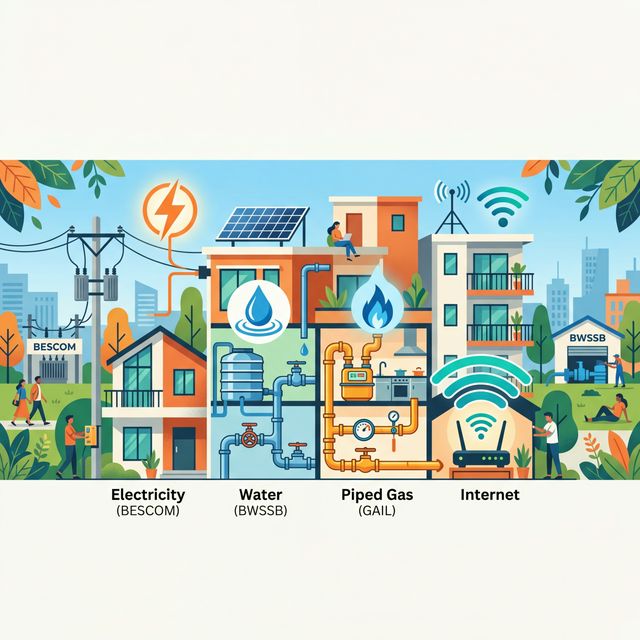
Water supply is the single most important infrastructure factor for renters in Bengaluru - often more consequential than power backup, internet connectivity, or proximity to transit. Unlike metros where municipal piped water is the default across most neighborhoods, Bengaluru’s supply is a mixed system of Cauvery River piped water managed by BWSSB, private and community borewells, and commercial water tankers. Your daily experience with water - its availability, quality, pressure, and cost - varies dramatically based on where you live.
A resident in Malleshwaram with a BWSSB Cauvery connection lives in a fundamentally different water reality than someone in Sarjapur Road dependent on a borewell that may run dry in April. Understanding this landscape before choosing a home is essential. This guide provides a comprehensive analysis of Bengaluru’s water supply infrastructure, area-by-area coverage, quality considerations, cost structures, and the specific questions and checks that help you make an informed decision.
How Bengaluru Gets Its Water: The Four Sources
Bengaluru’s water supply relies on four distinct sources, often used in combination within a single property or locality. Understanding each source - its reliability, quality, and cost - is foundational to evaluating any rental property.
1. BWSSB Cauvery Water (Piped Municipal Supply)
The Bangalore Water Supply and Sewerage Board (BWSSB) is the statutory body responsible for providing treated water supply and sewerage services to Bengaluru. BWSSB sources its water from the Cauvery River at the Thorekadanahalli (TK Halli) reservoir, approximately 100 km south of Bengaluru. The water is treated at multiple treatment plants and distributed through a network of pipelines, pumping stations, and storage reservoirs.
Current capacity: BWSSB’s older Cauvery stages supplied roughly 1,450 MLD, and the Stage V project is designed to add 775 MLD for peripheral BBMP areas. That expansion is important, but building-level supply still depends on whether the local distribution network, service connection, sump capacity, and apartment plumbing are actually commissioned.
Supply pattern: Unlike cities with 24/7 water supply, BWSSB provides water for 2-4 hours per day on a scheduled basis. The timing varies by zone and locality. Some areas receive water once daily, others on alternate days. The water is stored in underground sumps at the building level and pumped to overhead tanks for distribution within the building.
| Feature | Details |
|---|---|
| Source | Cauvery River (TK Halli reservoir) |
| Treatment | Full treatment (coagulation, sedimentation, filtration, chlorination) |
| Coverage | Primarily within the old BBMP corporation limits |
| Supply duration | 2-4 hours per day (not 24/7) |
| Quality | Good - TDS 150-300 ppm, soft water |
| Reliability | Moderate - seasonal variations, pipeline maintenance outages |
| Cost to tenant | Included in BWSSB bill (landlord’s account) or absorbed in maintenance charges |
2. Borewells (Groundwater Extraction)
Borewells are the primary water source for peripheral and newly developed areas of Bengaluru that are outside BWSSB’s Cauvery pipeline network. A borewell is a narrow, deep hole drilled into the earth to access groundwater, fitted with a submersible pump to extract water.
Bengaluru sits on a granitic geological formation with variable groundwater availability. The depth, yield, and longevity of borewells depend on local geological conditions, groundwater recharge rates, and the density of borewells in the area.
| Feature | Details |
|---|---|
| Depth | Typically 200-1,000+ feet in Bengaluru |
| Yield | Variable - from 0 (dry bore) to 5+ inches of water |
| Quality | Often hard water (TDS 500-1,500+ ppm) |
| Reliability | Depends on groundwater table - can deplete in summer |
| Lifespan | 5-15+ years depending on yield and geology |
| Cost | Electricity for motor operation (Rs 500-2,000/month shared) |
| Risk | Borewells can dry up, especially shallow ones (< 300 feet) |
The groundwater crisis: Bengaluru’s groundwater table has been declining steadily due to over-extraction and reduced recharge (caused by concretization that prevents rainwater from percolating into the ground). Areas that had reliable borewells a decade ago may now require deeper drilling or supplementary tanker supply. The Central Ground Water Authority (CGWA) has classified parts of Bengaluru as “over-exploited” - meaning groundwater extraction exceeds natural recharge.
3. Water Tankers (Commercial Supply)
Water tankers are the backup and supplementary source used across Bengaluru when piped water and borewells are insufficient. Tankers carry water from BWSSB filling stations, private bore sources, or treated lake water and deliver it to residential and commercial buildings.
| Feature | Details |
|---|---|
| Standard capacity | 6,000 liters (most common), also 3,000L and 12,000L |
| Cost (normal months) | Rs 500-1,000 per 6,000L load |
| Cost (summer peak) | Rs 1,000-1,500+ per 6,000L load |
| BWSSB tanker cost | Rs 300-500 per 6,000L (subsidized, limited availability) |
| Ordering | Phone call, WhatsApp, or mobile apps |
| Delivery time | 2-6 hours (normal), 12-48 hours (peak summer) |
| Who pays | Varies - check if included in maintenance charges |
Summer price spikes: Tanker water costs can increase by 50-100% during peak summer months (March to May). This is driven by increased demand (as borewells yield less and BWSSB supply drops) combined with constrained supply (fewer filling stations, longer travel distances). Some apartment complexes mitigate this by negotiating annual contracts with tanker suppliers at fixed rates.
4. Rainwater Harvesting (Supplementary Source)
Rainwater harvesting (RWH) systems collect and store rainwater for reuse or groundwater recharge. BBMP mandates RWH for all buildings on sites larger than 2,400 sq ft (223 sq meters) and for buildings with more than 4 dwelling units.
| Feature | Details |
|---|---|
| Mandate | Required for sites > 2,400 sq ft or > 4 units (BBMP) |
| BWSSB incentive | 5% rebate on water bill for properties with RWH |
| Penalty | BWSSB can levy penalty for non-installation in applicable buildings |
| Annual contribution | 50,000-1,00,000 liters per year for a typical apartment building |
| Quality | Good for non-potable use; treatable for drinking |
| Limitation | Seasonal - Bengaluru receives rain primarily June-October |
Relevance for renters: While you cannot install an RWH system as a tenant (it requires structural changes), you should check whether the building has one. A functional RWH system supplements the water supply, recharges the borewell (extending its life), and qualifies for a BWSSB bill discount.
Area-by-Area Water Coverage: Where Cauvery Reaches and Where It Does Not
The most important factor determining your water experience in Bengaluru is whether your locality has BWSSB Cauvery pipeline coverage. The coverage map broadly correlates with the old Bengaluru Corporation limits (before the 2007 BBMP expansion that brought 110 surrounding villages into the municipal area).
Areas with Good Cauvery Water Coverage
These localities are within the core BWSSB Cauvery pipeline network and generally receive 2-4 hours of daily piped water supply. Borewells in these areas serve as backup rather than the primary source.
| Locality | Supply Pattern | Notes |
|---|---|---|
| Jayanagar (all blocks) | Daily, 2-4 hours | One of the best-served areas |
| Basavanagudi | Daily, 2-3 hours | Old city area, well-connected network |
| Malleshwaram | Daily, 2-4 hours | Reliable coverage |
| Rajajinagar (I-VI blocks) | Daily, 2-3 hours | Good coverage in older blocks |
| Vijayanagar | Daily, 2-3 hours | Well-served |
| Sadashivanagar | Daily, 2-3 hours | Premium residential area |
| Seshadripuram | Daily, 2-3 hours | Good coverage |
| Indiranagar (core area) | Daily, 2-3 hours | Extensions may have weaker supply |
| Koramangala (1st-4th blocks) | Daily, 2-3 hours | Outer blocks may depend on borewell |
| JP Nagar (phases 1-4) | Daily, 2-3 hours | Later phases have limited coverage |
| BTM Layout (1st and 2nd Stage) | Daily, 2-3 hours | Good coverage in older stages |
| Hebbal (core area) | Daily, 2-3 hours | Extensions are borewell-dependent |
| Banashankari (1st-3rd Stage) | Daily, 2-3 hours | Later stages have mixed supply |
| Wilson Garden | Daily, 2-3 hours | Well-served old area |
| RT Nagar (core) | Daily, 2-3 hours | Extensions have weaker coverage |
Areas with Limited or No Cauvery Coverage (Borewell-Dependent)
These localities are largely outside the BWSSB Cauvery pipeline network. Residents depend primarily on borewells, supplemented by tanker water during dry periods.
| Locality | Primary Source | Notes |
|---|---|---|
| Sarjapur Road | Borewell + tanker | Rapid development, groundwater stress |
| Harlur Road | Borewell + tanker | Adjacent to Sarjapur corridor |
| Whitefield | Borewell + tanker | IT corridor, high demand |
| Brookefield | Borewell + tanker | High-density apartments |
| Varthur | Borewell + tanker | Groundwater quality concerns |
| Electronic City (Phase 2) | Borewell + tanker | Phase 1 has some BWSSB coverage |
| Chandapura | Borewell + tanker | Peripheral area |
| Hennur (extensions) | Borewell + tanker | Core Hennur has some coverage |
| Thanisandra (extensions) | Borewell + tanker | Rapidly developing |
| Yelahanka (outer areas) | Borewell + tanker | Air Force area has coverage |
| Kogilu, Jakkur (outer) | Borewell + tanker | Limited infrastructure |
| Devanahalli corridor | Borewell + tanker | Airport vicinity, low coverage |
| Kanakapura Road (beyond NICE) | Borewell + tanker | Coverage ends near NICE junction |
| Begur, Bommanahalli (outer) | Borewell + partial Cauvery | Transition zone |
| Attibele | Borewell + tanker | Industrial area, peripheral |
The Cauvery Stage V Expansion
BWSSB’s Cauvery Water Supply Stage V Phase 2 project aims to bring Cauvery water to 110 villages that were merged into BBMP in 2007. When completed, this will significantly expand piped water coverage to areas currently dependent on borewells.
Current status: Stage V has moved from project announcement into commissioning, but last-mile connections across the 110 villages remain uneven. For renters, “Cauvery line nearby” is not enough. Ask whether the specific building has an active BWSSB connection, whether the association has received bills, and how many hours of actual supply residents received in the last summer.
Practical implication for renters: Do not rely on announced pipeline projects when making rental decisions. Verify the current, actual water source at the specific building you are considering. Pipeline extensions can take years to reach individual buildings even after the main trunk line is laid.
Water Quality: What Flows Through Your Taps
Water quality varies significantly by source and directly impacts your health, the taste of your drinking water, the lifespan of appliances, and the ongoing cost of water purification.
Quality by Source
| Parameter | Cauvery (BWSSB) | Borewell | Tanker |
|---|---|---|---|
| TDS (Total Dissolved Solids) | 150-300 ppm | 500-1,500+ ppm | Variable (300-1,000 ppm) |
| Hardness | Soft (< 200 mg/L) | Hard to very hard (300-800+ mg/L) | Variable |
| Color | Clear | Often slightly yellow/brown | Variable |
| Taste | Neutral | Mineral/metallic taste possible | Variable |
| Bacterial contamination risk | Low (chlorinated) | Moderate (untreated) | Moderate to high |
| Iron content | Low | Can be elevated | Low to moderate |
| Fluoride | Within limits | Can exceed safe limits in some areas | Variable |
Water Purification: What You Need
The choice of water purifier depends on the water source at your rental property:
For Cauvery water areas:
- UV (Ultraviolet) or UF (Ultrafiltration) purifier is generally sufficient
- RO (Reverse Osmosis) is optional and may over-purify soft Cauvery water
- Cost: Rs 5,000-10,000 (purchase) or Rs 300-400/month (rental)
For borewell water areas:
- RO purifier is strongly recommended due to high TDS and hardness
- Look for RO + UV + TDS controller models for optimal quality
- Cost: Rs 8,000-20,000 (purchase) or Rs 400-700/month (rental)
- Annual maintenance cost: Rs 2,000-4,000 (filter replacement)
For tanker water:
- RO purifier is recommended (source quality is unpredictable)
- Consider a sediment pre-filter to protect the RO membrane
Hard water effects on daily life:
- Soap and shampoo lather less effectively, requiring more product
- White mineral deposits on taps, shower heads, and bathroom tiles
- Scale buildup in geysers and washing machines (reduced appliance lifespan)
- Clothes may feel stiff after washing
- Hair may feel dry and dull over time
- A water softener (Rs 15,000-30,000 installed) can mitigate these effects but is typically a landlord investment, not a tenant purchase
What to Check Before Renting: The Water Audit
Before committing to any home in Bengaluru, conduct a thorough water audit of the property. This is especially critical for borewell-dependent areas but equally important in Cauvery-supplied localities where infrastructure age and building-level systems affect supply quality.
Questions to Ask the Landlord
“What is the primary water source - Cauvery, borewell, or tanker?” This is the single most important question. Get a definitive answer, not a vague reassurance.
“How many hours of water supply per day?” For Cauvery areas, expect 2-4 hours. If the answer is vague, it may indicate inconsistent supply.
“What is the sump capacity and overhead tank capacity?” The sump (underground tank) stores water from the Cauvery supply. The overhead tank distributes it to individual units. Larger capacity means more buffer between supply cycles. A typical apartment building should have 500-1,000 liters per flat in sump capacity.
“Is there a borewell? If yes, what is its depth and yield?” Even in Cauvery areas, a borewell backup is valuable. Know the depth (deeper is generally more reliable) and current yield.
“Has there been any water shortage in the past year, especially during summer?” This question tests whether the building’s water infrastructure held up under peak demand. If the landlord or property manager hesitates, it is a red flag.
“Who pays for water tankers during shortages?” In many apartment complexes, tanker costs are shared through maintenance charges. In some, they are billed separately. Clarify this to avoid surprise costs during summer.
“Is there a water purifier installed? If yes, what type?” In borewell areas, an RO purifier is essential. If one is provided, check its condition and recent servicing date.
“Is there a rainwater harvesting system?” A functional RWH system indicates responsible building management and provides supplementary water.
“What is the BWSSB account status? Are bills current?” Unpaid BWSSB bills can result in supply disconnection. Verify that the account is in good standing.
“What is the monthly maintenance charge, and what does it cover?” Confirm whether water tankers, borewell electricity, water purifier maintenance, and sump/tank cleaning are included.
Physical Checks to Perform During Property Visit
Turn on all taps simultaneously: Check water pressure and flow. Low pressure may indicate pump issues, small tank capacity, or supply problems.
Check water color and odor: Fill a glass and observe. Yellow or brown tinting suggests iron content or contaminated borewell water. A chlorine smell (in Cauvery areas) is normal and indicates treated water.
Inspect the sump and overhead tank: If accessible, check their capacity, cleanliness, and structural condition. Look for algae growth, cracks, or leaks. Well-maintained buildings clean their sumps at least once or twice a year.
Look for water damage signs: Water stains on walls and ceilings, damp patches, peeling paint, and mold growth can indicate persistent moisture issues from plumbing leaks or tank overflow.
Check bathroom fixtures: White mineral deposits (scale) on taps, shower heads, and tiles indicate hard water. Heavy scaling suggests the building relies on high-TDS borewell water.
Ask neighbors or existing tenants: Other residents are the best source of ground truth about water availability, quality, and the building management’s responsiveness to water issues.
BWSSB Account and Billing for Tenants
Understanding how BWSSB billing works is important for managing your water costs and ensuring uninterrupted supply.
Billing Structure
BWSSB uses a telescopic tariff structure - the per-kiloliter rate increases as consumption increases:
| Consumption Slab (per month) | Residential Rate (per KL) |
|---|---|
| Up to 8 KL | Rs 6 |
| 8-25 KL | Rs 12 |
| 25-50 KL | Rs 42 |
| 50-75 KL | Rs 57 |
| 75-100 KL | Rs 72 |
| Above 100 KL | Rs 84 |
Note: Sewerage charges are levied additionally at a percentage of the water charges. Actual rates may be revised periodically by BWSSB.
Tenant’s Position on BWSSB Accounts
| Scenario | Tenant’s Position |
|---|---|
| Apartment complex | Water billed through association maintenance - no direct BWSSB account needed. The apartment association holds the BWSSB connection. |
| Independent house/floor | BWSSB account is usually in the owner’s name. Clarify who pays the bill and how meter readings are shared. |
| New connection request | Requires landlord’s property documents, khata extract, and NOC. Typically the landlord applies, not the tenant. |
| Connection transfer to tenant | Possible with landlord’s consent and BWSSB paperwork, but uncommon for rental properties. |
| Metered vs unmetered | Metered connections are charged by consumption. Some older connections are unmetered and charged a flat rate. |
What to Confirm in Writing About Water
To avoid disputes, confirm these details in writing with the owner or association:
- Primary water source and backup arrangements
- Who pays the BWSSB bill, if applicable
- Who pays for tanker water during shortages
- Whether water purifier maintenance is owner-paid or resident-paid
- Owner or association responsibility for borewells, pumps, and tanks
- Procedure for reporting water supply issues
Bengaluru’s Water Future: What Renters Should Know
Bengaluru’s water infrastructure is undergoing significant expansion and modernization. While renters should base decisions on current conditions, understanding the trajectory helps in evaluating longer-term rental commitments.
Cauvery Stage V Phase 2 Expansion
The most significant ongoing infrastructure project is the Cauvery Stage V Phase 2 pipeline expansion, which aims to bring treated Cauvery water to the 110 villages that were incorporated into BBMP in 2007. This project, when fully completed, will significantly expand piped water coverage to areas like Sarjapur Road, Whitefield, Electronic City, and other peripheral localities that currently depend on borewells. However, the project has experienced delays, and full commissioning of the distribution network to individual buildings in these areas will take additional time beyond the main pipeline completion.
Groundwater Management
The Karnataka Ground Water (Regulation and Control of Development and Management) Act, 2011 regulates borewell drilling and groundwater extraction. The Central Ground Water Board (CGWB) periodically assesses groundwater levels across Bengaluru’s blocks and classifies them as safe, semi-critical, critical, or over-exploited.
For renters, this means:
- In “over-exploited” blocks, existing borewells are at higher risk of declining yield
- New borewell drilling is restricted in over-exploited areas, limiting backup options
- Buildings with deeper borewells (800+ feet) in granitic formations tend to have more stable yield
Rainwater Harvesting Enforcement
BWSSB has been progressively tightening enforcement of rainwater harvesting mandates. Buildings that do not comply with RWH requirements may face:
- BWSSB bill surcharges
- Denial of new or additional water connections
- Penalties for non-compliance
This incentivizes building owners to install and maintain RWH systems, which benefits tenants through better water availability.
Practical Tips for Managing Water as a Renter
Invest in storage: If you are in a borewell-dependent area, consider keeping 2-3 large water containers (20L each) as emergency backup. This costs little and provides peace of mind during supply interruptions.
Time your water usage: In areas with scheduled BWSSB supply, learn the supply timing and ensure washing machines, dishwashers, and heavy water use align with the supply window or the period immediately after (when the overhead tank is full).
Monitor your purifier: In borewell areas, RO membranes and filters clog faster due to high TDS. Service your purifier every 3-4 months (not the standard 6 months recommended for soft water areas).
Report leaks promptly: A leaking pipe or running toilet wastes significant water - up to 200 liters per day for a constantly running flush. Report leaks to the landlord immediately.
Track summer patterns: Your first summer at a new rental will reveal the true water situation. If you experience shortages, document them and discuss solutions with your landlord (additional tanker supply, borewell servicing, tank capacity upgrade).
Confirm water responsibility before moving: If the property is in a borewell-dependent area, get written clarity on who arranges and pays for tankers during shortages.
Key Takeaways
- Verify the water source (Cauvery, borewell, or tanker) before committing to a home. This is the single most important infrastructure check for Bengaluru renters.
- Core city areas (Jayanagar, Malleshwaram, Koramangala, Indiranagar, Rajajinagar) have BWSSB Cauvery water. Peripheral areas (Sarjapur Road, Whitefield, Electronic City Phase 2, Hennur extensions) depend on borewells.
- BWSSB supply is 2-4 hours daily, not 24/7. Check the sump and overhead tank capacity to understand how long stored water lasts between supply cycles.
- Borewell water is typically hard (TDS 500-1,500+ ppm). Budget for an RO water purifier in borewell-dependent areas - Rs 8,000-20,000 to purchase or Rs 400-700/month to rent.
- Water tanker costs range from Rs 500-1,000 per 6,000-liter load during normal months and can spike to Rs 1,000-1,500+ during summer. Clarify whether tanker costs are included in maintenance charges.
- Ask the landlord and existing tenants about last summer’s water experience. Summer is the stress test for any building’s water infrastructure.
- Confirm water supply terms in writing - source, tanker responsibility, purifier maintenance, and responsibility for borewells and tanks.
- Bengaluru’s groundwater table is declining. Borewells in “over-exploited” blocks carry higher risk of yield reduction over time.
Worried about water before you sign?
Water supply varies wildly building to building in Bengaluru. See what residents actually say about a specific building, its water source, borewell or Cauvery, tanker dependence, and more, on know.place, a map of honest, building-level rental experiences across India.
Explore know.placeReferences
- BWSSB for official Bengaluru water supply, tariff, tanker, and consumer-service information.
- Central Ground Water Board for groundwater assessment and aquifer reports.
- Central Ground Water Authority for groundwater extraction guidelines and NOC context.
- Bureau of Indian Standards for drinking-water quality standards, including IS 10500.
- BBMP for municipal building and rainwater-harvesting context.
- Ministry of Jal Shakti for national water-resource policy and groundwater-management context.